
Voice
The 11 best AI voice agents for healthcare in 2026
11 AI voice agents for healthcare compared: who signs the BAA, how patient calls connect, EHR write-back, and pricing.

By Osman Husain
Updated September 2026
AI voice agents for healthcare answer patient phone calls, direct queries, take notes, and perform tasks like scheduling, intake, refill requests, and billing. The goal is to automate routine inquiries and keep human agents for critical interactions. The best voice agents for healthcare cover both configurable platforms and healthcare-native solutions, each with its own specialty:
- Telnyx: best for teams building their own agent under one BAA
- Hyro: best for health systems on existing contact centers
- Hippocratic AI: best for non-diagnostic clinical outreach calls
- Prosper AI: best for outpatient groups calling patients and payers
- Infinitus: best for pharma hubs and payer benefit calls
- Assort Health: best for specialty practices needing EHR write-back
- Zocdoc Zo: best for 24/7 scheduling on existing phone lines
- PolyAI: best for enterprise contact centers with Epic lookups
- Retell AI: best for developers who need a self-serve BAA
- Vapi: best for developers assembling their own model stack
- Synthflow: best for enterprise teams building agents without code
Consider a typical situation: a patient calls a specialty practice after hours to reschedule a follow-up visit, ask about a refill, and find out whether a referral arrived.
In one scenario, an AI voice agent books the new slot in the EHR, files the refill as a staff task, and hands the referral question to a person with a summary attached. In another, the agent takes a message and routes all the work to a human.
What separates those two calls is the infrastructure behind the conversation: who carries the call, which parts a business associate agreement (BAA) covers, and where the data is stored.
Subtleties like this distinguish the top voice AI agents from one another.
Evaluating the agents that made it on this list
I evaluated each AI voice agent for healthcare against six buyer questions:
- Who carries the phone call: does the product bring its own numbers and carrier, or connect to the phone system that the healthcare organization already runs?
- Does the agent say and hear drug names, provider names, and medical acronyms correctly, and can the organization's team correct it?
- Will the vendor sign a BAA, on which plan, and which parts of the call does it cover?
- Does the outcome land in the EHR, practice management system, or payer record, or in a summary someone has to rekey?
- When the call needs a person, does the agent transfer with context? Does it stay on the line to keep notes?
- Is pricing published, and what does the headline rate cover?
I weighted the most toward who carries the call and BAA coverage metrics.
Together they show which vendors touch a patient's call and whether each one sits under a BAA, which decides whether the agent can handle protected health information (PHI) at all.
The numbering of the vendor sections below is not a ranking. Telnyx, is listed first because it publishes this guide. The other vendors have unique strengths and weaknesses, which are clearly labeled for transparency.
Pricing has the least weightage because a healthcare buyer has other pressing concerns with compliance, support, and ease of deployment bigger factors than saving a few hundred dollars.
The 11 AI voice agents for healthcare compared
Best fit and key trade-off by vendor
| Vendor | Best for | Key trade-off |
|---|---|---|
| Telnyx | Teams building their own agent under one BAA | No native EHR connector; write-back is built with webhook tools |
| Hyro | Health systems on existing contact centers | English and Spanish only; BAA terms not published |
| Hippocratic AI | Non-diagnostic clinical outreach calls | Call path undocumented; safety testing is self-run |
| Prosper AI | Outpatient groups calling patients and payers | Phone connection method undocumented |
| Infinitus | Pharma hubs and payer benefit calls | No EHR named; EHR work goes through partners |
| Assort Health | Specialty practices needing EHR write-back | Telephony runs through a third party |
| Zocdoc Zo | 24/7 scheduling on existing phone lines | Scheduling only; refills and referrals go to staff |
| PolyAI | Enterprise contact centers with Epic lookups | No public BAA terms; pricing sales-gated |
| Retell AI | Developers who need a self-serve BAA | Only packaged EHR path is Keragon middleware |
| Vapi | Developers assembling their own model stack | HIPAA is a paid add-on; warm-transfer modes need Twilio |
| Synthflow | Enterprise teams building agents without code | Annual contract minimum; no self-serve plan |
1. Telnyx: Best for teams building their own agent under one BAA
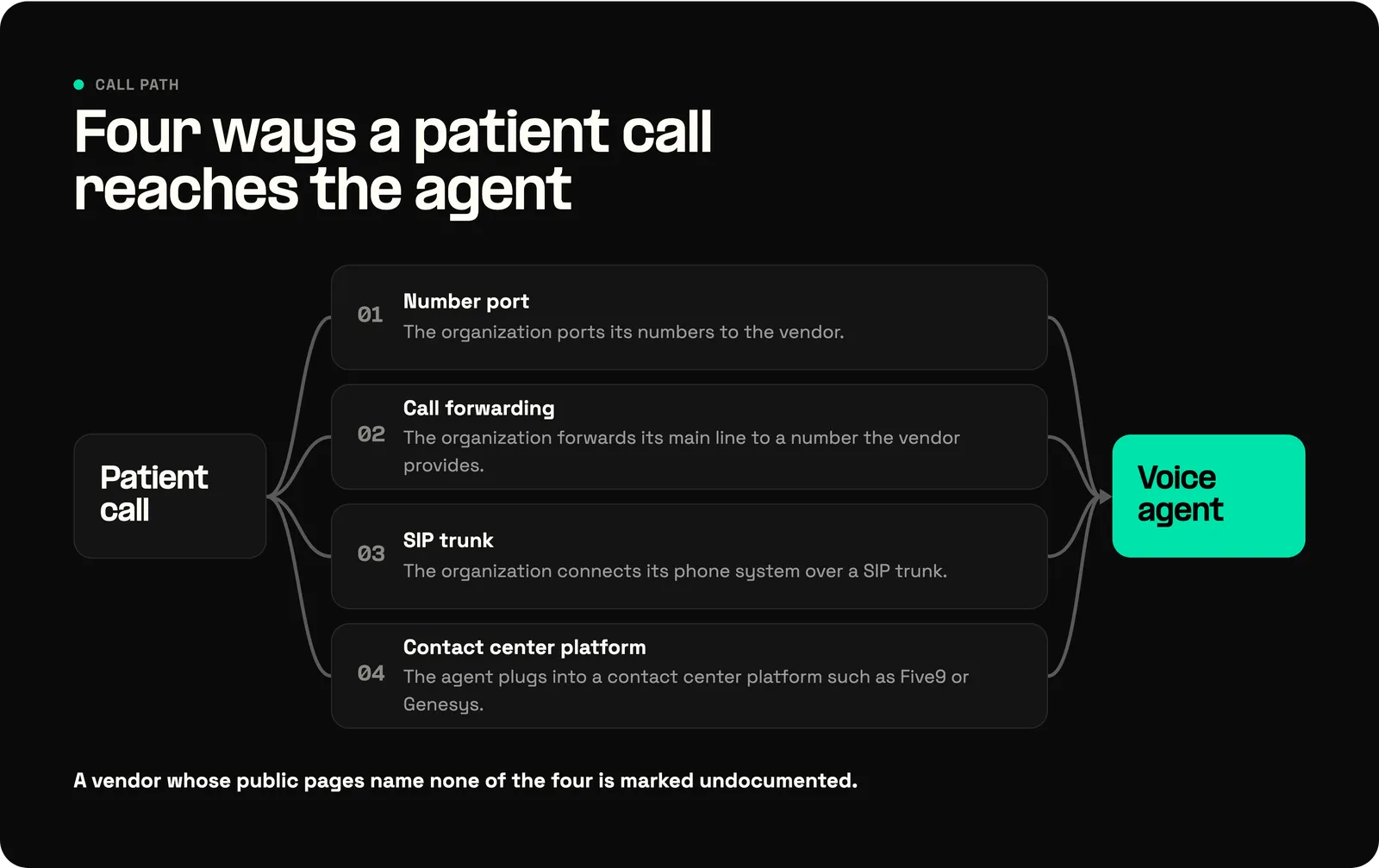
Telnyx's Voice AI Agents run speech recognition and text-to-speech, and can run the language model, on the same licensed carrier network that carries the patient's call. Telnyx is a licensed carrier in 45+ countries with phone numbers in 100+. Practices can buy or port numbers to Telnyx, forward an existing line to a number assigned to the agent, or connect a PBX over Telnyx SIP trunking.
The organization can set where the call's data lives and how much of it is retained. Data locality keeps stored data in the US, Germany, Australia, or the UAE. A retention setting stops an agent from keeping transcripts or cached audio, and the organization can switch recording off if it wants.
Best for: Healthcare technology teams with engineers who want control over their workflow.
Key features:
- Pronunciation dictionaries set how the agent says drug names and acronyms, and Telnyx publishes an open-source medical dictionary that imports in one command.
- Built-in transfer tools, including SIP REFER, hand calls to staff with warm-transfer instructions, and voicemail detection stops a transfer that reaches a machine.
- HIPAA is included on every plan, including pay as you go, under a Business Associate Addendum (Telnyx's name for its BAA) that covers HIPAA-eligible services.
- Telnyx's certifications and compliance programs are SOC 2 Type II, HIPAA, PCI DSS Compliant, ISO 27001, and GDPR with EU-deployed infrastructure.
Limits:
- Telnyx's HIPAA guide requires workflows that handle PHI to run on Telnyx-hosted models such as Llama and Qwen, so the Anthropic and OpenAI model options fall outside a HIPAA deployment.
- No native EHR connector is documented. Native integrations cover Salesforce, ServiceNow, HubSpot, Zendesk, and Jira, and EHR write-back is built with webhook tools.
Pricing: $0.05 per minute for speech-to-text, text-to-speech, and orchestration, with language model tokens and telephony billed separately (US inbound from $0.0032 per minute). The voice engine bills each call in 60-second increments.
Choose Telnyx if: the organization has engineers to own the EHR write-back and wants the number, the carrier, and the speech layers on one contract.
Talk to Telnyx about moving patient calls and phone numbers onto its carrier network. PatientSync, which handles millions of healthcare calls a year, moved from Amazon Connect to Telnyx.
2. Hyro: Best for health systems on existing contact centers
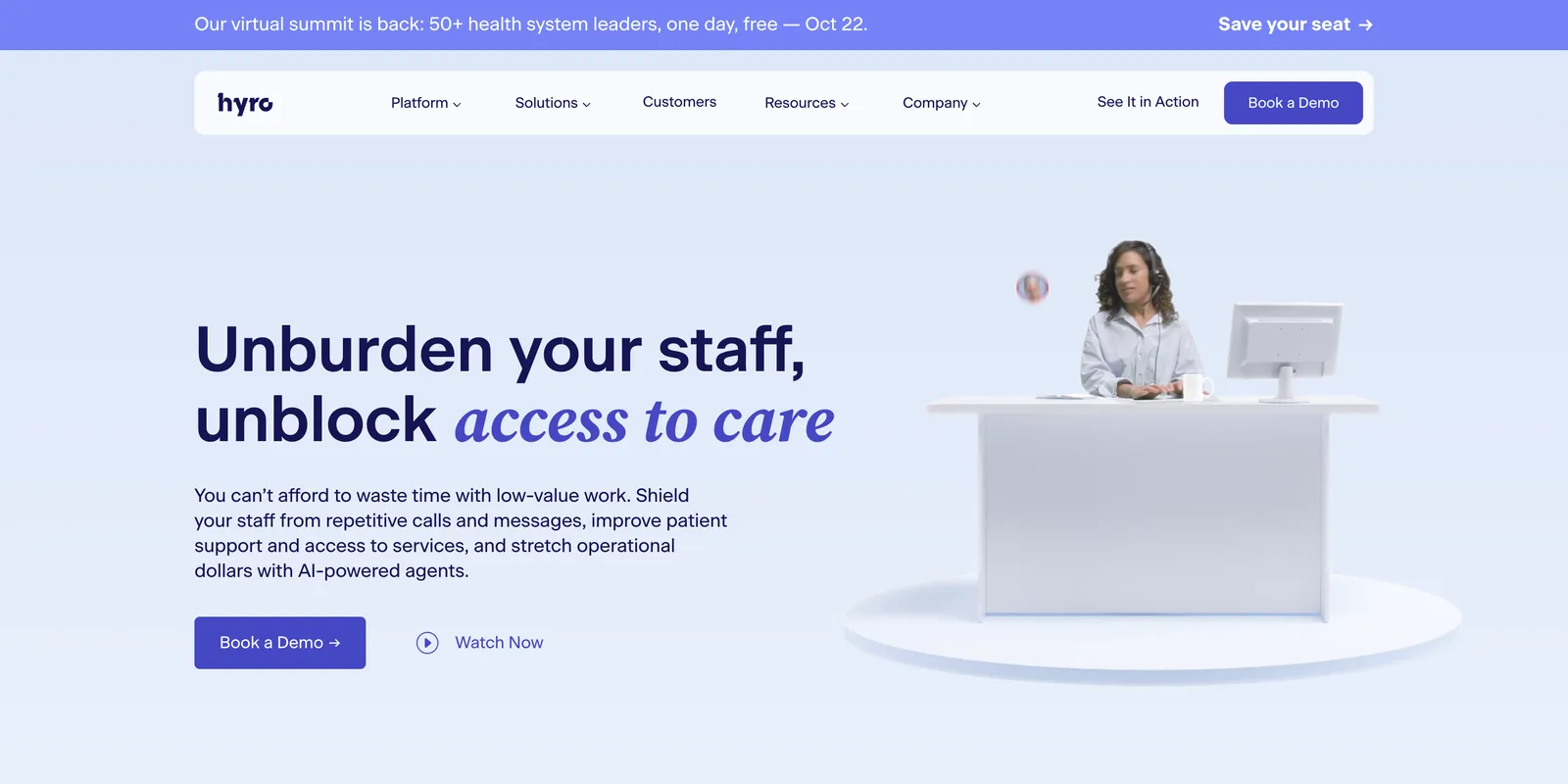
Hyro builds patient-access agents that plug into the contact center a health system already runs. It connects over SIP, DID, or PSTN to Cisco, NICE CXone, Genesys, Five9, Avaya, RingCentral, and Amazon Connect. It is listed on Epic Showroom, Epic's marketplace for third-party apps, which notes that Epic does not certify listed developers.
Hyro is an accredited Five9 partner and a vendor on NICE's CXexchange marketplace, and it redacts PII and PHI in conversations. Tampa General Hospital reported a 56% drop in ambulatory queue abandonment after Hyro's voice agent became the primary point of contact for incoming calls.
Best for: Health systems that want scheduling, refills, and routing automated inside the Five9, NICE, Genesys, or Cisco contact center they already operate.
Key features:
- Epic-certified workflows, including patient verification, plus connections to Oracle Cerner, eClinicalWorks, athenahealth, and Meditech.
- Transfers pass the conversation to staff with summary fields already filled in.
- Healthcare-specific small language models and knowledge graphs, grounded in the organization's approved knowledge base.
Limits:
- The agents support English and Spanish only.
- Hyro does not publish BAA terms or controls for drug-name pronunciation.
Pricing: Sales-gated, with no published pricing model.
Choose Hyro if: the contact center already runs on one of those platforms and patients call in English or Spanish.
3. Hippocratic AI: Best for non-diagnostic clinical outreach calls
Hippocratic AI builds its own healthcare model stack, Polaris, and uses it for patient calls that sit close to clinical care: post-discharge follow-up, screening outreach, chronic care check-ins, and intake.
Its agents do not diagnose or prescribe, and the company excludes AI agents from handling mental health disorders, hospice, and children under two. WellSpan Health reports that its Hippocratic AI agent manages more than 160,000 patient calls a month.
Best for: Health systems, payers, and life sciences teams running non-diagnostic outreach programs, such as post-discharge calls and cancer screening reminders.
Key features:
- A custom clinical speech recognizer and a text-to-speech model tuned for branded and generic drug names, backed by a dedicated drug-name pronunciation supervisor model.
- A published safety program: Hippocratic reports more than 7,700 licensed clinicians making 775,000 test calls, live sampling of 0.5% to 1% of calls, and escalation of patients to nursing staff.
- EHR write-back from its Nurse Co-Pilot product, and 50+ EMR integrations.
Limits:
- Hippocratic does not document its call path. No carrier, number provisioning, or contact center platform is named, and no BAA terms are published. Its certifications are SOC 2 Type II and a one-year HITRUST e1 issued in July 2025.
- The safety testing benchmarks have no independent clinical evaluation.
Pricing: Hippocratic lists Polaris Pro at $9/hour, and other pricing is sales-gated.
Choose Hippocratic AI if: the program requires clinical outreach at scale.
4. Prosper AI: Best for outpatient groups calling patients and payers
Prosper AI runs voice agents that cover both sides of an outpatient group's phone work: inbound patient calls for scheduling and billing, and outbound calls to payers for benefits, authorization, and claims. When an electronic eligibility check falls short, Prosper's agent calls the payer, works through the menu, and waits on hold.
In Prosper's own case study, Northeast OB/GYN resolved 50% of 18,000 monthly calls end to end. Its agents support up to 45 languages, including Spanish, Arabic, Chinese, and Creole.
Best for: Outpatient and specialty groups that want patient scheduling and payer follow-up handled on one platform.
Key features:
- Structured read and write to 80+ EHRs, including athenahealth, ModMed, eClinicalWorks, Epic, and NextGen.
- A BAA and SOC 2 Type II, both stated on its integrations page, plus an on-premises deployment option.
- Ambiguous or failed calls go to staff with a full transcript and confidence score.
Limits:
- Prosper says it connects to your existing phone setup without documenting the mechanism or naming contact center platforms.
- Its published results come mostly from ModMed specialty practices.
Pricing: Usage-based, with rates behind sales; Prosper says customers pay nothing until they go live.
Choose Prosper AI if: payer calls take as much staff time as patient calls.
5. Infinitus: Best for pharma hubs and payer benefit calls
Infinitus automates the calls healthcare organizations place to payers, starting with benefit verification and prior authorization. Its agents can work through more than 1,000 payer phone menus and pull data digitally from clearinghouses and payers before they dial.
Amgen, a customer Infinitus cites with results, reported patient benefits verified within 48 hours or less.
Best for: Pharma patient-support hubs, payers, and provider reimbursement teams whose phone load is benefit verification and prior authorization calls.
Key features:
- A BAA signed with each customer that processes PHI, a SOC 2 Type II report on request, and US-only data storage.
- Drug-name pronunciation, formulary logic, and adverse-event detection ship built in, and regulated statements such as dosing information and boxed warnings play word for word.
- Exceptions and anything clinical go to human staff with full context, and a clinical escalation feature maps patient conversations to a nurse triage protocol.
Limits:
- Infinitus names no EHR integration, routes EHR work through system integrators and partners, and leaves inbound call routing undocumented.
- Most of its case studies are anonymized, and only English and Spanish support is documented.
Pricing: An annual platform fee plus usage per task or minute, or a subscription, with rates behind sales (Infinitus pricing page, September 2026).
Choose Infinitus if: payer calls run at pharma-hub or reimbursement-team volume
6. Assort Health: Best for specialty practices needing EHR write-back
Assort Health builds patient-access agents for specialty groups, primary care, FQHCs, and health systems, covering inbound calls, outbound outreach, referrals, intake, and refill requests. Its agents write bookings and tasks directly into the EHR. Assort lists nine supported EHRs and documents partner-program status with four of them: athenahealth, NextGen, Veradigm, and ModMed.
Assort says medical practices can keep their current phone and scheduling systems. It integrates with Genesys, Five9, Cisco, and NICE contact centers and operates in 29 languages.
Best for: Specialty practices whose scheduling rules, referrals, and refill queues need to land in the EHR without staff rekeying them.
Key features:
- Integrations listed with Epic, Oracle Health, eClinicalWorks, Allscripts, and Medent.
- Strong compliance features with a published BAA, SOC 2 Type II certifcation, and HIPAA attestation.
- Staff get a full summary before they pick up a transferred call, and urgent after-hours calls escalate through the practice's existing on-call workflow.
Limits:
- Assort says it holds downstream BAAs without publishing them. No page says whether a practice forwards its main line or connects over SIP.
- Custom vocabulary and pronunciation controls are not documented, and Assort's EHR and interaction counts differ across its own pages.
Pricing: Sales-gated, with no public pricing page.
Choose Assort Health if: referrals are the bottleneck and the practice's EHR is athenahealth, NextGen, Veradigm, or ModMed.
7. Zocdoc Zo: Best for 24/7 scheduling on existing phone lines
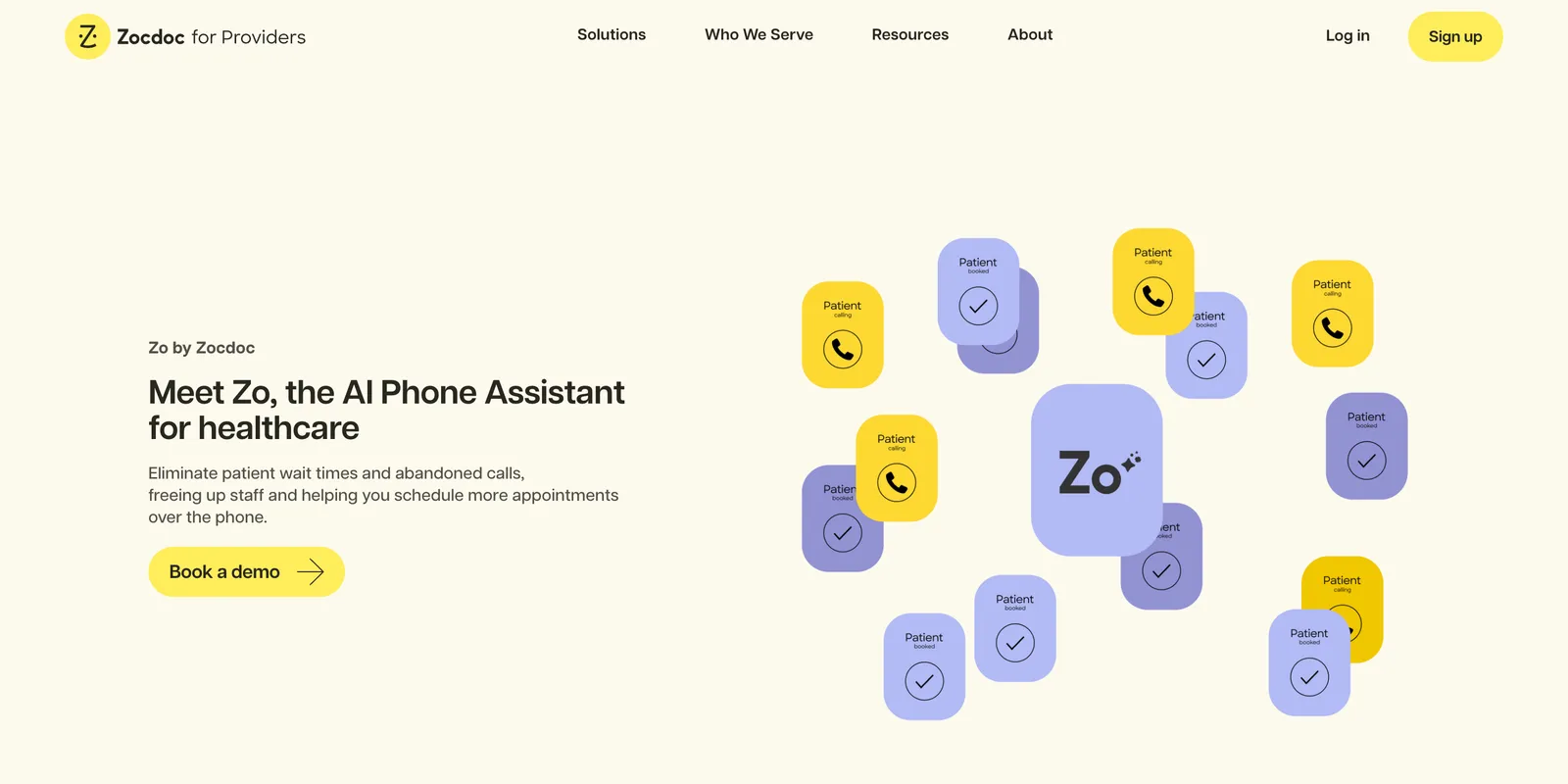
Zo is Zocdoc's AI phone assistant, and it answers a practice's calls around the clock to book, reschedule, confirm, and cancel appointments. Practices do not need to be Zocdoc Marketplace customers. Zo connects to the existing phone system and books through Zocdoc's integrations with 175+ EHR and practice management systems.
Zocdoc says Zo can resolve up to 70% of scheduling calls without staff, and it answers unlimited calls at once, so peak-hour callers do not hit a busy signal.
Best for: Practices that want scheduling calls answered 24/7, including new-patient calls with insurance collection, and every other request routed to staff.
Key features:
- Zo checks availability against the EHR in code before it confirms a booking, and the language model only interprets what the caller said.
- A published list of transfer reasons, with staff receiving an AI summary and a link to the patient's EHR record.
- Zocdoc states Zo is HIPAA-compliant and SOC 2 certified, and its privacy policy describes a business associate role.
Limits:
- Refills, referrals, lab results, billing, and medical questions transfer to staff, and Zocdoc claims multilingual support without naming the languages.
- Zocdoc publishes no BAA, its pages cover neither how calls reach Zo nor pronunciation controls.
Pricing: Pricing varies, per Zocdoc's help center; at launch, Zocdoc charged only when Zo successfully managed an appointment.
Choose Zocdoc Zo if: nearly every call is about an appointment.
8. PolyAI: Best for enterprise contact centers with Epic lookups
PolyAI builds enterprise voice agents on its own dialog model, Raven, and opened self-serve agent building in May 2026. It lists 73 response languages, 24 of them on Raven. In healthcare, it handles scheduling, billing, and insurance updates, outbound reminders, and routing.
PolyAI sells US, UK, and Canadian numbers and also connects to Twilio, SIP trunks, and major contact center platforms.
Every PolyAI plan includes a 99.9% uptime SLA on phone lines and 24/7 emergency support.
Best for: Large health systems and payers running high-volume contact centers on Genesys, Five9, NICE CXone, or Amazon Connect.
Key features:
- An Epic integration over SMART on FHIR with read access to patient and operational data, subject to Epic's trusted-application approval.
- Pronunciation rules in IPA or SSML, keyphrase biasing for speech recognition, and transcript corrections, with a drug name and a medical abbreviation as the documented examples.
- Handoffs over SIP REFER or SIP INVITE carry context through SIP headers, a Handoff API, and the full transcript.
Limits:
- PolyAI publishes no BAA terms, and its documentation says its systems are designed to meet HIPAA requirements "where relevant."
- Custom SIP routing is a managed service arranged through an account manager.
Pricing: Per minute, with no published rate; the first agent is free to build (PolyAI pricing page, September 2026).
Choose PolyAI if: agents need Epic lookups during the call and procurement can negotiate BAA terms directly with sales.
9. Retell AI: Best for developers who need a self-serve BAA
Retell AI is a developer platform for building, testing, and deploying voice agents, with published per-minute pricing. Its BAA is self-signed online at no additional fee, letting a small clinic or digital health startup reach HIPAA coverage quick.
Once the BAA is signed, per-agent data retention can be set from one day to two years.
Pine Park Health, a senior primary care provider, uses Retell for outbound appointment reminders and proactive scheduling. The pay-as-you-go plan includes 20 concurrent calls, with more at $8 per concurrent call per month.
Best for: Developer teams and digital health startups building custom patient-call agents on a pay-as-you-go plan.
Key features:
- Retell sells US and Canadian numbers backed by Twilio or Telnyx, or connects a SIP trunk the customer already has, with no Retell telephony charge.
- A pronunciation dictionary for voices that support it, plus up to 100 boosted keywords, which Retell's documentation recommends for medical terminology.
- Cold, warm, and agentic warm transfer, in which a second agent briefs the human with the conversation before bridging the call.
Limits:
- The only packaged EHR path runs through Keragon, a healthcare automation platform.
- The pronunciation dictionary does not work on OpenAI voices or on ElevenLabs multilingual and v3 voices.
Pricing: $0.07 to $0.31 per minute depending on the model and voice, built from a $0.055 per minute platform fee plus language model, voice, and telephony charges.
Choose Retell AI if: the team needs a signed BAA this week and has an engineer to build the EHR connection.
10. Vapi: Best for developers assembling their own model stack
Vapi is an API-first developer platform that lets a team choose each layer of the agent: the speech recognition, the language model, the voice, and the carrier. It charges for its hosting and passes provider costs through at provider prices.
UnityAI, a Vapi customer that schedules for ambulatory networks, handles more than 250,000 patient calls a month across its clients, after building its own EHR connections for real-time availability checks. Outbound reminder campaigns run from Vapi's dashboard, but they need an imported number, because free Vapi numbers only take inbound calls.
Best for: Engineering teams that want to pick every model and provider, including medical speech recognition, and build the workflow in code.
Key features:
- Deepgram's medical speech recognition models are selectable, alongside keyword and keyterm boosting and pronunciation dictionaries for supported voices.
- HIPAA mode applies across the whole organization and rejects provider configurations that are not HIPAA compliant.
- Blind transfer can pass an AI summary in a SIP header, and assistant-based warm transfer briefs the operator using the conversation.
Limits:
- HIPAA is a paid add-on per organization. HIPAA mode stores recordings, transcripts, and logs in a HIPAA-compliant manner, so it cannot run alongside Zero Data Retention, which keeps none.
- The five standard warm-transfer modes work only on Twilio calls, free numbers are US-only, and no EHR integration is named.
Pricing: $0.05 per minute for Vapi hosting, with speech, model, voice, and carrier costs billed on top; HIPAA costs $2,000 per month per organization.
Choose Vapi if: model choice matters more than the cost of the HIPAA add-on.
11. Synthflow: Best for enterprise teams building agents without code
Synthflow is a no-code voice agent builder sold through sales-led enterprise contracts. It runs its own call infrastructure and offers a HIPAA Setting that, once enabled, keeps PHI from being logged, recorded, or stored persistently. Its legacy self-serve plans are closed to new customers.
Synthflow meters calls per second and bills unanswered calls as five seconds, so short and failed calls cost little, and it lists 33 supported languages. Synthflow's healthcare page credits Medbelle, a UK and EU healthcare provider, with 2.5x more booked appointments. An April 2026 partnership with 8x8 brings the agents into enterprise contact centers.
Best for: Enterprise operations teams that want to build scheduling, intake, and after-hours agents in a visual builder under a signed contract.
Key features:
- A BAA executed at contract signing for customers who use the HIPAA Setting, which is off by default.
- Business-hours rules decline, route, or transfer out-of-hours calls, and warm transfer plays an AI summary to staff before connecting.
- Native integrations with Twilio, Telnyx, RingCentral, and Vonage, plus SIP guides for Five9, Genesys Cloud, and other contact center platforms.
Limits:
- SIP, PBX, and caller ID options require an enterprise plan, and Synthflow positions its own numbers for testing rather than production.
- Custom Vocabulary is documented for speech recognition, but a phoneme-level pronunciation dictionary is not, and the docs include no EHR setup guide.
Pricing: Enterprise contracts start at $30,000 a year, with no published per-minute rate.
Choose Synthflow if: nobody on the team writes code and an annual contract fits the budget.
Which AI voice agents are HIPAA compliant?
HIPAA compliance isn't only restricted to the underlying platform - any third-party that creates, receives, maintains, or transmits PHI on its behalf is a business associate that must sign a business associate agreement (BAA).
This matters because HHS guidance lists a third-party AI chatbot that handles appointment scheduling and reminders as an example of a business associate. A voice agent that records calls, stores transcripts, or writes to an EHR maintains PHI.
Every layer that touches the audio or the transcript then needs BAA coverage: the carrier once it records or transcribes, the speech recognizer, the language model, the voice, and the recording store.
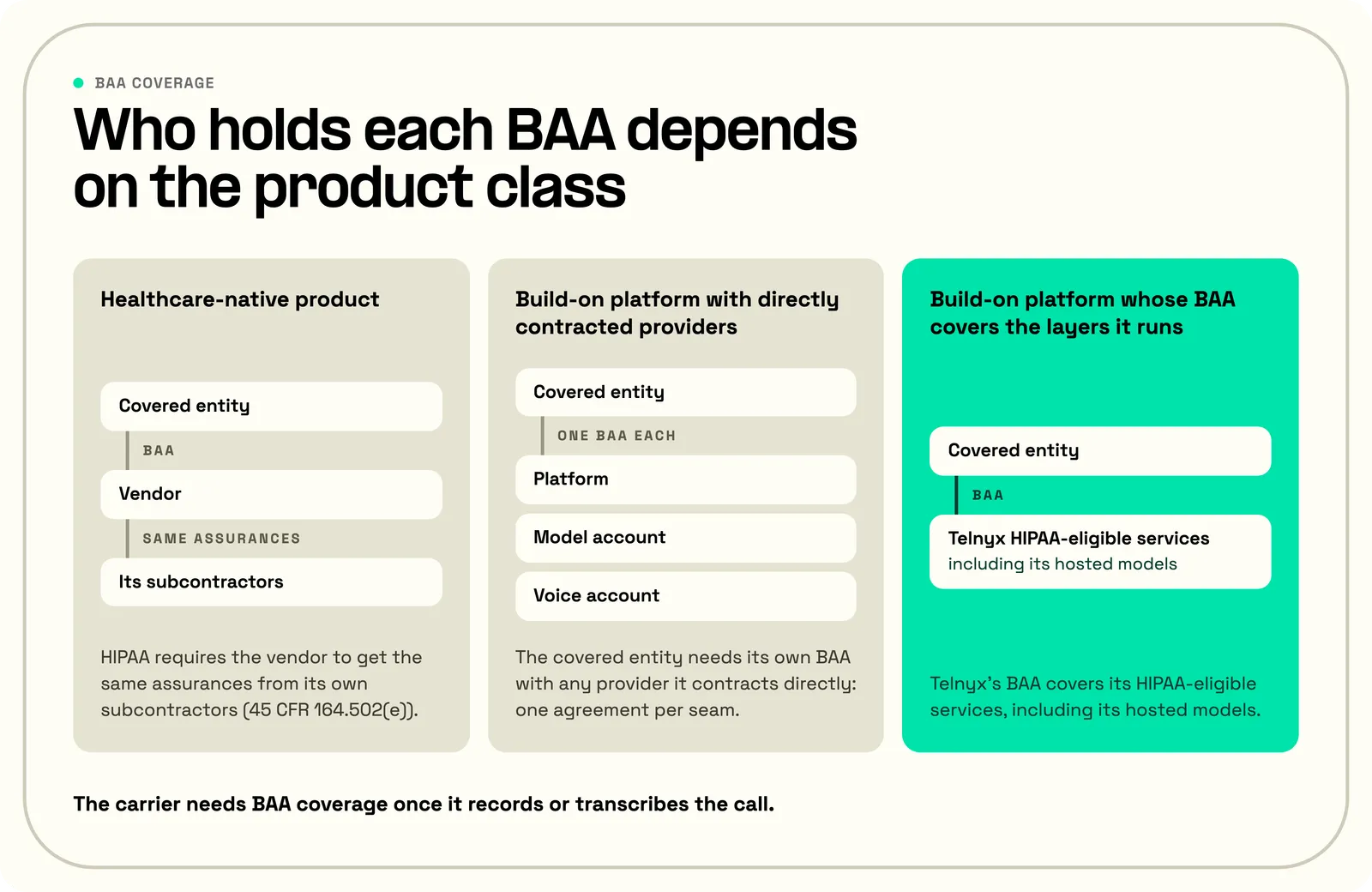
A BAA also puts duties on the covered entity. Telnyx's HIPAA architecture guide sets rules for each product, such as call recording and messaging, and requires signed webhooks, no PHI in support tickets, and Telnyx-hosted models for any AI feature that touches PHI.
Healthcare use cases for voice AI
Voice agents in healthcare handle high-volume administrative calls: scheduling and intake, refill requests, benefit and eligibility checks, prior authorization, and claim status calls to payers. Each workflow has a point where the agent stops, and staff takes over.
Healthcare call workflows and where each one hands off to staff
| Workflow | What the agent does | What goes to staff |
|---|---|---|
| Scheduling and intake | Books, reschedules, and cancels in the EHR; collects intake and insurance details (Assort Health, Zocdoc Zo, Prosper AI, Hyro) | Visit types outside the practice's rules, unverified callers |
| Reminders and rebooking | Calls patients before visits and fills cancelled or missed slots (Assort Health, Prosper AI, Hyro, PolyAI) | Patients who ask for a person |
| Refill requests | Captures the request and files a task for review (Assort Health, Hyro, Prosper AI) | Approval and any medication question |
| Benefit and eligibility checks | Calls the payer when an electronic check falls short and returns structured benefit data (Infinitus, Prosper AI) | Coverage disputes |
| Prior authorization and claim status | Checks status, works through payer phone menus, waits on hold (Infinitus, Prosper AI) | Medical necessity and appeal decisions |
| Post-discharge and screening outreach | Places scheduled calls, collects non-clinical answers, escalates to nurses (Hippocratic AI) | Symptoms and clinical judgment |
| After-hours coverage | Answers and books around the clock (Zocdoc Zo, Assort Health); routes out-of-hours calls to on-call staff or a fallback (Assort Health, Synthflow) | Emergencies |
The configurable platforms (Telnyx, Retell AI, Vapi, Synthflow) can run any of these workflows once the organization's team builds the EHR connection.
Scheduling counts as automated only when the booking lands in the EHR, so a pilot has to test EHR write-back directly.
There's an outbound element, too, because missed appointments cost the schedule directly. A systematic review of 105 studies put the average no-show rate at about 23%, close to one booked visit in four. That is why reminder and rebooking calls sit next to inbound scheduling.
Payer calls are the other cost center. Practices complete an average of 40 prior authorizations per physician each week, and 95% of physicians say the process delays care. The 2024 CAQH Index puts a provider's labor cost for a manual prior authorization at $12.88 against $5.38 for electronic, and a manual claim status inquiry at $13.80 versus $3.64.
How much do voice agents for healthcare cost?
It's hard to come up with a benchmark rate for healthcare given the complex workflows involved. Most healthcare-native products price through a sales conversation, and platforms publish a per-minute rate with variable add-ons.
A completed call carries six cost layers:
- The voice engine or platform fee (orchestration, and speech-to-text and text-to-speech on some platforms)
- Language model tokens
- Telephony minutes and phone numbers
- HIPAA access, which is free on some platforms and a monthly add-on or contract term on others
- Call recording and storage
- EHR integration and implementation work
Published rates for build-on platforms and what each one leaves out
| Platform | Published rate | What it leaves out |
|---|---|---|
| Telnyx | $0.05/min voice engine | Language model tokens; telephony from $0.0032/min US inbound |
| Retell AI | $0.07 to $0.31/min | Range varies with the model, voice, and telephony chosen |
| Vapi | $0.05/min hosting | Speech, model, voice, carrier, and the HIPAA add-on |
| Synthflow | From $30,000/year | Per-minute rate not published |
Telnyx's pricing page estimates a production agent near $0.06 per minute with the language model and US inbound telephony included, or about $0.24 for a four-minute scheduling call.
Pricing for healthcare-native products
| Vendor | Pricing model | Published anchor |
|---|---|---|
| Hyro | Not published | None |
| Hippocratic AI | Hourly for Polaris Pro; other products sales-gated | From $9/hour, billing hour undefined |
| Prosper AI | Usage-based | $0 until go-live |
| Infinitus | Annual platform fee plus per task or minute, or a subscription | None |
| Assort Health | Not published | None |
| Zocdoc Zo | Varies; launched as payment per managed appointment | None |
| PolyAI | Per minute | First agent free to build |
What to test during a pilot
A pilot has to prove the call path, the handoff, and the write-back. It passes when each of these tests runs successfully:
- A listener hears each of the organization's top 100 drug and provider names correctly.
- An unverified caller gets no appointment or medication details until identity checks out.
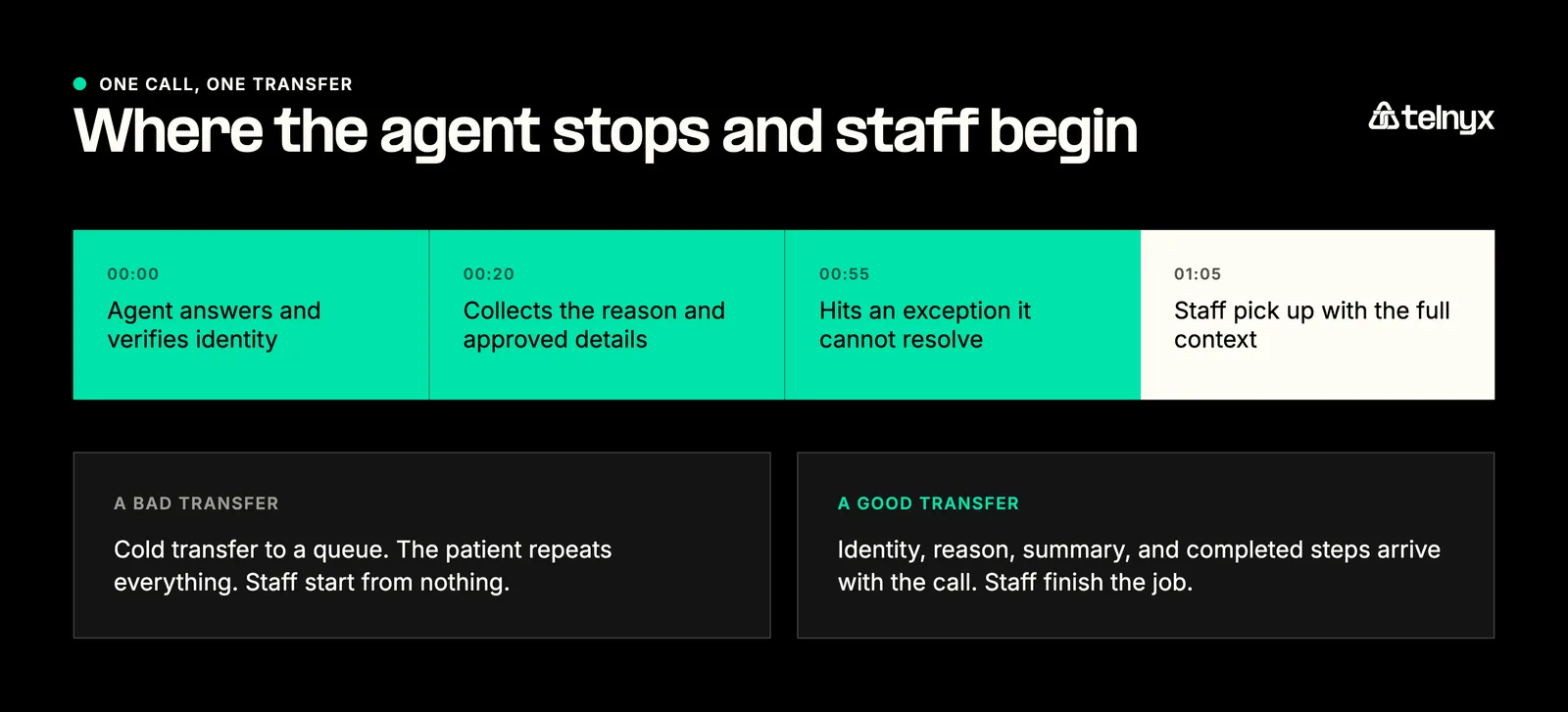
- Staff see the transfer reason, a summary, and the completed steps before they answer, and the same holds after hours when nobody is available.
- If an EHR integration times out mid-call, the agent informs the caller, creates a follow-up task, and confirms no booking it could not write.
- Each test booking appears in the EHR with the right provider, location, and visit type.
- Agents apply different rules to two locations with different scheduling rules and phone numbers.
Three questions may need additional verification:
- The carrier of record, whether the organization's existing numbers are ported or connected over SIP, and which number outbound calls display.
- What the EHR vendor requires for the integration, including marketplace or API approval, fees, and timeline.
- Consent obtained for outbound calls. The FCC's February 2024 ruling treats AI-generated voices as artificial under the TCPA, so outbound AI calls need prior express consent unless an emergency purpose or exemption applies.
The healthcare exemptions in FCC rules are narrow. Exempt provider calls must be free for the patient and limited to one per day with a maximum of three per week. Each call must run generally one minute or less, carry no billing content, and include an in-call opt-out.
 | “The gap between a voice AI pilot and a production deployment in healthcare usually comes down to one architectural choice: how many vendor seams sit on the call path between the patient and the EHR write-back. Every seam is another BAA, another point of failure, another compliance audit.” Abhishek Sharma |
Choosing the right voice agent
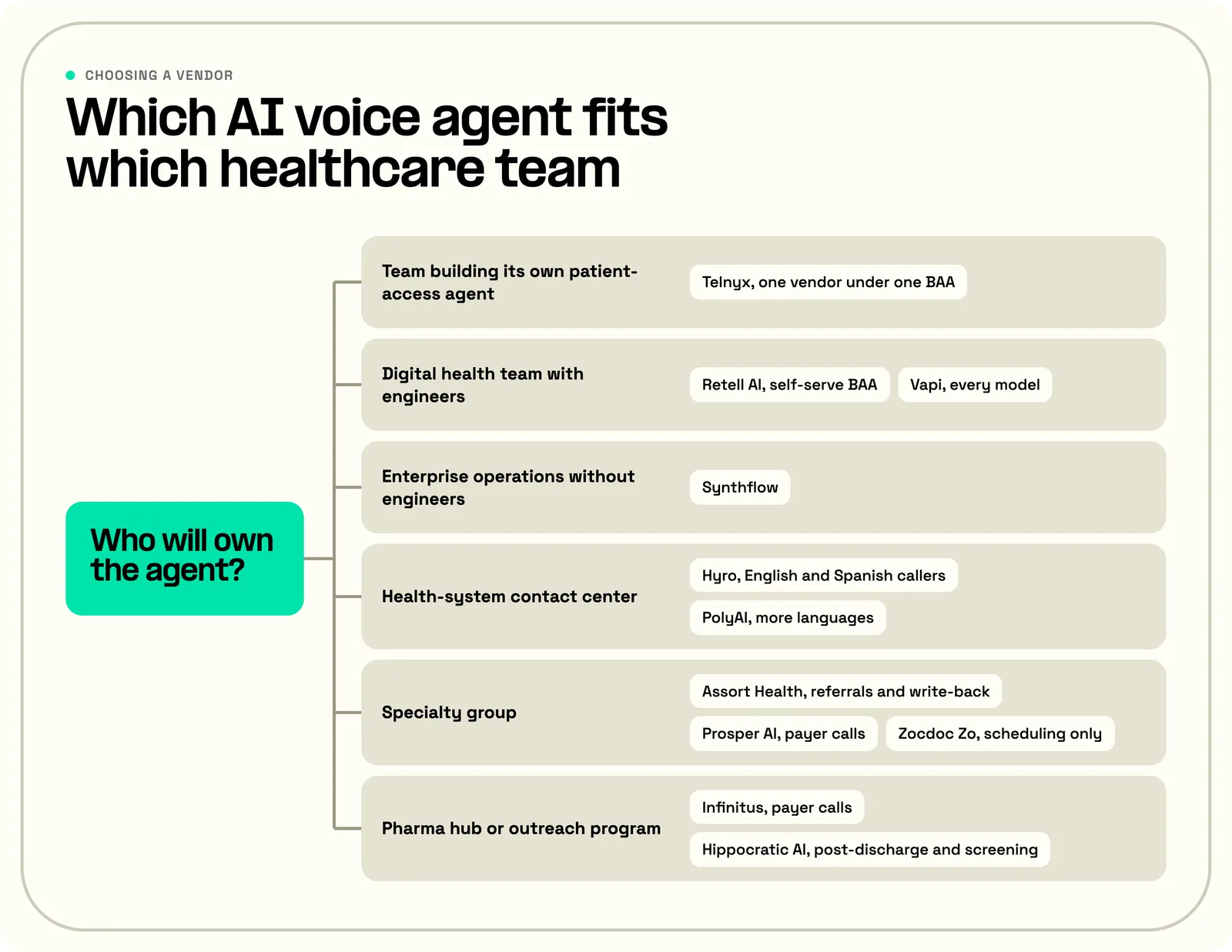
Customizable platforms (like Telnyx) suit teams that want to run the workflow, and healthcare-native products suit teams that want a turnkey solution (with less flexibility).
- If you build your own patient-access agent and want one vendor under one BAA, start with Telnyx.
- If you lead a digital health team with engineers, start with Retell AI for a self-serve BAA or Vapi .
- If you run operations at an enterprise without engineers, look at Synthflow
- If you run a health-system contact center, start with Hyro for English and Spanish callers, and add PolyAI when you need more languages.
- If you run a specialty group, pick Assort Health for referrals and write-back, Prosper AI when payer calls are half the load, or Zocdoc Zo when scheduling is nearly all of it.
- If you run a pharma hub or reimbursement team, start with Infinitus; if you run post-discharge or screening outreach, start with Hippocratic AI.
Build healthcare voice AI on Telnyx
Telnyx can run every layer of a healthcare voice agent: the phone number, the carrier network, speech recognition, the language model on Telnyx-hosted GPUs, and the voice, under one Business Associate Addendum. Clients get sub-200 millisecond response times, which keeps the pause short after a patient stops speaking.
Hello Patient, which builds AI agents for patient calls, texts, and web chat, chose Telnyx and has powered more than 5 million patient conversations in under two years. PatientSync moved millions of healthcare calls a year from Amazon Connect to Telnyx's call control APIs. Teams that already run their own agent can carry the calls on Telnyx's Voice API at carrier cost.
 | “Patients respond well when the AI can complete the task they called about, especially when it can connect back to the systems that manage scheduling.” Alex Cohen |
Saying drug names correctly is part of a production-grade healthcare workflow. The Telnyx open-source medical pronunciation dictionary loads into a Telnyx account with one clone and one import script:
The repository includes 966 drugs, clinical terms, anatomical terms, and medical acronyms with both phonetic aliases and IPA pronunciations. See the Telnyx healthcare page for more information on real-world deployments and compliance details.
See Telnyx Voice AI agents handle healthcare workflows
Hello Patient has powered more than 5 million patient conversations on Telnyx in under two years.
Book a callFrequently asked questions
Which AI voice agent is best for healthcare claims and RCM calls?
Infinitus and Prosper AI are the strongest fits for healthcare claims and RCM calls. Infinitus focuses on payer calls for benefit verification and prior authorization, including pharma patient-support hubs. Prosper AI handles payer calls and patient billing for outpatient groups. Teams building their own RCM agent can start on Telnyx, Retell AI, or Vapi.
Which voice AI platforms work best for large health systems and hospital call centers?
Telnyx is the strongest fit for large health systems and hospital call centers with engineers to build their own agent. Telnyx's Voice AI Agents keep the phone number, carrier network, speech, and language model under one Business Associate Addendum. Hyro and PolyAI suit teams that want a packaged agent inside their existing contact center, with documented Epic lookups.
Which voice AI platform is best for specialty practices?
Assort Health is the closest fit for specialty practices, with specialty scheduling, referral processing, and documented partner integrations with athenahealth, NextGen, Veradigm, and ModMed. Prosper AI suits specialty groups whose payer calls rival their patient calls. Zocdoc Zo covers scheduling-only needs around the clock on the practice's existing phone lines.
Which AI voice agents support multilingual patient scheduling?
Telnyx supports 80+ languages and dialects, Prosper AI up to 45 languages, and Assort Health 29, per each vendor's documentation. PolyAI documents 73 response languages, Hippocratic AI runs English, Spanish, and Mandarin agents, and Hyro supports English and Spanish. Zocdoc does not name Zo's languages. A pilot should cover the languages patients actually speak, on real scheduling calls.
Can AI voice agents automate patient scheduling and intake?
AI voice agents automate patient scheduling and intake when they write the result into the EHR. Assort Health, Zocdoc Zo, and Prosper AI book, reschedule, and cancel appointments in connected EHRs and collect intake and insurance details. Hyro automates scheduling inside health-system contact centers. Unverified callers and unusual visit types should transfer to staff with a summary.
Is it legal to use AI voice agents to call patients?
Using AI voice agents to call patients is legal in the US when the calls meet the TCPA and HIPAA. The FCC ruled in 2024 that AI-generated voices count as artificial voices, so outbound calls need prior express consent unless an exemption applies. Any vendor handling PHI also needs a BAA. Legal counsel should review and vet any calling program before it launches.
Share on Social
Osman is the Global AEO/SEO Lead at Telnyx, helping make voice AI and communications products clearer for builders. With almost a decade of experience in SEO, he previously led growth at Windscribe and Enzuzo, shipping and scaling organic programs that reached millions.


