
Telnyx
5 Best Voice AI Agents for Banking in 2026
Explore the 5 best voice AI agents powering efficient, secure customer support in banking for 2026.

By Eli Mogul
Best AI voice agents for banking: 5 platforms compared (2026)
Quick answer
Telnyx Voice AI supports banking customer service, KYC, and fraud-alert workflows on a licensed carrier network, with orchestration from $0.05 per minute and STT and Telnyx-native TTS included, a sub-500 ms end-to-end latency benchmark, and a unified compliance stack: SOC 2 Type II attestation, HIPAA-aligned controls with BAAs available, GDPR-aligned controls, and PCI-DSS-aligned DTMF masking and pause/resume.
The five platforms evaluated below are Telnyx, Retell AI, PolyAI, Cognigy, and Parloa.
Why banks are deploying voice AI in 2026
Banking contact centers are among the highest-cost and most heavily regulated voice operations in financial services, and AI voice agents are emerging as a direct response. Voice AI now sits at the intersection of cost-to-serve pressure, agent attrition, 24/7 customer expectations, and AI maturity reaching production-grade performance for regulated workflows.
Most production deployments target 30-45% contact-center cost reductions, according to McKinsey research on AI in financial-services customer care.
Regulatory adoption has advanced as well. The 2024 Bank of England and FCA survey on AI in UK financial services found that 75% of firms are already using AI, up from 58% in 2022, with the biggest perceived benefits in fraud detection, AML, and customer care. That is exactly the workload the next wave of voice AI is being built to absorb.
The pace is set to accelerate. Gartner projects that agentic AI will autonomously resolve 80% of common customer-service issues by 2029, with a projected ~30% reduction in operating costs. McKinsey's "The contact center crossroads" finds that 50-60% of customer interactions remain transactional even after years of automation, which is precisely the workload voice AI is positioned to absorb.
Production deployments today cluster around balance inquiries, transaction history, KYC re-verification, fraud alerts, collections monitoring, payment processing, loan servicing, and 24/7 customer authentication. AI agents typically land first in these high-volume, lower-complexity workflows before expanding into higher-risk journeys.
The top 5 AI voice agents for banking in 2026
This list spans the agent layer (PolyAI, Cognigy, Parloa) and the infrastructure layer (Telnyx, Retell AI). Different layers solve different problems: the best choice depends on whether you need pre-built agents or production voice infrastructure. Banks with heavy call volumes typically buy infrastructure because per-call economics matter more than out-of-the-box flows.
Pricing below reflects public information as of May 2026 and may change. For usage-based platforms, LLM costs are billed based on token usage and vary by model.
| Platform | Best for | Why it made the list | Pricing |
|---|---|---|---|
| Telnyx | Production banking deployments at scale | Orchestration-based pricing with STT and Telnyx-native TTS included, sub-200ms RTT, full SOC 2 / HIPAA / GDPR / PCI-ready compliance stack on a single vendor | From $0.05/min for orchestration (STT and Telnyx-native TTS included) |
| Retell AI | BYO-LLM voice agent orchestration | Transparent usage pricing, voice agent QA tooling, strong production track record across enterprise voice deployments | $0.07-0.08/min voice + $0.015/min telephony + $0.006-0.06/min LLM |
| Cognigy | Mature CCaaS replacement with banking references | Omnichannel coverage on one platform (voice + chat + messaging + email); established Genesys / Avaya / Cisco partnerships | Custom / quote-based |
| Parloa | European enterprise contact-center deployments | European retail banking references; GDPR-native architecture and EU data residency | Custom / quote-based (enterprise) |
| PolyAI | Voice-first IVR replacement at enterprise scale | Voice-first product focus with established financial-services and retail banking references | Custom / quote-based (enterprise) |
Each platform is profiled below.
Telnyx Voice AI Agents
Summary: Telnyx Voice AI integrates STT, LLM inference, TTS, and the underlying voice network on one platform, reducing the multi-vendor handoffs that often increase banking voice AI costs and latency.
Best for: Production banking deployments scaling to enterprise call volumes that need transparent per-minute pricing, low perceived latency, and PCI-aligned payment capture on one vendor.
Key strengths:
- Carrier-grade voice network with native PSTN and SIP coverage, plus support for STIR/SHAKEN attestation based on enterprise vetting and call origination
- Transparent pricing starting at $0.05 per minute for orchestration, with STT and Telnyx-native TTS included
- Unified compliance posture: SOC 2 Type II attestation, HIPAA-aligned controls with BAAs available, GDPR-aligned controls, and PCI-DSS-aligned payment capture controls
Limitations:
- Less brand-voice and emotive customization than dedicated voice-cloning vendors
- No fully no-code visual builder; deployment still assumes engineering involvement
Banking use cases:
- High-volume customer authentication, balance inquiries, and KYC verification
- Fraud-alert callbacks and collections calls where low latency reduces abandonment and escalations
- CRM and case-system integrations via SIP, webhooks, and connector patterns
Compliance posture (at a glance): SOC 2 Type II; HIPAA-aligned controls with BAAs available; GDPR-aligned controls; PCI-DSS-aligned DTMF masking and pause/resume.
Retell AI
Summary: Voice-agent orchestration with transparent usage breakdowns and an active developer community. Strong production track record, including financial-services use cases.
Best for: Engineering teams that want to choose their own LLM and speech stack while moving quickly in prototyping and deployment.
Key strengths:
- Clear, published usage categories in a market with many quote-only contracts
- Agent evaluation and QA tooling to test flows before production
- Broad integrations across LLM, STT, and TTS providers
Limitations:
- Telephony, LLM, and STT/TTS are billed separately on top of orchestration, so total costs can rise at scale
- Perceived latency depends on the chosen vendor mix and network hops
Banking use cases:
- Usage-based orchestration for teams building custom inbound and outbound flows
- Integrations with CRM and helpdesk systems through webhooks and connectors
- Flexible vendor selection for banks that want to optimize the stack component by component
Compliance posture (at a glance): SOC 2 publicly referenced. HIPAA, PCI, and GDPR posture depends on sub-vendor selection and implementation.
PolyAI
Summary: Voice-first enterprise CX platform designed to replace legacy IVR with AI voice agents. Established references in financial services and large retail banking.
Best for: Enterprise banks replacing legacy IVR with voice-first AI agents, typically under large annual contracts.
Key strengths:
- Voice-first product focus with tooling suited to banking workflows
- Established enterprise references in financial services and retail banking
- Customer-facing voice experience tuned for live-call interactions
Limitations:
- Quote-only pricing, often in the mid-six figures or higher
- Omnichannel teams may need additional vendors for chat, email, or messaging
Banking use cases:
- IVR replacement at enterprise volumes
- Balance inquiries, servicing, and branch-routing flows
- Custom integrations with core banking environments
Compliance posture (at a glance): SOC 2 Type II and ISO/IEC 27001 publicly referenced. No published voice-latency benchmark we could verify as of May 2026.
Cognigy
Summary: Omnichannel AI agent platform across voice, chat, messaging, and email, with named enterprise banking customers. Positioned more as a CCaaS replacement than a voice-first platform.
Best for: Banks modernizing contact-center stacks with one platform across channels.
Key strengths:
- Mature enterprise replacement option for legacy CCaaS stacks
- Omnichannel coverage on one platform
- Integrations with Genesys, Avaya, Cisco, and major CRM and ITSM platforms
Limitations:
- Quote-only enterprise pricing
- Voice infrastructure often runs through CPaaS partners, so latency depends on underlying carrier pathing
Banking use cases:
- Modernization of legacy banking contact centers
- Integrations with Salesforce, ServiceNow, and other enterprise systems
- Large-scale omnichannel customer-service programs
Compliance posture (at a glance): SOC 2 and ISO 27001 publicly referenced. No published voice-latency benchmark we could verify as of May 2026.
Parloa
Summary: European enterprise CX platform with large-bank references in Germany and across the EU, built around GDPR-native architecture and EU data residency.
Best for: European banks prioritizing EU data residency and GDPR-native design.
Key strengths:
- European banking and insurance references
- GDPR-native architecture with EU data residency options
- Depth in legacy CCaaS integrations
Limitations:
- Quote-only pricing with significant annual commitments
- North American references are less established than its EU track record
Banking use cases:
- European retail-banking customer service
- GDPR-sensitive customer communications
- Enterprise contact-center modernization with regional data residency requirements
Compliance posture (at a glance): GDPR-native posture and ISO 27001 publicly referenced. No published voice-latency benchmark we could verify as of May 2026.
How we evaluated these voice AI platforms
Banking voice AI spans two layers: the agent layer (PolyAI, Cognigy, Parloa) and the infrastructure layer (Telnyx, Retell AI). We evaluated each platform on five criteria relevant to banking: pricing transparency, perceived latency, vendor consolidation, compliance posture, and banking-workflow coverage.
Pricing transparency
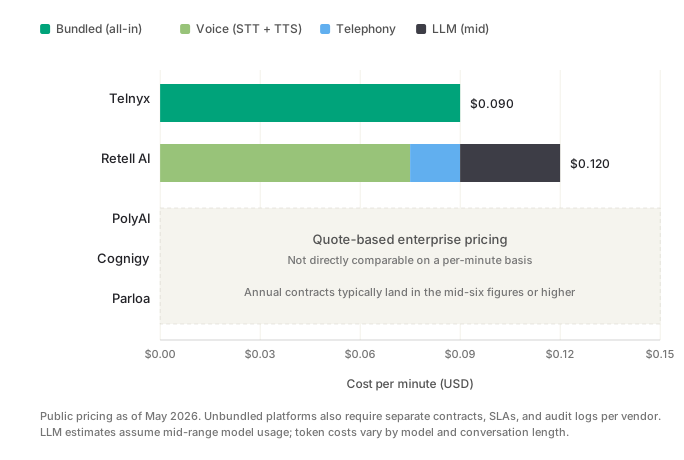
Bundled stacks combine STT, LLM inference, TTS, and telephony in one per-minute rate. Unbundled stacks charge separately for orchestration, telephony, model usage, and speech services. Enterprise CX platforms are usually quote-only.
As of May 2026, Telnyx conversational AI pricing starts at $0.05 per minute for orchestration, with STT and Telnyx-native TTS included. Multi-vendor orchestration stacks are often materially more expensive at production scale because costs compound across STT, TTS, LLM tokens, and telephony minutes.
Perceived latency
Banking call experiences degrade as response latency rises. Abandonment and escalations increase noticeably once delays move beyond natural conversational timing. Human turn-taking averages around 200 ms, with typical gaps under 300 ms (PNAS; Journal of Cognition).
For production banking flows, a sub-500 ms end-to-end benchmark is a meaningful target. That usually requires colocated inference, streaming ASR, and streaming TTS. Multi-hop stacks can add meaningful delay at each network boundary, making natural turn-taking harder to sustain.
Vendor consolidation
When fraud-alert or KYC calls fail, split accountability across multiple vendors slows incident response and complicates audits. Single-vendor stacks unify SLAs, logs, and records for regulator review. The FFIEC BSA/AML Examination Manual underscores the importance of comprehensive audit trails, which is often easier to satisfy with one system of record.
Compliance posture
Banking voice AI routinely touches:
- SOC 2 for baseline control expectations
- PCI-DSS for payment-card data handling, including DTMF masking and pause/resume
- GDPR for EU data rights and residency needs
- HIPAA when insurance, benefits, or health-adjacent workflows are involved
Many vendors cover SOC 2 directly and rely on sub-vendors for the rest. Telnyx provides controls aligned to all four areas on one platform, though banks should still validate attestations, BAAs, and scope directly with each vendor before production. See PCI SSC guidance for telephone-based payments.
Banking workflow coverage
High-volume journeys drive ROI: balance inquiries, transaction history, KYC re-verification, fraud alerts, collections, payments, loan servicing, and authentication. Vendors with pre-built flows can shorten time to value but often cost more per call. Infrastructure vendors provide the foundation for custom flows at lower per-call cost.
KYC and AML workflows can compound value quickly. McKinsey notes that analytical AI reduces false positives across transaction monitoring, sanctions detection, name screening, and fraud detection. Voice agents that capture verification signals cleanly can strengthen those downstream systems.
Ready to deploy voice AI for banking?
A sub-500 ms end-to-end latency benchmark, unified compliance controls, and a single-vendor stack spanning STT, LLM inference, TTS, and telephony are structural advantages for production banking voice AI.
The Telnyx Voice AI Agents platform brings these together on the Telnyx Voice API and finance solutions infrastructure already used for regulated voice traffic.
Frequently asked questions about voice AI for banking
Are AI voice agents secure enough for banking customer authentication? Yes, when deployed on a platform with the right controls and paired with layered authentication. Platforms with SOC 2 Type II attestation, PCI-DSS-aligned payment capture, and GDPR-aligned handling can support knowledge-based checks, optional voice biometrics, and step-up challenges. STIR/SHAKEN can strengthen caller identity verification on the network side, but it is not a substitute for customer authentication controls.
How much do AI voice agents for banking cost per minute? Telnyx conversational AI pricing starts at $0.05 per minute for orchestration, with STT and Telnyx-native TTS included; LLM billed separately, as of May 2026. Unbundled orchestration platforms often add telephony and token-based model usage separately, which can raise total costs at production scale. Enterprise CX vendors are generally quote-only.
Which AI voice agents cover SOC 2, HIPAA, GDPR, and PCI for banking? Telnyx provides SOC 2 Type II attestation, HIPAA-aligned controls with BAAs available, GDPR-aligned controls, and PCI-DSS-aligned payment capture on one platform. PolyAI and Cognigy publicly reference SOC 2 and ISO 27001. Parloa emphasizes GDPR-native architecture and ISO 27001. Retell AI often depends more heavily on sub-vendor posture for HIPAA, PCI, and GDPR coverage. Banks should validate attestations and scope directly.
What latency should I expect on banking calls? A sub-500 ms end-to-end benchmark is a reasonable target for natural turn-taking. Multi-hop stacks often introduce enough delay to push beyond that range. Once latency moves above about one second, callers may start to feel lag; above two seconds, the experience often stops feeling conversational.
Can AI voice agents handle KYC verification and fraud detection in production? Yes, for the right tasks. Voice agents already handle KYC re-verification, document-confirmation prompts, fraud-alert callbacks, transaction confirmations, and step-up challenges. Initial KYC for higher-risk segments still often routes to human review. The best results usually come when call control, AI inference, and audit logging live on the same platform.
How do AI voice agents integrate with core systems and CRMs? Most vendors integrate through APIs and webhooks, with connectors for platforms such as Salesforce, HubSpot, Zendesk, and ServiceNow. Core banking systems such as FIS, Fiserv, Jack Henry, and Temenos usually require custom integration work. Scope and timeline expand with the number and depth of upstream systems involved.
Which platforms work best for collections and payment workflows? Platforms with PCI-DSS-aligned payment capture controls, including DTMF masking and pause/resume, are structurally better suited to payment workflows. Voice-first enterprise platforms and omnichannel CCaaS replacements can support outbound collections at scale, while infrastructure bundles often win on per-call economics. Outbound use cases still require TCPA-compliant consent management and DNC integration regardless of platform.
Share on Social


