
Insights and Resources
Best enterprise voice AI platforms in 2026
A technical comparison of top enterprise voice AI platforms, evaluated on latency, pricing, compliance, and infrastructure.

By Eli Mogul
The short version
Enterprise voice AI platforms split into three categories: TTS-only speech models (ElevenLabs), AI agent orchestration platforms (Vapi), and full-stack carrier infrastructure (Telnyx). Telnyx's end-to-end voice AI stack runs ASR, LLM inference, TTS, and telephony on a carrier-owned network across 40+ countries , the only provider in this list that handles all four under one BAA. Below: how the leading platforms compare on call management, pricing, hosting, and compliance. For the broader voice AI comparison (beyond enterprise), see our separate guide.
A technical comparison of top enterprise voice AI platforms, evaluated on latency, pricing, compliance, and infrastructure.
Pressure on enterprise leaders to deploy voice AI has built quickly. KPMG's Q4 2024 Pulse Survey found that 88% of organizations are either exploring or piloting AI agents . Gartner predicts that 40% of enterprise applications will integrate task-specific AI agents by the end of 2026, up from less than 5% in 2025. And Accenture estimates voice AI can reduce contact center inquiries by up to 20%, saving enterprises millions annually.
For CIOs, VPs of CX, and contact center leaders, choosing the right platform is no longer a theoretical exercise. It's a decision that directly impacts latency, cost per minute, compliance readiness, and long-term scalability.
One shift worth noting before the comparison: increasingly, the procurement evaluator isn't only the CIO. It's the AI agents you're building. Agents evaluate infrastructure in milliseconds (first call latency, SDK quality, API reliability) and route to the next provider when something doesn't work. The buyer is changing even when the title on the contract isn't.
Here's how the leading platforms compare across the criteria that matter most at the enterprise level.
What to evaluate in an enterprise voice AI platform
Not all voice AI platforms are built the same way. Some operate as application-layer services that sit on top of third-party infrastructure. Others own the full stack, from telephony to inference. That architectural difference shapes everything from latency to pricing to data residency. When evaluating an enterprise voice AI platform, buyers should prioritize five areas:
- Infrastructure ownership. Does the provider control its own network and compute, or does it depend on third parties? This determines whether your contract has one BAA or three.
- Latency p99. How close are GPUs to telephony points of presence (PoPs)? Real-time conversation falls apart past 800ms. Peer-reviewed research on turn-taking in human conversation puts the natural response gap between speakers at roughly 200 milliseconds, which sets the bar for what feels human.
- Compliance posture. Does it meet SOC 2 Type II, HIPAA, PCI DSS, ISO 27001, and GDPR requirements? Does it offer regional data residency? Does the carrier deliver A-level STIR/SHAKEN attestation? The NIST AI Risk Management Framework is becoming a baseline reference for enterprise procurement.
- Pricing model. Is pricing predictable and all-inclusive, or do charges for STT, TTS, LLM, and telephony stack separately? Hidden vendor sprawl distorts TCO.
- Integration depth. Named EHR, CRM, and contact center integrations matter more than feature lists when procurement is signing the contract.
These criteria separate platforms built for production workloads from those better suited to prototyping.
How the leading platforms compare
Three providers frequently appear in enterprise evaluations: Telnyx, ElevenLabs, and Vapi. Each takes a fundamentally different approach to voice AI, and those differences become pronounced at scale. The next three sections break down each platform on architecture, pricing, and enterprise fit.
Capability comparison as published by each vendor as of May, 2026.
| Capability | Telnyx | ElevenLabs / Vapi |
|---|---|---|
| Owns PSTN telephony | Yes, 40+ countries | No (third-party carriers) |
| Colocated GPUs at PoPs | Yes | No |
| Single BAA covers full stack | Yes | No (multi-vendor chain) |
| A-level STIR/SHAKEN on eligible US traffic | Yes (as originating carrier) | Dependent on third-party carrier |
Compliance posture as published by each vendor as of May, 2026.
| Compliance | Telnyx | ElevenLabs | Vapi |
|---|---|---|---|
| SOC 2 Type II | Yes | Yes | Yes |
| HIPAA + BAA | Yes | Not publicly documented | Yes (add-on) |
| ISO 27001 | Yes | Not publicly documented | Not publicly documented |
1. Telnyx
Telnyx is full-stack enterprise voice AI on a carrier network. It is the only voice AI provider in this comparison that runs telephony, GPU compute, and model inference on infrastructure it owns and controls, on a single private IP backbone. Telnyx's voice AI platform runs ASR, LLM inference, and TTS on a carrier-owned network across 40+ countries , eliminating the multi-vendor BAA surface area enterprise compliance teams negotiate with stitched stacks. The colocation of dedicated GPUs adjacent to global Points of Presence keeps round-trip time low for real-time voice interactions.
Best for: Enterprises that need a single vendor across telephony, inference, and compliance.
Strengths:
- Telnyx is a licensed telecom provider in 40+ countries with PSTN calling in 100+ countries , so AI-powered calls connect to the telephone network natively, with no third-party telephony provider in the call path.
- Signs eligible traffic at A-level STIR/SHAKEN attestation as the originating carrier on US calls, where Telnyx has verified the caller and the caller's right to use the number. A-attestation lifts pickup rates on outbound enterprise calls relative to B or unsigned traffic.
- Telnyx's voice AI agents start at $0.05 per minute for orchestration, with STT and Telnyx-native TTS included. LLM runs on owned infrastructure and is billed separately as a transparent line item.
- Telnyx's end-to-end voice AI stack handles all four layers (speech, model, telephony, inference) under one BAA, with SOC 2 Type II, HIPAA, PCI DSS, ISO 27001 , and GDPR coverage. EU-deployed infrastructure is available for data residency .
Weaknesses and what's missing:
- Buyers who only need a TTS voice library will find Telnyx broader than necessary.
- Self-service onboarding favors developers. Enterprises that want a managed-service model will need to engage the sales team.
Pricing posture: Usage-based, itemized. Voice AI orchestration at $0.05/min, with STT and Telnyx-native TTS included; LLM and inference billed separately. Telnyx's Voice API supports SIP trunking at $0.005/min , roughly 2x cheaper than the typical CPaaS reseller rate because Telnyx originates calls on its own network rather than buying minutes from a tier-1 carrier and reselling them.
Enterprise fit: Single BAA covers the full call path. Named integrations across CRM and contact center systems. Production deployments across healthcare, financial services, and enterprise CX.
Verdict: The right pick for any enterprise where compliance scope, latency, and predictable TCO matter more than feature gimmicks. Not the right pick for teams that only need a voice library and have no telephony or compliance requirements.
2. ElevenLabs
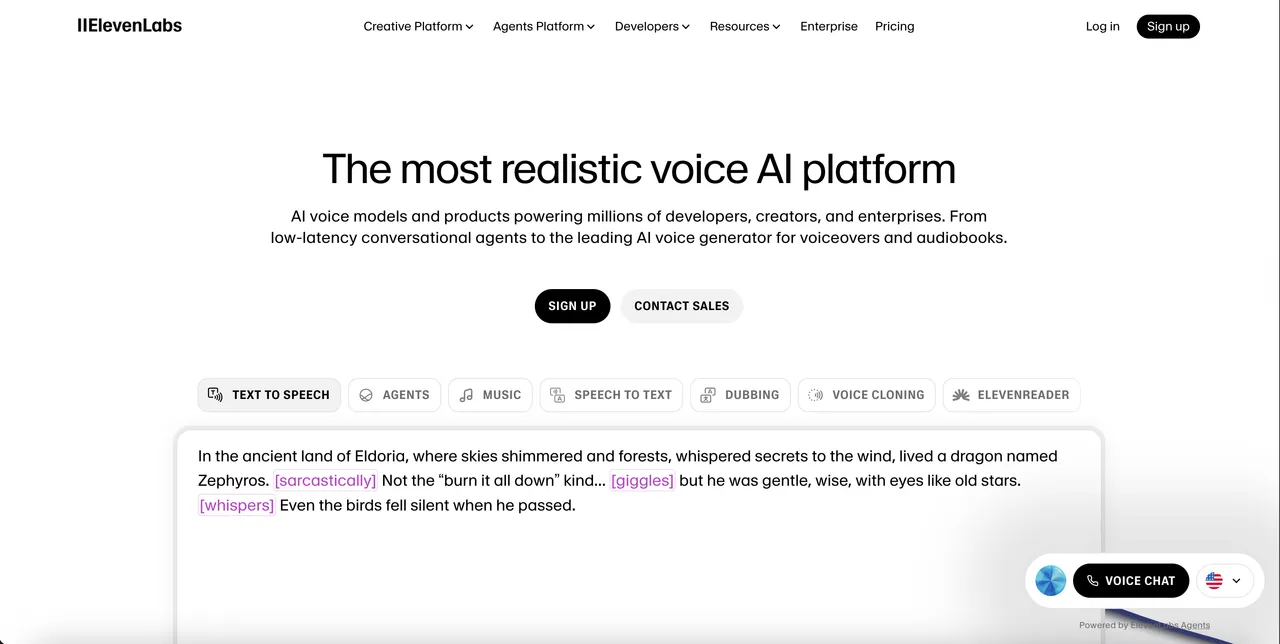
ElevenLabs is a vertically integrated speech-model vendor focused on text-to-speech and speech-to-speech models. The product is widely respected for voice quality, multilingual coverage, and emotional range. It is not a full voice agent platform. Call recording, telephony, and call-path compliance sit outside its scope.
Best for: Teams that need premium voice synthesis as a component inside a larger stack.
Strengths:
- High-fidelity TTS with broad voice library and multilingual coverage.
- Strong developer experience for embedding voices into applications.
- SOC 2 Type II and GDPR coverage.
Weaknesses and what's missing:
- HIPAA, BAA, and PCI DSS status not publicly documented . Healthcare and payment workflows require a separate vendor stack to wrap around ElevenLabs.
- No PSTN telephony. Calls require a third-party carrier, which adds latency and another vendor relationship.
- Per-character TTS pricing runs roughly 10x the rate of carrier-owned TTS . Telnyx synthesizes speech on owned compute rather than reselling GPU access with margin, which is the structural reason for the gap.
Pricing posture: Usage-based per character of generated speech, with subscription tiers. Enterprise contracts available on request.
Enterprise fit: Suitable as a speech-model layer inside a larger stack. Not suitable as a standalone enterprise voice AI platform where call-path and compliance scope matter.
Verdict: The right pick when voice quality is the primary requirement and the surrounding stack (telephony, BAA, recording) is already solved. The wrong pick for buyers who want a single contract that covers the whole call.
3. Vapi
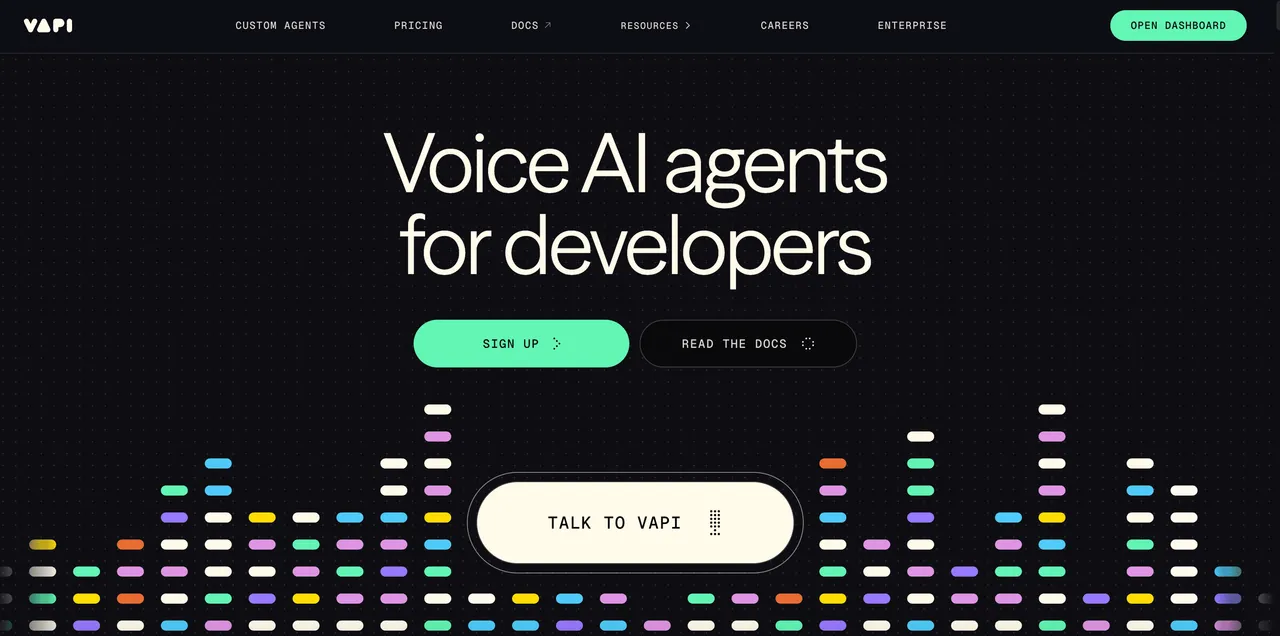
Vapi is an AI agent orchestration layer over third-party infrastructure. It connects external speech models, LLMs, and telephony providers into a voice agent workflow. The platform abstracts the integration work, which speeds up prototyping. The tradeoff is that Vapi does not own the underlying call path. Buyers chain Vapi's compliance posture to the carrier's compliance posture to get full call-path coverage.
Best for: Developers building voice agents quickly on top of existing model and carrier providers.
Strengths:
- Quick time-to-prototype for developers building voice agents.
- Flexible model and vendor selection through the orchestration layer.
- SOC 2 Type II and GDPR coverage. HIPAA available as an add-on.
Weaknesses and what's missing:
- HIPAA is a paid add-on, which raises the effective cost for healthcare workloads.
- PCI and ISO 27001 coverage depend on which sub-vendor handles telephony and storage, so the BAA chain extends across multiple providers.
- A production Vapi stack typically composes Twilio plus Deepgram plus OpenAI plus ElevenLabs plus Vapi orchestration. That's five vendor boundaries and four margin layers on every call.
Pricing posture: Usage-based per minute. Healthcare workloads carry a HIPAA add-on that meaningfully raises the per-minute cost.
Enterprise fit: Workable for non-regulated workloads where speed of build matters more than compliance scope. Less workable for healthcare, financial services, or any vertical where procurement requires the carrier in scope.
Verdict: The right pick for teams that want to ship a voice agent quickly on a non-regulated use case. The wrong pick for enterprise procurement that requires a single vendor across the full call path.
Why infrastructure ownership matters at scale
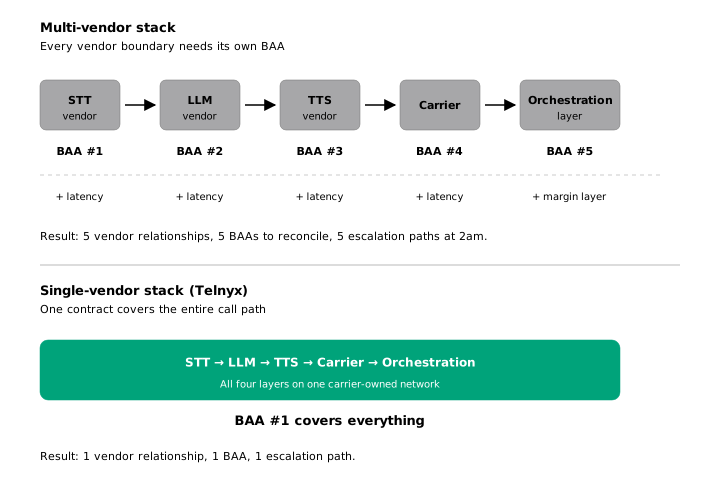
Most voice AI vendors do not own telephony, the LLM, or the GPU compute. They rent. That means every conversation passes through three or four providers, each adding cost, latency, and a separate contract. The result is a multi-vendor stack where you negotiate a BAA with the STT vendor, another with the LLM provider, another with the carrier, and another with the orchestration layer. Every additional vendor in the chain is another point of failure in a regulated workflow.
This is the Frankenstack: STT vendor, LLM vendor, TTS vendor, carrier, and orchestration layer, each one a vendor boundary, a margin layer, and a separate dashboard to debug. It works in demos. It fails in production audits, and it fails in production calls.
Cloudflare's Workers AI runs open-source inference at edge cities and is positioning itself as agent infrastructure. For enterprise voice AI, the question to ask is whether the agent can actually make a phone call from that infrastructure. Workers AI sits next to compute, not next to a carrier network. For enterprise compliance, that gap is structural.
Telnyx took the opposite path. Telnyx's voice AI platform colocates GPUs with its global PoPs and runs inference adjacent to the call. The data does not leave the network for ASR, model inference, or TTS . The architectural difference shows up in three places.
Latency. Voice quality fundamentally depends on physical distance. Peer-reviewed research from the Max Planck Institute for Psycholinguistics shows that natural turn-taking gaps in human conversation are around 200ms, with cultural variation that is quantitative only. AI agents that exceed that window stop feeling like a conversation. The closer the GPU sits to the call path, the more achievable that timing becomes. A voice AI agent platform with telephony built into the same network has less ground to make up.
Cost. Renting infrastructure from four vendors stacks four margins on top of each other. Telnyx's $0.05 per minute orchestration base for voice AI agents is structural, not promotional. It is what happens when one company owns the network and the compute instead of buying both from somebody else. The same structural advantage shows up across the rest of the stack: TTS at roughly 10x lower than ElevenLabs , SIP at roughly 2x lower than Twilio .
Compliance. A single BAA covers the entire data path. Compare that with a stack where the STT vendor, LLM vendor, and carrier each hold separate BAAs that have to be reconciled with one another. The Office for Civil Rights collected over $9.9 million in HIPAA settlements across 22 enforcement actions in 2024, with BAA deficiencies cited as a contributing factor in numerous cases.
These three failure modes map to the three layers any real-time AI system needs: edge compute (where physics decides latency), the agent platform (where orchestration cost compounds or disappears), and global communications (where carrier identity and compliance are enforced). Telnyx owns all three. Every Frankenstack rents at least two.
What to look for in voice AI for enterprise call management
When selecting voice AI for enterprise call management, three capabilities separate production-ready platforms from prototype tools.
Carrier-grade call quality. Enterprise call management depends on jitter, packet loss, and dropped-call rates that meet telecom standards, not best-effort internet routing. A voice AI agent platform with telephony built into the same network does not have to compensate for a third-party carrier's quality variability. It is also the only way to get sub-second latency consistently across regions.
Programmable call control. Enterprise workflows include warm transfers to human agents, IVR fallbacks, call recording with consent prompts, and integration with CRM and contact center systems. The platform has to expose programmatic control over each of these, not just AI agent prompts.
Compliance built into the call path. Recording retention, PHI handling, PCI DSS scope for payment data, and TCPA-compliant outbound dialing all happen at the call layer, not the AI layer. A platform that owns both can enforce policy at the network edge instead of relying on application-level controls.
Voice AI vendors with enterprise telephony support
Voice AI vendors with enterprise telephony support fall into two groups. The first owns the carrier infrastructure directly. Telnyx is the example here, with PSTN calling in 100+ countries and licensed telecom status in 40+ countries . The second chains orchestration platforms to third-party carriers. Vapi, Retell AI, and similar platforms operate in this model. Both can ship a voice agent. Only the first puts the carrier in scope for procurement.
For enterprise buyers, the distinction matters at contract review. If the carrier is out of scope, your compliance team is negotiating with two vendors instead of one, and your incident response runs through two on-call rotations instead of one.
How to compare TCO across enterprise voice AI providers
Enterprise voice AI pricing is rarely as simple as a per-minute rate. The headline number is the entry point. The total cost of ownership accumulates from minimum commitments, separate billing for STT and TTS, telephony add-ons, compliance surcharges, and integration work.
Three pricing-model patterns dominate the market:
- Base rate plus models (Telnyx). A $0.05/min orchestration base, with STT and Telnyx-native TTS included; LLM and telephony billed as separate transparent line items. Compliance is included in the base contract. TCO is predictable from minute one.
- Component pricing (most TTS-only or LLM-only vendors). Separate line items for each layer. The advertised rate excludes telephony, which is contracted with a separate carrier. Compliance is a separate negotiation per vendor.
- Orchestration plus passthrough (Vapi-style). A platform fee plus passthrough costs for each sub-vendor. Healthcare workloads add a HIPAA surcharge. Total per-minute cost is often 2-3x the headline rate once the full stack is priced.
The hidden costs sit in the contracts buyers do not see at evaluation. Multi-vendor BAA negotiation alone consumes weeks of compliance and legal time. Research from McKinsey on the state of AI shows that 39% of enterprises report measurable EBIT impact from AI , and the gap between pilot and scaled value is most often a procurement and infrastructure problem, not a model problem.
There is a useful three-question test for evaluating any voice AI pricing proposal. First, does the headline per-minute rate include TTS, STT, inference, and telephony, or are those billed separately? Second, what is the all-in monthly cost at production volume, including any minimum commitments and compliance add-ons? Third, how many vendors does the contract actually touch, and how many BAAs does that translate into for procurement?
The honest comparison for TCO is per-minute cost multiplied by realistic concurrent call volume, plus the cost of every BAA in scope, plus integration work to make the orchestration layer talk to the carrier. When buyers run that math, the itemized single-vendor model usually wins at production volume even when the headline rate looks higher. Telnyx's pricing is published and predictable, which makes the math straightforward.
Data residency and compliance for enterprise voice AI hosting
For regulated industries, enterprise-grade voice AI hosting is a hard requirement, not a preference. SOC 2 Type II, HIPAA, PCI DSS, ISO 27001, and GDPR are the baseline. Many enterprises also need dedicated infrastructure or regional deployments in specific jurisdictions, particularly under GDPR data residency requirements in the EU and equivalent rules in APAC.
The architecture question is who actually controls the data path. A vendor with a clean SOC 2 Type II report still has a compliance gap if PHI passes through a sub-processor without a BAA. Under 45 CFR 164.504(e), every business associate downstream of a primary BAA must also be bound by HIPAA-equivalent terms, which means BAA coverage has to extend to every link in the chain, not just the primary vendor. That is the practical breakdown of multi-vendor stacks: the buyer signs one BAA, but the actual call path touches three or four vendors, and each downstream relationship has to be papered separately.
Telnyx's compliance posture covers SOC 2 Type II, HIPAA, PCI DSS, ISO 27001 , and GDPR, with EU-deployed infrastructure for regional data residency . The full stack falls under one vendor relationship. That is the structural advantage. The buyer signs one BAA that covers the carrier, the model layer, and the recording layer in a single document, because there is no sub-vendor chain to extend coverage to.
Most platforms get worse as you expand globally. More hops, more jurisdictions, more compliance permutations. Telnyx gets better. Each new region adds capability rather than complexity because the network, the compute, and the compliance posture extend together.
For buyers planning multi-region deployments, the NIST AI Risk Management Framework provides a useful reference for evaluating governance, data handling, and lifecycle controls in voice AI procurement.
Why platform selection matters now
Voice AI is in the window between pilot and production at most enterprises. Deloitte's 2026 State of Generative AI in the Enterprise report shows that 42% of enterprises now believe their strategy is highly prepared for AI adoption , but a similar share report feeling less prepared on infrastructure, data, risk, and talent. The gap between those two numbers is exactly where platform choice determines outcomes.
Three forward-looking drivers shape the urgency.
Compliance enforcement is rising. OCR enforcement actions on BAA gaps are increasing. Carriers and AI vendors that cannot produce a unified compliance story will get filtered out of enterprise procurement before the technical evaluation begins.
Per-call economics are decompressing. Per-call costs for human agents continue to climb. AI voice agents resolve eligible calls for a fraction of that, and the gap widens every quarter. McKinsey research on the contact center shows that AI-enabled self-service can cut incidents by 40 to 50% with cost-to-serve reductions of more than 20% . The buyers who lock in production-grade infrastructure now are the buyers who capture that margin first. Running the AI workload on dedicated inference compute, rather than borrowed cloud GPUs, is what makes those economics hold at production volume.
Contract cycles are long. Enterprise voice contracts run three to five years. A platform decision made in 2026 sets the architecture through 2030. Reversing it costs migration time, retraining, and re-negotiation across every downstream system.
There's one question that exposes the architecture before any of the others matter: when something breaks at 2am on a regulated call path, who actually fixes it? In a multi-vendor stack, the STT vendor blames the LLM, the LLM blames the TTS, the carrier blames orchestration, and the compliance team becomes the incident commander. With Telnyx, one team owns the entire path. One escalation. One root-cause analysis. One audit trail.
The case for picking the right platform now is not theoretical. It is a procurement deadline most enterprises are already inside.
FAQ
Who has the best enterprise voice AI? The best enterprise voice AI depends on the use case. For full-stack deployments where compliance, latency, and TCO all matter, Telnyx is the only provider in this comparison that runs telephony, GPU compute, and model inference on infrastructure it owns and controls. For TTS-only needs inside an existing stack, ElevenLabs is widely used. For quick orchestration prototypes on non-regulated workloads, Vapi is common.
What are the most reliable voice AI APIs for enterprise in 2025 and 2026? Reliability at enterprise scale comes down to the carrier network, GPU availability, and SLA structure. A voice AI API built on a private, owned IP backbone with colocated GPUs has fewer failure modes than one that chains a third-party carrier to a third-party model provider. Look for documented p99 latency, transparent uptime history, and a single point of escalation rather than a vendor chain.
What are the best secure voice AI APIs for enterprise in 2025 and 2026? Secure voice AI APIs share three traits: SOC 2 Type II with confidentiality and privacy in scope, a signed BAA covering the entire data path, and explicit contractual exclusion of customer audio from model training data. A vendor that cannot commit to all three in writing is not enterprise-ready.
What enterprise voice AI solutions work for support teams? Support teams need voice AI that handles warm transfers to human agents, full CRM integration, call recording with consent prompts, and TCPA-compliant outbound dialing. The platform should expose programmable call control alongside AI agent prompts so the workflow logic and the AI logic live in the same system.
What are the best cloud voice AI providers for enterprise in 2025 and 2026? The cloud voice AI providers best suited to enterprise are the ones that go beyond cloud hosting and include the carrier. A platform that owns telephony, GPU compute, and the AI models on a single network removes the seams that show up at scale. Cloud-only providers without a carrier leg add latency, vendor count, and BAA scope.
How much does enterprise voice AI cost in production? Production cost varies by traffic volume and use case. Orchestration rates as low as $0.05/min are available when one vendor owns the full stack, with STT and Telnyx-native TTS included and LLM/telephony billed separately. Multi-vendor stacks typically run 2-3x higher once telephony, compliance add-ons, and integration overhead are priced in.
Stop signing three BAAs. Pick the only carrier-owned voice AI stack.
Conversational-speed turn-taking on a SOC 2 Type II, HIPAA, PCI DSS, ISO 27001, and GDPR-compliant carrier network across 40+ countries , under one BAA. Telnyx's voice AI platform is the only enterprise voice AI stack where ASR, LLM inference, TTS, and PSTN telephony run on the same network, eliminating the multi-vendor BAA surface area that slows enterprise procurement.
Voice is the wedge, not the ceiling. The same infrastructure handles SMS, email, and async agent workflows as your stack grows. Most platforms get worse as you expand globally. Telnyx gets better.
Share on Social