
Voice
How to Call Vietnam
This guide provides helpful tips for calling Vietnam from the U.S. Learn how to make calls to Vietnam with confidence.

The Vietnam country code is +84. Use +84 as the international dialing prefix for calls to Vietnam from any country, then dial the vietnamese area code without the leading 0 and the local number. The ISO codes are VN and VNM.
VIETNAM COUNTRY CODE
+84
Dial before any vietnamese number from outside Vietnam
What is the country code for Vietnam?
| Quick reference | Detail | When to use |
|---|---|---|
| Country Code | +84 | Dial before a vietnamese number |
| ISO Code | VN / VNM | Country identifiers |
| International Prefix | +84 | Use for calls into Vietnam |
| Trunk Prefix | 0 | Use only for domestic dialing |
| Number Length | 8-9 digits after +84 | Area or mobile code plus subscriber number |
| Emergency | 115 | Police, fire, and ambulance |
Good to know: Vietnam uses 2-digit area codes. Mobile numbers start with 3, 5, 7, 8, or 9.
For vietnamese numbers, the 0 at the start of a domestic area code is the trunk prefix. Keep it for calls inside Vietnam. Remove it when calling from another country.
How to call Vietnam
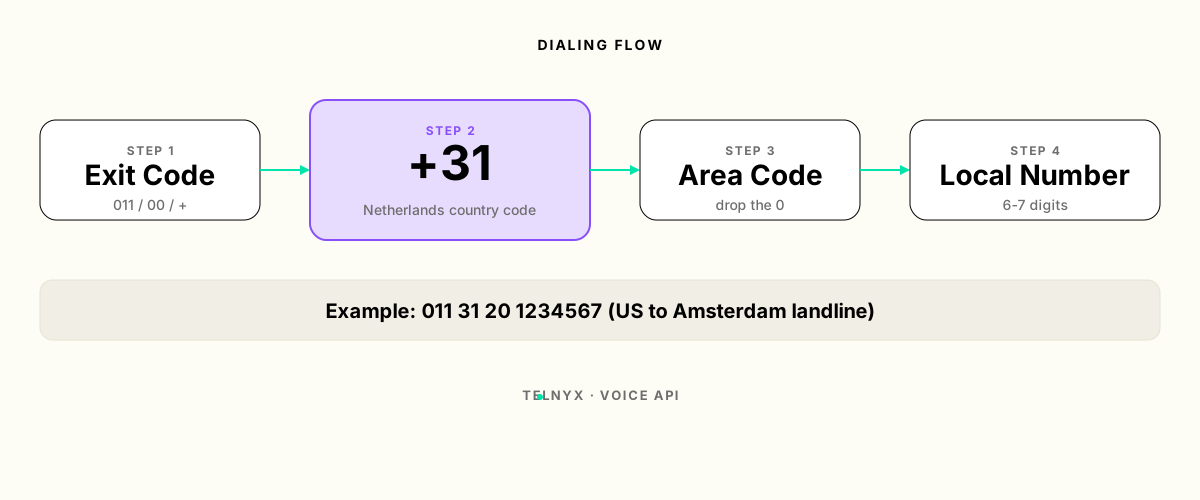
Use this universal format: exit code, then +84, then area code with the trunk 0 removed, then local number.
- Dial your exit code, or press + on a mobile phone.
- Dial 84 for Vietnam.
- Dial the area code without the leading 0.
- Dial the local subscriber number.
International call flow:
1. Exit code
→
2. +84
→
3. Area code without 0
→
4. Local number
Exit code by country
US and Canada
011
UK and most of Europe
00
Australia
0011
Mobile, any country
+
Vietnamese numbers use a 0 trunk prefix for domestic calls. Remove it when calling from abroad.
Dialing format and examples
The +CC format works on any mobile phone. Use +84 24 1234 5678 for a Hanoi landline and +84 91 234 5678 for a mobile number.
| Origin | Format | Example |
|---|---|---|
| US/Canada | 011 84 area code local number | 011 84 24 1234 5678 |
| UK | 00 84 area code local number | 00 84 24 1234 5678 |
| Australia | 0011 84 area code local number | 0011 84 24 1234 5678 |
| Mobile, any country | +84 area code local number | +84 24 1234 5678 |
For other dialing guides, see How to call the Netherlands or How to call Germany.
What a Vietnam number looks like
A vietnamese phone number in international format has two parts. The country code +84 and the national number.
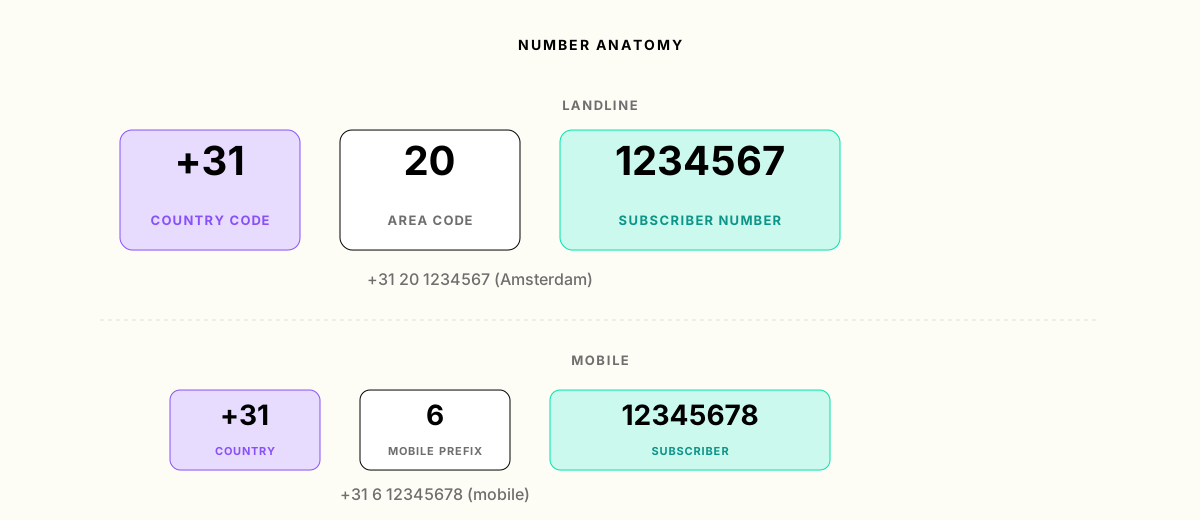
Landline
+84 | 24 | 12345678
Mobile
+84 | 91 | 2345678
Number format and length
After +84, vietnamese numbers contain 8-9 digits after +84. Landlines and mobile numbers follow the national format.
| Number type | Pattern | Example |
|---|---|---|
| Hanoi landline | +84 24 XXXX XXXX | +84 24 1234 5678 |
| Ho Chi Minh City landline | +84 24 XXXX XXXX | +84 24 1234 5678 |
| Vietnamese mobile | +84 9X XXX XXXX | +84 91 234 5678 |
Format a Vietnam number for WhatsApp
For WhatsApp, save the Vietnamese number in international format with +84 and no trunk 0. A Vietnamese mobile written as 091 234 5678 becomes +84 91 234 5678. You can also save it without spaces as +84912345678.
If your team needs a vietnamese number for customer calls or local presence, see Telnyx Phone Numbers for numbers in 140+ countries with instant activation.
Good to know: WhatsApp needs the full international format. Drop the leading 0 before you add +84.
Vietnam number formats and emergency numbers
Vietnamese numbers follow the national format. From another country, place +84 before the national number.
| City or region | Domestic code | International code |
|---|---|---|
| Hanoi | 024 | +84 24 |
| Ho Chi Minh City | 028 | +84 28 |
| Da Nang | 0236 | +84 236 |
| Hai Phong | 0225 | +84 225 |
| Can Tho | 0292 | +84 292 |
| Nha Trang | 0258 | +84 258 |
| Number type | Dialed in NL | Notes |
|---|---|---|
| Emergency | 115 | Police, fire, ambulance |
| Toll-free | 0800 | Free from vietnamese lines, not always reachable from abroad |
| Premium rate | 0900 | Can cost more than standard calls |
| Business numbers | 085 | Non-geographic business lines |
Keep in mind: 115 works inside Vietnam only. If you are outside Vietnam, call the emergency number for your current location. Some service numbers may not accept calls from outside Vietnam.
Cost and best time to call Vietnam
Call cost and timing depend on your carrier, your country, and whether you call a landline, mobile, toll-free, or premium-rate number.
How much does it cost to call Vietnam
For business calling, Telnyx SIP Trunking gives per-minute pricing for calls to vietnamese landline and mobile destinations with usage-based pricing and no monthly minimums. Your total cost can change based on call volume, destination type, and fees from your current provider.
| Calling method | Cost pattern | Best for |
|---|---|---|
| Mobile carrier | Plan rate or international fee | Personal calls |
| International add-on | Recurring fee plus lower per-minute rates | Repeat callers |
| VoIP or SIP | Per-minute pricing by destination type | Teams and high-volume calling |
Good to know: Ask your provider whether vietnamese mobile calls are priced differently from landline calls. They often are.
Time zones and best time to call
Vietnam follows Indochina Time, UTC+7, year-round with no daylight saving. For business calls, aim for 9:00 a.m. to 5:00 p.m. Vietnamese time.
| Calling from | Offset from NL | Best call window |
|---|---|---|
| United Kingdom | VN offset varies | 8:00 a.m. to 4:00 p.m. UK time |
| US Eastern | VN offset varies | 9:00 a.m. to 11:00 a.m. ET |
| US Pacific | VN offset varies | 6:00 a.m. to 8:00 a.m. PT |
Good to know: Time differences can shift for short periods because daylight saving dates do not match in every country.
Is calling Vietnam free
Calling Vietnam is not automatically free. It may be free if your mobile or landline plan includes Vietnam calling, if both parties use an app over data, or if a company gives you a reachable local number.
WhatsApp and similar apps do not charge per minute for app-to-app calls, but your internet or roaming plan may charge for data. Business callers can use SIP Trunking with usage-based pricing for the lowest per-minute rates.
FAQ
Global numbers, voice, and messaging from one network.No reseller markup. No finger-pointing. One provider for the full stack.
Explore Global CommunicationsShare on Social

Serhii Omelchenko
Global AEO/SEO Manager
Serhii is Global AEO/SEO Manager at Telnyx, based in Amsterdam, he is focused on making communications infrastructure findable and credible across both traditional search and AI-driven discovery. He previously led SEO and GEO strategy for some of the world’s most recognized consu


