
Conversational AI
Voice AI in Logistics: Consumer Adoption Study April 2026
New U.S. consumer data finds over 70% of shoppers would use Voice AI for logistics tasks, from live shipping updates to rescheduling deliveries by voice instead of navigating phone menus.
By Telnyx Team
New U.S. consumer data finds shoppers would rather talk to an AI than wait on hold for logistics updates. Across five questions covering delivery tracking, address changes, rescheduling, identity verification, and phone menus, over 70% of respondents expressed preference for Voice AI alternatives. The strongest signal: 76% would rather say "track my package" than navigate a "press 1" phone tree.
- 76% want to replace phone menus with voice commands for tracking and logistics inquiries
- 73% say a courier with voice rescheduling would stand out from competitors
- 70%+ prefer Voice AI across every logistics task tested, from address updates to live status calls
The IVR Replacement: Where Demand Is Strongest
76% of respondents agree they would rather say "track my package" than hear "press 1 for tracking." 46% strongly agree, the highest Strongly Agree rate of any question in the survey. Just 11% disagree.
The question tapped into a specific frustration: the legacy IVR experience. For anyone who has navigated a five-deep phone menu to reach a shipping update, the appeal of a single natural-language command is immediate. The strength of the response suggests the gap between what callers expect and what logistics phone systems currently deliver is widest here.
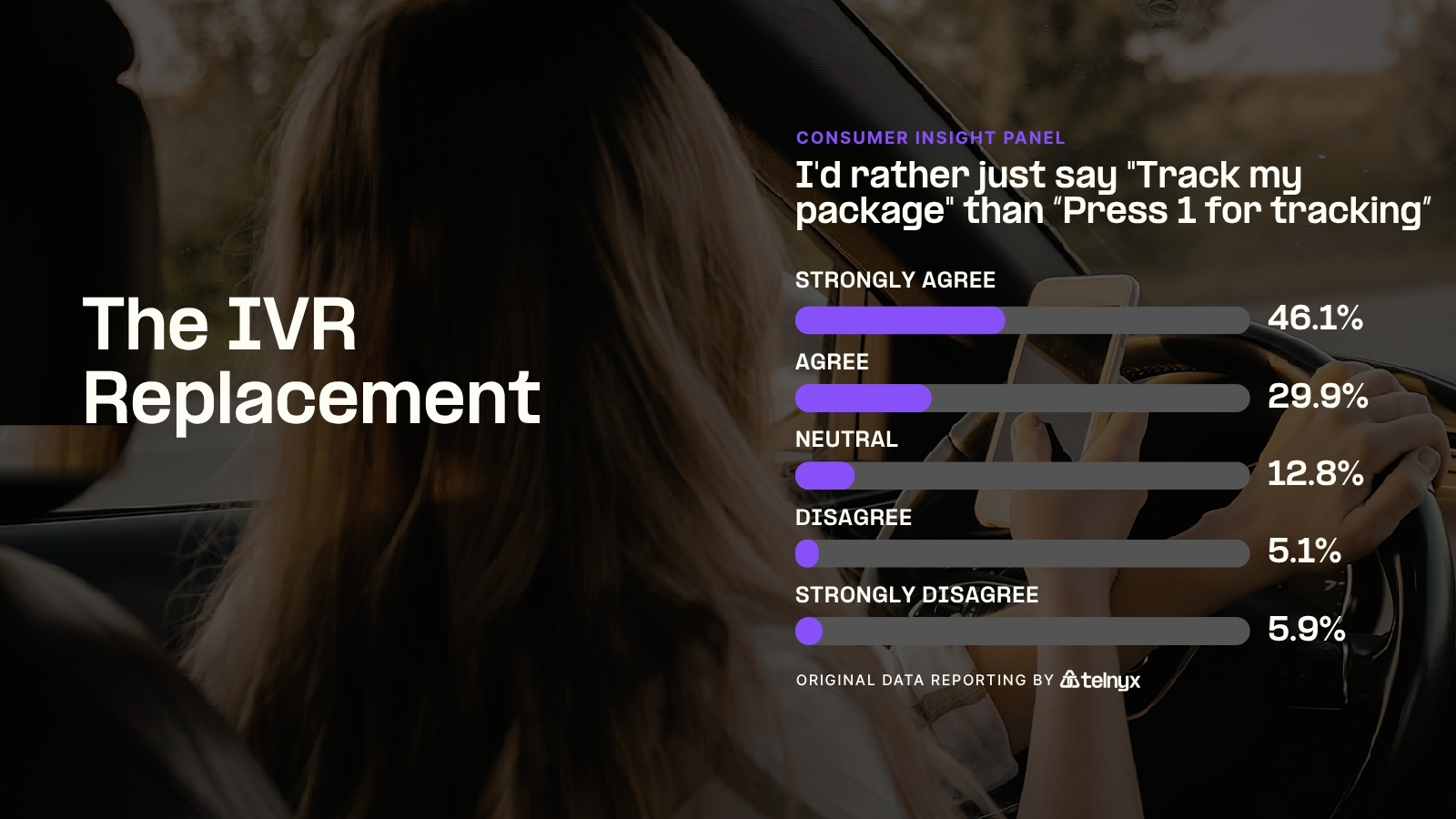
The 30% who agreed (but not strongly) represent the group most likely to adopt once the experience proves reliable. They are not opposed; they need to see it work.
The Reschedule Advantage: A Brand Differentiator
73% agree that a courier offering voice rescheduling would stand out from competitors. 43% strongly agree, and the combined agree rate (42.7% + 30.8%) makes this the second-highest preference in the set.
What makes this finding notable is the question framing: it is not about personal convenience alone but about brand perception. Respondents are saying a Voice AI feature would make a specific carrier memorable, which positions voice automation as a competitive advantage rather than a cost center.
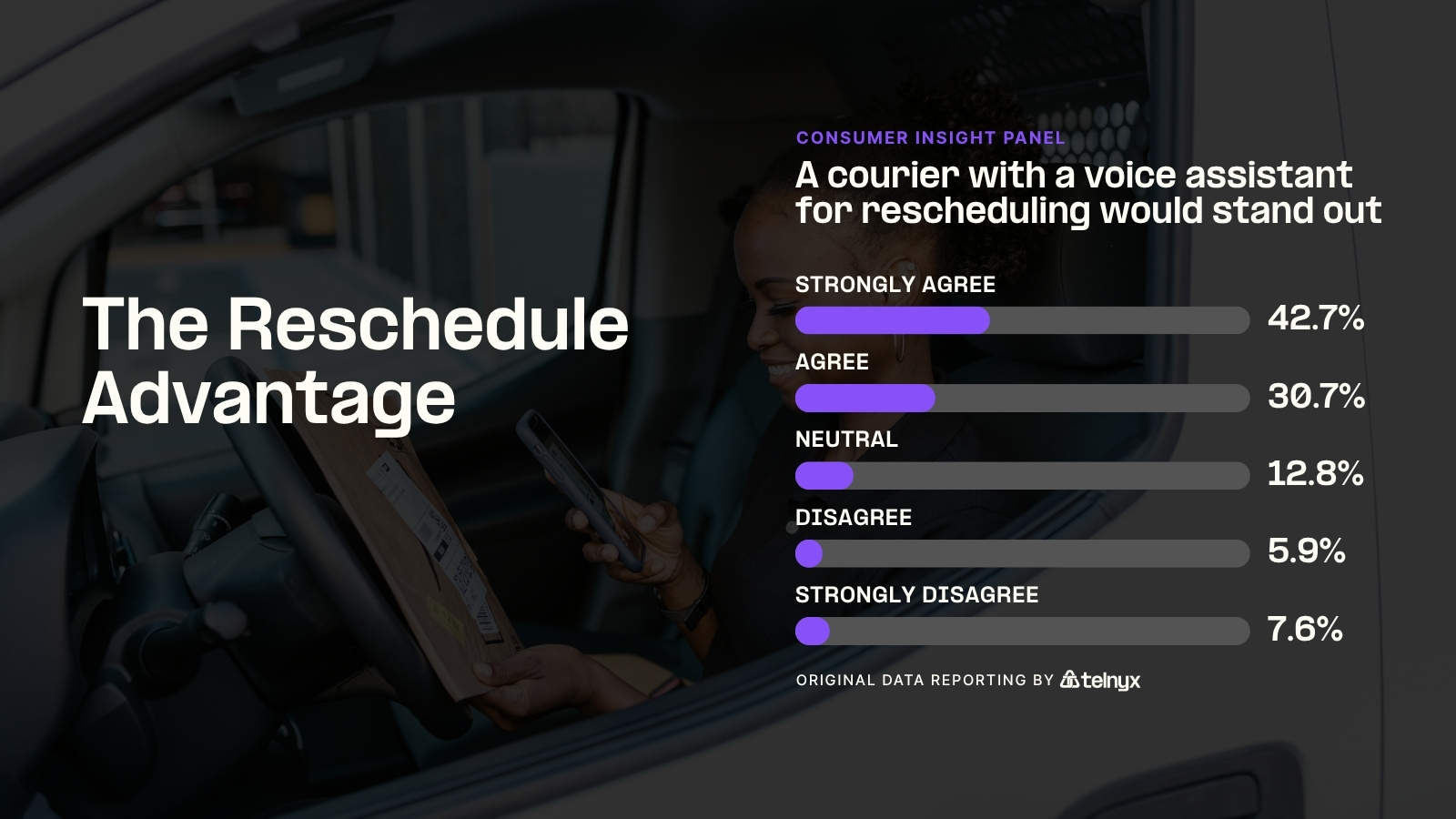
The 14% who disagree may include shoppers who have not experienced delivery rescheduling friction or who default to app-based workflows.
The Live Status Call: Real-Time Expectations
73% agree they would appreciate a shipping company that gives live voice updates on delivery status. 44% strongly agree, and the agree rate mirrors the rescheduling question closely.
Live tracking is now table stakes for parcel delivery apps, but the phone channel has lagged. Respondents are not asking for a new capability; they are asking for parity. When an app can show a driver on a map, a phone call should be able to give the same information without a three-minute hold.
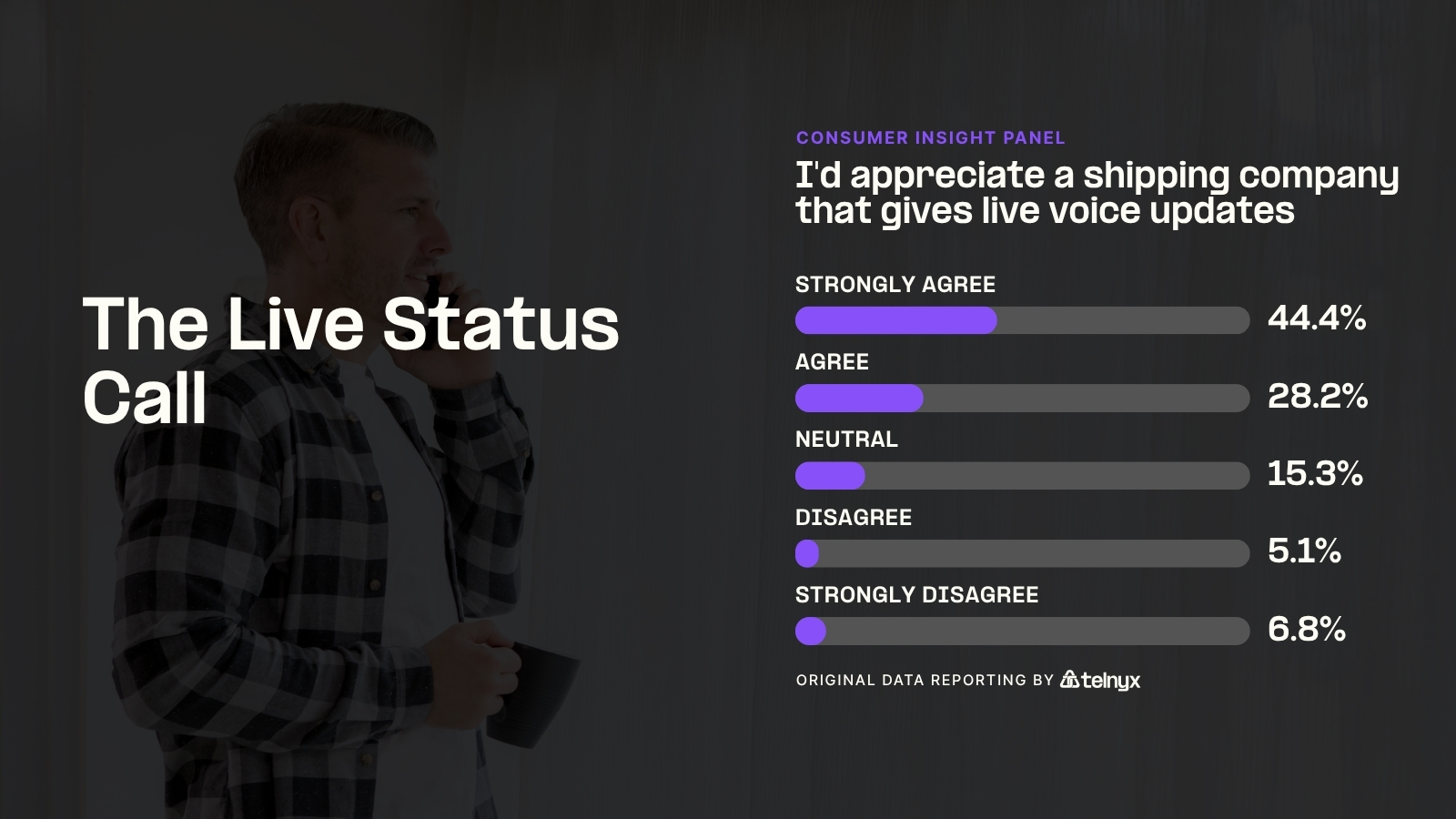
The 12% who disagree may prefer self-service tracking via app or email notifications over any phone interaction.
The Address Update: Low Effort, High Value
70% agree they would update a delivery address by telling an AI instead of waiting for an agent. 44% strongly agree.
Address changes are high-frequency, low-complexity transactions. They are also one of the most common reasons a customer calls a shipping company, which makes them an ideal candidate for Voice AI automation: the task is structured, the data requirements are predictable, and the alternative (waiting on hold for a form field change) is disproportionately frustrating.
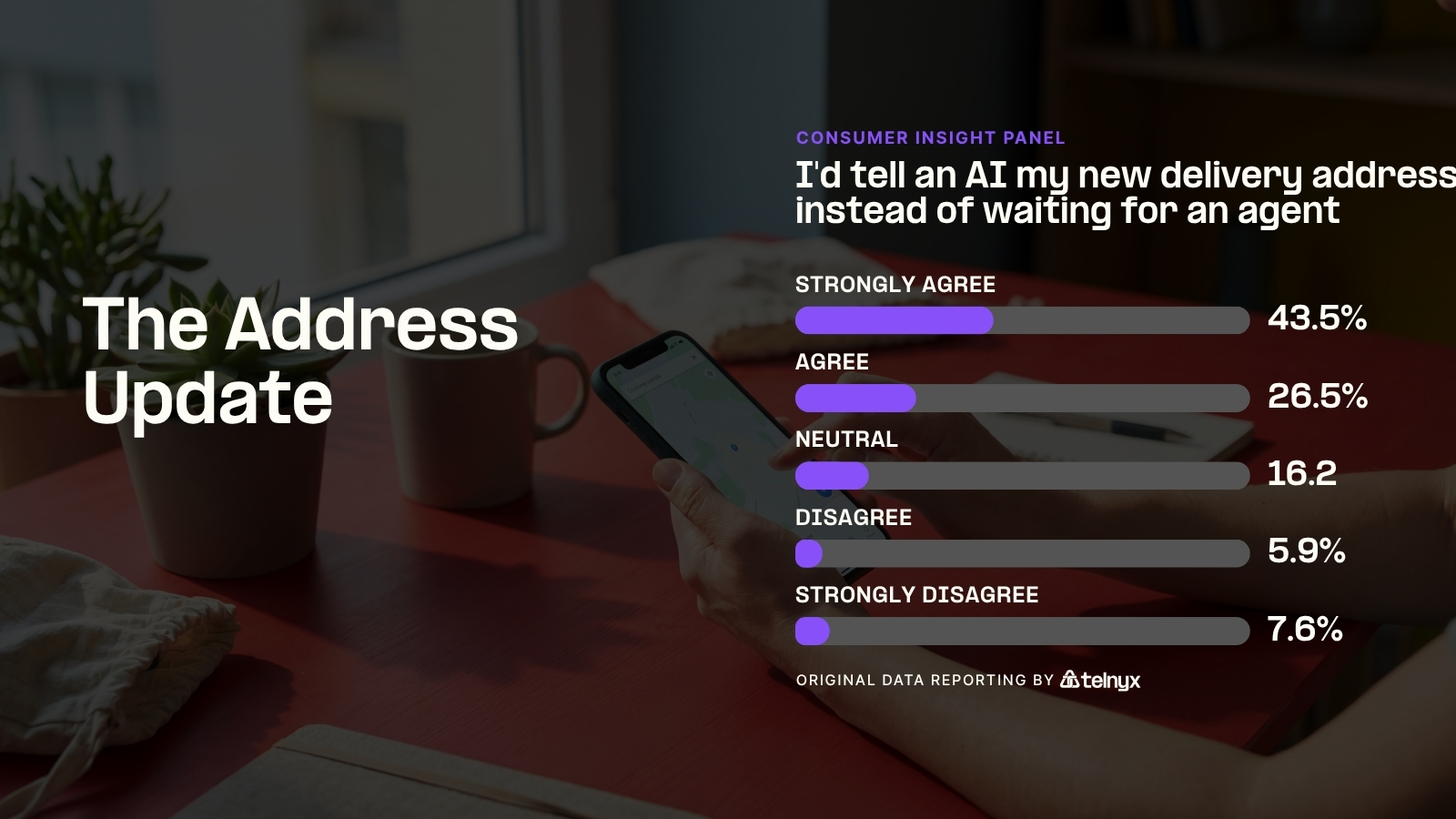
The 14% who disagree may include respondents who view address changes as sensitive enough to require human confirmation.
The Identity Pull: Modern But Less Urgent
68% agree that when an AI voice can identify them and pull up their order automatically, it feels modern and efficient. 43% strongly agree.
This was the lowest combined agree rate of the five questions, and the highest neutral at 18%. The pattern suggests respondents recognize the convenience of automatic identification but are less sure it solves an immediate pain point. Identity pull is an enabler for other features rather than a standalone demand driver.
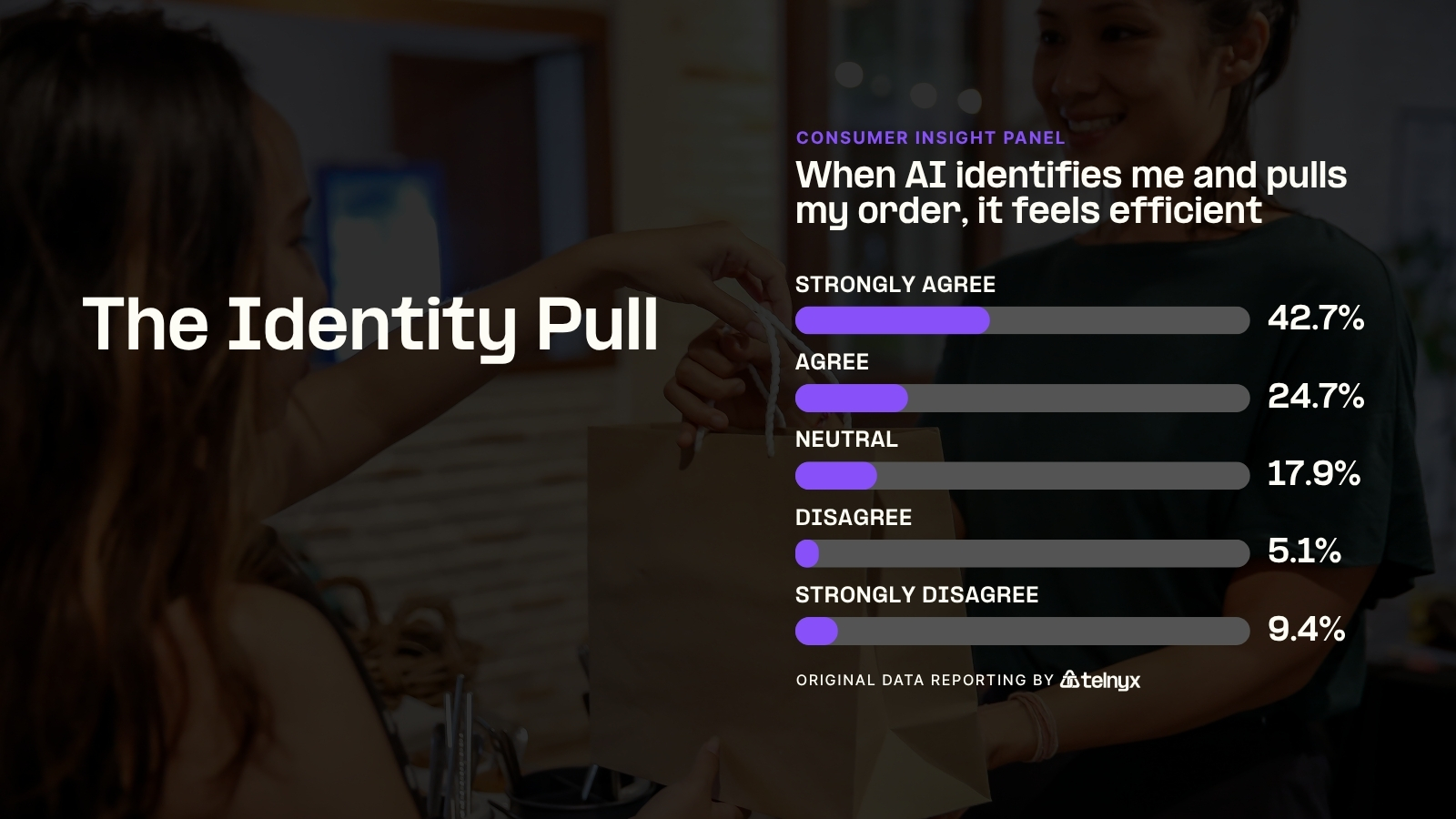
The 15% who disagree may have privacy concerns about automatic caller identification, or may not see the benefit relative to existing verification flows.
Key Takeaways
Demand concentrates where the alternative is waiting. The three highest-scoring questions (IVR Replacement, Reschedule Advantage, Live Status Call) all involve replacing hold time with instant voice interaction. When the alternative is frustration, adoption intent spikes.
Brand perception tracks with voice capability. The Reschedule Advantage question explicitly tested brand differentiation, and 73% said it would make a carrier stand out. Voice AI is not just an operational efficiency tool; it is a signal.
Logistics consumers are more receptive than the general population. Compared to the hospitality consumer study, logistics respondents show higher agree rates on every parallel question and lower neutral/disagree rates. This likely reflects the transactional, low-stakes nature of logistics calls versus the emotional weight of hotel stays.
The "press 1" menu is the most hated interaction in logistics. 76% agree is a strong enough signal to treat IVR replacement as the lead use case for Voice AI in shipping and delivery.
Strategic Implications
These findings suggest logistics Voice AI adoption will follow the pattern seen in financial services: starting with high-volume, low-complexity transactions and expanding as the technology proves reliable. The IVR replacement and address update use cases are the most immediately deployable because they map to existing call flows and require minimal integration complexity.
For carriers and logistics platforms, the data supports a phased rollout: replace phone menus first, add live status and rescheduling second, then layer in identity-based personalization. Each step reduces call volume and improves the customer experience without requiring a full platform overhaul.
The carrier-grade infrastructure matters here. When a customer says "track my package," the speech-to-text engine has to understand the query, the system has to authenticate the caller, and the response has to be delivered in real time. That requires low-latency inference running alongside the telephony layer on a single network.
Survey Methodology
This Consumer Insight Panel surveyed 117 U.S. respondents via SurveyMonkey in April 2026. The survey used five-point Likert-scale questions (Strongly Agree to Strongly Disagree). All percentages are rounded to one decimal place.
Demographics: Gender split 50/51% female to 49/50% male. Age skewed toward 30-60 (79%), with the largest group 45-60 (41%). Nearly all respondents (98%) completed the survey on a mobile device. The largest regional concentrations were Pacific (34%), South Atlantic (20%), and Middle Atlantic (17%).
The panel was conducted in accordance with AAPOR transparency standards.
Explore Voice AI for logistics or contact us to discuss deployment.
Share on Social


