
Voice
What is Conversational AI? A Guide for Singapore Businesses
Build smarter automation with real-time voice AI for Singapore. Compare platforms, explore PDPA-compliant deployments, and learn how multilingual Voice AI serves English, Mandarin, Malay, and Tamil callers from one deployment.

By Eli Mogul
What is conversational AI?
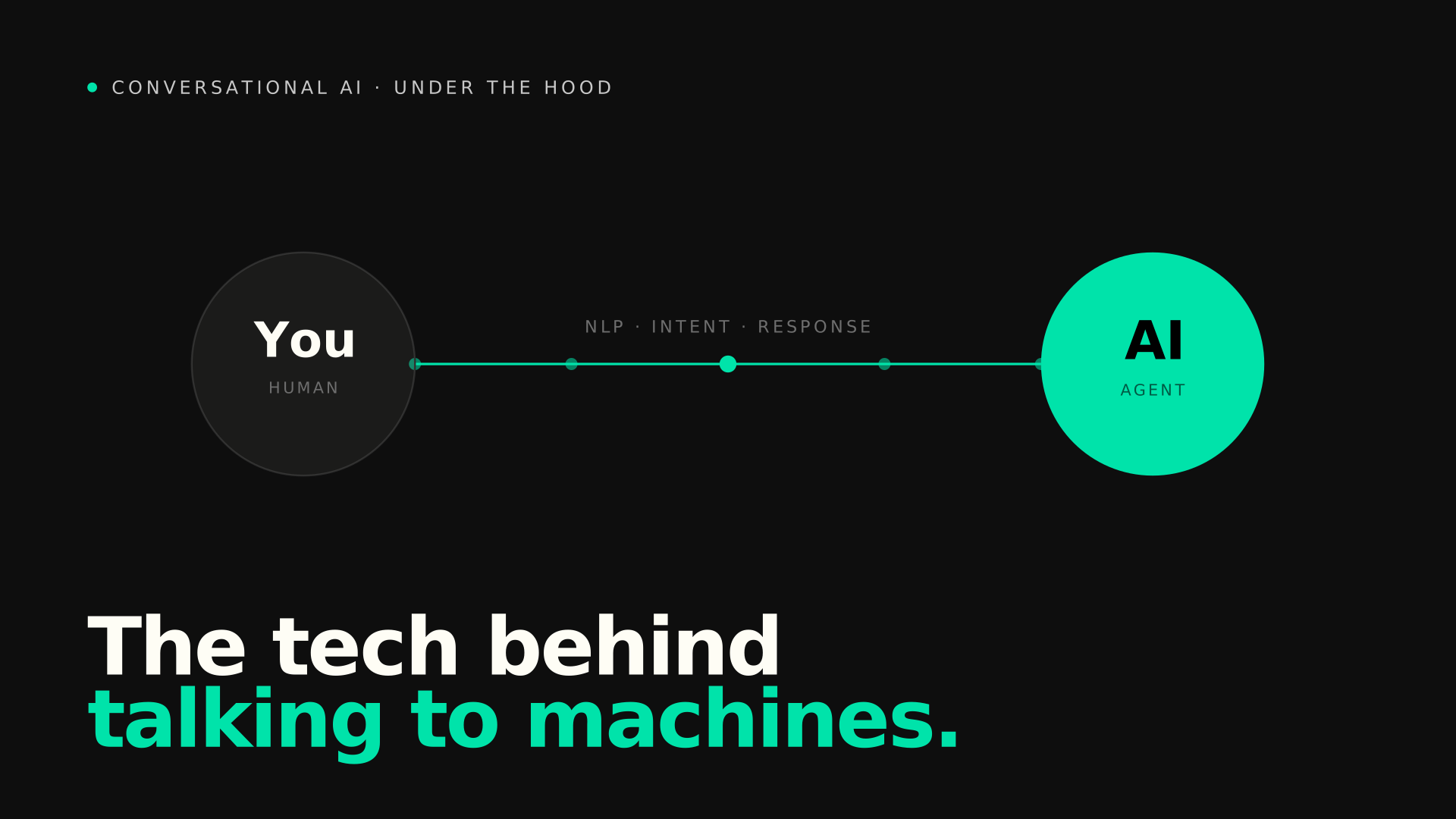
Conversational AI is technology that understands and responds to human language in real time. Voice-based conversational AI — the kind Telnyx builds — goes beyond chatbots: it listens, thinks, and speaks on live phone calls, handling complex interactions that text-only bots can't touch.
For Singapore businesses, conversational AI means 24/7 customer service in English, Mandarin, Malay, and Tamil — without hiring four separate teams. It means PDPA-compliant call handling with built-in consent management. And it means sub-200ms response latency from Telnyx's Singapore point of presence.
Top voice AI platforms
ElevenLabs
ElevenLabs built its reputation on high-quality TTS with natural prosody. Their Conversational AI platform wraps ASR, LLM, and TTS into a managed offering. Strengths: voice quality, ease of use. Limitations: limited code-switching for multilingual Singapore deployments, higher per-minute costs, and no carrier network — you bring your own telephony.
Vapi
Vapi offers a developer-focused voice AI platform with flexible LLM routing and webhooks. Good for rapid prototyping. Limitations: no Southeast Asian PoP (latency from US servers), limited multilingual support, and per-minute pricing that scales poorly for Singapore's high call volumes.
Bland.ai
Bland.ai provides a simple API for AI phone calls. Quick to set up for basic use cases. Limitations: limited customisation, no Singapore infrastructure, and no built-in compliance controls for PDPA or financial services regulations.
Together AI
Together AI focuses on LLM inference at scale. Their voice AI offering is new and limited — primarily model hosting rather than a complete voice platform. Not suitable for production voice AI in Singapore without significant custom integration.
Telnyx
Telnyx is the only platform that runs conversational AI on its own carrier network with a Singapore PoP. This means: sub-200ms full-pipeline latency, built-in PDPA compliance, multilingual support for English, Mandarin, Malay, and Tamil, and 11+ TTS engines through one API. You get the AI layer and the telephony layer from one provider — no stitching, no cross-region routing.
How voice AI works
Voice AI combines three core components:
ASR (Automatic Speech Recognition): Converts spoken audio to text. For Singapore, this means handling Singlish, code-switching, and accented English from across Southeast Asia. Telnyx Flux STT supports 100+ languages with sub-200ms processing.
LLM (Large Language Model): Interprets the text, maintains context, and generates a response. The LLM handles the "thinking" — understanding intent, managing conversation state, and producing natural replies in the caller's language.
TTS (Text-to-Speech): Converts the LLM's response back into spoken audio. For Singapore, this means voices that can code-switch between English and Mandarin, or deliver formal Malay for government services. Telnyx Ultra handles this in real time.
The orchestration layer ties everything together: managing call flow, enforcing PDPA compliance rules, and handling transfers to human agents when the AI reaches its limit.
Full pipeline latency from Telnyx's Singapore PoP: under 200ms. Typical DIY stacks routing through US servers: 800-1200ms.
Voice AI use cases across industries
Finance and insurance
Singapore's banking sector (DBS, UOB, OCBC) processes millions of calls monthly. Voice AI handles account inquiries, loan pre-qualification, and insurance claims in English and Mandarin. PDPA compliance is non-negotiable — Telnyx provides built-in consent management and audit trails.
Healthcare
Singapore's public healthcare system (SingHealth, NHG, NUHS) handles appointment scheduling, prescription refills, and triage screening. Voice AI automates 60-70% of routine calls in English, Mandarin, and Malay, reducing no-shows by 30-40%. HIPAA + BAA available for organisations with US data handling requirements.
Telecommunications
Singapore's telcos manage high-volume customer service for plan changes, top-ups, and technical support. Voice AI handles tier-1 queries in four official languages while routing complex issues to human agents.
E-commerce and retail
Singapore's e-commerce market (Shopee, Lazada, regional D2C brands) uses voice AI for order status, returns processing, and delivery scheduling. Multilingual support is critical — a single call might involve English and Mandarin within the same conversation.
Travel and hospitality
Changi Airport processes 60+ million passengers annually. Hotels, airlines, and tour operators use voice AI for booking management, flight status, and concierge services in multiple languages.
Government services
Singapore government hotlines (CPF, HDB, IRAS) serve citizens in four official languages. Voice AI handles routine queries about tax filing, housing applications, and CPF contributions — reducing wait times from minutes to seconds.
Key features to look for in a voice AI platform
- Multilingual + code-switching support: Can it handle English-Mandarin or English-Malay switching mid-call?
- Singapore PoP: Does inference run locally or route through US/EU servers?
- PDPA compliance: Are consent management, data retention, and audit trails built in?
- Carrier network: Can the platform handle call routing, SIP trunking, and number provisioning — or do you need a separate telephony provider?
- TTS engine variety: Can you switch between budget and premium voices without code changes?
- Uptime SLA: Is there a contractual guarantee for service availability?
- HIPAA/BAA: If you handle healthcare data, is a Business Associate Agreement available?
Conversational AI pricing: Singapore comparison
| Platform | Per-minute Cost | SG PoP | Multilingual | PDPA Controls |
|---|---|---|---|---|
| Telnyx | $0.05 | Yes | 100+ languages | Built-in |
| ElevenLabs | ~$0.12-0.18 | No | 32 languages | Limited |
| Vapi | ~$0.10-0.15 | No | Limited | None |
| Bland.ai | ~$0.09-0.12 | No | Limited | None |
| DIY stack | ~$0.18-0.25 | Varies | Custom | Custom |
Build production voice AI on infrastructure built for Singapore
Telnyx operates a carrier network with a Singapore PoP, so your voice AI runs on infrastructure designed for real-time audio — with the compliance controls, multilingual support, and latency characteristics that Singapore businesses require.
Explore Voice AI Agents → | Contact Sales →
FAQ
What is conversational AI in simple terms?
Conversational AI is software that understands and responds to human language. Voice-based conversational AI does this on phone calls — listening, understanding, and speaking in real time.
How is conversational AI used in Singapore?
Singapore businesses use conversational AI for customer service, appointment scheduling, financial services support, and government hotline automation. The key advantage is handling interactions in English, Mandarin, Malay, and Tamil from a single deployment.
What's the difference between a chatbot and conversational AI?
Chatbots handle text-based interactions on websites and apps. Conversational AI handles voice calls — understanding spoken language, managing conversation context, and responding in natural speech. For Singapore's phone-first service culture, voice AI is often more practical than chatbots.
Is conversational AI compliant with Singapore's PDPA?
Yes, when deployed correctly. Telnyx's platform includes built-in PDPA compliance controls: consent management, data retention policies, PII redaction in transcripts, and audit trails. The Singapore PoP also ensures data doesn't unnecessarily transit through other jurisdictions.
How much does conversational AI cost in Singapore?
Telnyx Voice AI costs $0.05/min flat (excluding model costs), compared to $0.50-1.00/min for human agents. The Singapore PoP eliminates cross-region data transfer costs that inflate pricing on US-based platforms.
Share on Social


