
Guides and Tutorials
How AI inference and training economics diverge in 2026
This guide defines both terms, walks through the diverging cost and compute curves shaping the year...

By Eli Mogul
Every large language model lives two lives. The first is training: the one-time, capital-intensive process of teaching a model to recognize patterns across vast datasets. The second is inference: the recurring, operational process of actually running that model to answer a question, transcribe a call, or drive a conversation. Both consume GPUs. Both cost money. But in 2026, their economics are pulling in opposite directions, and understanding that split is now one of the most consequential decisions an ML infrastructure team can make.
This guide defines both terms, walks through the diverging cost and compute curves shaping the year, and explains why owning the inference stack has become the difference between a defensible unit economic and a runaway bill.
What is AI training?
Training is how a model learns. Engineers feed a neural network enormous volumes of data, and the model adjusts billions of internal parameters until it can reliably predict the next token, classify an image, or complete a task. It is computationally brutal: a frontier training run can occupy thousands of GPUs for weeks or months.
Training is a one-time capital event per model version. You pay for it once, you amortize it across every future request, and then you move on. The cost is enormous but bounded.
What is AI inference?
Inference is what happens after training ends. It is the model in production: taking a live input, running it through the trained parameters, and returning an output. Every chatbot reply, every voice agent response, every API call to a deployed model is an inference request. For a deeper technical treatment, see our explainer on machine learning inference.
Unlike training, inference is a recurring operational cost. It runs every second of every day, scaling directly with usage. The more your product succeeds, the more inference you buy. That distinction, capital event versus operating expense, is the root of everything that follows.
Why inference got cheaper per token and more expensive overall
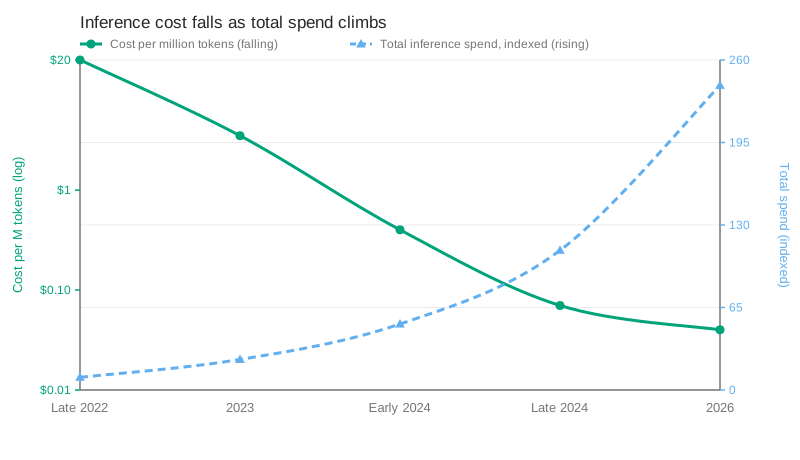
Here is the paradox at the center of 2026 AI economics. The cost to run a single inference request has collapsed, yet enterprise inference bills are climbing fast. Both things are true at once.
On the cost-per-token side, the decline has been staggering. Stanford HAI's AI Index documents that the cost of querying a model scoring the GPT-3.5 equivalent on the MMLU benchmark fell from $20.00 per million tokens in late 2022 to roughly $0.07 per million tokens by late 2024, a reduction of more than 280-fold in about two years. Epoch AI's tracking of model benchmarks shows per-token inference prices falling between 9x and 900x per year depending on the performance tier. Hardware is helping: price-performance has improved roughly 30% annually and energy efficiency by about 40% annually, according to IEEE Spectrum's review of the AI Index.
So why are the bills going up? Because volume is up far faster than price is down. Agentic deployments are the main driver. Gartner's 2026 analysis finds that agentic AI consumes 5 to 30 times more tokens per task than a standard chatbot interaction, as each task fans out into multiple reasoning steps, tool calls, and retries. Those same agents are increasingly the ones choosing where inference runs. An agent evaluating infrastructure measures cost per token and latency directly, then routes to the provider that wins on both. The buyer driving the volume is also the buyer making the procurement decision, at machine speed. Goldman Sachs Research projects total token consumption will multiply 24 times between 2026 and 2030, reaching 120 quadrillion tokens per month. When per-token cost falls 50% a year but volume rises 10x a year, the bill grows.
The compute split tells the same story. Inference now consumes the majority of an AI system's lifetime compute, with industry analyses putting it at roughly 80 to 90% of total compute dollars over a model's lifecycle versus 10 to 20% for training. Training still climbs exponentially at the frontier, with the largest runs historically doubling every three to four months. But inference is where the recurring money goes, and it is where deployed AI draws most of its ongoing energy. The 2026 AI Index estimates that emissions from the least efficient inference models run more than 10 times higher than the most efficient ones, making inference, not training, the dominant ongoing environmental and economic draw of AI in production.
Training vs inference at a glance
| Dimension | Training | Inference |
|---|---|---|
| Cost type | One-time capital event | Recurring operating expense |
| When it runs | Once per model version | Every request, continuously |
| Cost trend in 2026 | Climbing at the frontier | Per-token cost falling 9x to 900x per year |
| Share of lifecycle compute | Roughly 10 to 20% | Roughly 80 to 90% |
| Primary cost driver | Model size and dataset scale | Token volume and request latency |
Why open models change the math
The economics get more interesting when you factor in open versus closed models. MIT Sloan's 2026 analysis of OpenRouter inference data found that closed proprietary models from the major labs account for nearly 80% of all tokens processed, even though open models average about 90% of closed-model performance and usually close that gap within roughly 13 weeks of a closed model's release. The catch: open models cost 87% less to run, averaging $0.23 per million tokens against $1.86 for closed models. For most workloads, teams are paying a large premium for capability they could match with open weights.
That finding only matters, though, if you control your own inference. If you are renting inference from a third party, you take whatever per-token price they set. If you run open models on infrastructure you own, the 87% gap becomes yours to capture. This is why the open-source question is really an infrastructure question, and why AI training vs fine-tuning decisions increasingly hinge on where the model actually runs.
Inference is becoming an edge and sovereignty problem
The location of inference is now as important as its cost. GSMA's 2025 operator guide frames inference as the workload telcos must serve at the network edge, where it must be fast, responsive, and efficient under real power and compute constraints. Training can be centralized and amortized once. Inference has to happen close to the user, in real time, every time.
That geographic reality shows up at the macro level too. The Federal Reserve's 2025 note on AI competition treats compute capacity, the processing and network resources used for both training and inference, as the clearest measure of a country's ability to develop and deploy AI, and documents how heavily data-center capacity concentrates in the US. As regional data and AI sovereignty requirements tighten across the EU, APAC, and LATAM, where your inference physically runs stops being an implementation detail and becomes a compliance and latency requirement.
This is also where carrier-grade infrastructure separates from generic edge compute. Providers like Cloudflare run inference at edge cities, closer than a hyperscaler region but not adjacent to a carrier network. For real-time voice, carrier proximity is what closes the latency gap. And most platforms get worse as they expand globally, adding hops and jurisdictions. A carrier that places inference at each new point of presence gets better, because each region adds capability rather than complexity.
Own the stack, own the economics
This is where infrastructure ownership decides the outcome. As Telnyx CEO David Casem puts it:
"The economics of AI inference and training are diverging. Training is a one-time capital event; inference is a recurring operational cost that runs every second of every day. If you don't own the GPU stack and the network underneath it, your unit economics on inference will eat you alive."
David Casem, CEO at Telnyx
Most platforms rent. They orchestrate inference across third-party GPUs, route calls through third-party carriers, and pass a markup along at every layer. Telnyx took the opposite approach. We colocate GPU infrastructure directly alongside our global telephony Points of Presence, so inference latency and per-token cost are both controlled in-house rather than bought from a vendor. The data travels the shortest possible physical distance, which is the only durable way to deliver real-time voice AI.
The pricing reflects the architecture. Because Telnyx owns the network and the compute, Voice AI Agents start at $0.05 per minute for orchestration (US/global), with STT and Telnyx-native TTS included. Open-source LLM processing runs on Telnyx-owned GPUs and is billed on token usage, separate from the per-minute orchestration rate, so cost scales with how much the model generates. At $0.05 per minute, that's about $3 per hour of orchestration, a fraction of what a Frankenstack costs once every third-party markup compounds. Telephony vendor, STT vendor, LLM provider, TTS vendor, each one takes a margin, and those margins compound on every minute of every call. The same ownership shows up across the stack: Telnyx TTS runs roughly 10x cheaper than ElevenLabs and SIP roughly 2x cheaper than Twilio, because each layer runs on owned compute rather than reseller margin. When per-token prices keep falling, owning the stack means you capture the savings instead of waiting for a reseller to pass them on.
The same ownership captures the open-model advantage MIT Sloan quantified. Telnyx maintains an LLM library of leading open-source models that run directly next to the communications infrastructure, with no vendor lock-in and the freedom to swap models or bring your own. You get the 87% cost gap working in your favor, on infrastructure that terminates the call.
The takeaway
Training and inference are not two flavors of the same cost. Training is a bounded capital investment. Inference is an unbounded operating expense that scales with your success. In 2026, per-token inference is cheaper than ever while total inference spend is climbing fast, driven by agentic token volume and the shift of compute toward deployment.
The teams that stay solvent are the ones that control the stack their inference runs on, from the GPU to the network underneath it. That stack has three layers: edge compute (where inference physically runs), the agent platform (where the model becomes a live conversation), and global communications (the carrier network carrying the call). Telnyx owns all three, which is why inference cost and latency are controlled in-house rather than bought from a vendor at a markup.
Voice is the wedge, not the ceiling. The same owned inference that powers real-time voice powers SMS, email, and async agent operations as your token volume grows.
Explore Telnyx Inference or talk to our team to model what owning your inference stack would do for your unit economics.
Share on Social