
Guides and Tutorials
Building Cellular AI Agents: Complete Guide
A cellular AI agent is an autonomous AI system that uses cellular networks (voice, SMS, and data) as its primary communication channel.

By Eli Mogul
AI agents are moving beyond the browser. As enterprises race to deploy autonomous systems that can initiate calls, send messages, and respond to customers in real time, a new class of agent is emerging: one that runs on cellular networks instead of Wi-Fi and broadband alone.
Cellular AI agents combine the intelligence of modern language models with the reach and reliability of telecom infrastructure. For teams building distributed, voice-first, or field-ready AI systems, understanding how cellular connectivity fits into the stack is becoming a core competency.
What is a cellular AI agent?
A cellular AI agent is an autonomous AI system that uses cellular networks (voice, SMS, and data) as its primary communication channel. Unlike traditional chatbots confined to web interfaces, cellular AI agents operate like software-controlled phone systems. They can initiate calls, send text messages, and respond to incoming communications across the globe.
Think of it this way: a web-based AI agent waits for a user to open a chat window. A cellular AI agent can call the user, text them an update, or respond to an inbound call with a natural-sounding voice, all over the same mobile networks that carry everyday phone traffic.
These agents are particularly well-suited for:
- Distributed field operations (fleets, service teams, logistics)
- Automated outreach (customer support, collections, compliance notifications)
- IoT and AI convergence (devices that communicate with both AI systems and humans)
- Voice-first interactions (accessibility, hands-free workflows)
Why cellular connectivity matters for AI agents
Web-based AI agents work well in controlled environments with reliable broadband. But for many real-world use cases, they hit a wall.
Traditional agents face several key limitations:
- Dependency on internet uptime with no built-in redundancy if broadband fails
- Regional restrictions that make it difficult to reach users in areas with limited connectivity
- Synchronous-only operation, meaning they can't initiate outbound contact without user action
- No offline resilience, since cellular networks often have better coverage than broadband in rural and remote regions
According to the GSMA's State of Mobile Internet Connectivity 2025 report, 96% of the global population now lives within the footprint of a mobile broadband network. Fixed broadband coverage is far less pervasive, particularly outside major metro areas. The OECD found in 2025 that rural regions across member countries recorded fixed broadband adoption rates averaging 24 percentage points lower than urban areas, with mobile broadband gaps even wider in some markets.
Cellular connectivity enables AI agents to operate where broadband is unavailable, initiate calls and messages proactively, fall back to voice when data connections are unstable, and leverage decades of telecom reliability. For industries like field services, logistics, and healthcare, this is not a marginal improvement. It is the difference between an AI that works in the office and one that works everywhere.
The market opportunity
The convergence of AI and cellular infrastructure is riding several major tailwinds.
Gartner predicts that 40% of enterprise applications will integrate task-specific AI agents by the end of 2026, up from less than 5% in 2025. In a best-case scenario, the firm projects agentic AI could drive approximately 30% of enterprise application software revenue by 2035, surpassing $450 billion.
Simultaneously, cellular IoT is scaling fast. The Ericsson Mobility Report projects total cellular IoT connections will reach approximately 4.5 billion by the end of 2025, growing at a compound annual growth rate (CAGR) of around 10% through 2031. Omdia's research corroborates this trajectory, forecasting 5.1 billion cellular IoT connections by 2030.
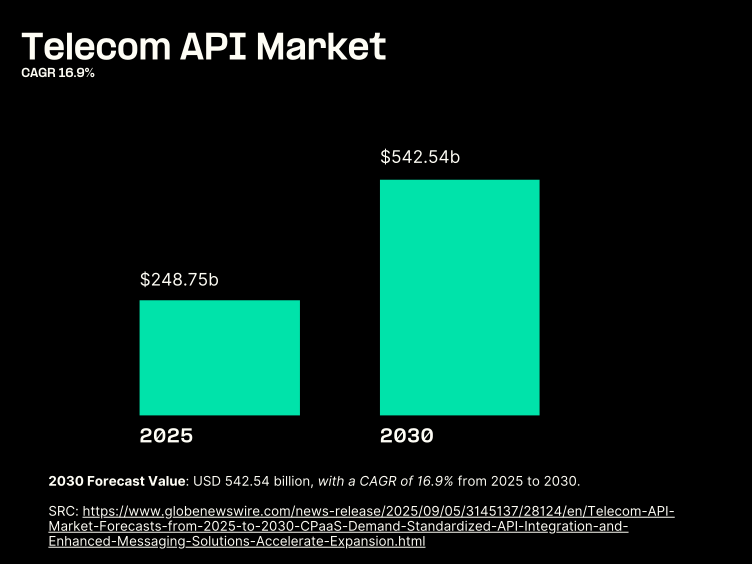
On the platform side, IDC reports that worldwide revenues for telecom and network APIs will reach $6.7 billion by 2028, growing at a CAGR of 57.1% from 2023. The broader telecom API market is valued at over $248 billion in 2025 and is expected to grow at a 16.88% CAGR through 2030, according to Research and Markets.
The CPaaS market, which underpins programmable communications for AI agents, grew 7.7% year-over-year to $16.7 billion in 2024, according to IDC's Unified Communications and Collaboration Tracker.
How it works: the stack
A cellular AI agent architecture combines several layers that work together to deliver intelligent, real-time communication. Here is how the components fit together:
| Layer | Function | Example technologies |
|---|---|---|
| Inference engine | Processes language, generates responses | LLMs (open-source or proprietary), fine-tuned models |
| Orchestration | Manages conversation flow and multi-turn logic | Voice AI Agents, workflow engines |
| Telephony gateway | Handles call setup, routing, and SMS delivery | SIP trunking, Voice APIs, WebRTC |
| SIM/connectivity | Provides global cellular access | Programmable SIMs, Wireless APIs, eSIM management |
| Data pipeline | Supplies context, history, and knowledge bases | CRMs, vector databases, communication platform APIs |
The key architectural insight is that latency between these layers determines whether a voice conversation feels natural or robotic. According to human conversational benchmarks, the ideal turn-taking delay is about 200 to 300 milliseconds. Exceeding that threshold makes the system feel unresponsive. This is why colocating inference engines near telephony points of presence (PoPs) matters: reducing the physical distance data travels directly improves voice quality and response time.
Use cases
Field service AI assistant. A solar installation company deploys AI agents to coordinate with field teams. The agent receives job site data, analyzes it for hazards, and calls the foreman with risk alerts over cellular—no Wi-Fi required. When broadband is spotty at remote installation sites, cellular connectivity keeps the communication loop intact.
Distributed fleet coordination. A logistics company uses AI agents deployed on edge devices to coordinate fleet operations via voice. Agents call dispatch, accept routing instructions, and report delivery status—all over cellular networks. Programmable SIMs automatically switch carriers based on signal strength, ensuring uptime even when one network degrades.
HIPAA-compliant voice AI in healthcare. A healthcare provider uses cellular AI for automated patient follow-ups. Encrypted voice calls over a private cellular network ensure HIPAA compliance without exposing patient data to public cloud infrastructure. The agent can schedule appointments, confirm medications, and escalate to a human nurse when needed.
Key technical considerations
Getting cellular AI agents into production requires attention to several interrelated factors.
Latency requirements are paramount. For natural-sounding voice interactions, the target is sub-300ms round-trip latency. Research from Hamming AI, based on analysis of over 4 million production voice agent calls, recommends targeting under 800 milliseconds end-to-end for production systems. Colocating GPU infrastructure with telecom PoPs collapses the distance between inference and telephony, which is one of the most effective ways to hit these targets.
Codec selection directly affects AI processing quality. G.711 remains widely compatible, but Opus and HD voice codecs at 16 kHz deliver better speech recognition accuracy and more natural-sounding synthesis.
SIM management is a differentiator for global deployments. Programmable SIMs that can switch carriers based on signal strength, along with eSIM provisioning, give agents the ability to maintain connectivity across geographies without manual intervention.
Failover strategy is essential. Multi-carrier routing ensures uptime even if one network degrades. For mission-critical applications, the architecture should include automatic failover between carriers and between cellular and broadband where available.
Compliance varies by industry and region. HIPAA, GDPR, and CCPA each impose specific requirements on how voice data is transmitted, stored, and processed. Private network infrastructure, rather than public cloud, is often necessary for regulated industries. Organizations deploying edge computing alongside cellular connectivity can keep sensitive data closer to the source, reducing both latency and compliance risk.
Getting started
Building a cellular AI agent does not require assembling the stack from scratch. The key is choosing a platform that unifies the telecom and AI layers so you are not stitching together five different vendors.
Start by assessing your connectivity gaps. Where does broadband fail but cellular succeeds? Where do your users, customers, or field teams actually operate? That analysis will tell you whether cellular AI is a nice-to-have or a requirement.
From there, the build process follows a logical path:
- Provision phone numbers and SIP trunks for call handling
- Configure a Voice AI Agent with your desired LLM and conversation logic
- Connect your data pipeline (CRM, knowledge base, user context)
- Deploy programmable SIMs for global cellular access
- Test latency across the geographies you plan to serve
Telnyx provides the complete stack for this workflow: Voice API for call handling, Voice AI Agents for pre-built inference, Wireless API for global SIM management, and private network options for regulated industries. Because Telnyx colocates GPU infrastructure with its global telecom PoPs, the platform delivers sub-200-millisecond round-trip times for voice AI workloads, keeping conversations within the natural turn-taking window.
The bottom line
AI agents are only as good as the infrastructure they run on. As the market moves from web-first chatbots to distributed, voice-capable autonomous systems, cellular connectivity is becoming the backbone that makes it all work. The organizations that build on a unified telecom-plus-AI platform now will have a structural advantage as the space scales.
The future of AI agents is not just intelligent. It is connected.
Explore Telnyx Voice AI Agents to build, test, and launch voice AI on a full-stack platform with carrier-grade connectivity, colocated GPU infrastructure, and global telephony built in.
Share on Social