
Insights and Resources
OpenAI alternatives for inference: A 2026 buyer's guide
This guide lays out the case for leaving (or hedging) OpenAI, what to look for in a replacement, and where Telnyx Inference fits for builders running production workloads, especially anything that touches a phone call.

By Eli Mogul
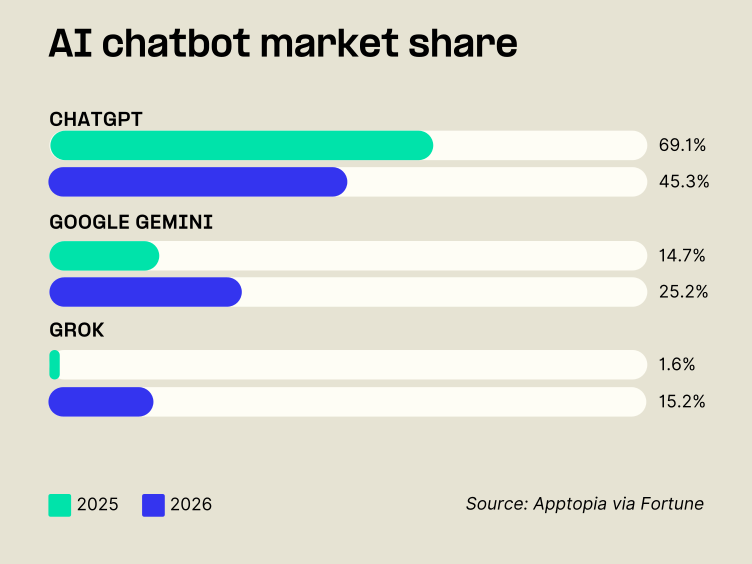
The build-vs-buy calculus on OpenAI has changed. In January 2025, ChatGPT held just under 70% of the U.S. AI chatbot app market. 13 months later, that share had dropped to 45.3%, with Google Gemini climbing to 25.2% and Grok jumping from 1.6% to 15.2%, according to Apptopia data first reported by Fortune. The category leader is now a minority-share product, and that single fact reframes every conversation a CTO, VP of Engineering, or AI platform lead is having about where the next inference workload should run.
If you're typing "OpenAI alternative" into a search bar in 2026, you've already done the hard part. You've decided that single-vendor exposure to one API is a risk you no longer want to underwrite. The remaining question is which alternative actually solves the problem rather than recreating it under a different logo.
This guide lays out the case for leaving (or hedging) OpenAI, what to look for in a replacement, and where Telnyx Inference fits for builders running production workloads, especially anything that touches a phone call.
Why the migration is happening now
Three forces are pushing teams toward alternatives at the same time, and they reinforce each other.
Market signal: incumbents miss targets. In late April 2026, reports surfaced that OpenAI had missed multiple internal revenue and user-growth targets, news that wiped billions off the market caps of partners like Oracle, CoreWeave, and SoftBank. For procurement teams, missed-target reporting on the category-defining vendor is a textbook trigger for adding a second inference provider rather than deepening single-vendor exposure.
Public sentiment: optimism and nervousness rising together. Stanford HAI's 2026 AI Index Report found that the global share of respondents who say AI offers more benefits than drawbacks rose from 55% in 2024 to 59% in 2025, even as the share saying AI products make them nervous climbed to 52%. IEEE Spectrum's coverage of the report called this the most surprising finding of the year. Optimism and caution rising in parallel is exactly the sentiment profile that pushes buyers to hedge a single-vendor dependency. The same dynamic shows up domestically: Pew Research found in March 2026 that half of US adults say the increasing use of AI in daily life makes them more concerned than excited, with only 10% saying the reverse.
Architectural signal: enterprises went multi-model. Andreessen Horowitz's 2026 survey of 100 enterprise CIOs found 37% of respondents are now using five or more LLMs in production, up from 29% the prior year. Multi-model is the default architecture, not the exception. Even academic institutions reflect this: Boston University's AI Development Accelerator describes its TerrierGPT platform as "a gateway for BU faculty, staff, and students to have equitable access to leading models, such as ChatGPT from OpenAI, Claude from Anthropic, Google Gemini, Meta Llama, and more, in a secure environment." If a university built a multi-model router as its default access pattern, the question for an enterprise buyer isn't whether to do the same. It's how.
What you actually need from an OpenAI alternative
Most "Top 10 OpenAI alternatives" listicles miss the point. They rank model quality and pricing in isolation. But the buyer leaving OpenAI usually needs three things at once:
| Capability | What it solves | Why it matters | What to verify |
|---|---|---|---|
| OpenAI-compatible API endpoint | Migration is a base-URL swap, not a rewrite | Existing application code, agent frameworks, and SDKs keep working | The provider exposes /v1/chat/completions with matching request/response shapes |
| Curated open-weight catalog | Eliminates lock-in at the model layer | Llama, Mistral, Qwen, and Kimi-class models give cost and flexibility headroom | Catalog updates within days of major open-weight releases |
| Co-located GPU infrastructure | Low latency for real-time workloads | Voice and agentic use cases break down above ~300ms round-trip | Inference GPUs sit adjacent to the network points of presence, not behind public-cloud passthroughs |
A provider that gives you one of these but not the other two is a partial solution. The OpenAI-compatible API without the open-weight catalog still locks you to whichever models that vendor licenses. The open-weight catalog without low-latency infrastructure works fine for batch jobs and falls apart for real-time use cases like voice. The infrastructure without the API compatibility means a rewrite every time you switch.
The academic case for substitution
If the market data is the demand-side signal, peer-reviewed research is the supply-side proof that substitution is viable.
A 2025 paper in the Computational and Structural Biotechnology Journal by Dailin Gan and Jun Li at the University of Notre Dame, "Small, open-source text-embedding models as substitutes to OpenAI models for gene analysis," tested ten small open-source embedding models from Hugging Face against OpenAI's text-embedding service across four gene-classification tasks. The motivation was explicit:
"While foundation transformer-based models developed for gene expression data analysis can be costly to train and operate, a recent approach known as GenePT offers a low-cost and highly efficient alternative... However, the closed-source, online nature of OpenAI's text-embedding service raises concerns regarding data privacy, among other issues."
The result: across all four tasks, several of the small open-source models matched or outperformed OpenAI's embeddings. For a production scientific workload with real privacy stakes, the open-source substitute wasn't a compromise. It was the better choice.
This pattern generalizes well beyond gene analysis. Hugging Face's State of Open Source report for spring 2026 documents a community where open and open-weight models now span every performance tier, with efficiency gains "pushing 10x to 1000x lower costs than flagship AI models." The gap that justified paying premium API rates for OpenAI in 2023 has narrowed to the point where, for most workloads, the question isn't whether an open alternative is good enough. It's which one fits the use case.
What "OpenAI-compatible" actually means in practice
The phrase gets used loosely. In practice, OpenAI compatibility means a provider exposes an API endpoint that accepts the same request format as api.openai.com/v1/chat/completions and returns the same response shape. For developers, this is the difference between a one-line config change and a multi-week migration.
Telnyx's OpenAI-compatible LLM endpoint is the implementation of this pattern. Point your existing OpenAI SDK at the Telnyx base URL, swap your API key, and select an open-weight model from the catalog. Your agent framework, your orchestration code, your evals, your prompt templates: all unchanged.
The catalog itself matters as much as the API surface. Telnyx maintains a continuously updated library of open-source language models, and the team ships new open-weight LLMs for voice AI as they become available, including Llama, Mistral, and Kimi-class reasoning models. This is the part most "OpenAI alternative" providers underdeliver on. They route to one or two open models behind the OpenAI-shaped door and call it a day. A real alternative gives you the catalog and lets you A/B test models against your actual workload.
Why latency separates the serious alternatives from the rest
For text-only workloads (batch summarization, embedding generation, content moderation), latency tolerance is generous. A 500ms response time on a background job is fine. A 500ms response time on a phone call is a broken product.
This is where most public-cloud passthrough providers fail. They host open-weight models on commodity GPU instances, geographically distant from wherever the audio is being captured and the SIP signaling is being negotiated. Every additional network hop adds 30-80ms. Stack three of them and a real-time voice agent stops feeling real-time.
Telnyx solved this by colocating GPU infrastructure with the global telephony Points of Presence (PoPs) that already carry the voice traffic. The LLM inference happens on the same physical infrastructure as the SIP signaling, not three clouds away. For builders who need conversational AI workloads to feel human in real time, this isn't a marketing point. It's the architectural choice that determines whether the product works.
The self-hosting trap
A frequent reflex when teams decide to leave OpenAI is to swing the pendulum the other direction and self-host. The math looks attractive on paper. Run Llama on your own H100s, eliminate per-token costs, control everything.
In practice, self-hosting LLMs fails for most production teams within six months. GPU procurement timelines stretch to quarters. Inference frameworks need constant tuning. Model updates require redeployment cycles. Capacity planning becomes a full-time engineering function. And the per-token math that looked great at 100 million tokens a month inverts when you're sitting on idle GPUs at 3 a.m.
The middle path is what most enterprises actually want: an inference provider that runs the open-weight stack on dedicated, co-located infrastructure, exposes an OpenAI-compatible API, and prices like a cloud service rather than a capex commitment. That's the niche Telnyx Inference was built for.
A note on voice
If your workload is text-only, you have more options than you think. If your workload involves a phone call (inbound support, outbound sales, IVR replacement, voice agents), the option set narrows quickly. Most "OpenAI alternative" providers don't ship telephony. The moment your AI agent needs to make or receive a call, you're back to integrating a third-party CPaaS, managing SIP separately, and absorbing the latency penalty of the extra hop.
This is the structural advantage of running inference on the same network as the voice path. Telnyx is a licensed telecom provider in 30+ markets with PSTN calling in 100+ countries, and the inference stack runs on the same Layer-0 backbone. Provision a number, attach an open-weight LLM, and the whole thing operates as a single product. For teams currently piecing together OpenAI plus Twilio plus a TTS provider plus an STT provider, that consolidation is often the real reason to migrate.
David Casem on the open-source economics
Telnyx CEO David Casem put the cost case bluntly in a recent post:
"My feed is full of people proudly showing off their '10 billion Token' trophies. What I see: 'I just paid OpenAI a premium for something I could've run with open-source models at 90% less cost.' At this point, OpenAI should engrave them: 'Thank you for your service to our ARR.' Meanwhile, anyone actually shipping with FOSS is too busy saving money to post about it."
The framing is sharper than most marketing copy, but it tracks the data. TechCrunch's coverage of the Stanford 2026 report noted a growing divergence between AI insider sentiment and the public, with only 10% of Americans more excited than concerned about AI. The buyers in that 90% are exactly the audience for whom predictable pricing on open-weight inference matters more than another GPT release.
The migration checklist
If you're evaluating an OpenAI alternative for production inference, the short list of things to verify:
The provider exposes a true OpenAI-compatible endpoint with matching request and response shapes. The open-weight catalog includes the models your team actually wants to test, with regular updates. Inference latency is measured with the network path your workload will actually use, not synthetic benchmarks from the provider's nearest data center. Pricing scales predictably from prototype to production volume. And, if voice is in your roadmap or already in your product, the inference path and the telephony path are not separate vendors held together with webhooks.
Most providers in the SERP get one or two of these right. The handful that get all five are the ones worth a proof-of-concept.
Build on the carrier-grade landing pad
Telnyx Inference is the migration target for teams leaving (or hedging) OpenAI:
- OpenAI-compatible API
- Curated open-weight model catalog
- GPU infrastructure co-located with global telephony PoPs
- Carrier-grade voice path for when your LLM goes into production
Talk to our team about routing your next inference workload through Telnyx, or start building with the open-weight model catalog today.
Share on Social