
Guides and Tutorials
SMS API Australia: A2P messaging guide for compliant delivery
This guide covers everything you need to know about implementing an SMS API for the Australian market: regulations, use cases, cost benchmarks, and a practical implementation checklist.

By Eli Mogul
Australia's mobile market is massive. With 33.59 million cellular connections active as of early 2024 (equivalent to 126% of the total population), SMS remains one of the most direct channels for reaching Australian consumers. For businesses building transactional alerts, two-factor authentication (2FA), or marketing campaigns, an SMS API provides programmable access to that channel at scale.
But sending SMS in Australia isn't as simple as firing off API calls. The regulatory environment is strict, enforcement is increasing, and getting compliance wrong can cost millions. This guide covers everything you need to know about implementing an SMS API for the Australian market: regulations, use cases, cost benchmarks, and a practical implementation checklist.
What is an SMS API?
An SMS API (Application Programming Interface) allows applications to send and receive text messages programmatically. Instead of manually composing messages, your application handles delivery, receipts, and opt-out management through code.
There are two general approaches to SMS infrastructure:
Self-managed SMS gives you full control over routing and carrier relationships. You build and maintain the infrastructure, negotiate directly with carriers like Telstra, Optus, and Vodafone, and handle compliance internally. Upfront costs are higher, but per-message costs can be lower at scale. An SMS API platform handles carrier relationships, routing, and compliance tooling for you. You focus on application logic while the platform manages delivery reliability and messaging infrastructure. Costs are transparent on a per-message basis with lower upfront investment.
For most businesses entering the Australian market, an API platform significantly reduces the time and complexity required to achieve compliant, high-quality SMS delivery.
SMS regulations in Australia
Australia's SMS regulatory landscape is governed by several overlapping laws. Understanding each one is non-negotiable for any business sending A2P (application-to-person) messages to Australian numbers.
The Spam Act 2003
The Spam Act 2003 is the primary legislation governing commercial SMS in Australia. It applies to any commercial electronic message with an "Australian link," meaning messages sent to, from, or accessed in Australia. The Act requires three things for every commercial message:
- Prior consent from the recipient (express or, in limited cases, inferred)
- Clear sender identification, including your legal business name or ABN
- A functional unsubscribe mechanism that costs the recipient nothing beyond a standard SMS charge
Unsubscribe requests must be processed within five business days.
The Australian Communications and Media Authority (ACMA) enforces the Spam Act aggressively. Penalties have escalated in recent years, with fines reaching AUD $2.5 million for Sportsbet and AUD $7.5 million for the Commonwealth Bank of Australia in separate enforcement actions. Companies including Ticketek, Woolworths, Uber, and DoorDash have all faced six- and seven-figure penalties for Spam Act violations.
ACMA's SMS Sender ID Register
Starting on 1 July 2026, all alphanumeric sender IDs used in SMS to Australian numbers must be registered through the ACMA's new SMS Sender ID Register. Messages sent with unregistered sender IDs will be labeled "Unverified" or blocked entirely. This register is part of the Australian government's Fighting Scams initiative and will directly impact any business using branded sender names (like "MyBank" or "HealthCo") rather than standard phone numbers.
Businesses should register their sender IDs through a participating telecommunications provider well before the enforcement date to avoid disruption.
Do Not Call Register Act 2006
While the Do Not Call Register primarily governs telemarketing voice calls rather than SMS, businesses running blended campaigns (calls plus texts) need to ensure their calling lists are checked against the register. Infringement penalties for calling registered numbers can reach up to AUD $222,000 per day, with court-ordered penalties reaching AUD $2.22 million per day.
Privacy Act 1988 and Australian Privacy Principles
The Privacy Act and its 13 Australian Privacy Principles (APPs) govern how personal information (including mobile numbers) is collected, stored, used, and disclosed. APP 7 specifically addresses direct marketing. Businesses must have documented privacy policies explaining how SMS data is handled, and recipients must be able to opt out of direct marketing at any time.[12:57 PM]## SMS API use cases in Australia
| Use case | Example messages | Compliance notes | Market context |
|---|---|---|---|
| E-commerce | Order confirmations, shipping updates, delivery notifications | Consent typically inferred from purchase relationship; include sender ID and unsubscribe | 33.59M active mobile connections in Australia |
| Healthcare | Appointment reminders, prescription alerts, patient follow-ups | Must comply with Australian Privacy Principles for health data | SMS open rates up to 98% (Gartner) |
| Financial services | 2FA codes, fraud alerts, payment confirmations | Align with AUSTRAC requirements; time-sensitive delivery within seconds | A2P SMS market valued at USD $52.28B globally in 2025 |
| Government | Citizen notifications, tax alerts, license renewals | Designated commercial messages may be exempt from consent requirements under the Spam Act | Scam losses in Australia totaled AUD $2.03B in 2024 |
For businesses implementing two-factor authentication, SMS remains the most universally accessible delivery method. Unlike app-based authenticators, SMS 2FA works on every mobile phone without requiring a smartphone or internet connection.
Cost and performance benchmarks
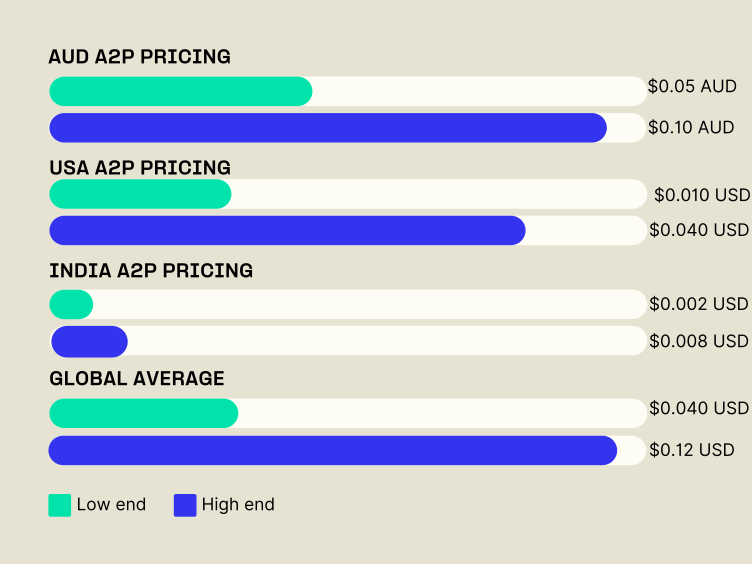
A2P SMS pricing in Australia typically ranges from AUD $0.05 to $0.15 per message for domestic delivery, depending on volume, carrier, and whether you're using a long code, short code, or alphanumeric sender ID. International rates vary more widely, from USD $0.01 to $0.50 per message globally.
Domestic delivery times in Australia generally fall under five seconds, with carrier coverage effectively universal given Australia's 126%+ mobile penetration. Enterprise throughput typically ranges from 100 to 1,000 messages per second, scaling higher with dedicated short codes or high-volume agreements.
The compliance burden in Australia is comparatively high. Between the Spam Act, ACMA's Sender ID Register, the Privacy Act, and sector-specific rules (AUSTRAC for financial services, for example), businesses must invest in consent management, record retention, and ongoing monitoring—overhead that an SMS API platform with built-in compliance tooling can significantly reduce.
Implementation checklist
Getting SMS API integration right in Australia requires preparation across legal, technical, and operational dimensions.
Legal and compliance setup. Start by auditing your consent management processes. Every recipient must have provided express consent before receiving commercial SMS, and you need to maintain auditable records of when and how that consent was given. Register your sender IDs with a participating telco ahead of the 1 July 2026 ACMA deadline. Update your privacy policy to reflect SMS data handling practices, and document a complaint handling procedure in case ACMA investigates.
Technical integration. Provision your API credentials (API key and secret) and configure webhook endpoints for delivery receipts so you can track message status in real time. Implement rate limiting to prevent abuse and protect against SMS flooding. Build error handling for common failure cases: invalid numbers, carrier timeouts, and undeliverable messages. Following A2P messaging best practices during integration will save significant debugging time later.[12:57 PM]Operational readiness. Establish carrier relationships or select an SMS API platform that manages those relationships for you. Set up a monitoring dashboard to track delivery success rates, costs per message, and opt-out rates. Assign staff to compliance monitoring, as ACMA's enforcement activity has increased consistently since 2022. Finally, build an incident response plan that covers carrier outages, regulatory inquiries, and potential data breaches.
Fraud prevention and scam mitigation
Fraud is a significant concern in Australian messaging. According to the ACCC's Targeting Scams Report 2024, Australians reported AUD $2.03 billion in combined scam losses in 2024, a 25.9% decrease from the prior year. Phone-based scams accounted for AUD $107.2 million in losses reported to Scamwatch alone, making sender verification and fraud prevention a priority for any business operating in this space.
Implementing proper sender ID registration, rate limiting, and content filtering helps protect both your brand and your recipients. The ACMA's Sender ID Register, once fully enforced, will add another layer of trust by ensuring recipients can distinguish verified business messages from potential scams.
Getting started
Australia's combination of high mobile penetration, strict regulatory enforcement, and an increasingly fraud-aware consumer base means that SMS API implementation requires more upfront planning than in many other markets. But the payoff is direct access to one of the most engaged mobile audiences globally, through a channel with open rates that far outperform email.
The fastest path to compliant, reliable SMS delivery in Australia is through a platform that handles carrier relationships, consent tooling, and sender ID registration for you. Telnyx's SMS API provides global A2P routing with Australian origination, built-in compliance tools aligned with Spam Act requirements, and the fraud prevention infrastructure that the Australian market demands.
Share on Social