
Messaging
SMS verification in Australia: A complete guide
How to implement SMS verification in Australia, including regulations, sender ID rules, and A2P messaging best practices.

By Eli Mogul
Australia's near-universal mobile penetration, with 29.1 million mobile cellular subscriptions reported in 2023 across a population of roughly 27 million, makes SMS verification one of the most reliable and effective channels for confirming user identity. Whether you're building two-factor authentication (2FA) for a fintech app, confirming e-commerce transactions, or securing account signups, sending SMS verification codes to Australian numbers requires a solid understanding of local regulations, carrier infrastructure, and deliverability best practices.
This guide covers everything you need to implement SMS verification in the Australian market: from the regulatory landscape and A2P messaging mechanics to step-by-step setup and provider selection.
What is SMS verification?
SMS verification is the process of confirming a user's identity by sending a one-time password (OTP) to their mobile phone via text message. The user enters that code into your application, proving they have access to the phone number they provided.
Businesses rely on SMS verification for several core use cases: account registration, two-factor authentication during login, password resets, and transaction confirmations. It's a straightforward layer of security that dramatically reduces unauthorized access. According to a 2019 Microsoft report cited by Eftsure, two-step authentication blocks 99.9% of automated attacks, and an estimated 93% of organizations worldwide use SMS OTPs for verification processes.
Despite growing interest in alternative methods like authenticator apps and passkeys, SMS-based OTP remains the most widely adopted verification channel due to its universal device compatibility and ease of implementation. Among organizations that have adopted 2FA, roughly 41% rely on SMS-based verification, while authenticator apps and biometrics follow behind.
Australian regulations for SMS verification
Australia has several overlapping regulatory frameworks that govern how businesses send messages to mobile users. Understanding these rules before sending a single OTP is non-negotiable.
Spam Act 2003
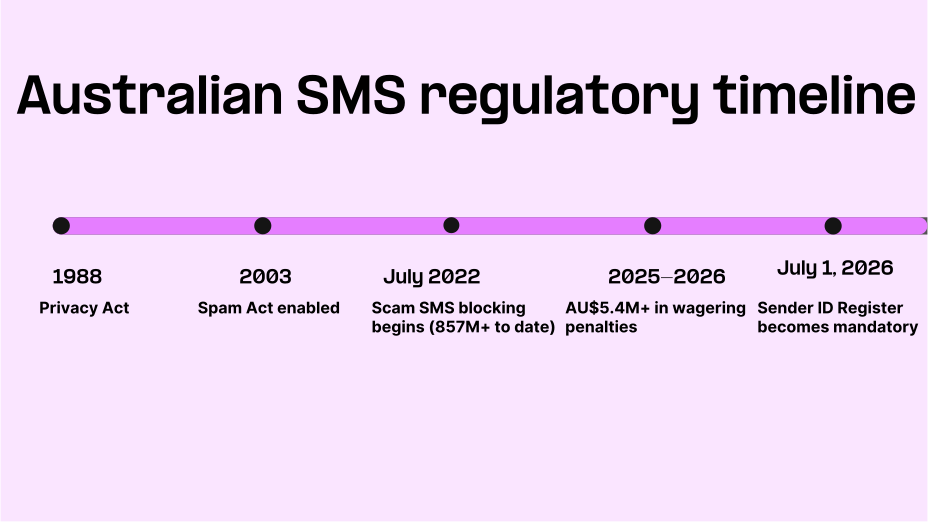
The Spam Act 2003 is Australia's foundational anti-spam legislation, enforced by the Australian Communications and Media Authority (ACMA). Under the Spam Act, a commercial electronic message must not be sent without prior opt-in consent from the recipient. Each message must also identify the sender and include a functional unsubscribe mechanism.
The good news for verification use cases: transactional messages like OTP codes are exempt from the consent and explicit unsubscribe mechanism requirements that apply to marketing SMS. However, you still must clearly identify your business as the sender. Verification codes don't require prior opt-in if the user requested the service (e.g., signing up for an account), but the sender ID must always be clear. It's worth noting that consent for one message type does not extend to another: if a user consents to receive email, that does not grant permission to send them SMS. Violations of the Spam Act can result in penalties of up to $2.1 million for repeated breaches.
ACMA enforcement
ACMA has ramped up enforcement activity significantly. Telcos reported blocking more than 857.4 million scam SMS since July 2022, and the regulator has issued millions of dollars in penalties to businesses that fail to comply with spam rules. In one high-profile case, the Commonwealth Bank of Australia received a penalty of more than $7.5 million for sending over 170 million non-compliant emails. Multiple wagering companies also paid over AU$5.4 million in combined penalties during 2025 and 2026 for consent, unsubscribe, and sender ID violations. The Australian government has committed nearly $170 million to anti-scam initiatives in recent years, including the establishment of the National Anti-Scam Centre, signaling that enforcement will only intensify.
SMS Sender ID Register
Australia is preparing to roll out its SMS Sender ID Register in 2026, with the registry set to become mandatory from 1 July 2026. Led by ACMA, the initiative requires businesses using alphanumeric sender IDs to register those identifiers. Unregistered sender IDs risk having their messages flagged or blocked entirely by carriers. If you currently send verification codes under a branded sender name (e.g., 'MyApp'), you will need to register that ID with an authorized telco provider by July 1, 2026, to avoid delivery disruptions. For a practical overview of how these rules affect business texting, MessageMedia's guide to ACMA texting rules provides a useful checklist.
Privacy Act 1988
The Privacy Act 1988 governs how organizations collect, store, use, and disclose personal information, including phone numbers. It is the main piece of Australian legislation that protects the handling of personal information about individuals. The Act's 13 Australian Privacy Principles (APPs) apply to government agencies and private sector organizations with an annual turnover of $3 million or more. Organizations collecting phone numbers for verification purposes must only collect data reasonably necessary for their functions, secure it against unauthorized access, and destroy it when no longer needed. Penalties for serious breaches can reach up to AUD $50 million or 30% of adjusted annual turnover.
How A2P messaging works in Australia
Application-to-Person (A2P) messaging is the technical framework behind SMS verification. It refers to any automated message sent from a business application to an individual's mobile phone, as opposed to person-to-person (P2P) texts between individuals. The global A2P messaging market was valued at approximately USD $71.5 billion in 2024 and continues to grow as businesses across banking, e-commerce, and healthcare adopt SMS for transactional communication.
In Australia, businesses can send A2P messages using several sender types:
| Sender type | Description | Best for | Throughput | Sender ID Register |
|---|---|---|---|---|
| Virtual mobile number | A standard Australian mobile number (+61 4xx) provisioned for A2P traffic | Transactional messages, 2FA | Moderate | Not required |
| Short code | A dedicated 5-6 digit number leased through carriers | High-volume campaigns | High | Not required |
| Alphanumeric sender ID | A branded text string (e.g., "MyApp") displayed as the sender | Brand recognition, OTP | Moderate | Required from July 2026 |
| Toll-free number | An 1800 or 1300 number configured for SMS | Customer service, inbound | Moderate | Not required |
Australian carriers enforce rate limits on A2P traffic to prevent spam and maintain network quality. Direct carrier routes typically offer faster delivery and higher throughput compared to messages routed through aggregator chains, which can introduce latency that degrades the OTP experience.
How to send SMS verification codes to Australian numbers
Getting started with SMS verification in Australia involves four key steps: provisioning a number, configuring your messaging profile, sending the OTP, and validating the code.
1. Provision an Australian number. Select a local Australian number that supports outbound SMS. A local number improves deliverability and builds trust with recipients. Through Telnyx's Australian number provisioning, you can search for and activate numbers via the Mission Control Portal or API.
2. Configure a verification profile. If using a purpose-built verification API, create a profile that defines the OTP code length, expiry window, and delivery channel (SMS, voice, or flash call). The Telnyx Verify API handles code generation, delivery, and timeout management automatically, so you don't need to build that logic from scratch.
3. Send the OTP. Trigger a verification request by providing the recipient's Australian phone number and your profile ID. Here's a simplified example using cURL:
4. Validate the code. When the user enters the OTP, submit it to the verification endpoint. The API confirms whether the code is correct and has not expired. Failed attempts can trigger automatic retries or fallback to voice-based delivery.
For teams that prefer more granular control over message formatting and delivery, the Telnyx Messaging API provides direct SMS sending capabilities with delivery receipts and webhook-based status tracking.
Best practices for SMS verification in Australia
Following these guidelines will help maximize delivery rates and protect your users:
Keep OTP codes short with clear expiry. Use 6-digit numeric codes with a 5-minute expiration window. Shorter, time-limited codes reduce the attack surface for interception while giving users enough time to enter them.
Use local Australian numbers. Sending from a local +61 number or a registered alphanumeric sender ID increases the likelihood of delivery. Messages from international numbers are more likely to be filtered or delayed by Australian carriers due to routing rules and spoofing prevention systems.
Implement rate limiting. Protect your verification endpoint from abuse by capping the number of OTP requests per phone number within a time window (e.g., no more than 5 requests per phone number per 15 minutes). This prevents both brute-force attacks and unnecessary messaging costs.
Provide fallback channels. Not every SMS will arrive on the first attempt. Offering a voice OTP fallback, where the code is read aloud via an automated call, ensures coverage even when SMS delivery fails due to carrier issues or number portability delays.
Monitor delivery metrics. Track delivery rates, latency, and failure codes to identify routing issues early. The Telnyx developer documentation provides detailed delivery receipt data to help you optimize performance over time.
Choosing an SMS verification provider for Australia
Not all messaging providers are built the same, especially for time-sensitive use cases like OTP delivery where every second of latency matters.
Here's what to evaluate when selecting a provider for Australian SMS verification:
Direct carrier routes vs. aggregator chains. Providers that route messages through multiple intermediaries introduce additional latency, sometimes adding 10 to 30 seconds to delivery time, compared to direct carrier connections. For OTP codes that expire within minutes, this delay can mean the difference between a successful login and a frustrated user. Direct carrier connectivity shortens the delivery path and increases reliability.
Purpose-built verification tools. Generic SMS APIs require you to build OTP generation, expiry management, retry logic, and code validation from scratch. A dedicated verification API handles all of this out of the box, reducing development time and the risk of implementation errors.
Compliance and coverage. Your provider should support Australian number types, comply with ACMA regulations, and be prepared for the mandatory Sender ID Register. Telnyx operates with carrier-grade infrastructure and global coverage, including direct connectivity in Australia, making it straightforward to stay compliant as regulations evolve.
Transparent pricing. Look for per-message or per-verification pricing without hidden platform fees. Some providers charge for both successful and failed verification attempts, inflating costs. Look for providers that charge only for successful verifications, which aligns your costs with actual user outcomes.
Get started with SMS verification in Australia
Implementing SMS verification in Australia doesn't have to be complex. With the right provider and a clear understanding of the regulatory landscape, you can go from zero to sending OTP codes in under an hour.
Here's how to get started:
- Sign up for a Telnyx account and provision an Australian number through the Mission Control Portal.
- Create a Verify profile with your preferred OTP settings (code length, timeout, delivery channel).
- Integrate the Verify API into your application using your preferred language SDK or direct REST calls.
- Send your first verification code and validate it programmatically.
Australia's regulatory environment is tightening, with the mandatory Sender ID Register taking effect in mid-2026 and ACMA continuing aggressive enforcement against non-compliant messaging. Building your verification flow on a platform that offers direct carrier routes, a private global network, and built-in compliance support positions your application for both reliability and regulatory readiness from day one.
Share on Social