
Telnyx
Sovereign AI vs data residency: what's the difference and why it matters for enterprise AI
Data residency says where data is stored; data sovereignty says which laws govern it; sovereign AI means end-to-end control of the AI stack. Knowing the difference helps enterprises close compliance gaps and choose safer AI infrastructure.

By Eli Mogul
Your compliance team just asked IT to certify your AI tools as "sovereign." But what does that actually mean? Depending on who you ask, sovereign AI could refer to a national initiative to build domestic GPU clusters, an enterprise's decision to self-host its LLMs, or simply choosing a cloud region within your own borders. The term carries different weight for a government procurement officer than it does for a CTO evaluating inference providers.
That ambiguity creates real risk. When legal, compliance, and engineering teams don't share a common vocabulary, organizations end up with gaps between what they think they've secured and what they actually control. This guide breaks down three related but distinct concepts (data residency, data sovereignty, and sovereign AI) so your team can make sharper infrastructure decisions.
What is data residency?
Data residency refers to the physical location where data is stored and processed. When an organization selects an EU cloud region, or mandates that call recordings stay on servers in Frankfurt, that's a data residency decision. It's the most tangible layer of data control: you can point to a data center on a map and say, "Our data lives there."
Regulations around the world codify this concept. GDPR (specifically Article 46) restricts transfers of personal data outside the EEA without adequate safeguards. Brazil's LGPD, India's Digital Personal Data Protection Act, and Saudi Arabia's Cloud First policy all impose similar geographic requirements. For many enterprises, choosing the right cloud region is the first checkbox on a long compliance list.
But data residency alone doesn't tell the full story. It doesn't govern where model training happens, who can access inference logs, or whether a vendor's proprietary model was trained on your data. Treating data residency as a synonym for compliance is a common mistake. It's a necessary condition, not a sufficient one.
What is data sovereignty?
Data sovereignty is the legal principle that data is subject to the laws of the jurisdiction where it resides. While residency is a technical mechanism (choosing a server location), sovereignty is the legal framework that governs what happens to data once it's there.
This distinction matters when data crosses borders. Standard Contractual Clauses (SCCs) under GDPR, for instance, attempt to extend EU-level protections to data processed outside the EEA. But laws like the U.S. CLOUD Act, which allows U.S. authorities to compel American companies to hand over data regardless of where it's stored, create jurisdictional tension. This is not a theoretical conflict: the EU's Court of Justice invalidated the EU-U.S. Privacy Shield in its Schrems II ruling on precisely this basis, and the European Data Protection Board has since flagged the CLOUD Act as a direct challenge to GDPR compliance. Your data may physically reside in the EU, but if a U.S.-headquartered vendor controls access, sovereignty questions arise.
According to Gartner, more than 75% of enterprises outside the U.S. will have a digital sovereignty strategy by 2030, up from less than 5% today. That signals a fundamental shift in how organizations think about cloud infrastructure: not just as a technical choice, but as a geopolitical one.
What is sovereign AI?
Sovereign AI goes further than either data residency or data sovereignty. It describes full organizational (or national) control over the entire AI stack: the infrastructure that runs the models, the model weights themselves, the training data pipelines, and the inference layer that processes inputs and generates outputs.
Think of it as three layers. Infrastructure sovereignty means owning or controlling the compute hardware (GPUs, networking, storage) rather than relying on a hyperscaler's shared environment. Model sovereignty means controlling which models run, how they're trained, and whether you can fine-tune or replace them. Data sovereignty (as defined above) ensures the legal and jurisdictional protections travel with your data throughout the pipeline.
In practice, sovereign AI can look like an on-premises LLM deployment, a private model hosted in your own cloud tenancy, or an air-gapped inference environment for classified workloads. Government programs in the EU, UK, and Gulf states are investing heavily in sovereign AI infrastructure. The EU's €20 billion InvestAI initiative aims to accelerate domestic GPU capacity. But sovereign AI isn't just a government concern. Any enterprise that fine-tunes a model on proprietary customer data needs to ask: who else can access those model weights, and under which jurisdiction?
The EU AI Act, which applies high-risk system obligations starting August 2, 2026, adds urgency. Organizations deploying AI in regulated contexts, including credit scoring, hiring, and medical diagnostics, must demonstrate governance over the full pipeline, not just the data storage layer.
How these concepts overlap
These three concepts are related but not interchangeable. The table below maps the key differences.
An organization might satisfy data residency by hosting in a local cloud region, achieve partial data sovereignty through SCCs, and still lack sovereign AI because a third-party vendor controls model training and inference logs. Each layer addresses a different dimension of control.
Why enterprise IT needs both data residency and sovereign AI
Regulated industries face the sharpest version of this challenge. Financial services firms operating under MiFID II or SEC oversight must prove data governance across their technology stack. Healthcare organizations bound by HIPAA (or France's HDS certification) need to demonstrate control not just over patient records, but over any AI system that processes them. Government agencies pursuing FedRAMP or IL5 authorization (U.S. federal security standards that govern how cloud services handle sensitive and classified government data) need end-to-end auditability.
Consider a concrete scenario: a U.S. hyperscaler offers an EU region for your cloud deployment. That checks the data residency box. But if you fine-tune a model on customer data using that provider's managed AI service, where does the gradient data go? Who has access to the updated model weights? Can the provider's own systems access your inference inputs? These are sovereign AI questions that data residency alone cannot answer.
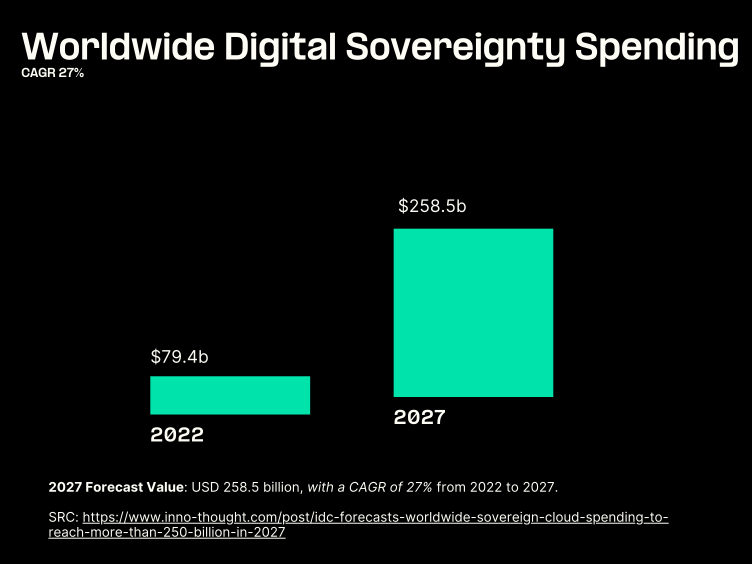
The financial stakes are growing. IDC projects global sovereign cloud spending will reach $258.5 billion by 2027, reflecting a compound annual growth rate of 26.6%. And Gartner predicts that 70% of enterprises adopting GenAI will cite digital sovereignty as a top criterion for choosing cloud services by 2027. Meanwhile, Gartner forecasts that organizations will abandon 60% of AI projects that lack AI-ready data governance by 2026. The message is clear: data governance isn't just a compliance exercise. It's a prerequisite for AI projects that actually ship.
How to evaluate AI vendors for sovereignty
When evaluating AI infrastructure providers, sovereignty should be part of your procurement checklist, not an afterthought. Here are the questions that matter:
Data residency options: Can you choose where data is stored and processed? Does the provider offer region-specific deployments, and do those options extend to inference logs and model artifacts, not just raw data?
Model hosting flexibility: Can you bring your own model? Can you fine-tune on proprietary data without that data leaving your controlled environment? Can you swap models without rebuilding your integration?
Inference log controls: Are inference inputs and outputs stored? If so, where, for how long, and who has access? Does the vendor offer a no-retention policy for sensitive workloads?
On-premises and private cloud deployment: For the most sensitive use cases, can you deploy the full stack, including inference, in your own environment?
Contractual provisions: Does the vendor's DPA explicitly address AI-specific data flows? Are there clear terms around model training exclusions, subprocessor oversight, and jurisdiction?
Any vendor that can't answer these questions clearly is asking you to take their sovereignty claims on faith. In a regulatory environment that's tightening globally, faith isn't a compliance strategy.
How Telnyx approaches sovereign communications infrastructure
Telnyx is built differently from hyperscaler-dependent providers. The platform operates on a private, global multi-cloud IP network with owned-and-operated points of presence (PoPs) across 100+ locations, interconnected by a private MPLS fiber backbone. This means customer data travels over Telnyx's own infrastructure, not across the public internet.
For AI workloads, Telnyx colocates GPU infrastructure directly adjacent to its global PoPs, enabling low-latency inference without sending data to a distant cloud region. Developers can deploy leading open-source and proprietary models through the LLM Library or bring their own models via any OpenAI-compatible endpoint, including self-hosted inference servers, for full model sovereignty.
Telnyx also provides granular data residency controls that let customers specify where call detail records, message records, and media storage reside. And the company's GDPR compliance program and Data Processing Addendum address cross-border data transfer obligations with standard contractual clauses baked in.
For enterprise teams building AI-powered voice, messaging, or connectivity workflows, this architecture means you don't have to choose between performance and control. You get both, on infrastructure designed for sovereignty from the ground up.
Making sovereignty actionable
Data residency, data sovereignty, and sovereign AI aren't interchangeable terms, and treating them as such leaves gaps in your compliance posture. Data residency tells you where your data lives. Data sovereignty tells you whose laws apply. Sovereign AI tells you who actually controls your AI stack end-to-end.
As AI regulation accelerates and geopolitical pressures reshape cloud strategy, enterprises need infrastructure partners that address all three layers. The organizations that get this right won't just avoid compliance pitfalls. They'll build AI systems they can trust, audit, and scale with confidence.
Schedule a consultation with Telnyx about private deployment and sovereign AI infrastructure
Share on Social


