
Insights and Resources
Top 3 Voice AI Agent providers in Brazil
Evaluating voice AI vendors in Brazil? Compare the top 3 providers on infrastructure, pricing, and compliance to find the right fit for your business.

By Eli Mogul

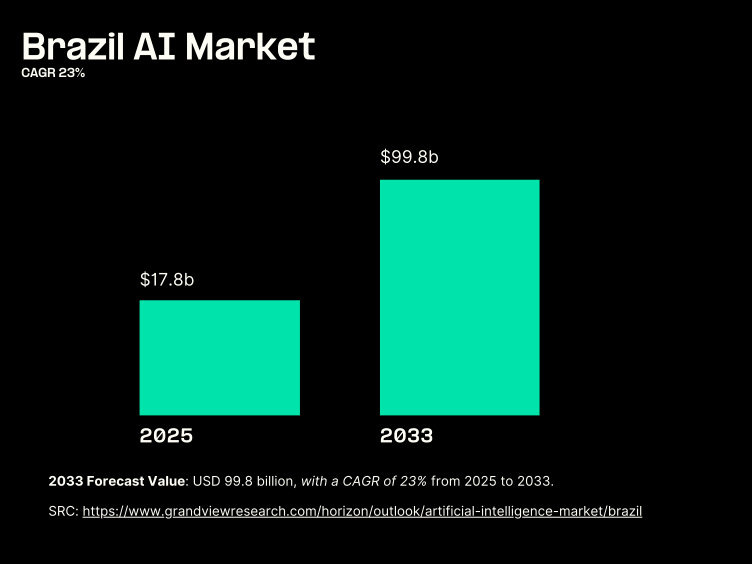
Brazil's AI market generated $17.8 billion in revenue in 2025 and is projected to grow at a 23% CAGR through 2033, making it the fastest-growing AI market in Latin America. That growth extends directly into voice. With 185 million internet users, 98.4% of whom connect via mobile, and 44% of Brazilian companies already deploying conversational AI for customer service, the country has become one of the most active markets for voice AI adoption globally.
For enterprises in banking, healthcare, retail, and logistics, automating high-volume voice interactions is no longer optional. Gartner predicts that 80% of customer service organizations will apply generative AI to improve agent productivity and customer experience, while a more recent forecast projects agentic AI will autonomously resolve 80% of common service issues by 2029.
But choosing the right voice AI provider for Brazil carries unique challenges. Latency sensitivity, LGPD compliance requirements, Portuguese-language NLP accuracy, and reliable PSTN connectivity all factor into the decision. Below, we break down the top 3 voice AI providers worth evaluating for Brazilian deployments in 2026.
What to look for in a voice AI provider for Brazil
Before comparing vendors, it helps to establish the criteria that matter most for this market. Brazil's regulatory and infrastructure landscape demands more from voice AI platforms than what a standard global comparison might surface.
Latency and infrastructure proximity. Voice AI quality degrades with distance. Providers that colocate compute infrastructure near Brazilian points of presence (PoPs) deliver noticeably faster response times. For real-time conversations, delays exceeding 800 milliseconds cause 40% higher call abandonment rates, according to enterprise research.
LGPD and data residency. Brazil's General Data Protection Law (Lei Geral de Proteção de Dados) requires organizations to maintain strict data handling, consent management, and breach notification protocols. Vendors that offer data residency options within Brazil, or at minimum within Latin America, simplify compliance for regulated industries like finance and healthcare.
Portuguese-language support. Accurate Brazilian Portuguese NLP, including STT and TTS, is non-negotiable. Generic multilingual models often struggle with regional accents, slang, and conversational cadence.
PSTN connectivity. Many voice AI platforms lack native telephony. If a provider requires third-party carriers to connect calls, that adds latency, cost, and compliance complexity.
Full-stack vs. multi-vendor. Some platforms handle the complete voice AI pipeline (telephony, STT, LLM inference, TTS) in one place. Others require stitching together multiple providers, which creates operational challenges around debugging, billing, and performance monitoring.
1. Telnyx
Telnyx stands out as the only provider that unifies carrier-grade communications infrastructure with fully integrated AI on a single platform. Where most competitors require you to assemble a stack of third-party services, Telnyx owns the entire voice pipeline, from SIP trunking and number provisioning to STT, TTS, and LLM inference.
Infrastructure. Telnyx operates a private, global Tier-1 network with 15+ points of presence worldwide, routing calls over its own backbone rather than through third-party carriers. By colocating dedicated GPUs directly adjacent to these PoPs, Telnyx minimizes the physical distance data travels, resulting in sub-500ms response latency for voice AI interactions.
Voice AI Agents. Telnyx Voice AI Agents run natively on the same network that handles telephony. This means LLM inference, speech recognition, and voice synthesis all happen within a single infrastructure layer. There is no hop between a telecom provider, a separate AI vendor, and an external TTS engine. For Brazilian enterprises handling thousands of concurrent calls, this architecture eliminates the stacked latency that plagues multi-vendor setups.
Brazil-specific advantages. Telnyx is a licensed telecom provider in 30+ markets with PSTN calling capabilities in 100+ countries, including Brazil. Teams can provision local Brazilian numbers, configure SIP trunks, and deploy voice AI agents from a single dashboard. Multilingual AI support, including Brazilian Portuguese, ensures conversations sound natural and contextually accurate.
Pricing. Telnyx offers Voice AI orchestration at $0.05 per minute (USD), with STT and Telnyx-native TTS included. Open-source model inference is billed separately, so you pay only for the models each call uses. That pricing model makes it accessible for high-volume use cases like contact center automation, outbound campaigns, and appointment scheduling.
Compliance. With regional deployment options, SOC2 certification, and the ability to keep data within specific geographies, Telnyx provides a straightforward path to LGPD alignment.
Best for: Enterprises that want full-stack control over the voice AI pipeline without managing multiple vendors, and teams building at scale in regulated industries.
2. Twilio
Twilio is the most widely recognized CPaaS provider globally, and it has a meaningful presence in Brazil. The company held its SIGNAL São Paulo conference in 2025, underscoring its investment in the Latin American market.
Infrastructure. Twilio provides programmable voice APIs with coverage in 180+ countries, including SIP trunking, call control, and basic speech recognition. Twilio's carrier network is extensive and reliable and has been the default telephony layer for many voice AI deployments.
Voice AI capabilities. Twilio's ConversationRelay, now generally available, lets developers build voice AI agents using their choice of LLM, with real-time streaming, interruption handling, and expressive voices. Twilio also launched Conversational Intelligence for analyzing voice calls and converting them into structured data. However, Twilio does not provide native LLM inference or a built-in AI model layer. Developers need to integrate third-party LLMs, TTS engines (such as ElevenLabs or Deepgram), and orchestration layers, which can introduce stacked latency across providers.
Brazil-specific considerations. Twilio has invested in data residency for the EU and is expanding regionalization, but Brazil-specific data residency is still limited. Twilio's 2026 conversational AI report found a satisfaction gap in the Brazilian market: 96% of organizations believe customers are happy with their AI, but only 66% of consumers agree.
Pricing. Twilio charges per-minute rates for voice, with additional costs for STT, TTS, and LLM services from third-party providers. Total cost depends heavily on which vendors you choose for each layer of the stack.
Best for: Developer teams comfortable assembling and managing a multi-vendor voice AI stack, and organizations already invested in the Twilio ecosystem.
3. Vonage
Vonage, now a subsidiary of Ericsson, offers a suite of communication APIs with growing AI capabilities. Its partnership with AWS, announced in mid-2025, pairs Amazon Nova Sonic's speech-to-speech model with Vonage's Voice API.
Infrastructure. Vonage provides global voice API coverage with SIP trunking and WebRTC support. Being part of Ericsson gives it access to carrier-grade network resources. However, the AI infrastructure itself relies on third-party cloud providers like AWS rather than Vonage-owned compute.
Voice AI capabilities. Vonage AI Studio is a low-code/no-code flow builder for creating virtual agents across voice and messaging channels. It includes a proprietary NLU engine and supports automatic speech recognition in 120+ languages. The platform is designed for organizations that want to deploy voice bots without deep technical resources. However, the platform leans more toward structured IVR-replacement workflows than open-ended, multi-turn conversational AI. For teams building complex voice AI agents with dynamic context and memory, the tooling may feel constrained.
Brazil-specific considerations. Vonage supports Portuguese-language interactions and has global carrier reach for PSTN connectivity in Brazil. LGPD compliance will depend on the specific cloud deployment and data residency configuration, which may require additional coordination given the AWS dependency.
Pricing. Vonage offers per-second billing for voice API usage, with managed AI services available at additional cost. The fully managed voice bot packages include professional services hours, but complex deployments may require custom scoping.
Best for: Organizations seeking a managed, low-code approach to voice AI, particularly those already using Ericsson or Vonage infrastructure for their communications stack.
Provider comparison at a glance
| Criteria | Telnyx | Twilio | Vonage |
|---|---|---|---|
| Native PSTN + AI on one platform | Yes | Partial (requires third-party AI) | Partial (AI via AWS) |
| Voice AI latency | Sub-500ms (colocated GPUs) | Varies by stack configuration | Depends on AWS region |
| Brazilian Portuguese NLP | Built-in multilingual support | Via third-party integrations | 120+ languages via ASR/NLU |
| LGPD-friendly data residency | Regional deployment options | EU available; Brazil limited | Dependent on AWS configuration |
| Pricing transparency | From $0.05/min for orchestration (STT and Telnyx-native TTS included) | Per-minute + third-party costs | Per-second + managed services |
Making the right choice for Brazil
The voice AI market in Brazil is maturing quickly. The global conversational AI market was valued at $11.58 billion in 2024 and is projected to reach $41.39 billion by 2030, with Latin America among the fastest-growing regions. For Brazilian enterprises, the decision comes down to how much control, speed, and simplicity you need.
If your priority is reducing vendor complexity and running voice AI with the lowest possible latency on infrastructure purpose-built for real-time telephony, Telnyx is the platform to evaluate first. Its full-stack architecture, competitive pricing, and native PSTN connectivity give it a structural advantage that multi-vendor approaches struggle to match.
Twilio and Vonage both bring strengths to the table, with established developer ecosystems, broad carrier reach, and familiar APIs. But for Brazilian deployments where latency, compliance, and cost at scale are deciding factors, the platform that owns the full pipeline from network to inference will consistently outperform one that depends on third-party integrations.
Voice AI in Brazil is not a future bet. It is a present-day competitive requirement. Choosing the right infrastructure partner now determines how quickly and reliably your organization can scale.
Discussing Voice AI in Brazil? Join us on the Telnyx subreddit.
Share on Social


