
Insights and Resources
WhatsApp AI agents: voice and messaging on one platform
This post explains how to do that with Telnyx, why it matters for WhatsApp-first markets, and what a unified AI stack looks like in production.

By Eli Mogul
WhatsApp has become the operating system of customer communication. In Brazil, 98% of smartphone users have it installed. In Spain and Germany, adoption sits above 90%. Across the UAE, Saudi Arabia, and Egypt, penetration tops 90% as well. With over 3 billion monthly active users globally and more than 100 billion messages exchanged daily, WhatsApp is no longer just a consumer app. It's the default business channel in much of LATAM, MENA, Southeast Asia, and Europe.
Yet most businesses still confine their AI agents to web chat. That leaves a massive gap between where customers actually spend their time and where companies are able to meet them. The fix isn't another bolt-on chatbot, it's extending your existing AI agents into WhatsApp, with messaging and voice unified on the same platform you already use for PSTN calls and SMS.
This post explains how to do that with Telnyx, why it matters for WhatsApp-first markets, and what a unified AI stack looks like in production.
Why WhatsApp is the channel your AI agents need to be on
If you build customer-facing AI, regional channel preference is no longer a soft preference. It's the difference between an agent that gets used and one that doesn't.
A snapshot of recent regional adoption data:
| Region | WhatsApp adoption signal | Why it matters for AI agents |
|---|---|---|
| LATAM | >90% penetration in Brazil, Mexico, and Argentina | Customers expect support, sales, and even checkout in-chat |
| MENA | >90% adoption in UAE, Saudi Arabia, and Egypt | Voice notes and conversational support dominate over forms and email |
| Europe | 82% mobile phone penetration; Spain and Germany above 90% | Already core business infrastructure, not an "alt" channel |
| South Asia / SEA | 535M users in India alone; high adoption in Indonesia and the Philippines | High-volume support and commerce flows favor messaging-first AI |
Sources: World Population Review, SQ Magazine, Backlinko, and Statista.
The behavioral data tells a similar story. WhatsApp users open more than 70% of business messages within minutes, compared to the slow, low-engagement nature of email. And 76% of consumers say they want the flexibility to switch between messaging and calling within a single interaction, according to research cited by Meta during its 2025 Business Calling API launch.
If your AI agent can't follow customers across both modes, you're forcing them to leave the channel they prefer.
The shift: from chatbots to AI agents on WhatsApp
For most of the last decade, WhatsApp automation meant rule-based chatbots: keyword triggers, scripted flows, and rigid menu trees. That's changed.
A WhatsApp AI agent is an LLM-powered assistant that understands intent, maintains context across multi-turn conversations, and integrates with internal systems like CRMs, order databases, and ticketing tools. Unlike a scripted bot, it can interpret messy, fragmented customer messages, pull live data, take action (place an order, reschedule an appointment, escalate a ticket), and hand off to a human or to a specialized AI agent when needed.
The market is moving fast in this direction. In 2022, Gartner projected that conversational AI will reduce contact center labor costs by $80 billion globally by 2026, and that agentic AI will autonomously resolve 80% of common customer service issues without human intervention by 2029. McKinsey research suggests AI deployments can reduce total customer interactions by 40 to 50%.
Combine those efficiency gains with WhatsApp's reach, and the business case is clear: businesses that put AI agents on the channel customers already use see compounding returns.
What changed in 2025: WhatsApp Business Calling API
In July 2025, Meta launched the WhatsApp Business Calling API, opening up native voice calls to larger businesses through the WhatsApp Business Platform. Until then, only small business accounts on the WhatsApp Business app could take voice calls. Enterprise-tier accounts integrating through the API were limited to messaging only.
Now both inbound and outbound voice calls are supported within the same WhatsApp thread as messages. Per TechCrunch's coverage of the announcement, this also opens the door for AI-enabled voice agents to run customer service over WhatsApp, not just text-based ones.
Early results from Meta's case studies make the impact clear. Banco PAN, a São Paulo financial services firm, shifted its loan conversations end-to-end into WhatsApp and saw measurable lifts in loan offers and conversion. Cartão de Todos, one of Brazil's largest private discount programs, reported a 26% higher conversion rate and a 50% reduction in average call time to make a sale after adding voice. According to analysis from the Mobile Ecosystem Forum, early testers reported conversion increases from 2% to 45% when adding calling to a messaging-only flow.
That's the bigger pattern: text qualifies, voice converts. AI agents that can do both, without forcing the customer to change apps, win.
The infrastructure problem most teams run into
Here's where it gets messy. Stitching together WhatsApp messaging, WhatsApp voice calling, PSTN calling, SMS, and a conversational AI stack usually means five separate vendors:
- A WhatsApp Business Solution Provider (BSP) for messaging
- A separate provider (or BSP) for WhatsApp calling
- A CPaaS or carrier for PSTN voice and SMS
- A voice AI platform for STT, TTS, and LLM orchestration
- Custom middleware to keep state, context, and identity consistent across all of them
Every handoff between systems adds latency, brittle integrations, and one more bill. Worse, your AI agent's logic ends up duplicated: one version for web chat, one for WhatsApp, one for phone. Update the prompt, and you're patching it in three places.
Telnyx was built to collapse that stack. Voice, SMS, WhatsApp messaging, WhatsApp calling, and the conversational AI layer (STT, TTS, LLM orchestration, agent builder) all run on a single platform tied to a single number.
The Telnyx approach: one number, every channel, one AI stack
In April 2026, Telnyx launched WhatsApp Business Calling, letting businesses place and receive WhatsApp voice calls on the same Telnyx number they already use for PSTN voice, SMS, and AI-powered communications.
What that means in practice:
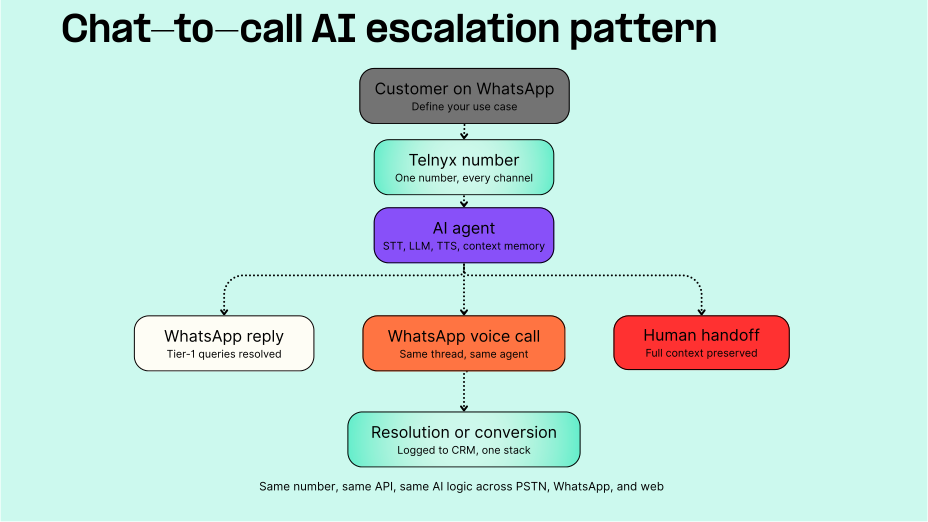
If you have a Telnyx Voice AI agent answering calls today, that agent now reaches WhatsApp users too. The same call flows, AI models, transfer logic, and CRM integrations work across channels. Inbound WhatsApp calls route to your existing SIP, Voice API, or TeXML connection. Outbound calls dial through a dedicated WhatsApp SIP subdomain. No new integrations, no separate voice AI stack for WhatsApp, no duplicated prompts.
For omnichannel customer engagement, that consolidation matters. As Zendesk's CX Trends Report notes, 70% of consumers expect anyone they interact with to have full conversation context, and 66% believe support interactions shouldn't interrupt what they're already doing. A unified AI agent that follows the customer from WhatsApp message to WhatsApp call to PSTN to web chat is the only way to deliver on that expectation without exponential engineering cost.
Sample workflows: chat-to-call AI agent escalation
Three patterns we see working in production:
1. Sales qualification, then voice close. An AI agent qualifies a lead over WhatsApp messaging (budget, timeline, intent), then offers a voice consult with the same agent (or a human) inside the same thread. Banco PAN's loan conversion flow follows this pattern.
2. 24/7 support with intelligent escalation. AI handles tier-1 WhatsApp queries (order status, password resets, FAQs). When sentiment, complexity, or explicit request crosses a threshold, the agent transfers to a specialist AI agent or human, optionally moving from chat to a voice call. McKinsey research cited by industry analysts shows GenAI-enabled agents achieve a 14% increase in issue resolution per hour.
3. Proactive outbound with consent. Send an approved WhatsApp template requesting permission to call. On opt-in, the AI agent places the outbound voice call for appointment confirmation, payment reminder, or service follow-up. All consent, throttling, and Meta-imposed rate limits (one permission request per 24 hours, up to five calls per 24 hours after consent) are handled in-platform.
What to look for when picking a stack
If you're evaluating how to add WhatsApp AI agents to your operation, a few things to scrutinize:
- Number consolidation. Can you run WhatsApp messaging, WhatsApp calling, PSTN, and SMS on the same number? Or are you provisioning separate numbers for each channel?
- AI stack ownership. Is the STT, TTS, and LLM orchestration native to the platform, or do you need to bolt on third-party voice AI? Native integration matters for latency, which directly affects how human your agent sounds.
- Reusable logic. Can the same AI assistant configuration handle calls from PSTN, WebRTC, and WhatsApp? Or do you maintain three copies?
- Compliance and regional reach. WhatsApp Business Calling availability varies by region and BSP. Confirm your provider covers your target markets, and check for licensed telecom presence in countries you serve.
- Pricing transparency. WhatsApp messaging, WhatsApp calling, PSTN, and AI inference each carry costs. A unified bill makes unit economics easier to model than four separate invoices.
Where this is heading
The lines between channels are blurring. WhatsApp now supports text, voice, video, voice messages, payments, and interactive product catalogs inside a single persistent thread. As PPC Land reported, Meta processes more than two billion WhatsApp calls daily already. Adding a programmable, AI-ready voice layer on top of that volume reshapes what "customer support" and "conversational commerce" look like in WhatsApp-first markets.
For businesses, the strategic question isn't whether to deploy AI agents on WhatsApp. It's whether to deploy them on a stitched-together vendor stack that splits voice from messaging from PSTN, or on a single platform that treats every channel as one conversation.
Telnyx WhatsApp Business API brings WhatsApp messaging and calling onto the same number, API, and AI stack you already use for voice and SMS. Same logic, every channel.
Start building for free or talk to our team about extending your AI agents to WhatsApp.
Share on Social


