
Telnyx
AI use cases in healthcare: patient engagement
Practical AI patient engagement use cases in healthcare, with ROI, tooling, and steps to launch securely.

By Eli Mogul
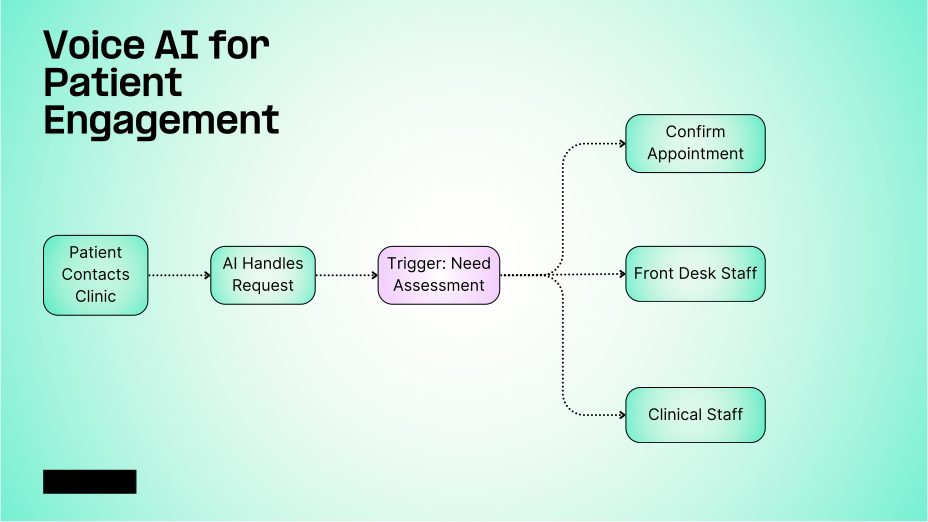
AI use cases in healthcare: AI patient engagement
Bottom line: Poor communication drives 63% of patients to switch providers, costing healthcare organizations millions in lost revenue. AI patient engagement tools, built on carrier-grade infrastructure with HIPAA compliance, can reduce no-shows by 30%, cut administrative burden by 17%, and improve satisfaction scores by over 30%. This guide shows you exactly which use cases deliver ROI and how to implement them across your health system.
The numbers tell a concerning story: clinical professionals report administrative tasks consuming significant portions of their week, sometimes up to 28 hours. Patient communication breakdowns have real consequences: nearly half of patients report avoiding scheduling due to phone frustrations, and poor communication is a major driver of provider switching.
Healthcare leaders understand the stakes. Approximately 70% of health-system executives recognize AI patient-engagement technology as critical to their organizations. The challenge isn't whether to adopt AI, it's knowing which use cases deliver measurable returns and how to deploy them without disrupting clinical workflows.
This playbook cuts through the noise. You'll find 12 proven AI patient engagement patterns, implementation guidance for Epic and Cerner environments, compliance frameworks for HIPAA and GDPR, vendor selection criteria, and KPIs that map to your strategic goals.
Why AI patient engagement matters now
The global AI in healthcare market is projected to reach $95.65 billion by 2028, but growth alone doesn't justify your budget allocation. Three forces make AI patient engagement urgent:
1. Labor scarcity is permanent
The global shortfall of healthcare workers will reach 11 million by 2030. Strikes in England canceled more than 1.5 million NHS appointments. New Zealand saw 36,000 nurses strike nationwide in December 2024. These aren't isolated incidents, they're symptoms of structural capacity constraints.
AI can free up 13%–21% of nurses' time, roughly 240–400 hours per nurse per year. That's not replacing clinicians, it's reclaiming time for care delivery.
2. Consumer expectations have shifted
About 65% of consumers view virtual care as more convenient than in-person visits. More than 84% expect healthcare organizations to partner with them in making health decisions.
When 73% of younger patients (ages 17–54) will switch doctors over poor customer experience, the cost of outdated communication becomes existential.
3. Economic pressure demands efficiency
U.S. health expenditures total $4.5 trillion. Health inequities alone account for $320 billion in annual healthcare spending, projected to reach $1 trillion by 2040 if unaddressed.
AI-driven workflows address both cost and equity. Automated outreach reaches underserved populations. In a survey of over 1,000 U.S. patients, 54% of non-white patients who missed appointments due to communication frustrations reported life-threatening health implications, compared with 33% of white patients (Artera/PureSpectrum).
12 high-impact AI patient engagement use cases
These use cases span the patient journey from initial contact through post-discharge. Each includes ROI metrics, implementation considerations, and compliance requirements.
1. Appointment scheduling and rescheduling
The problem: Phone trees frustrate patients. Patients will frequently choose not to schedule health appointments due to phone frustrations.
The solution: Voice AI agents handle scheduling 24/7, checking EHR availability in real time, offering appropriate slots based on provider schedules and patient preferences, and confirming appointments via SMS.
ROI: Reduced administrative burden, increased appointment volume, improved patient satisfaction.
Implementation: Integrate with Epic or Cerner scheduling APIs. Configure business rules for specialty-specific booking windows. Set up fallback routing for complex cases.
Compliance: Log all interactions for audit trails. Obtain consent for SMS confirmations. Ensure HIPAA-compliant data transmission.
2. Appointment reminders and confirmations
The problem: No-shows waste clinical capacity and drive revenue loss. Traditional reminder systems lack engagement.
The solution: Multi-channel reminders (voice, SMS, email) sent at optimized intervals. AI agents confirm attendance, reschedule if needed, and provide pre-visit instructions.
ROI: AI-driven reminders can reduce no-shows by up to 30%.
Implementation: Configure reminder cadence based on appointment type. Enable two-way SMS for quick confirmations. Track response rates by channel and adjust.
Compliance: Honor opt-out requests immediately. Use recognizable 10-digit numbers.
3. Triage and symptom assessment
The problem: Patients call with urgent questions. Staff triage adds wait time. Inappropriate ED visits strain resources.
The solution: AI agents ask structured symptom questions, assess urgency using clinical protocols, route to appropriate care level (telehealth, urgent care, ED), and document assessments in the EHR.
ROI: Reduced ED visits, improved resource allocation, better patient outcomes.
Implementation: Collaborate with clinical leadership to define triage protocols. Integrate with telehealth scheduling systems. Establish escalation paths for high-acuity cases.
Compliance: Ensure clinical oversight of triage logic. Document all assessments. Clearly communicate that AI triage doesn't replace medical judgment.
Learn more about how conversational AI improves access to mental health care.
4. Medication refill requests
The problem: Refill requests clog phone lines. Manual processing delays care. Patients abandon refills.
The solution: Voice AI captures refill requests, verifies patient identity, checks prescription status in the EHR, routes to pharmacy, and confirms processing timelines.
ROI: Users who used chatbot reminder features improved medication compliance by more than 20%.
Implementation: Integrate with pharmacy management systems. Configure identity verification (DOB, last four of SSN). Set up alerts for controlled substances requiring provider review.
Compliance: Verify patient identity robustly. Log all refill requests. Comply with state-specific controlled substance regulations.
5. Post-discharge follow-up
The problem: Missed follow-ups increase readmission rates. Manual outreach doesn't scale. Patients forget discharge instructions.
The solution: AI agents call within 24–48 hours post-discharge, review discharge instructions and medications, screen for complications, schedule follow-up appointments, and escalate concerning symptoms.
ROI: Lower readmission rates, improved patient satisfaction, early detection of complications.
Implementation: Trigger follow-up calls from EHR discharge events. Customize scripts by diagnosis or procedure. Route high-risk responses to care coordinators.
Compliance: Obtain consent for follow-up calls during discharge. Document all interactions in the EHR. Ensure care coordinators review flagged cases promptly.
6. Care gap closure and preventive outreach
The problem: Patients miss preventive screenings. Care gaps drive quality penalties. Manual outreach is expensive.
The solution: AI identifies patients with care gaps (colonoscopy, mammography, HbA1c), reaches out via preferred channel, educates on screening importance, and schedules appointments.
ROI: 57% of patients who watched interactive videos about colorectal cancer screening took action and got screened. Higher quality scores improve reimbursement.
Implementation: Pull care gap reports from population health platforms. Segment outreach by gap type and patient demographics. Track closure rates by cohort.
Compliance: Ensure culturally appropriate messaging. Offer language options. Track opt-outs and honor preferences.
Explore how AI outreach solutions improve high-risk care.
7. Lab results delivery and education
The problem: Delayed lab communication frustrates patients. Staff spend hours returning calls. Complex results confuse patients.
The solution: AI agents deliver normal results, explain clinical significance in plain language, flag abnormal values for provider callback, and schedule follow-up appointments when needed.
ROI: Reduced staff time on routine calls, improved patient understanding, faster time-to-treatment for abnormal results.
Implementation: Integrate with lab information systems. Define thresholds for automated delivery versus provider review. Provide clear explanations of common tests.
Compliance: Ensure provider authorization for automated delivery. Log all result deliveries. Provide easy escalation to live staff.
Read more about how to automate lab results delivery and patient education.
8. Pre-visit intake and registration
The problem: In-office paperwork slows check-in. Data entry errors reduce billing accuracy. Staff duplicate effort.
The solution: AI collects demographics, insurance information, medical history, and current medications via voice or text before visits. Data flows directly into the EHR.
ROI: Faster check-in, improved data accuracy, reduced staff burden.
Implementation: Send intake links after appointment confirmation. Validate insurance eligibility in real time. Flag incomplete forms for staff follow-up.
Compliance: Use secure, encrypted channels. Obtain consent for data collection. Provide paper options for patients without digital access.
9. Billing inquiries and payment reminders
The problem: Billing questions overwhelm staff. Payment delays impact cash flow. Patients avoid calling about bills.
The solution: AI agents answer common billing questions, explain charges in clear terms, set up payment plans, and process payments securely.
ROI: Higher digital engagement correlates with improved payment collection rates. Patients are significantly more likely to pay bills on time when contacted through recognizable communication channels like long-code texting.
Implementation: Integrate with revenue cycle management systems. Configure payment plan options. Provide escalation to billing specialists.
Compliance: Comply with Fair Debt Collection Practices Act. Secure payment processing (PCI DSS). Clearly identify the healthcare organization.
10. Insurance verification and prior authorization
The problem: Manual verification delays care. Prior authorization requests sit in queues. Denials require rework.
The solution: AI verifies coverage before visits, initiates prior authorization requests with complete documentation, tracks authorization status, and alerts staff to denials requiring appeal.
ROI: Faster care delivery, reduced staff time, fewer claim denials.
Implementation: Connect to payer portals and clearinghouses. Define documentation requirements by procedure. Set up alerts for approaching authorization expirations.
Compliance: Protect patient information during payer communications. Document all verification attempts. Track authorization status for audit purposes.
11. Remote patient monitoring follow-up
The problem: RPM generates data but requires human follow-up. Alert fatigue overwhelms clinicians. Patients need education on device use.
The solution: AI agents reach out when RPM data triggers alerts, confirm symptom status, provide device troubleshooting, and escalate concerning trends to care teams.
ROI: The patient engagement rate with RPM technology exceeded 78% at Mayo Clinic. Up to $265 billion worth of services could shift to home settings by 2025.
Implementation: Integrate with RPM platforms. Define clinical thresholds for automated outreach. Configure escalation paths by condition.
Compliance: Obtain consent for RPM follow-up. Document all patient interactions. Ensure timely clinical review of escalated alerts.
Discover real-world examples of healthcare IoT implementations.
12. Patient satisfaction surveys
The problem: Low survey response rates limit insight. Manual follow-up is impractical. Negative feedback reaches leadership too late.
The solution: AI conducts post-visit surveys via voice or SMS, asks targeted questions based on visit type, identifies detractors for immediate follow-up, and analyzes sentiment across encounters.
ROI: Higher response rates, real-time issue resolution, actionable insights for improvement.
Implementation: Send surveys shortly after visits. Keep surveys brief (under five questions). Route negative feedback to patient relations immediately.
Compliance: Make surveys optional. Protect patient anonymity when reporting aggregated results. Respond to concerns promptly.
Implementation framework: From pilot to enterprise scale
Healthcare organizations that successfully deploy AI patient engagement follow a structured path. Here's how to move from proof-of-concept to system-wide adoption.
Phase 1: Define objectives and select initial use case
Start with a single high-impact use case. Appointment reminders or post-discharge follow-up work well because they're well-defined, measurable, and low-risk.
Key activities:
- Identify pain points with quantified impact (call volume, no-show rates, readmissions)
- Secure executive sponsorship and clinical champions
- Define success metrics (KPIs below)
- Establish project governance
Timeline: 2–4 weeks
Phase 2: Vendor selection and platform evaluation
Not all AI platforms deliver on healthcare's unique requirements. Evaluate vendors on seven criteria:
| Criterion | Why it matters | What to look for |
|---|---|---|
| Compliance | HIPAA violations carry penalties up to $50,000 per incident | BAA signing, SOC 2 Type II, regular audits, data encryption at rest and in transit |
| Integration | Siloed systems double work and create errors | Native Epic/Cerner connectors, HL7/FHIR support, REST APIs, webhook flexibility |
| Voice quality | Poor audio drives abandonment and frustration | Sub-200ms latency, carrier-grade voice termination, global PSTN reach, STIR/SHAKEN authentication |
| Scalability | Platform should grow with your organization | Concurrent call capacity, multi-site support, regional deployment options, usage-based pricing |
| Customization | Clinical protocols vary by specialty and site | Configurable conversation flows, specialty-specific templates, multi-language support, A/B testing capability |
Telnyx addresses each requirement with carrier-grade infrastructure. As the only platform that unifies global communications infrastructure with low-latency AI, Telnyx colocates GPUs with global telecom points of presence. This delivers sub-200ms latency, STIR/SHAKEN compliance, and transparent pricing starting at $0.05 per minute for Voice AI orchestration, with STT and Telnyx-native TTS included.
The platform provides full-stack Voice AI Agents, Voice API, SIP trunking, global numbers, and messaging on one private IP network. Healthcare organizations can provision numbers and SIP trunks on the same platform they use to build AI agents and workflows, no third-party integrations required.
Phase 3: Pilot deployment
Deploy to a limited population (single clinic, specific department, or patient cohort). This validates technical integration, clinical workflows, and patient acceptance before broader rollout.
Key activities:
- Configure EHR integration and test data flows
- Train AI on specialty-specific terminology and protocols
- Develop escalation protocols for edge cases
- Monitor interactions daily and adjust scripts
- Collect patient and staff feedback
Timeline: 4–8 weeks
Success indicators: >80% task completion without human escalation, positive patient feedback, staff time savings, measurable impact on primary KPI
Phase 4: Scale across sites
Expand proven use cases to additional locations. Prioritize sites with similar characteristics to the pilot for easier replication.
Key activities:
- Document implementation playbook from pilot learnings
- Standardize configurations while allowing site-specific customization
- Train site champions on monitoring and optimization
- Establish centralized reporting and regular performance reviews
Timeline: 3–6 months for system-wide deployment
Phase 5: Add use cases and optimize
Layer additional use cases on proven infrastructure. Monitor performance and continuously refine based on outcomes.
Key activities:
- Identify next-highest-impact use case
- Replicate implementation framework
- Analyze cross-use-case efficiencies
- Track cumulative ROI
Ongoing: Continuous improvement cycle
KPIs that matter: Measuring AI patient engagement success
Define metrics before deployment. Track weekly during pilot, monthly at scale. Here are the KPIs that healthcare executives use to evaluate AI patient engagement:
Operational efficiency:
- Call volume to contact center (target: 20–30% reduction)
- Staff hours spent on routine outreach (target: 240–400 hours saved per FTE annually)
- Average handle time for complex inquiries (target: 15–25% reduction)
Patient access:
- Time to appointment for new patients (target: <7 days for primary care, <2 days for urgent)
- Appointment no-show rate (target: <10%)
- After-hours inquiry resolution (target: >70% resolved without next-day callback)
Clinical outcomes:
- Care gap closure rate (target: 10–20% improvement)
- Readmission rate (target: 5–15% reduction)
- Medication adherence (target: 10–20% improvement)
Financial performance:
- Cost per patient interaction (target: <$3 for AI vs. ~$25 for live agent)
- Revenue capture from reduced no-shows (quantify based on appointment value)
- Collections rate (target: 2–5% improvement)
Patient satisfaction:
- Net Promoter Score (target: >50)
- Survey response rate (target: >30%)
- Patient portal adoption (target: 10–15% increase)
These results are achievable when you select the right platform and measure consistently.
Compliance and security: HIPAA, GDPR, and beyond
AI patient engagement requires robust data protection. Healthcare organizations face regulatory requirements that extend beyond typical SaaS compliance.
HIPAA requirements
What you need:
- Business Associate Agreement (BAA) with your AI vendor
- Encryption of protected health information (PHI) at rest and in transit
- Access controls and audit logging
- Breach notification procedures
- Regular risk assessments
How Telnyx delivers: SOC 2 Type II certified infrastructure, BAA signing for all healthcare customers, end-to-end encryption, role-based access controls, comprehensive audit trails, and HIPAA-compliant voice and messaging.
GDPR compliance (for international operations)
What you need:
- Lawful basis for processing (typically consent or legitimate interest)
- Data minimization and purpose limitation
- Right to erasure and data portability
- Data processing agreements with vendors
- Data Protection Impact Assessment (DPIA) for high-risk processing
How Telnyx delivers: Regional GPU deployment ensures data sovereignty, processing data in EU regions for EU patients. Clear consent mechanisms, data retention controls, and support for right-to-erasure requests.
State privacy laws
California (CCPA), Virginia (VCDPA), and other states impose additional requirements:
- Consumer right to know what data you collect
- Right to delete personal information
- Right to opt out of sale of personal information
- Non-discrimination for exercising privacy rights
Implementation tips:
- Provide clear privacy notices at first patient contact
- Enable easy opt-out mechanisms
- Train staff on privacy request handling
- Document all privacy-related decisions
AI-specific considerations
The EU AI Act classifies AI systems into four risk categories; "unacceptable-risk" systems are prohibited. Healthcare AI typically falls into high-risk categories, requiring:
- Human oversight and intervention capability
- Transparency about AI use
- Robustness and accuracy standards
- Data governance and documentation
Best practices:
- Disclose AI use to patients clearly
- Maintain human-in-the-loop for clinical decisions
- Monitor for bias in AI outputs
- Document model training data and performance
Establish a cross-functional compliance team (privacy officer, legal, IT, clinical leadership) to review AI implementations before launch.
Getting started: Your AI patient engagement roadmap
Healthcare organizations ready to deploy AI patient engagement should follow this 90-day roadmap:
Days 1–30: Assessment and planning
- Audit current patient communication workflows
- Quantify pain points (call volume, wait times, no-shows, staff hours)
- Select initial use case based on impact and feasibility
- Assemble project team (clinical champion, IT lead, compliance officer)
- Define success metrics and target outcomes
- Draft project charter and secure executive approval
Days 31–60: Vendor selection and setup
- Issue RFP or conduct vendor demos
- Evaluate platforms on compliance, integration, voice quality, scalability, and customization
- Select vendor and negotiate contract
- Sign BAA and complete security review
- Configure EHR integration
- Develop conversation scripts with clinical input
- Set up monitoring dashboards
Days 61–90: Pilot launch and iteration
- Deploy to limited patient population
- Monitor daily for first two weeks
- Collect patient and staff feedback
- Refine scripts based on interaction data
- Address escalations and edge cases
- Calculate preliminary ROI
- Present results to stakeholders and plan scale-up
For organizations looking to move faster, consider platforms that offer pre-built healthcare templates and proven EHR integrations. Telnyx provides dedicated support for healthcare implementations, reducing time-to-value.
Common implementation pitfalls and how to avoid them
Healthcare organizations often encounter similar challenges when deploying AI patient engagement. Here's how to navigate them:
Pitfall 1: Insufficient clinical input
Problem: IT-led implementations miss clinical nuances. Conversations sound robotic or medically inappropriate.
Solution: Involve clinical staff from day one. Have nurses or physicians review all scripts. Test with real patient scenarios. Iterate based on clinical feedback.
Pitfall 2: Over-reliance on AI without human backup
Problem: Patients get stuck when AI can't handle their request. Frustration increases. Satisfaction drops.
Solution: Design clear escalation paths. Make it easy to reach a human. Monitor escalation rates and add handling for common edge cases.
Pitfall 3: Ignoring patient communication preferences
Problem: 71% of patients see more texts from unfamiliar numbers that appear to be scams. 87% are less likely to read messages from numbers they don't recognize.
Solution: Use recognizable (identifiable by caller ID) 10-digit numbers for SMS. Let patients choose their preferred contact method. Respect opt-outs immediately.
Pitfall 4: Weak EHR integration
Problem: Data doesn't flow automatically. Staff manually transfer information. Errors increase. Time savings disappear.
Solution: Prioritize vendors with native EHR connectors. Test data flows thoroughly before launch. Monitor data quality metrics continuously.
Pitfall 5: Neglecting change management
Problem: Staff resist new tools. Workflows clash with existing processes. Adoption stalls.
Solution: Train staff early and often. Explain how AI reduces their burden. Celebrate quick wins. Address concerns transparently.
Pitfall 6: Inadequate monitoring and optimization
Problem: Performance degrades over time. Conversation scripts become outdated. ROI diminishes.
Solution: Review interaction data weekly during the first month, then monthly. Update scripts seasonally. Track KPIs consistently. Assign ownership for ongoing optimization.
Why infrastructure matters for healthcare AI
Most healthcare leaders evaluate AI platforms on features and cost. The smart ones also evaluate infrastructure because infrastructure determines reliability, latency, compliance, and long-term scalability.
Carrier-grade reliability: Healthcare can't tolerate downtime. When your AI system goes down, appointments don't get scheduled, lab results don't get delivered, and staff scramble to cover gaps manually. Telnyx operates as a Tier-1 licensed telecommunications provider with 99.99% uptime SLAs.
Low-latency voice: Conversational AI requires low latency for natural interactions. Traditional cloud providers route calls through distant data centers, adding hundreds of milliseconds. Telnyx colocates GPUs directly adjacent to global points of presence, minimizing physical distance and delivering consistently low latency.
Native PSTN connectivity: Other voice AI companies lack global telephony networks, forcing you to integrate third-party providers for PSTN calling. Telnyx provides programmable access to the PSTN combined with AI infrastructure on one platform, no additional integrations, no data handed off to other vendors.
STIR/SHAKEN authentication: Spam protection is critical. Patients ignore calls from unverified numbers. Telnyx implements STIR/SHAKEN authentication to ensure your calls display as legitimate, improving answer rates.
Regional deployment for data sovereignty: GDPR and other regulations require data to remain in specific jurisdictions. Telnyx offers regional GPU deployment in EU, APAC, and LATAM, keeping patient data local while maintaining performance.
Infrastructure isn't glamorous, but it's the foundation for everything else. When you're comparing vendors, ask how they achieve low latency, where their data centers are located, whether they own their telecom network, and how they authenticate outbound calls.
Learn more about Telnyx Voice AI for healthcare.
The future of AI patient engagement
Healthcare AI is moving fast. Here are three trends that will shape patient engagement over the next 24 months:
1. Multimodal AI interactions
Current AI agents handle voice or text. Next-generation systems will combine voice, video, and visual inputs. Patients will show a rash during a video call and receive preliminary assessment. AI will analyze images alongside conversation to provide richer triage.
2. Deeper personalization
AI will remember previous conversations, patient preferences, and care history across encounters. Instead of starting fresh each time, AI agents will reference past discussions, anticipate needs, and adapt communication style to individual patients. 20% of studies report users share detailed personal information with chatbots—information they wouldn't share with providers—because of perceived privacy and reduced judgment.
3. Proactive outreach based on predictive models
Rather than waiting for patients to call, AI will identify patients at risk (missed screenings, medication non-adherence, early readmission warning signs) and reach out proactively. 62% of healthcare leaders say generative AI will hold the highest potential value in improving patient engagement.
These capabilities require platforms that can handle complex integrations, process large datasets, and deliver consistent performance at scale for both inbound and outbound communications, exactly what Telnyx's full-stack architecture enables.
For a broader look at where healthcare communications are headed, read what the future of healthcare communications holds.
Take the next step
Poor communication costs your organization millions in lost revenue, decreased satisfaction, and staff burnout. AI patient engagement tools built on carrier-grade infrastructure offer a clear path to measurable ROI, but only when implemented correctly.
Start with one high-impact use case. Choose a vendor that delivers HIPAA compliance, low-latency voice, native PSTN connectivity, and robust EHR integration. Deploy a pilot, measure results, and scale what works.
Telnyx provides the only platform that unifies carrier-grade communications with full-stack AI. Schedule a demo to see how Voice AI Agents, Voice API, SIP trunking, and messaging work together on one private network, with predictable pricing, regional deployment, and enterprise support.
Explore additional resources:
- 10 best voice AI agents for healthcare in 2025
- Top healthcare SMS use cases
- 7 conversational AI use cases for faster, smarter support
- Enhance patient engagement by automating communications
Ready to build voice AI that actually works? Start your free trial and get $10 in credit to test our platform. Join developers from startups to Fortune 500 companies who trust Telnyx to power their voice AI applications.
Share on Social