
SIP Trunking
Business SIP trunking is the practical upgrade from PRI
Cut legacy voice costs, scale call capacity faster, and modernize your phone stack for global voice and AI workloads.

By Andy Muns

SIP trunking is becoming the default for enterprise voice.
Businesses still running PRI or analog lines face rising costs, limited scalability, and a shrinking vendor ecosystem. SIP trunking solves all three by routing voice as data packets over IP, eliminating dedicated physical circuits.
Key takeaways
- The SIP trunking market will reach $181.58 billion by 2031, growing at a 16.38% CAGR (overall market)
- Businesses save 25% to 65% on voice costs compared to legacy PRI lines
- Cloud SIP deployment specifically is growing at a 15.05% CAGR through 2031, outpacing on-premise installations
Understanding how SIP works is the first step toward modernizing your voice stack.
How business SIP trunking works
A SIP trunk is a virtual connection between your PBX and the public switched telephone network (PSTN). Instead of physical copper lines, SIP uses your internet connection to carry voice traffic as data packets.
Each trunk supports multiple simultaneous calls through individual channels. You scale by adding channels, not hardware.
| Feature | PRI | SIP trunking |
|---|---|---|
| Channels per line | 23 fixed | Unlimited, on demand |
| Infrastructure | Physical T1 circuit | IP network |
| Scaling | Install new lines | Add channels instantly |
Traditional PRI locks you into fixed capacity. A 23-channel PRI line costs the same whether you use 5 channels or all 23. SIP trunking lets you pay only for what you use.
Why businesses switch from PRI to SIP
Cost reduction is the primary driver. Businesses save up to 65% on voice spend after migrating from PRI to SIP.
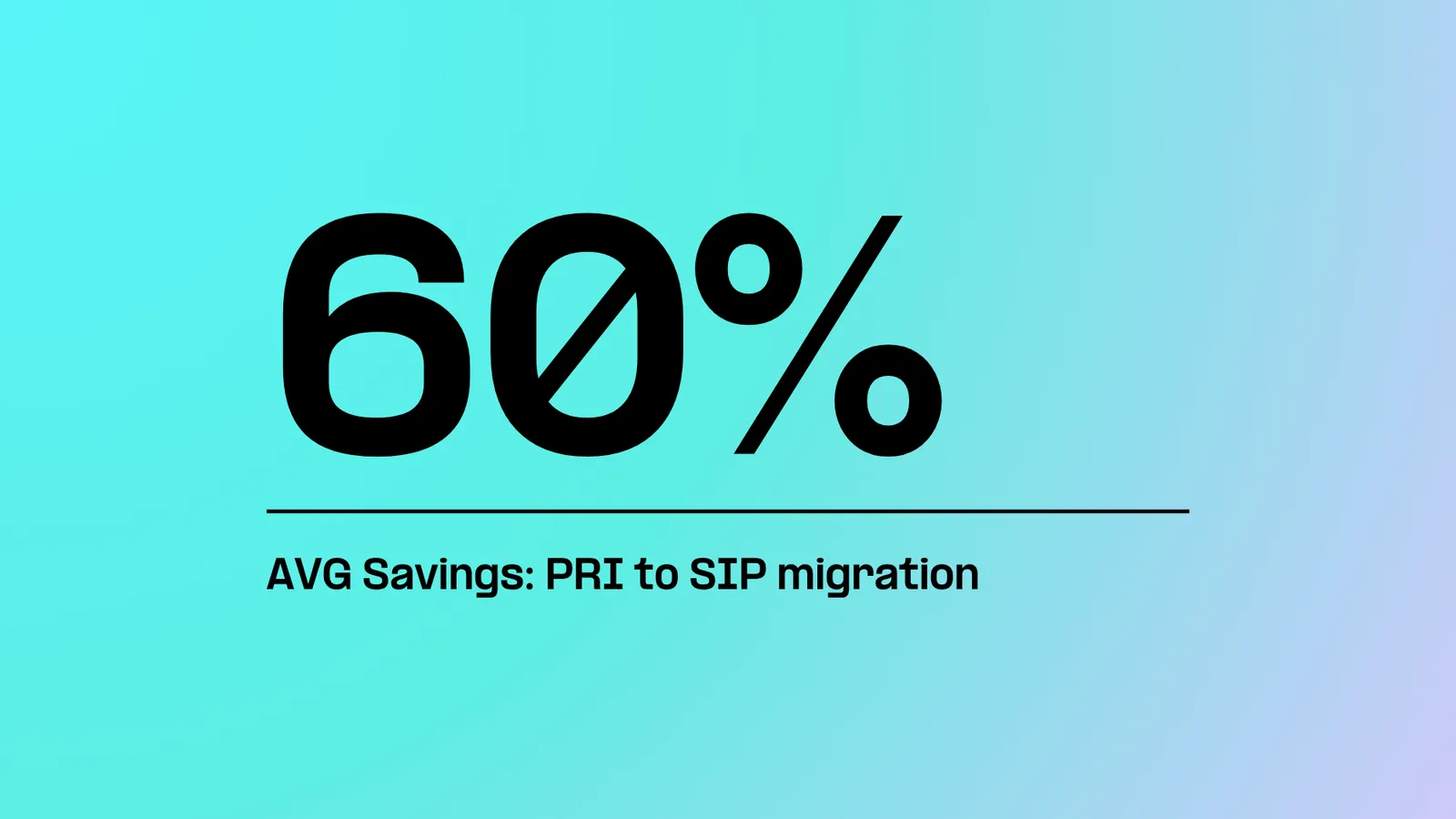
Those savings compound across locations. Multi-site organizations eliminate per-location PRI circuits and centralize voice routing through a single provider. Fewer contracts, one bill, and consistent call quality across every office.
Beyond cost, businesses gain:
- Redundancy: SIP trunks fail over to backup routes automatically; PRI goes down when the physical line does
- HD voice: Wideband codecs deliver clearer audio than narrowband PRI
- Global reach: Provision local numbers in new markets without physical presence
- AI readiness: SIP infrastructure supports voice AI agents and real-time speech processing
Top business SIP trunk providers
1. Telnyx
Telnyx is a licensed carrier that owns its private global IP network across 30+ countries. Unlike resellers, Telnyx originates and terminates calls on infrastructure it controls, giving businesses carrier-grade reliability and full-stack programmability.
- Pay-per-minute and per-channel pricing options with no contracts
- Full A-level STIR/SHAKEN attestation and default TLS/SRTP encryption
- Programmable Voice API for embedding SIP into custom applications
- Global number coverage with local DIDs in 140+ countries
- Built-in support for voice AI agents and real-time speech processing
2. VoIP.ms
VoIP.ms is a Canadian provider popular with cost-conscious small businesses and power users who prefer a self-serve, pay-as-you-go model. Configuration is DIY through a functional but utilitarian web portal.
- Pay-per-minute pricing starting around $0.005/min with no per-channel fees
- Large North American DID inventory across the US and Canada
- Wide feature set for the price: IVR, call recording, fax, and SMS
- Limited international coverage and no owned network infrastructure
3. SIP.us
SIP.us targets small businesses replacing PRI or analog lines with a straightforward, flat-rate trunking service. The simple pricing model removes per-minute bill variability.
- Flat rate of roughly $24.95/month per channel with unlimited US calling
- Quick setup with no long-term contracts
- Compatible with common PBXs: Asterisk, FreePBX, and 3CX
- US-only coverage with minimal API or programmable voice capabilities
Choosing a SIP trunk provider
Not all SIP trunks are equal. The provider's network architecture determines call quality, uptime, and troubleshooting speed.
Resellers route calls across third-party networks, adding latency and creating blind spots when something breaks. Carrier-grade providers own the underlying infrastructure and control the entire call path from ingress to egress.
How to get started with Business SIP Trunking
Telnyx is a licensed carrier that owns its global IP network. Telnyx SIP trunks connect directly to carrier-grade infrastructure: no reseller hops, built-in TLS/SRTP encryption, and full STIR/SHAKEN attestation.
To get started:
- Create a Telnyx account and configure a SIP connection with your PBX credentials
- Port existing numbers or provision new phone numbers in your target markets
- Set up failover rules and enable encryption
- Test inbound and outbound routing, then go live
Frequently asked questions
What is business SIP trunking?
Business SIP trunking is a voice connectivity method that replaces physical phone lines with virtual channels over IP. It connects your existing PBX to the PSTN without dedicated hardware.
How much does SIP trunking cost?
Pricing varies, but businesses typically pay $15 to $25 per month for unlimited channels. Metered plans run $0.005 to $0.01 per minute. See Telnyx SIP pricing for current rates.
Is SIP trunking better than PRI?
For most businesses, yes. SIP offers lower costs, instant scalability, HD voice, and built-in redundancy. PRI may still suit locations with zero internet dependency requirements.
What is the difference between SIP trunking and VoIP?
VoIP is the broad technology for transmitting voice over IP. SIP trunking is a specific VoIP implementation that connects a PBX to the PSTN.
Can SIP trunking work with my existing PBX?
Most modern PBX systems support SIP trunking, including Cisco, Avaya, FreePBX, and Asterisk. Telnyx provides setup guides for all major platforms.
Share on Social


