
Guides and Tutorials
Deploy internal AI agents on your existing PBX in 30 days
Deploy internal AI agents via PBX for routing, IT and HR helpdesk, scheduling, and call logging without reworking extensions.

By Eli Mogul
Internal teams are buried under repetitive voice traffic. Password resets, benefits questions, conference room bookings, access requests, expense lookups. None of it requires a human, but all of it hits the same overworked extensions. Forrester data cited by CIO.com pegs the average password reset cost at $87 per ticket, which translates to roughly $795 per employee per year. Gartner estimates that 40% of all helpdesk calls relate to password issues alone, according to research aggregated by Specops.
The instinct is to drop in an AI agent. The friction is everything else: the existing PBX, the dial plans IT has tuned for years, the call recording policies legal signed off on, the SIP trunks connecting hundreds of extensions. Ripping any of that out to chase a pilot is a non-starter for most CIOs, and the data backs them up. MIT's 2025 GenAI Divide report, covered by Fortune, found that 95% of generative AI pilots delivered no measurable P&L impact, with internal builds succeeding at roughly one-third the rate of vendor partnerships.
The good news: you do not have to choose between your PBX and AI. You can route specific extensions or hunt groups to a voice AI agent over SIP, keep everything else exactly as it is, and have a working internal agent answering calls in days rather than quarters. This guide walks through the architecture, the deployment path, and the use cases that pay back fastest.
Why internal AI agents are pulling ahead of customer-facing ones
Most of the AI agent conversation in 2024 focused on customer experience. That is shifting. PwC's May 2025 AI Agent Survey found that 88% of executives plan to increase AI-related budgets in the next 12 months because of agentic AI, and that early value is coming from internal use cases before customer-facing ones. Merge's 2026 State of AI report shows that companies are 24% more likely to build internal agents than customer-facing ones, a reversal of conventional wisdom about where agentic AI delivers first.
There are three reasons this is happening:
- The risk profile is lower. An internal agent that mishandles a password reset has a much smaller blast radius than a customer-facing agent that mishandles a billing dispute.
- The data is already governed. Identity systems, HRIS, and ITSM tools sit inside the corporate perimeter with existing audit trails, so connecting an agent does not require a new compliance review from scratch.
- The ROI is concrete and immediate. Tier-1 ticket volume is measurable, deflection rates are easy to track, and the cost per resolved request is well understood.
HR functions in particular are seeing fast uptake. Mordor Intelligence forecasts HR and recruiting chatbot use cases to grow at a 25.3% CAGR through 2030, outpacing most customer-facing categories.
Deloitte's 2026 State of AI in the Enterprise survey of 3,235 leaders found that agentic AI usage is set to rise sharply in the next two years, with internal productivity and knowledge management cited as some of the highest-impact use cases. Gartner predicts that by 2029, agentic AI will autonomously resolve 80% of common customer service issues without human intervention, cutting operational costs by 30%. Internal helpdesks will follow the same curve. Most teams will not wait until 2029 to capture it.
The architecture: keep the PBX, route specific extensions
The pattern that works is straightforward. Your existing PBX stays in place and continues to handle every extension, every dial plan, every voicemail box it already handles. You identify a small number of high-volume internal numbers (the IT helpdesk, the HR line, the facilities extension, an after-hours fallback) and route those, and only those, to a voice AI agent over a SIP trunk.
Here is the call flow:
- An employee dials the IT helpdesk extension on their existing desk phone or softphone.
- The PBX recognizes that extension is mapped to a SIP trunk pointing at the AI agent infrastructure.
- The call hits the AI agent over SIP. Real-time speech-to-text transcribes the request, the LLM determines intent, and the agent either resolves it directly (password reset, ticket lookup) or transfers the caller back to a human via the same trunk.
- Call control APIs handle transfers, hold music, conferencing, and recording in line with existing policies.
- Webhooks fire to your ITSM, HRIS, or scheduling system to log the ticket, update the record, or book the calendar slot.
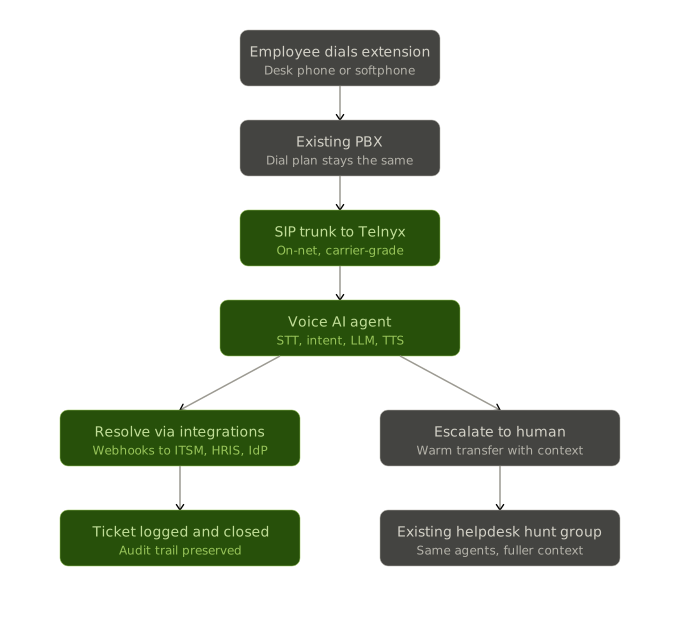
Extensions, dial plans, and the call recording policies legal already signed off on all stay exactly as they are. For background on the platform mechanics, Telnyx's guide on what call control is and how programmatic routing works covers the API patterns, and the walkthrough of internal voice agents on SIP details how to register agents as endpoints inside your existing dial plan.
For teams unfamiliar with how a modern PBX fits into this picture, Telnyx's primer on PBX and how it scales is a useful baseline before mapping extensions to AI endpoints.
High-value internal use cases (and what each one costs you today)
Not every extension benefits from an AI agent. The ones that do tend to share a profile: high call volume, repetitive intent, structured backend data, and a clear escalation path. Below is a breakdown of the use cases that pay back fastest, what they cost you in their current state, and the systems an AI agent needs to plug into.
| Use case | Typical call volume | What it costs today | Systems to integrate | Time to deploy |
|---|---|---|---|---|
| IT helpdesk (password resets, MFA, access) | 40% of all helpdesk calls per Gartner | $70 to $87 per reset, up to $5.2M annually at large enterprises (Keeper Security) | Identity provider, ITSM, MFA platform | 2 to 4 weeks |
| HR benefits and policy questions | 25% to 35% of HR inbound | Avg. 8 to 12 minutes per call, 60% repeat questions | HRIS, benefits portal, knowledge base | 3 to 5 weeks |
| Conference room and scheduling | Surges Mon/Fri, school holidays | Lost meeting productivity, no-show costs | Calendar API, room booking system | 1 to 2 weeks |
| Facilities and badge access | Spikes after long weekends | Manual ticket logging, slow response | Ticketing system, access control | 2 to 4 weeks |
| After-hours triage and routing | 15% to 25% of all internal calls | Voicemail backlog, missed urgent issues | On-call rotation, paging system | 1 to 2 weeks |
The IT helpdesk case is usually the easiest to justify. A self-service AI agent that handles even half of password reset calls at $87 per reset pays for itself inside a quarter at most mid-sized companies. The cost case stacks two ways: AI deflects the call entirely, and the underlying SIP minutes are roughly 2x cheaper on an owned carrier network ($0.005/min) than on a reseller like Twilio ($0.01/min). The savings are structural, not promotional.
What separates a pilot from production
The MIT GenAI Divide finding is worth sitting with. Most internal AI projects fail not because the model is wrong, but because the integration is brittle. A Cleanlab survey of AI agent production teams found that observability and evaluation are the lowest-rated parts of the stack, with fewer than one in three teams satisfied with their current tooling.
Three things separate the pilots that ship from the ones that stall:
Real-time latency under 300ms. Human conversation runs at 200 to 300ms turn-taking. Anything slower and employees start talking over the bot or hang up. The constraint is physics: speed of light in fiber is roughly 5ms per 1,000km, and every vendor boundary in a stitched-together stack adds 30 to 80ms of network overhead. Co-located GPU infrastructure adjacent to telecom points of presence is the difference between conversational AI and an annoying voicemail tree. The choice of audio codec matters too. Telnyx's deep dive on how Opus and G.722 HD codecs affect AI interactions explains why low-fidelity audio degrades model accuracy before the LLM even gets the input.
Clean escalation to humans. Callers will tolerate an AI agent if, and only if, there is an obvious path to a human when they need one. Call control APIs need to handle warm transfers, context handoff, and fallback to existing hunt groups without dropping the call.
Webhook integrations that log, ticket, and update in real time. An AI agent that resolves a password reset but does not log the ticket creates an audit gap. The integration to ITSM, HRIS, and identity platforms has to fire reliably on every interaction.
This is the part where the build-vs-buy decision really lands. Companies trying to wire all of this together themselves often hit the same brittle-integration trap the MIT report identified. The prevailing alternative is stitching together four to six vendors: a SIP provider, an STT vendor, an LLM, a TTS vendor, and an orchestration layer. That is the Frankenstack, and it fails three ways in production.
First, latency compounds. Each vendor boundary adds 30 to 80ms. Four hops puts you at 600ms+ before any model runs, and employees start talking over the bot.
Second, reliability degrades. Five vendors at 99.9% uptime each is 99.5% compound availability, roughly 4.4 hours of downtime per month.
Third, debugging is impossible. The 2am question is the one that exposes the architecture:
"When your AI agent goes down at 2am, who actually fixes the call?"
In a Frankenstack, the telephony vendor blames the STT provider, the STT provider blames the LLM, the LLM provider blames the TTS, and the orchestration layer blames telephony. The customer becomes the debugger. Vendor partnerships with platforms that handle the SIP, the inference, the call control, and the integrations as one infrastructure tend to ship faster and stay shipped, because there's one team to call when something breaks.
How to go from PBX to production in 30 days
A realistic timeline for a single high-volume use case looks something like this:
Days 1 to 5: Pick one extension and one workflow. The IT helpdesk password reset queue is usually the right starting point. Map the current call volume, intent distribution, average handle time, and cost per call. This becomes your baseline.
Days 6 to 10: Provision the SIP trunk and connect the AI agent. Provision a SIP trunk between your existing PBX and the AI agent infrastructure. Configure the specific extension to route to the trunk. Telnyx's SIP Attach release notes cover how to register agents as on-net SIP endpoints so calls never leave the trusted network. First successful call should run in under 5 minutes from API key creation, not days.
Days 11 to 20: Wire the integrations. Connect to your identity provider for password resets, your ITSM for ticket logging, and your knowledge base for policy answers. Build the escalation path to your existing human helpdesk hunt group as the fallback.
Days 21 to 25: Test in a controlled pilot. Route 10% to 20% of inbound IT calls to the agent. Track resolution rate, escalation rate, caller satisfaction, and integration reliability. Iterate on the prompt and the workflow.
Days 26 to 30: Scale. Ramp to full traffic on that one extension. Measure the cost-per-resolved-call against your baseline. Then pick the next extension.
The discipline that matters most is resisting the urge to do everything at once. Pick one extension, ship it, measure it, then expand.
What to look for in AI agent infrastructure
Internal voice AI is the first thing your agents do in the real world. It will not be the last. The same agents that handle internal helpdesk calls will increasingly send SMS confirmations, fire email follow-ups, and call out to other agents. Evaluate the platform on three layers, because the agent has to operate across all of them.
Trust: a licensed telecom provider that originates calls rather than reselling carrier minutes. Internal voice traffic should never leave a trusted network. STIR/SHAKEN attestation only carries weight when the originating carrier is the one running the AI. Telnyx is a licensed carrier in 40+ countries and issues A-level attestation as the originating carrier on every call.
Infrastructure: SIP trunking, call control, and AI agents on one operational domain. Stitching telephony, STT, LLM, and TTS across four vendors is the Frankenstack. One platform means one SLA, one contract, one bill, and one team to call when something breaks at 2am. The same platform should also handle the other channels the agent will eventually need: SMS, email, async operations.
Physics: co-located GPU infrastructure adjacent to telecom points of presence. Sub-300ms response times require eliminating inter-provider hops, not optimizing them. Speed of light in fiber is roughly 5ms per 1,000km. Running inference in a cloud region 100ms from the call means the physics is already against you. Architecture wins.
Also worth verifying:
- Real-time media streaming and webhooks for integration with ITSM, HRIS, and identity systems.
- Open-source LLM compatibility so you are not locked into one model vendor as new models ship.
- 24/7 engineering support, because voice AI breaks at 3 a.m. just like voice does.
Most platforms get worse as you expand globally. More hops, more jurisdictions, more latency. Owning all three layers reverses that: each new region adds capability, not complexity.
Your first extension
You do not have to replace your PBX to put AI agents on it. You need a SIP trunk, AI agent infrastructure with carrier-grade ownership across all three layers, and a clear use case to start with. Telnyx unifies SIP trunking, programmable call control, and Voice AI Agents on a Tier-1 global IP network with co-located GPU infrastructure, so internal agents respond in real time and connect to the rest of your stack without a forest of third-party integrations. Voice is the wedge, not the ceiling. The same infrastructure handles SMS, email, and async operations as your agents expand beyond the helpdesk.
Talk to a Telnyx engineer about routing your first internal extension to an AI agent, or start building in the Telnyx Mission Control Portal and have a SIP trunk provisioned in minutes.
Share on Social