
Voice
What is call control? Direct, programmable control over every call
What is call control? Learn how call control works in a switch, a cloud API and a contact center, and how to transfer calls and stream media with Telnyx.
Takeaways
Call control is the logic that decides what happens to a call: answer, route, transfer, record, stream or hang up. If you build voice software, a programmable API lets you run that logic from your own code, one REST command per action.
- The term has four meanings you will meet: the carrier's switch software, the hold and mute features on a cell phone, contact center call handling, and the programmable API, which is the one your code talks to.
- Cloud call control is events in, commands out. The carrier tells your application what changed, your application replies with a command, and the audio never leaves the carrier network unless you ask to stream it.
- Telnyx runs call control on points of presence (PoPs) in 18 regions with round trip time under 200 ms, priced from $0.002 per minute.
What is call control?
Call control is the decision-making part of a phone call: the logic that works out where your call goes and what happens to it, from the moment someone dials you to the moment it ends. Forwarding, transferring and recording are call control on a carrier switch, a private branch exchange (PBX) or a Voice over Internet Protocol (VoIP) platform alike. Telnyx gives you that layer as one-line API commands for every leg of a call through the Telnyx Voice API.
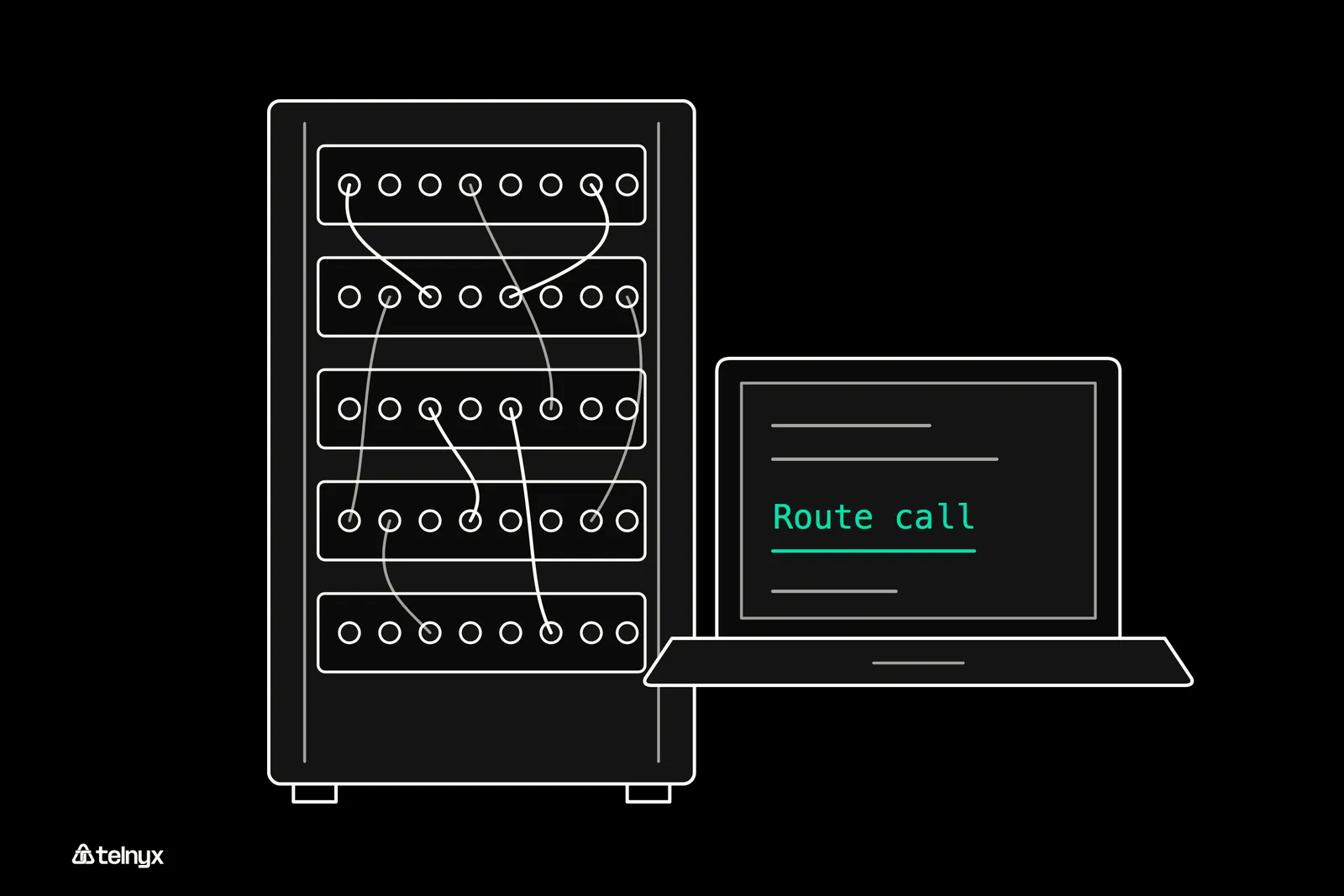
Call control used to live inside the exchange. A programmable API moves the same decisions into your code.
Call control, signaling and media: the three parts of every call
Every call has three parts. Signaling sets the call up and ends it. On the internet that is the Session Initiation Protocol (SIP), defined in the SIP specification. On the legacy phone network it is Signaling System No. 7 (SS7). Media is the audio you hear, carried as Real-time Transport Protocol (RTP) packets. Call control decides what happens in between, like sending your caller to a specialist.
The three parts of a VoIP call
| Part of the call | What it does | Example |
|---|---|---|
| Signaling | Sets up and ends the call | SIP INVITE to start, SIP BYE to end |
| Media | Carries the audio | RTP audio between endpoints |
| Call control | Decides what happens | Answer, transfer, record, stream |
The four meanings of call control
You will meet call control in four places, and each one puts the control in different hands:
| Where you hear 'call control' | Who holds the control | What it controls |
|---|---|---|
| Network switch | The carrier's switch | Routing, supplementary services |
| Cell phone | You, on the handset | Hold, mute, swap, forward, call waiting |
| Customer service | The agent's platform | Queues, transfers, hold, recording |
| Programmable API | Your code, via Telnyx | Answer, route, transfer, record, stream, hang up |
Call control in a network switch
The reference definition describes call control as software inside the telephone switch, often called call processing, and you reach a feature like forwarding by dialling a vertical service code such as *72. Telephony call control and call management name the same idea.
What is call control on a cell phone?
On a cell phone, call control means the handset and carrier features you use to manage a call in progress: hold, mute, swap, forward and call waiting. These are the supplementary services the switch definition describes, and you invoke them from your phone's dialler or your carrier's settings rather than from your code.
What is call control in customer service?
In customer service, call control is the routing, queueing, transfer, hold and recording logic that decides which agent a caller reaches and what happens while they wait. Agents also use it for the skill of keeping a conversation on track. Telnyx contact center solutions expose each step as a command, so you build interactive voice response (IVR) menus, conferencing and call recording without owning a switch. In the order a caller meets them:
- Route: time of day, caller ID or dialed extension picks which of your queues or agents the caller reaches.
- Queue and hold: your caller hears music or a message until one of your agents frees up.
- Transfer: you send the call to a colleague with the right expertise.
- Record: you keep the call for your quality review and compliance.
- Conference: you bring a supervisor into the call.
Call control in a programmable API
A programmable API moves that logic into your application: you receive a webhook when something happens on a leg and reply with a command, as in the Telnyx Call Control launch.
Run call control from your own code
Answer, route, transfer, record and stream any call leg with one REST command each.
How does cloud call control work?
Cloud call control moves the decision-making out of the switch and into your application, which never touches the audio unless it asks for media streaming over a WebSocket. A caller dials your Telnyx number, Telnyx sends your application an event, your code decides and replies with a command over the REST API, and Telnyx carries it out on the live leg.
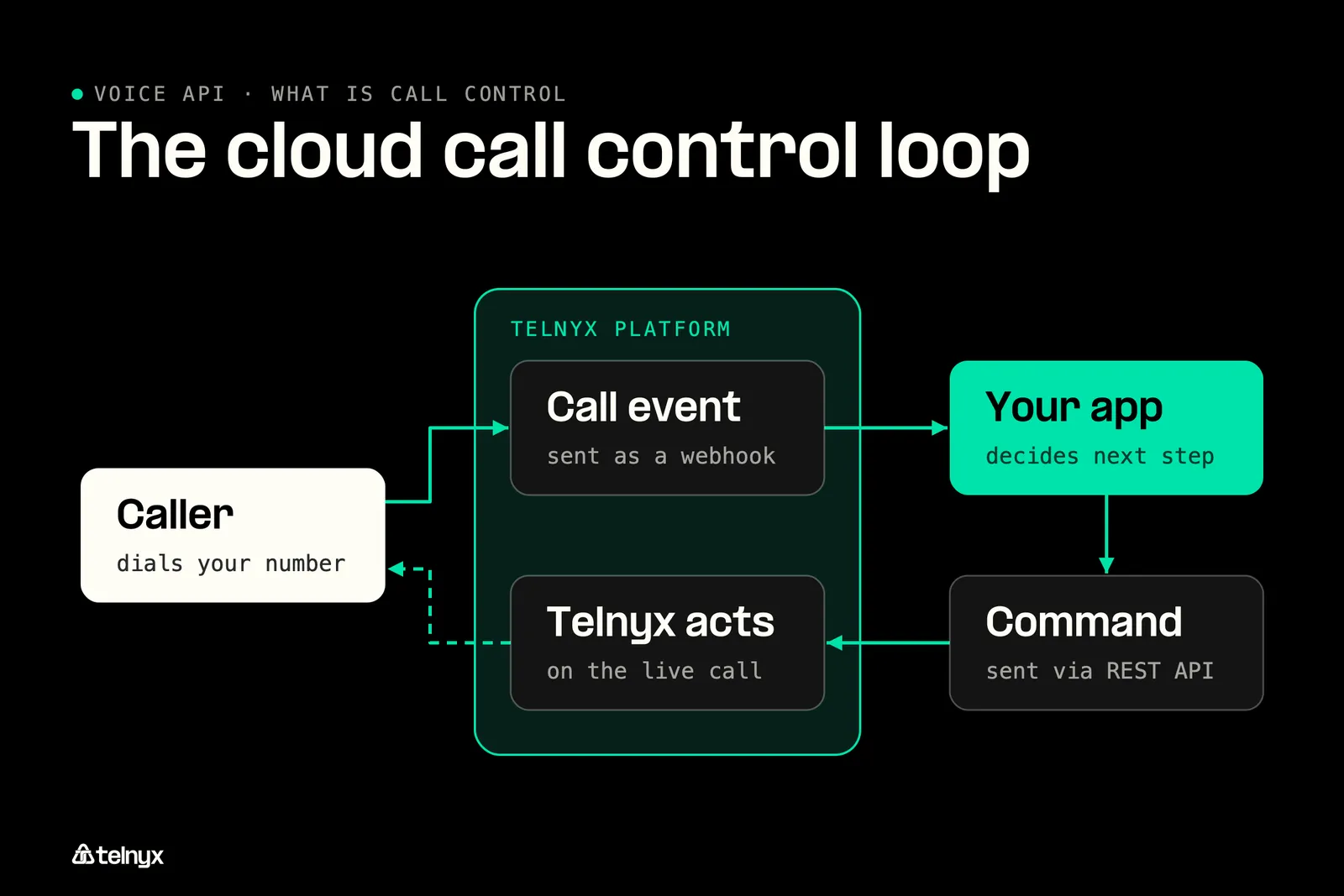
Your application only sees events and sends commands. The audio stays on the Telnyx backbone with PoPs in 18 regions.
Remote call control: events in, commands out
Your code can run in any region or cloud, and the commands are the same whether the far end is a SIP endpoint or a phone on the public network. Each round trip is time the caller waits, so where control plane and media sit decides whether the call feels instant.
Telnyx keeps that network round trip under 200 ms for your calls. Your voice traffic stays on a private backbone with telephony and AI inference co-located, with PoPs in 18 regions, the same setup that fixed voice AI latency. James Whedbee of Telnyx on why operating the network matters:
 | The advantage Telnyx has is that we operate the network and the voice platform, so we can make routing, media, and AI placement part of one system instead of treating them as separate black boxes. That does not make physics disappear, but it gives us more control over the parts of the call that decide whether the interaction feels responsive. James Whedbee, Telnyx |
In-depth Telnyx Call Control API features
Telnyx gives you one REST command per call action, applied to the call_control_id of the leg you want to change, with SIP and phone-network endpoints in 130+ countries. Telnyx vs Twilio sets the two command sets side by side.
Which command do you need?
- Handing the caller off, done with the leg: use transfer call. One REST command sends the caller to the new party, and your app stops managing that leg.
- Holding both legs, want them talking: use bridge calls. It joins the two legs you already control so both parties hear each other without dialing anyone new.
- Need live call audio in your app: use streaming start. Audio stays on the Telnyx network until you send it, then a copy flows to your app while the call carries on.
- Done forking audio, call stays up: use streaming stop. The audio copy to your app ends, but both parties stay connected and the leg keeps running.
Which commands does the Telnyx Call Control API give you?
Four documented commands work on a live leg. Dial creates an outbound leg from your number with a POST to the calls endpoint and returns its call_control_id. Record, sent as record_start, begins recording that leg, in mp3 with a single channel. Suppress noise, sent as suppression_start, cleans the audio and takes an empty body. Gather using AI, sent as gather_using_ai, asks the caller a question and returns the answer as JSON matching your schema. Each bills from $0.002 per minute.
The same legs carry real-time voice: speech-to-text from Telnyx, Deepgram, Whisper or AssemblyAI, text-to-speech in more than a hundred languages, and the AI Gather and AI Assistant commands.
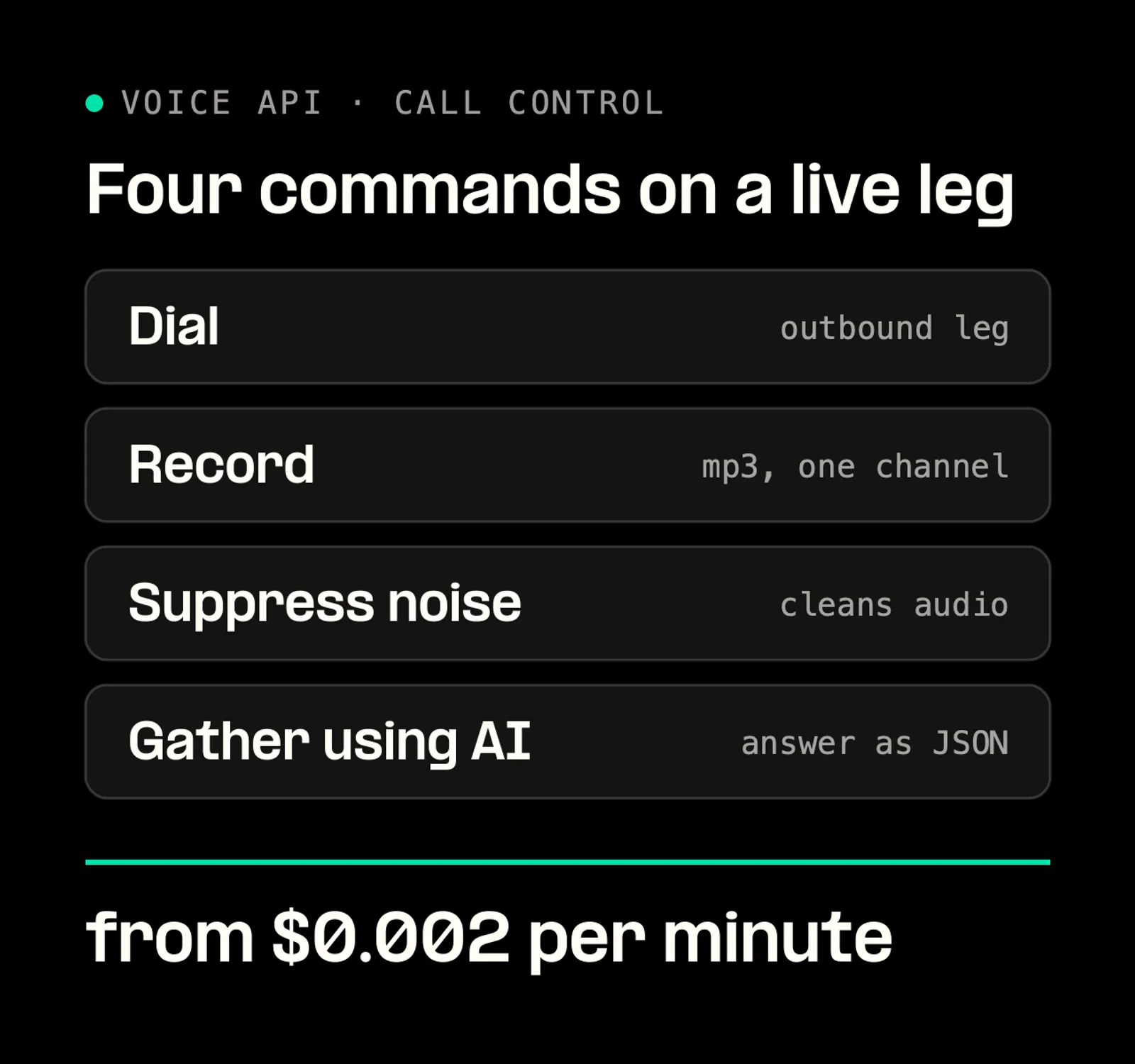
Each Telnyx call control action is one REST command on a live leg, priced from $0.002 per minute.
How does the Telnyx Call Control API transfer calls and stream media?
The transfer call command hands the caller's leg to a new SIP or phone-network destination. Bridge calls joins two legs you already control, which is the warm-transfer path: dial the specialist, then send the bridge calls command.
Media streaming forks the audio rather than moving the call. Streaming start sends bi-directional RTP audio over secure WebSockets to your application, which is how voice AI assistants and real-time coaching tools listen and talk back, and streaming stop ends the fork. The media streaming guide covers the WebSocket side.
Getting Started with Call Control
Pick what you are building, then place the first call every build starts with.
What can you build with Call Control?
Your AI builds only feel responsive when you control network, media plane and inference together, as voice AI that survives real calls shows.
IVR and call flows
Play a prompt, gather the caller's input, transfer to the right destination.
Contact center routing
Act on each event, transfer cold or bridge warm.
Call recording
One record_start on the leg you want kept.
Conferencing
Bridge two legs or add them to a conference.
AI voice agents
AI Gather, AI Assistant and media streaming, with text-to-speech in 100+ languages.
Browser and app calling
WebRTC SDKs for web, iOS and Android.
Place your first call with one REST request
- Sign up and generate an API key.
- Buy or port a number, from phone numbers in 140+ countries.
- Create a voice connection and copy its connection_id.
- Point its webhook URL at your application.
- Send the dial request below.
This request creates an outbound leg from your Telnyx number and returns the call_control_id you use for every later command:
Three reference implementations, not drop-in code, show the same request:
- Java outbound call example, a Java program that places this call.
- A C# and ASP.NET sample.
- A Python campaign orchestrator that adds rate limiting, SQL tracking and an SMS summary.
The TeXML call demo does the same in XML. Support is free 24/7 and pricing is usage-based.
Call control FAQ
Control every leg of your calls from one request
Dial, record, transfer or stream a call with one REST command each, on a carrier network with PoPs in 18 regions and round trip time under 200 ms, from $0.002 per minute.
Start with the Voice APIShare on Social

Serhii Omelchenko
Global AEO/SEO Manager
Serhii is Global AEO/SEO Manager at Telnyx, based in Amsterdam, he is focused on making communications infrastructure findable and credible across both traditional search and AI-driven discovery. He previously led SEO and GEO strategy for some of the world’s most recognized consu


