Programmable SIM cards are the link between autonomous AI and the real world.
AI agents are moving out of the cloud and into the physical world. They're monitoring equipment on oil rigs, optimizing delivery routes in real time, and analyzing soil conditions across thousands of acres. But distributed AI agents are only as reliable as their connectivity, and for most real-world deployments, that means cellular.
The agentic AI market is accelerating fast. Gartner predicts that 40% of enterprise applications will integrate task-specific AI agents by the end of 2026, up from less than 5% in 2025. McKinsey estimates AI-powered agents and robots could generate roughly $2.9 trillion in annual U.S. economic value by 2030. As these agents move beyond software environments and into physical infrastructure, the question of connectivity becomes central.
Programmable SIM cards are the link between autonomous AI and the real world.
Broadband is fundamentally location-based. A Wi-Fi connection or fixed-line setup works fine in a data center or office. But the moment an AI agent moves to a vehicle, a farm, or an offshore facility, that connection disappears.
Cellular is different. It provides coverage across 99%+ of populated areas, and modern networks extend into remote locations where fixed broadband is either unreliable or nonexistent. For AI agents operating in the field, cellular connectivity is the only viable option in many scenarios:
The global cellular IoT market reflects this reality. According to IoT Analytics, there are now over 21 billion connected IoT devices worldwide, with cellular IoT connections growing 16% year-over-year in 2024. The cellular IoT chipset market alone hit $4.07 billion in 2024 and is forecast to reach $14.08 billion by 2030.
Traditional SIM cards tie a device to a single carrier. You pick a provider, sign a contract, and your connectivity is locked in. That model breaks down when you're managing hundreds or thousands of devices across multiple regions.
Programmable SIMs flip the script. They use eUICC (embedded Universal Integrated Circuit Card) technology, which means carrier profiles can be downloaded, switched, and managed over the air. No physical swaps. No firmware changes. No truck rolls to remote sites.
The GSMA's SGP.32 specification, published in 2023 with the first certified solutions arriving in 2025, is accelerating this shift. SGP.32 enables server-driven remote SIM provisioning at scale, so enterprises can push network profiles to thousands of devices simultaneously. According to Juniper Research, global eSIM connections will grow 30% to reach 1.5 billion devices in 2026, with connected logistics, oil and gas, and smart street lighting driving the fastest growth.
For AI agent deployments, programmable SIMs enable:
When an AI agent runs on a device or at the edge, it needs a connectivity layer that can make intelligent decisions about how data gets routed. The SIM manager acts as that layer, continuously evaluating signal quality, carrier costs, and latency to select the optimal network path.
Here's what that looks like in practice:
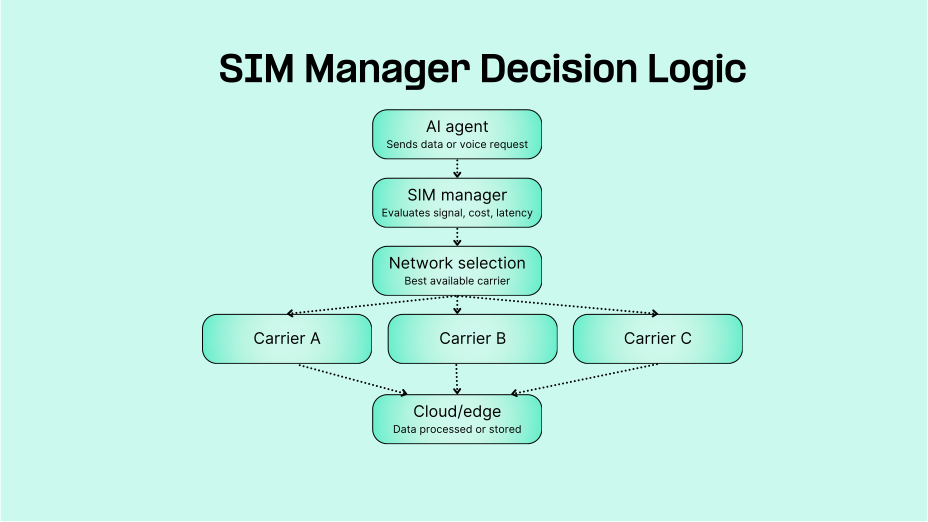
The AI agent generates a data or voice request. The SIM manager checks the available networks, selects the best carrier based on current conditions, and routes the traffic. If the signal degrades mid-transmission, the system fails over to an alternate carrier automatically, all without human intervention.
This architecture matters because AI agents are data-intensive. An agent running continuous inference can consume 100+ GB per month, depending on the application. Without intelligent routing and cost controls, cellular bills can spiral. Programmable SIMs give teams the ability to set per-agent data limits, schedule high-bandwidth tasks during off-peak hours, and route traffic through lower-cost carriers for non-critical transmissions.
Choosing the right SIM form factor depends on the device, the environment, and the deployment lifecycle:
| SIM type | Best for | Key advantage | Form factor | Carrier flexibility |
|---|---|---|---|---|
| Physical SIM (triple-cut) | Legacy devices with SIM slots | Easy to replace in the field | Standard, micro, nano | Moderate (manual swap) |
| eSIM (eUICC) | Smartphones, tablets, modern IoT | Over-the-air provisioning | Chip on circuit board | High (remote profile switch) |
| MFF2 (embedded) | Industrial IoT and M2M | Ruggedized for harsh environments | Soldered to board |
According to GSMA Intelligence, only a third of IoT connections will still use traditional removable SIMs by 2030. The shift toward embedded and integrated SIM technology is driven by the same forces powering AI agent adoption: the need for remote management, global reach, and reduced operational overhead.
For most new AI agent deployments, eSIM or MFF2 form factors offer the strongest combination of flexibility and durability.
Consider a fleet of 50 delivery vehicles, each equipped with an AI agent monitoring vehicle health, optimizing routes, tracking local regulations, and detecting real-time road hazards. Each agent needs persistent cellular connectivity that works in tunnels, on rural highways, and across state or national borders.
Programmable SIMs let the fleet operator provision all 50 vehicles from a single API, automatically switch carriers as vehicles cross coverage zones, and set data caps per vehicle to keep costs predictable. When an agent detects an anomaly, it can initiate a voice call to dispatch using the same connectivity platform, no separate telephony provider required.
Deploying AI-powered sensors across 10,000 acres of farmland means connecting hundreds or thousands of endpoints in locations where fiber is economically impossible. These agents analyze soil moisture, detect pest activity, forecast weather impacts, and trigger irrigation systems.
Cellular SIMs designed for IoT keep per-device costs low, with pay-as-you-go data plans running a few dollars per month per sensor. The agents sync data during off-peak windows and cache results locally when bandwidth is limited. eSIM technology enables remote provisioning of every sensor from a centralized dashboard, with no technician visits required.
An enterprise operating IoT devices in 45 countries traditionally needs 45 separate carrier relationships, 45 contracts, and 45 billing systems. Programmable SIMs consolidate that complexity into a single platform: one SIM per device, centralized API-driven management, automatic carrier selection per region, and unified billing.
According to Counterpoint Research, the boundaries between network types are dissolving in 2026, with enterprises demanding unified connectivity that spans public and private cellular, Wi-Fi, and satellite, all managed as a single programmable resource.
Data-hungry AI agents require a disciplined SIM strategy. Without controls in place, a fleet of always-on agents can rack up significant cellular bills. Key cost management tactics include:
Platforms that combine SIM management with voice, messaging, and AI infrastructure under one roof simplify both the operational and financial picture.
Deploying cellular-connected AI agents starts with a clear assessment of where your agents will operate and what connectivity they need:
Cellular connectivity is the infrastructure layer that makes distributed AI agents practical. As AI moves from centralized cloud environments to edge devices, vehicles, and remote facilities, the SIM card becomes the bridge between intelligence and action.
Programmable SIMs, especially eSIM and embedded form factors, give enterprises the control and flexibility to deploy agents globally without the operational overhead of managing dozens of carrier relationships. Combined with the rapid maturation of GSMA eSIM standards and the explosive growth of the agentic AI market, the case for SIM-connected AI agents is only getting stronger.
The organizations that build this connectivity layer now will be best positioned to operate AI agents reliably, affordably, and globally.
Telnyx IoT SIM cards provide programmable, multi-carrier cellular connectivity for AI agent deployments worldwide. With eSIM and MFF2 form factors, API-driven provisioning, automatic carrier switching, and pay-as-you-go pricing, you get the infrastructure to scale from pilot to production without managing dozens of carrier relationships.
Related articles
| High (remote provisioning) |
| iSIM (integrated) | Ultra-compact, low-power IoT | Smallest footprint, lowest cost at scale | Built into processor | High (remote provisioning) |