
Insights and Resources
Top 3 Voice AI Agent Providers in Mexico
Voice AI adoption is accelerating across Mexico, and the businesses investing now are positioning themselves to lead.

By Eli Mogul
Voice AI adoption is accelerating across Mexico, and the businesses investing now are positioning themselves to lead. The global conversational AI market is projected to reach $41.39 billion by 2030, growing at a CAGR of 23.7% (Grand View Research, 2025). Latin America is outpacing the global average, with 31% of companies in the region reporting fully deployed conversational AI for customer service, compared to 28% globally (Twilio, 2026).
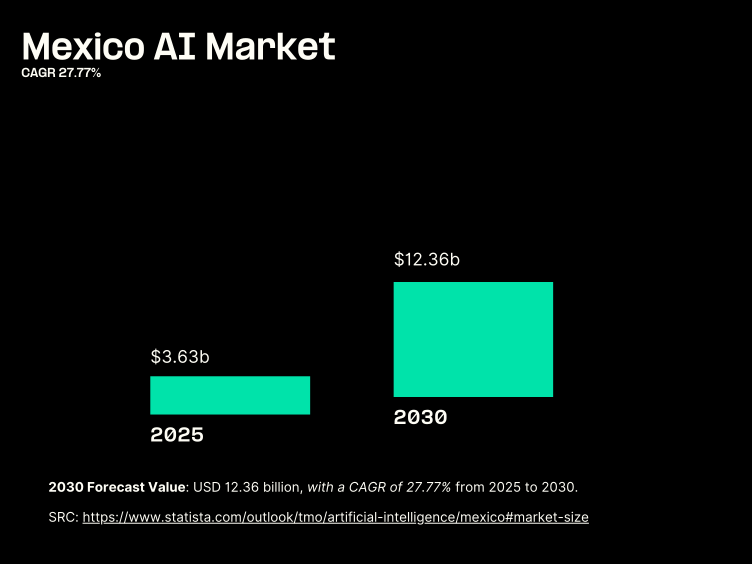
Mexico sits at the center of this momentum. The country's AI market reached approximately $3.68 billion in 2025 and is expected to grow at a CAGR of 27.77% through 2030 (Statista). AI investment among Mexican companies grew 359% year-over-year in 2025, outpacing both Brazil (210%) and Colombia (185%) (Mexico Business News, 2025). For businesses operating call centers, customer support lines, and sales operations, voice AI is becoming table stakes.
But not all voice AI providers are built the same. The infrastructure behind the voice matters just as much as the AI model powering it. Latency, call quality, PSTN connectivity, multilingual support, and pricing transparency all determine whether a voice AI deployment succeeds in production or falls flat after the pilot phase.
Here are the top three voice AI providers for businesses operating in Mexico, evaluated on infrastructure, performance, pricing, and regional readiness.
1. Telnyx
Telnyx is the only voice AI platform that owns and operates every layer of the stack, from the carrier network to AI inference. That distinction matters because it directly impacts the two things voice AI depends on: latency and call quality.
Most voice AI platforms route audio through a chain of third-party services: a telephony provider hands off to a transcription service, which sends data to a cloud-hosted AI model, which passes output to a text-to-speech engine, and then the response travels back to the caller. Each handoff adds 20–50 milliseconds of delay. At scale, those delays compound and produce the robotic, laggy experience that drives callers to hang up.
Telnyx eliminates this problem through colocation. Dedicated GPUs sit directly alongside Telnyx's global Points of Presence (PoPs), which means speech-to-text, LLM inference, and text-to-speech all run within the same infrastructure that handles the call. The result is sub-500ms round-trip latency, with many deployments achieving sub-200ms. That performance holds under production load, not just in controlled demos.
For businesses in Mexico specifically, Telnyx operates as a licensed carrier with native PSTN access. Local +52 numbers are available through the Mission Control Portal, and calls route over Telnyx's private MPLS backbone rather than the public internet. This architecture avoids the unpredictable latency spikes that plague platforms dependent on third-party carriers or public cloud routing.
Telnyx also supports 40+ languages with real-time multilingual transcription, which is particularly relevant for businesses serving both Spanish- and English-speaking customers across Mexico. And because Telnyx runs open-source LLMs alongside proprietary options, teams can experiment with different models and avoid vendor lock-in.
On pricing, Telnyx runs Voice AI orchestration at $0.05/minute (USD), with STT and Telnyx-native TTS included. Open-source LLM inference is billed separately, so you pay only for the models each call uses. That price point makes high-volume deployments economically viable for healthcare, financial services, logistics, and retail—industries driving voice AI adoption across Mexico.
Best for: Businesses that need production-grade voice AI with full-stack control, low latency, native PSTN connectivity in Mexico, and transparent, scalable pricing.
2. Twilio
Twilio is one of the most established names in cloud communications, and it brings substantial infrastructure and reach to the voice AI space. The platform supports programmable voice, SIP trunking, and a growing set of AI-powered tools, including ConversationRelay for building custom voice agents and Conversational Intelligence for analyzing call transcripts.
Twilio's strength is its ecosystem. With coverage in 100+ countries and well-documented APIs, Twilio provides a reliable foundation for teams that already build on its messaging, identity, or Segment CDP products. The company's recent "Inside the Conversational AI Revolution" report highlighted Mexico as a leading market in the region, noting that 74% of Mexican users cite speed as the top benefit of AI-powered service (Twilio, 2026).
However, Twilio's voice AI approach is more of a toolkit than a turnkey solution. ConversationRelay requires teams to bring their own LLM, which means the responsibility for model selection, training, and management falls on the deploying organization. Building a production-ready voice agent on Twilio is a full engineering project, and teams typically stitch together external providers for STT, TTS, and inference. Independent benchmarks have shown Twilio's voice channel averaging around 950ms latency, reflecting its architectural focus on reliability and global reach over raw speed optimization (Telnyx, 2025).
For enterprises with dedicated AI/ML teams and an existing Twilio integration, the platform remains a strong contender. For teams without deep engineering resources, the complexity of assembling a multi-vendor stack can slow down time to production.
Best for: Enterprises with existing Twilio integrations and in-house AI engineering teams who want maximum flexibility in assembling their own voice AI stack.
3. Amazon Connect
Amazon Connect, part of AWS, offers a cloud-based contact center platform with integrated AI capabilities through Amazon Lex (conversational AI), Amazon Polly (TTS), and Amazon Transcribe (STT). In March 2026, Amazon Connect expanded its voice AI agent support to include Spanish (Mexico) among 13 new language locales, bringing total language support to 40 (AWS, 2026).
Amazon Connect benefits from deep integration with the broader AWS ecosystem. Organizations already running workloads on AWS can use existing infrastructure, identity management, and data pipelines. The platform's pay-as-you-go pricing model keeps entry costs low, and its generative AI capabilities through Amazon Bedrock provide access to multiple foundation models.
The trade-off is that Amazon Connect is designed primarily as a contact center solution, not a standalone voice AI platform. Teams building custom voice AI agents outside the contact center context may find the platform more restrictive. Additionally, because Amazon Connect relies on AWS's public cloud infrastructure rather than owned telecom networks, voice traffic traverses standard internet routing. For latency-sensitive voice AI applications in Mexico, this architecture can introduce variability that purpose-built telecom platforms avoid. Amazon Connect also does not operate its own carrier network, so PSTN connectivity depends on third-party telephony providers or AWS-partnered carriers.
Best for: Organizations already committed to the AWS ecosystem that want to add AI-powered voice automation within a contact center framework.
How the top 3 compare
| Feature | Telnyx | Twilio | Amazon Connect |
|---|---|---|---|
| Owned carrier network | Yes, private MPLS backbone with global PoPs | No, relies on carrier partnerships | No, uses AWS cloud + third-party carriers |
| Round-trip latency | Sub-500ms (sub-200ms typical) | ~950ms average | Variable, dependent on AWS region |
| Mexico PSTN access | Native, licensed carrier with local +52 numbers | Available via carrier integrations | Available via third-party telephony |
| AI inference included | Yes, colocated GPUs with STT/TTS/LLM | No, bring-your-own LLM required | Yes, via Amazon Lex/Bedrock |
| Pricing (per minute) | From $0.05/min for orchestration (STT and Telnyx-native TTS included) | Variable, multi-vendor costs | Pay-as-you-go, varies by service |
What to prioritize when choosing a voice AI provider in Mexico
Selecting a voice AI provider for the Mexican market comes down to a few non-negotiable factors.
Latency and call quality should top the list. Gartner predicts that by 2029, agentic AI will autonomously resolve 80% of common customer service issues (Gartner, 2025). For that vision to materialize, voice interactions need to feel natural. Research consistently shows that response times above 300ms start to feel robotic and frustrate callers. Platforms that own their infrastructure and colocate AI processing with telephony PoPs have a structural advantage here.
Native PSTN connectivity is the second priority. Many voice AI companies lack their own telephony networks and depend on third-party providers to connect calls, which adds latency, cost, and points of failure. For global calling with voice AI, a provider with licensed carrier status and local number provisioning in Mexico simplifies deployment and improves reliability.
Multilingual support is essential for the Mexican market. Businesses operating across Mexico need fluent Spanish-language voice AI with natural intonation, plus English support for bilingual operations and cross-border use cases.
Total cost of ownership deserves close scrutiny. McKinsey research indicates that companies implementing AI for customer service report cost reductions of 15–40% in the first year (McKinsey, 2023). But those savings only materialize if per-minute rates, infrastructure costs, and multi-vendor fees stay predictable. A provider with transparent, itemized per-component pricing avoids the hidden costs that can erode ROI.
The bottom line
Mexico's voice AI market is growing fast, driven by consumer preference for voice-based support, rising digital transformation spending, and competitive pressure to automate high-volume customer interactions. Choosing the right provider now sets the foundation for how your business handles millions of conversations in the years ahead.
For teams that want the lowest latency, full-stack control, native PSTN access in Mexico, and pricing that scales, Telnyx Voice AI Agents deliver a production-ready platform built on owned infrastructure. No middlemen. No stitching together vendors. Just voice, AI, and telephony working as one system.
Discussing Voice AI in Mexico? Share your experience in our subreddit.
Share on Social