
Telnyx
Voice AI for developers: Build smarter, ship faster
Building production-ready voice AI requires orchestrating several moving parts.

By Eli Mogul
Voice AI for developers: Build smarter, ship faster
Voice AI adoption is exploding. ElevenLabs just closed a funding round at a $3.3 billion valuation, and OpenAI rolled out new voice tools for developers to meet surging demand. For developers building customer support systems, virtual agents, and voice-powered applications, one challenge remains constant: complexity.
Most platforms force you to stitch together multiple APIs: one for telephony, another for speech-to-text, a third for AI inference, and yet another for text-to-speech. Each integration adds latency, increases failure points, and creates maintenance overhead.
The problem with fragmented voice AI stacks
Building production-ready voice AI requires orchestrating several moving parts. You need telephony infrastructure to handle calls, speech recognition to understand users, AI models for intelligent responses, and voice synthesis for natural-sounding output. When these components come from different vendors, you're managing multiple authentication systems, handling inconsistent webhook formats, and debugging across disconnected platforms.
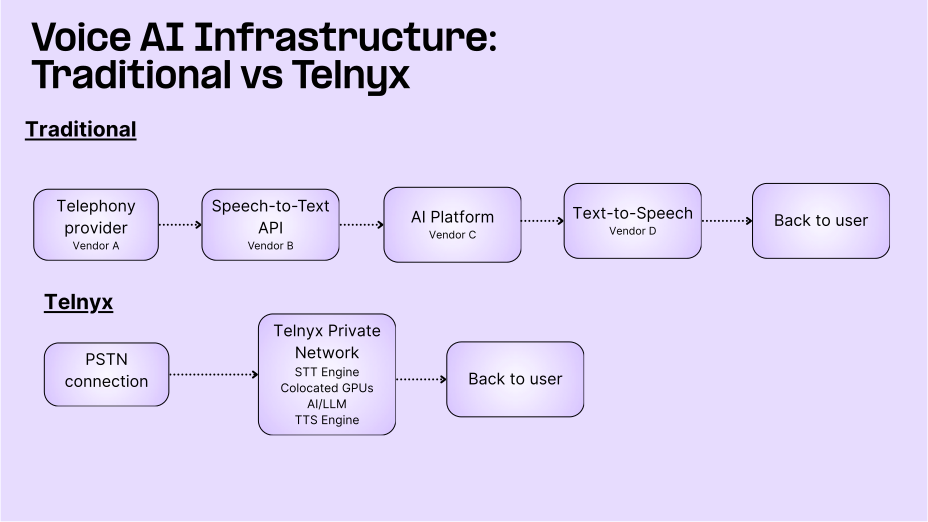
Latency compounds with each hop between services. A typical fragmented stack might route audio from your telephony provider to a cloud transcription service, then to an AI platform, and finally to a text-to-speech API. Each jump adds precious milliseconds, and when round-trip time exceeds 300ms conversations feel robotic and frustrating.
This architectural complexity directly impacts your ability to iterate quickly. Want to test a new AI model? You'll need to rewrite integration code. Need to optimize latency? Good luck tracing bottlenecks across multiple vendors' infrastructure.
What developers actually need from voice AI platforms
Modern voice AI development demands more than just API endpoints. Developers need unified platforms that handle the entire voice pipeline, from PSTN connectivity to AI inference, with consistent interfaces and predictable performance.
First, you need carrier-grade voice quality. As we've covered in our Voice API guide, enterprise applications require reliable PSTN connectivity, global reach, and features like answering machine detection with 97%+ accuracy. Without solid telephony fundamentals, even the most sophisticated AI falls flat.
Second, latency matters everywhere. Real-time conversation requires sub-300ms round-trip times. This means colocating infrastructure components and optimizing every step of the audio pipeline. When your telephony, transcription, AI, and synthesis run on the same network, you eliminate unnecessary hops and deliver natural conversations.
Third, flexibility beats vendor lock-in. Open-source AI models advance rapidly, new breakthroughs appear monthly. Your platform should let you swap models freely, experiment with different approaches, and bring your own fine-tuned models when needed.
Building on unified infrastructure
Telnyx takes a different approach: everything runs on our private global network. By colocating GPUs with our telephony points of presence, we eliminate the latency tax of bouncing between cloud providers. Your voice data travels the shortest possible path from caller to AI and back.
This architectural advantage translates to practical benefits for developers. Our Voice API provides granular call control through REST webhooks, while our AI Assistant APIs handle the complete conversational flow. You can start simple with our no-code voice assistant builder, then graduate to full API control as your needs grow.
Media streaming over WebSockets enables real-time audio processing for coaching platforms and voice analytics. Our speech-to-text and text-to-speech engines integrate directly with the voice pipeline, eliminating integration complexity. Need to gather structured data using AI? One API call handles natural language understanding and parameter extraction.
Practical implementation patterns
Let's look at how unified infrastructure simplifies common voice AI patterns:
| Use case | Traditional approach | Telnyx unified approach |
|---|---|---|
| AI receptionist | 4-5 separate APIs (telephony, STT, LLM, TTS, CRM) | Single voice AI agent with built-in integrations |
| Call transcription | Stream audio to external service, poll for results | Real-time transcription via WebSocket on same network |
| Dynamic IVR | Complex state management across multiple services | Gather using AI with natural language |
| Voice authentication | Separate voice biometrics service | Integrated voice analysis on private network |
These improvements compound in production. A typical AI receptionist handling appointment scheduling might make 10-15 API calls per conversation. On unified infrastructure, those calls stay within the same network, dramatically reducing total interaction time.
Open-source flexibility without compromise
Vendor lock-in kills innovation. That's why Telnyx supports the entire open-source AI ecosystem. Deploy Llama, Mixtral, or any model from our extensive LLM library. When breakthrough models launch, they're available on our platform within days.
This flexibility extends to voice synthesis. Start with Telnyx Ultra for Telnyx-native Voice AI speech, use Qwen3TTS when you need a custom voice clone path, choose NaturalHD for value or WebSocket-compatible Telnyx voices, integrate with xAI or other providers for specific standalone TTS needs, or bring your own TTS provider. Our API remains consistent regardless of which engine you choose.
For teams with specialized requirements, you can host custom models on our infrastructure. Fine-tune on your domain-specific data, deploy to dedicated GPUs, and maintain complete control over your AI pipeline, all while benefiting from our global telephony network.
Start building in minutes
This is why we architect for Diversity first, then Redundancy, then Resiliency.
David Casem, CEO @ Telnyx
Ready to consolidate your voice AI stack? Telnyx makes it simple to get started. Create your account, grab an API key, and you can have a working voice AI agent in under 10 minutes. Our comprehensive developer documentation includes examples in Python, Node.js, Ruby, and more.
For complex implementations, our Forward Deployed Engineers can embed with your team to architect and deploy production-ready solutions. Whether you're building an AI receptionist, automating customer support, or creating entirely new voice experiences, we provide the infrastructure and expertise to ship faster.
Ready to build voice AI that actually works? Start your free trial and get $10 in credit to test our platform. Join developers from startups to Fortune 500 companies who trust Telnyx to power their voice AI applications.
Share on Social