
Conversational AI
Voice AI in Hospitality: Consumer Adoption Study April 2026
New data shows 66% of guests want in-room AI voice assistants for service and room control. Discover where hospitality Voice AI adoption is strongest and where human staff remain essential.
By Telnyx Team
New U.S. consumer data suggests guests are more receptive to Voice AI agents in hospitality than commonly assumed, with 66% agreeing they would use an in-room AI voice assistant for service and room control. Across five hotel touchpoints, from booking through post-stay follow-up, majority sentiment favored AI voice assistance, with the strongest demand concentrated where the alternative is waiting on hold or standing in line.
These findings arrive as hotels face persistent labor shortages and rising guest expectations for instant service. Voice AI may address both pressures simultaneously, provided deployments target the right tasks and preserve human escalation for complex interactions.
Consumer acceptance appears strongest where the alternative to AI is inconvenience, not human connection. Guests who would gladly skip a front-desk line or avoid a billing hold may represent more immediate deployment opportunities than those seeking conversational AI for its own sake.
- Demand peaks inside the room: 66% agree on in-room AI for housekeeping, room service, and room control, the highest agreement of any question. Where the alternative is picking up a phone and waiting, AI voice wins.
- Booking shows the most resistance: Only 54% agree they would book through an AI voice assistant, the lowest of the five touchpoints. Transactional complexity and existing app/website habits may slow adoption here.
- Post-stay tasks are an overlooked opportunity: 65% agree AI should handle billing questions and lost-item follow-ups after checkout. These low-stakes, high-frequency interactions may be the fastest path to production deployment.
The In-Room Assistant: Where Demand Is Strongest
66% of respondents agree they would use an in-room AI voice assistant to request housekeeping, order room service, or control room settings, with 44% strongly agreeing. This is the highest agreement rate across all five questions, suggesting the hotel room itself may be the natural habitat for Voice AI agents in hospitality.
The 44% strong agreement rate is notable because it exceeds even the fraud-alert acceptance rate (60%) from Telnyx financial services consumer research. When the alternative is navigating a phone menu or waiting for a human response, guests appear ready to talk to AI.
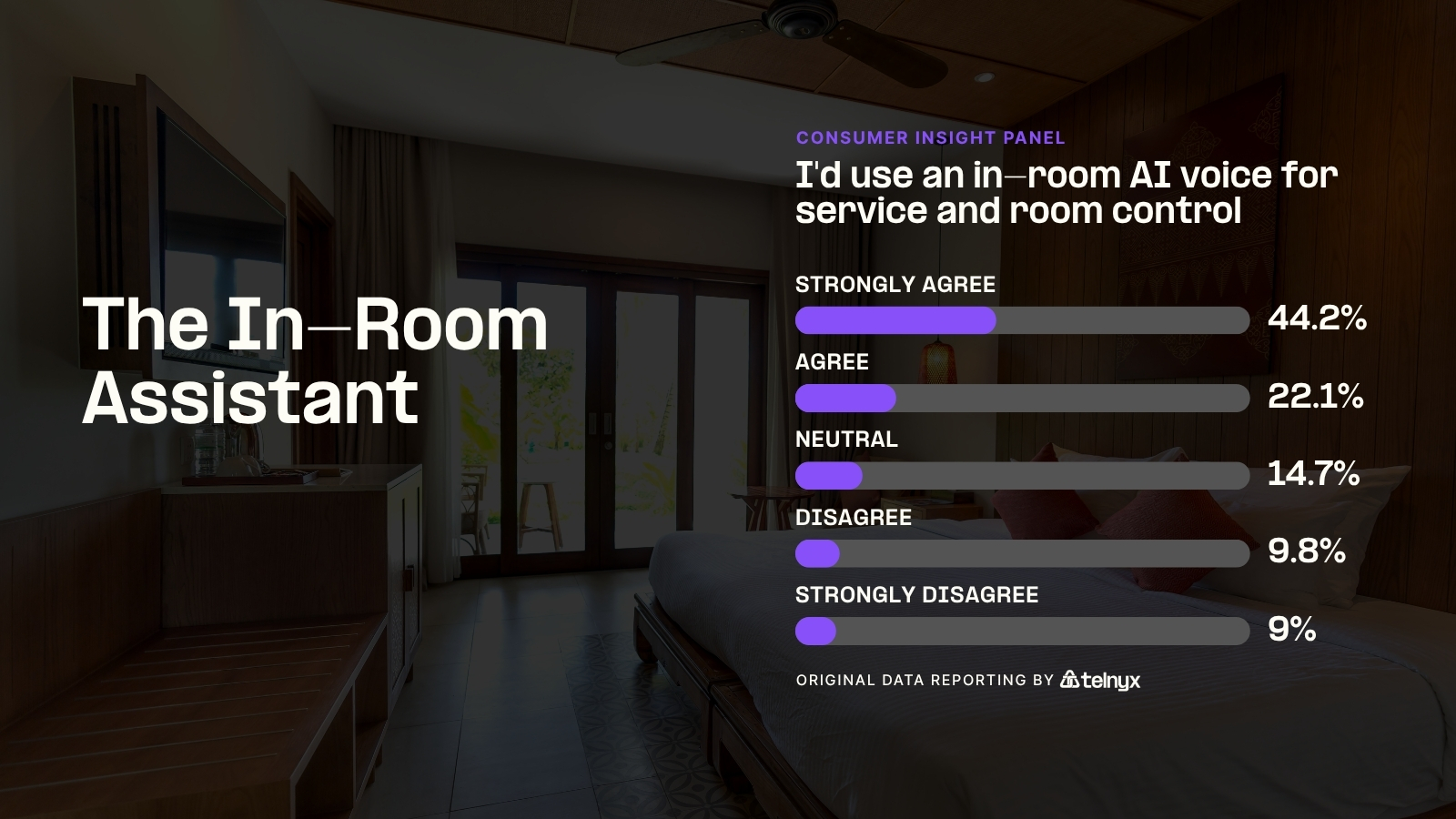
The 19% who disagree may include guests concerned about privacy in an intimate space or those who prefer the existing phone-based approach. Hotels deploying in-room Voice AI may need to make the AI opt-in rather than default, particularly given the privacy sensitivity of always-listening devices in sleeping quarters.
The AI Concierge: Personalization Without the Wait
68% of respondents agree they would take concierge recommendations from a voice AI that knows their preferences and itinerary, with 43% strongly agreeing. This is the second-highest agreement rate, driven by the combination of personalization and speed.
The concierge use case may benefit from a unique dynamic: guests already expect recommendations rather than definitive answers. Where booking and billing require precision, restaurant suggestions and local tips allow for AI approximation without serious consequences for errors. This tolerance for imprecision may make concierge a lower-risk deployment starting point.
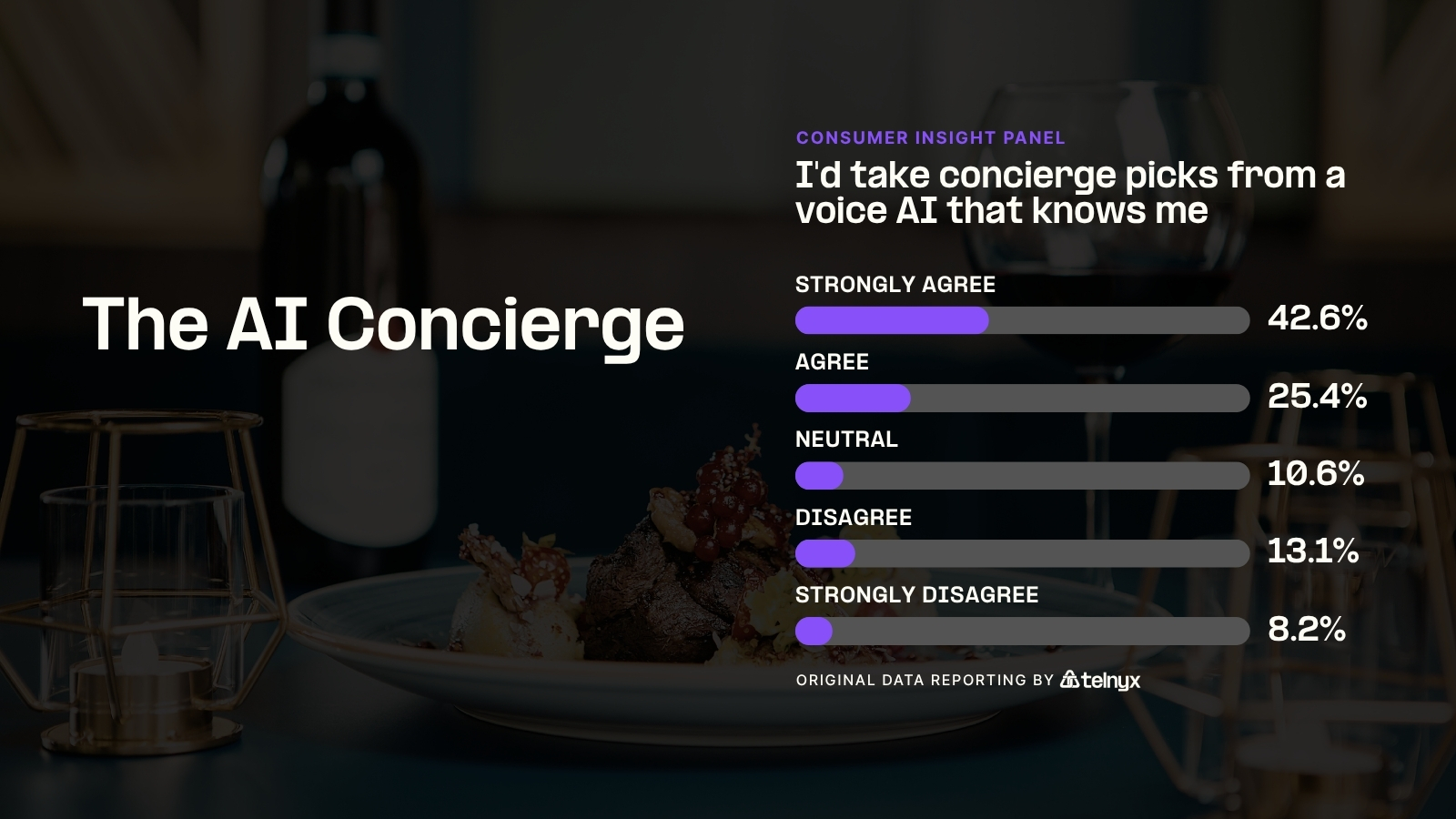
The 21% who disagree may reflect guests who value human concierge interaction as part of the hotel experience itself, particularly at luxury properties where staff recommendations carry social capital.
The Post-Stay Handoff: Low Stakes, High Volume
65% agree they would let AI handle billing questions and follow-up tasks after checkout, with 40% strongly agreeing. Post-stay interactions share characteristics that may make them ideal for early Voice AI deployment: they are routine, information-focused, and typically involve waiting on hold.
The relatively low neutral response (12%) suggests guests have formed opinions on this question, with most landing in favor of AI assistance when the alternative is calling a billing department.
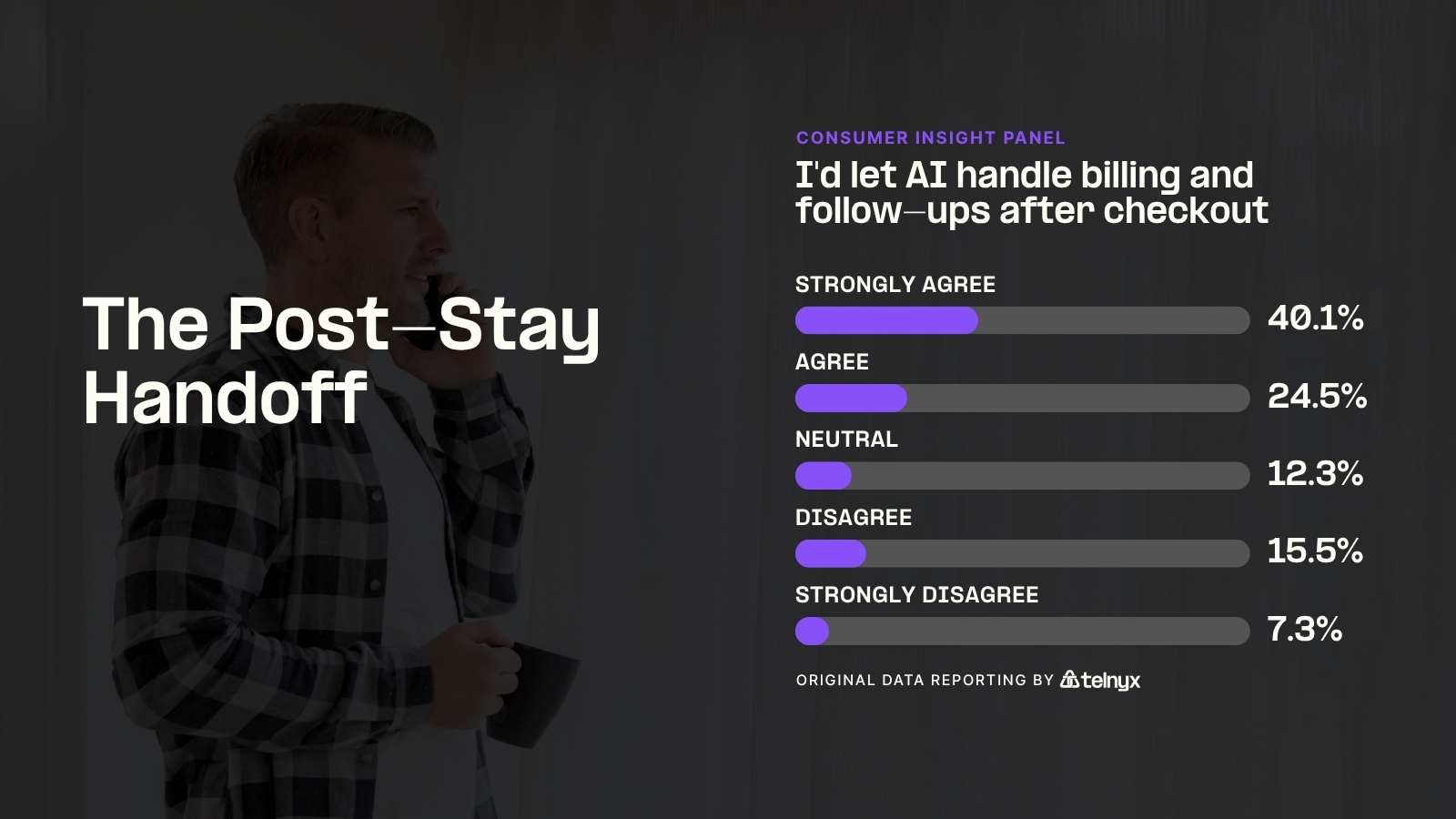
The 23% who disagree may reflect concern about financial accuracy or a preference for human handling of billing disputes. Hotels deploying AI for post-stay tasks may benefit from positioning it as a first-response channel with seamless human escalation for disputes, rather than a full replacement for billing staff.
The Front-Desk Bypass: Skip the Line
61% agree they would skip the front-desk line with an AI voice check-in, with 39% strongly agreeing. The front-desk bypass shows solid majority support but with more resistance than in-room or concierge use cases.
The higher neutral response (17%) compared to other questions suggests some guests are uncertain whether speech-to-text can handle the logistical complexity of check-in, even if they want to skip the line.
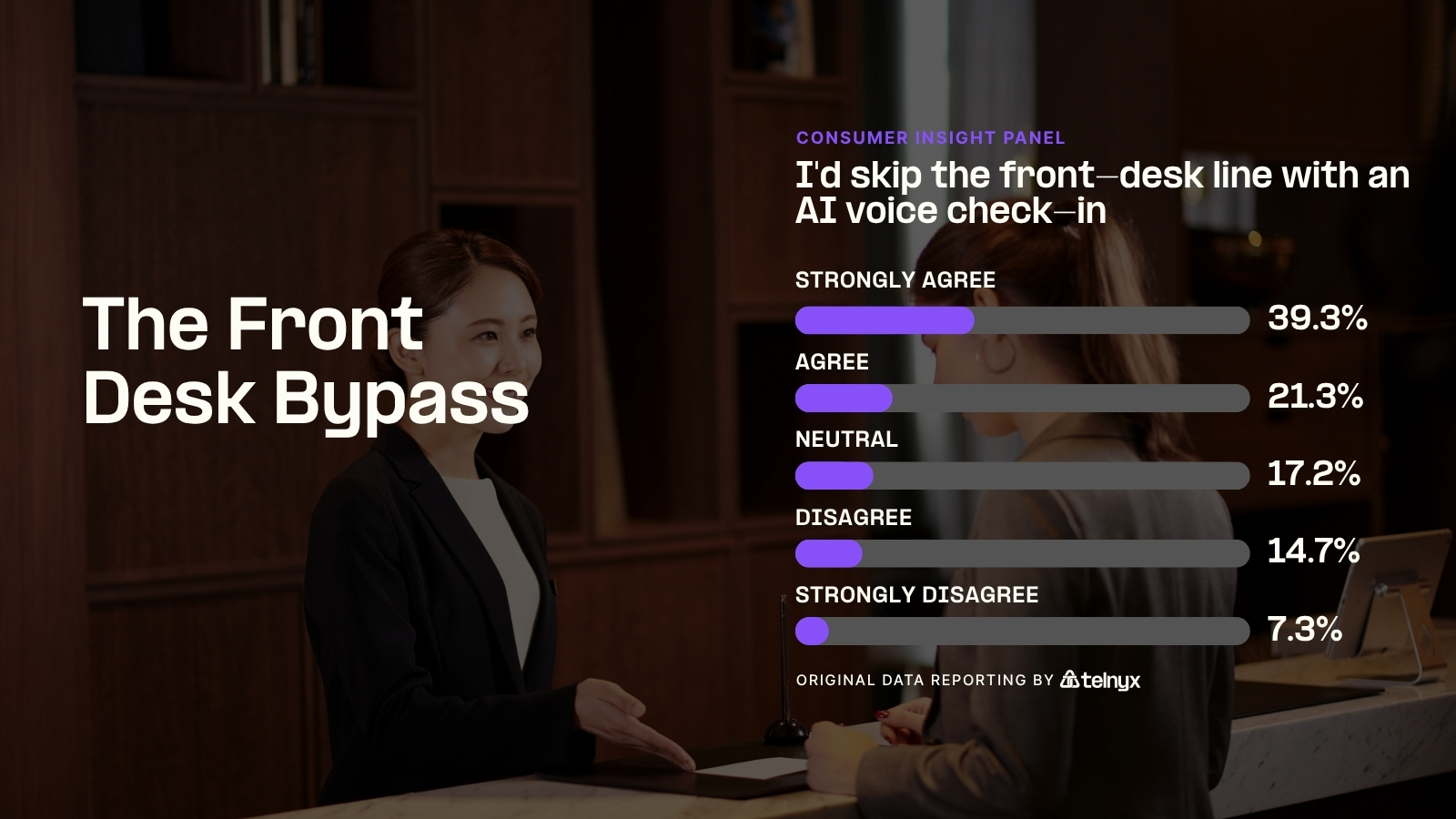
The 22% who disagree may reflect guests who view check-in as a security-sensitive interaction requiring identity verification, key handoff, and room assignment confirmation. Hotels may find higher adoption for AI-assisted check-in (where AI handles paperwork and the guest simply picks up a key) compared to fully automated check-in (where no human interaction occurs at all).
The Booking Conversation Shift: Lowest Appetite
54% agree they would rather book a hotel stay through an AI voice assistant than through a website, app, or travel platform, with 35% strongly agreeing. This is the lowest agreement rate across all five questions, and the only one where agreement barely crosses the majority threshold.
The tied Disagree and Strongly Disagree rates (both 15.5%) suggest a consistent block of resistance rather than a polarized minority. Hotels pursuing voice-based booking may need to pair AI with visual confirmation, such as sending a booking summary via text or app notification after the voice conversation.
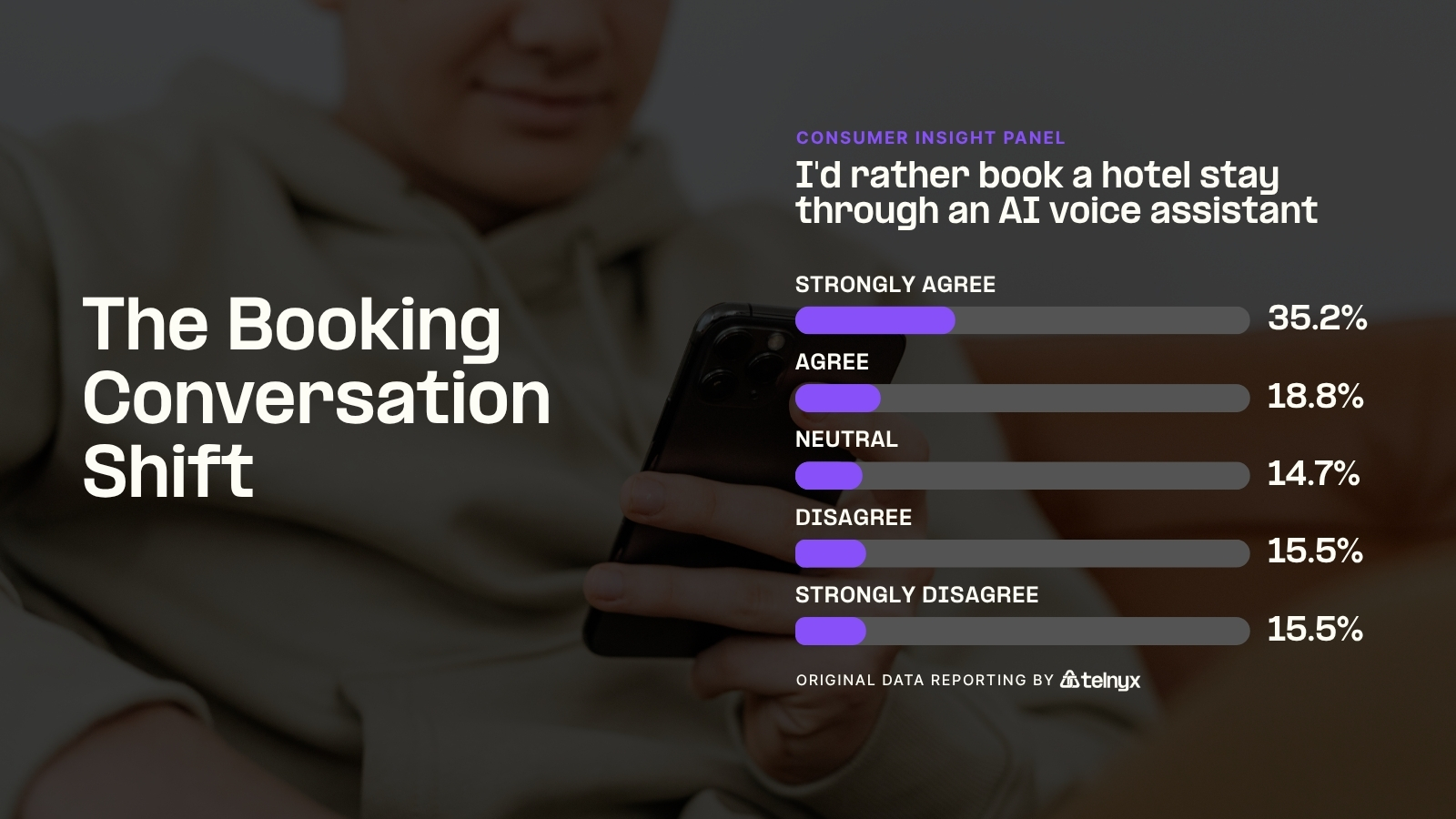
The 31% who disagree represent the highest resistance of any question, nearly matching the 54% who agree. This near-split suggests booking may be the hardest use case for Voice AI adoption. Guests have existing booking habits through apps and websites, and the transactional stakes (dates, room type, payment) leave little room for AI misunderstanding.
Key Takeaways
Demand concentrates where the alternative is inconvenience. The 66% agreement on in-room AI and 68% on AI concierge both involve scenarios where the current alternative is waiting. Hotels may find the fastest ROI by deploying Voice AI where it eliminates hold times rather than where it replaces meaningful human interaction.
The guest journey has a clear adoption curve. Agreement rates descend from concierge (68%) and in-room (66%) through post-stay (65%), front desk (61%), to booking (54%). Tasks closer to the room and further from high-stakes transactions show higher acceptance. This progression may inform phased deployment strategies.
Booking is the hardest use case, not the first. The near-even split on booking suggests guests are not ready to delegate reservation decisions to voice alone. Hotels may benefit from using Voice AI to assist booking (answering questions, confirming availability) rather than completing it end-to-end.
Strong agreement outpaces mere agreement. Across all five questions, the Strongly Agree rate exceeds Agree, often by 2:1. This concentration suggests a segment of enthusiastic early adopters rather than lukewarm majority sentiment. Hotels targeting these strong supporters first may generate positive word-of-mouth that shifts the neutral and hesitant segments over time.
Strategic Implications
These findings suggest hospitality Voice AI adoption may follow a different pattern than other industries. In financial services, Telnyx consumer research found fraud alerts generated 60% agreement while transactional tasks fell to 40%. Hospitality shows the inverse pattern: routine service interactions generate the highest acceptance, while complex transactions (booking) generate the most resistance.
This inversion may favor hotels that deploy Voice AI from the room outward rather than from the front desk inward. Starting with in-room controls, housekeeping requests, and concierge recommendations lets guests experience AI in low-stakes, convenience-driven scenarios. Once trust is established, more complex interactions like check-in and booking may become viable.
The data also suggests infrastructure decisions may determine whether initial acceptance converts to sustained adoption or hardens into resistance. Guests who try in-room Voice AI and experience latency, misunderstanding, or lack of escalation may become the 22% who disagree on the next survey. Deployments on infrastructure that delivers sub-200ms response times, clear STIR/SHAKEN attestation for outbound AI calls, and seamless human transfer may preserve the acceptance window that currently exists.
Hotels operating on carrier-grade infrastructure with embedded compliance (HIPAA, SOC 2) may also address the privacy concerns implicit in the 19% who resist in-room AI. When guests know their voice data stays on controlled infrastructure rather than passing through third-party cloud providers, the privacy objection may weaken without needing to be argued against directly.
The 66% in-room agreement rate represents an opening. Whether it becomes a trend or a peak depends on what guests experience the first time they say "order room service" to an AI and it works.
Survey Methodology
This Consumer Insight Panel surveyed 122 U.S. respondents in April 2026, examining consumer attitudes toward Voice AI across five hospitality touchpoints: booking, check-in, in-room service, concierge recommendations, and post-stay tasks. The sample includes balanced gender representation (52% male, 48% female), and geographic distribution with strongest representation in Pacific (34%), Middle Atlantic (22%), and South Atlantic (14%) regions. Age distribution centers heavily on 45-60 year-olds (45%), with 30-44 year-olds representing 31% of respondents. Household income shows broad distribution, with notable representation in $150,000-$174,999 (19%), $75,000-$99,999 (16%), and $125,000-$149,999 (12%) brackets.
Regional and Demographic Context
The sample reflects diverse U.S. geographic representation: 34% Pacific, 22% Middle Atlantic, 14% South Atlantic, with meaningful Mountain (10%) and East North Central (8%) distribution. This captures both coastal urban hospitality markets with competitive hotel options and interior regions where service access differences may influence automation acceptance. Income distribution spans economic segments, from 13% earning $25,000-$49,999 through 19% earning $150,000-$174,999, with 7% earning $200,000+. The 45% concentration in the 45-60 age bracket represents consumers with established travel habits, frequent hotel stays, and experience navigating booking and service interactions.
Methodology Disclosure Statement
Percentages are based on all respondents unless otherwise noted. These results are intended to provide indicative insights consistent with the AAPOR Standards for Reporting Public Opinion Research. This survey was conducted by Telnyx in April 2026. Participation was voluntary and anonymous. Because respondents were drawn from an opt-in, non-probability sample, results are directional and not statistically projectable to the broader population.
Survey Title: Consumer Attitudes Toward Voice AI in Hospitality
Sponsor / Researcher: Telnyx
Field Dates: April 2026
Mode: Online, self-administered questionnaire
Language: English
Sample Size (N): 122
Population Targeted: Adults with internet access who voluntarily participate in online research panels
Sampling Method: Non-probability, opt-in sample; no screening or demographic quotas applied
Weighting: None applied
Survey platform and questionnaire: Available upon request and after proper internal legal release process and confirmation.
Contact for More Information: Andrew Muns, Director of AEO, [email protected]
Explore Voice AI for hospitality or contact us to discuss deployment.
Share on Social