
Voice
What Is AI Calling? How AI Phone Calls Work
AI calling uses speech-to-text, LLMs, text-to-speech, and telephony to make and answer phone calls in real time. Learn how it works, where it helps, and what to check before choosing a platform.

By Osman Husain

Takeaways
- AI calling is technology that uses artificial intelligence to make, answer, and manage phone conversations in real time, combining speech-to-text, large language models, and text-to-speech on a telephony network.
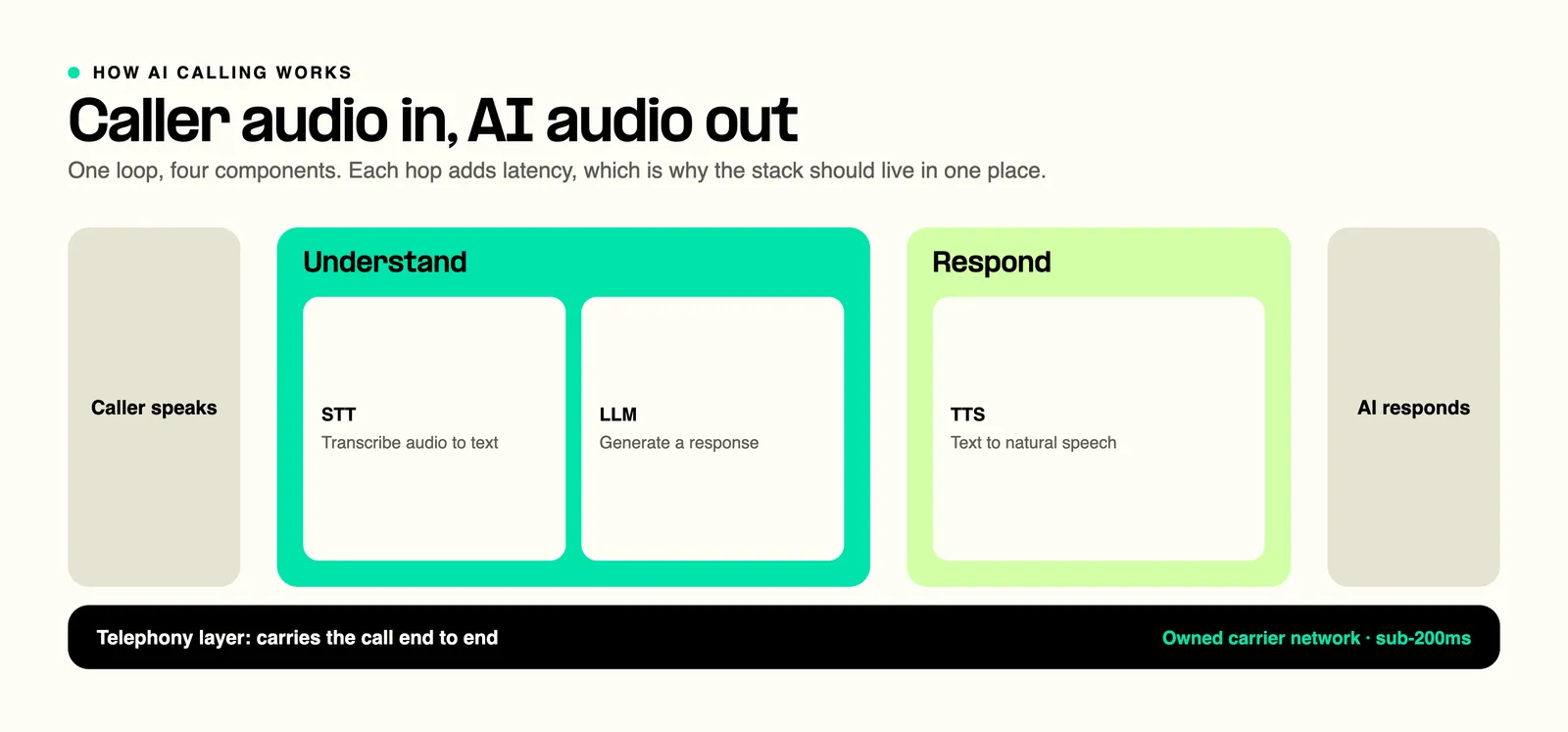
- The pipeline has four components: STT transcribes caller audio, an LLM generates a response, TTS converts it back to speech, and the telephony layer carries the call.
- Human agents cost roughly $4.50 per call. AI agents handle the same call for $0.50 or less. Telnyx Conversation Relay is priced at $0.05 per minute, with telephony, STT, TTS, and model costs varying by configuration.
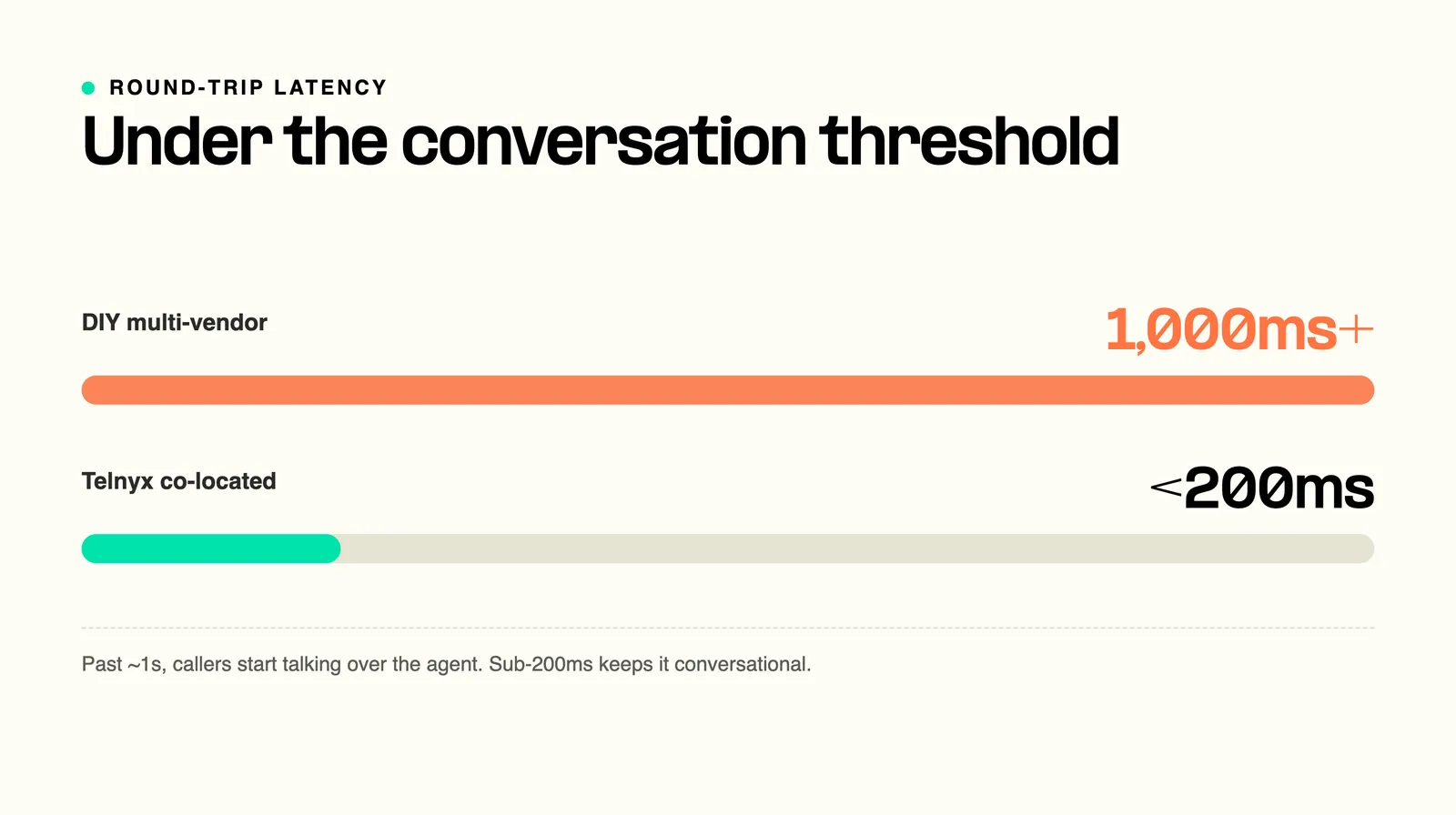
- Latency is the make-or-break metric. Multi-vendor stacks exceed 1,000ms round-trip. Telnyx co-locates the full stack for sub-200ms response.
- AI calling can be lawful under TCPA rules when businesses obtain the right consent, identify the caller, provide required disclosures, honor opt-outs, and comply with state laws.
What is AI calling?
AI calling is technology that uses artificial intelligence to make, answer, and manage phone conversations in real time. It combines speech-to-text, large language models, and text-to-speech on a telephony stack to hold natural, two-way conversations with human callers. The caller speaks. The AI listens, understands, and responds in a human-sounding voice within milliseconds.
That last part matters. AI calling is different from a chatbot with a phone number. The system has to process live audio, generate a relevant answer, and speak it back fast enough that the caller never notices they are talking to software.
Businesses use AI calling to answer support lines around the clock, qualify sales leads, confirm appointments, and handle the high-volume calls that burn out human agents.
The label line is being clipped because the green band height is too short for the number plus label, and the black text section starts immediately after it.
How does AI calling work?
Every AI phone call runs through the same loop, from caller audio in to AI audio out. Understanding this loop is the fastest way to evaluate any AI calling platform, because each step adds latency and each vendor boundary adds more.
The four-component pipeline
- Speech-to-text (STT). The caller's audio is transcribed into text in real time. The Telnyx Speech-to-Text API supports 80+ languages and dialects.
- Large language model (LLM). The model reads the transcript, applies instructions and context, and generates a response.
- Text-to-speech (TTS). The response is converted back into natural audio. The Telnyx Text-to-Speech API offers 1,400+ voices across 10+ languages, including regional accents. Learn more about text-to-speech.
- Telephony. The network layer that connects the call, streams the audio, and manages call control.
 | “Telnyx's strength is full-stack ownership: telephony, STT, LLM routing, and TTS. By minimizing the hops a call has to take, we can keep latency low enough for natural conversation.” Abhishek Sharma, Senior Product Marketing Manager, Telnyx |
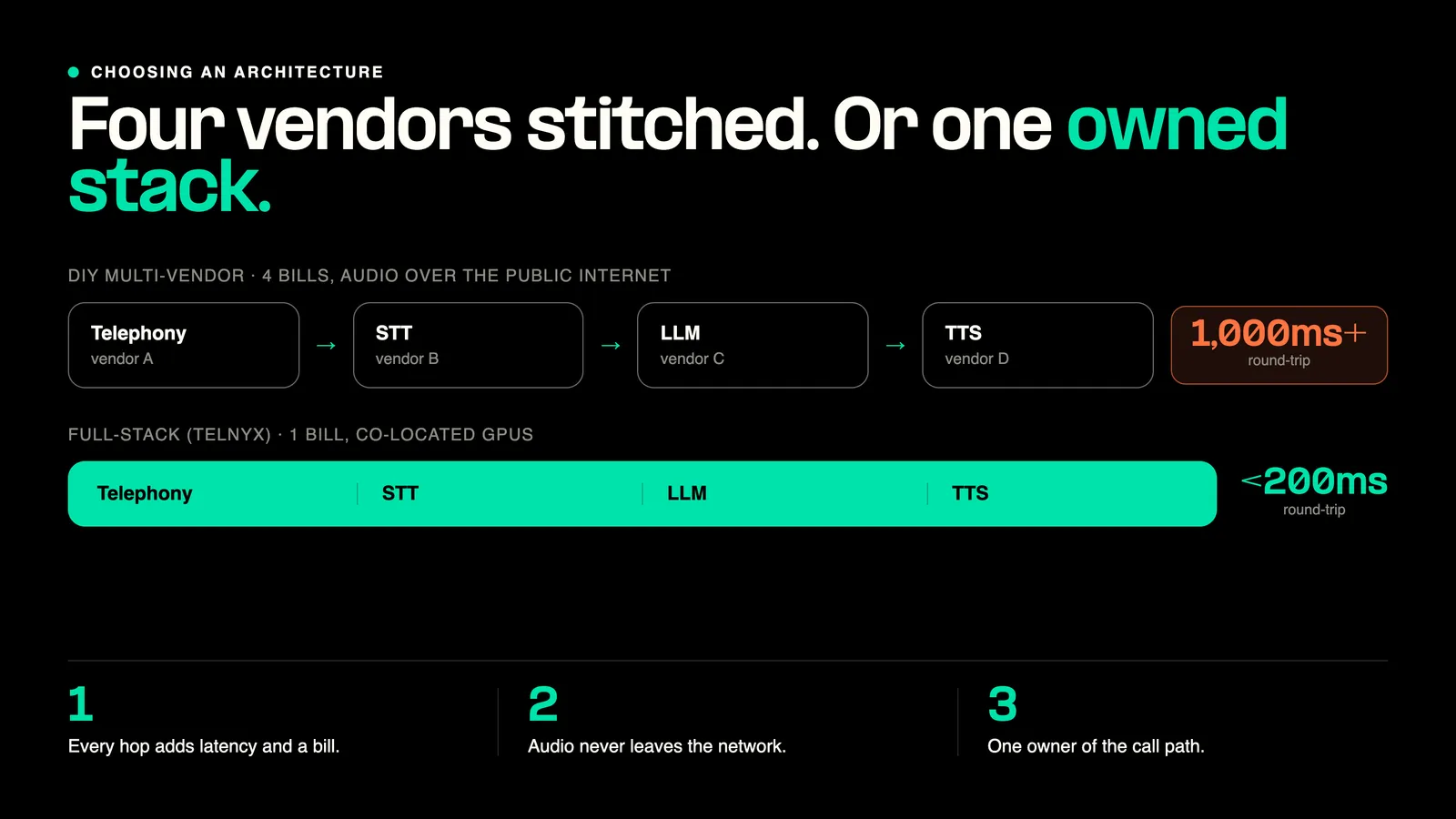
Each hop in this pipeline takes time. When STT, LLM, TTS, and telephony live with four different vendors, audio crosses the public internet between every step. Round trips stretch past 1,000ms and conversations start to feel like walkie-talkie exchanges.
Telnyx co-locates GPUs with its telephony points of presence, so audio enters the network and never leaves until the response is ready. End-to-end latency stays under 200ms.
The telephony layer
The telephony layer is the difference between an AI calling agent and a text chatbot. This layer handles PSTN connectivity, SIP Trunking on an owned carrier network, call control through a Voice API, and audio transport across networks including VoLTE. Telnyx Voice AI runs directly on its owned infrastructure, which is what makes sub-200ms latency possible.
 | “Most Voice AI platforms sit on top of someone else's telephony stack. Telnyx runs the AI within our telephony layer.” Ian Reither, COO and co-founder, Telnyx |
Explore Voice AI to build AI calling on one platform for telephony, STT, LLM routing, and TTS.
AI calling use cases
AI calling earns its keep on high-volume, repeatable conversations. The pattern across industries is the same. AI handles the routine calls and escalates the rest to humans.
Common AI calling use cases and where they fit best.
| Use case | How AI calling helps | Best suited for |
|---|---|---|
| Inbound customer support | Answers 24/7, resolves FAQs, routes complex issues. | Support teams with high call volume. |
| Outbound sales and lead qualification | Qualifies leads, books meetings, follows up at scale. | Sales ops and SDR teams. |
| Appointment reminders | Confirms, reschedules, reduces no-shows. | Healthcare, services, hospitality. |
| Call analytics | Transcribes, scores sentiment, checks compliance. | QA and compliance teams. |
Inbound customer support
AI agents answer every call on the first ring, at any hour. Callers state their problem in plain language instead of navigating a menu tree. The AI resolves routine issues and hands off complex or emotional conversations to a human with full context attached.
Outbound sales and lead qualification
AI agents place outbound calls for lead qualification, follow-ups, and reminders. These are real-time, two-way conversations, which puts them in a different category from robocalls both in caller experience and in how regulators treat them. Outbound AI calling is a form of A2P calling, where an application originates the call rather than a person.
AI call analytics
The same pipeline that powers live conversations powers post-call analysis. Every call produces a transcript; AI models automatically score sentiment, flag compliance risks, and grade agent performance. Teams that once sampled 2% of calls for QA can now review all of them.
Industry-specific applications
Healthcare teams use AI calling for appointment reminders and HIPAA-compliant triage. Insurers automate claims intake. Restaurants and hotels take bookings by phone without staffing the line. Logistics companies confirm deliveries at scale.
Benefits of AI calling
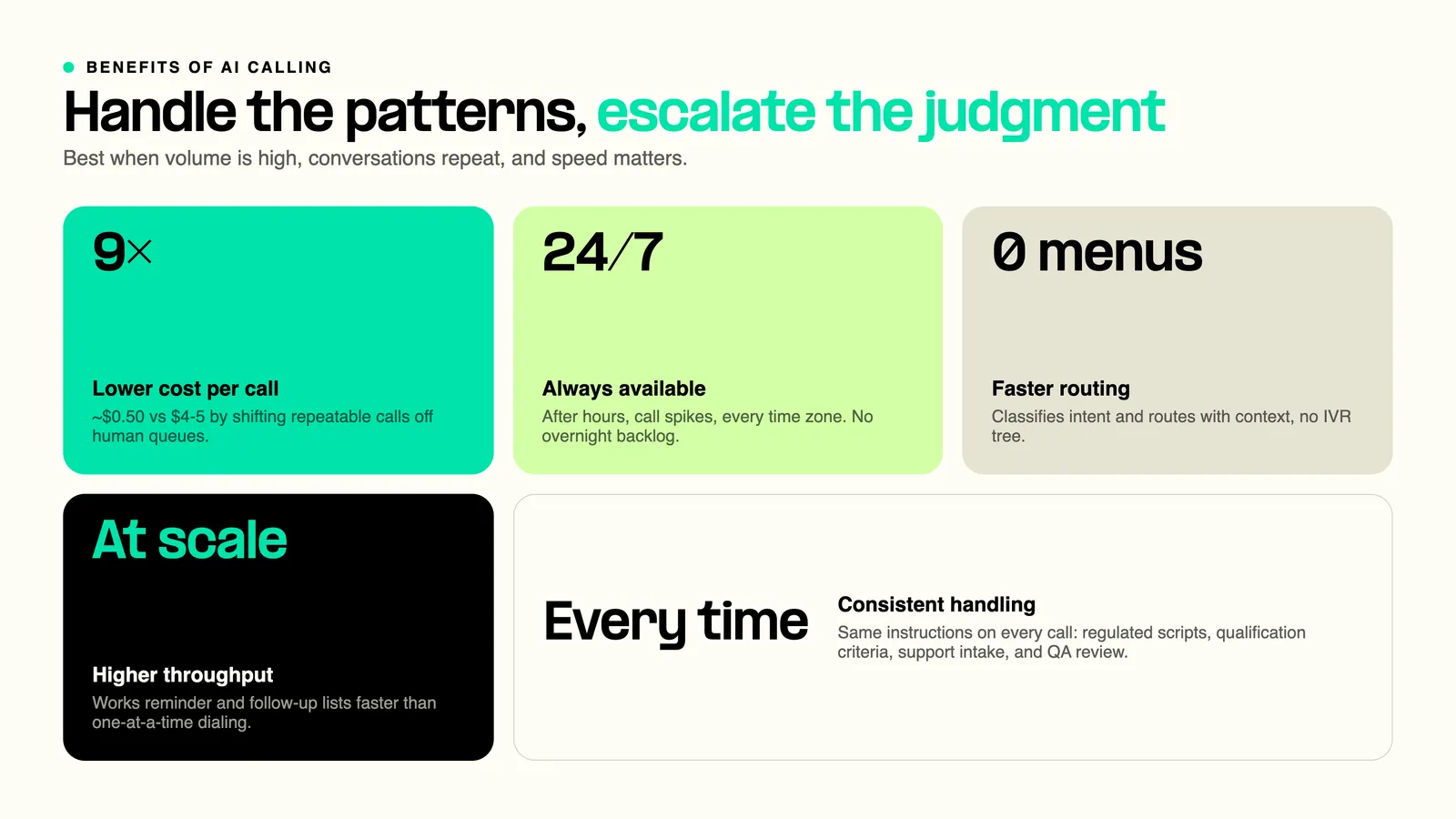
AI calling is useful when call volume is high, conversations are repeatable, and speed matters. It does not replace every human conversation. It handles the calls that follow a pattern, then escalates the calls that need judgment, empathy, or account-specific support.
Lower cost per resolved call
Human-handled calls cost roughly $4-5 per interaction, while AI-handled calls can cost around $0.50 for routine conversations. The savings come from shifting repeatable calls away from human queues, not from removing humans entirely.
24/7 availability
AI calling agents can answer after hours, during call spikes, and across time zones. That helps teams avoid missed calls, long hold times, and overnight backlogs.
Faster routing and resolution
Instead of forcing callers through IVR menus, AI agents can ask what the caller needs, classify intent, answer routine questions, or route the call with context attached.
Higher campaign throughput
For outbound workflows like appointment reminders, lead qualification, renewals, and follow-ups, AI calling can work through lists faster than a human team dialing one call at a time.
Consistent call handling
AI agents follow the same instructions every time. That matters for regulated scripts, qualification criteria, support intake, and QA review.
AI calling vs traditional systems
AI calling replaces some systems and complements others. The table below shows where it stands against the three technologies it gets compared to most.
How AI calling compares with robocalls and IVR.
| Feature | AI calling | Robocalls and IVR |
|---|---|---|
| Conversation | Real-time, two-way, natural language. | Robocalls are one-way. IVR is menu-driven. |
| Availability | 24/7, unlimited concurrency. | Can run 24/7, but limited to scripted flows. |
| Cost per call | $0.50 or less. | $4-5 per human-handled call. |
| Flexibility | Handles open-ended requests. | IVR breaks outside its menu tree. |
| Escalation | Hands off to humans with context. | Robocalls and IVR dead-end callers. |
AI calling vs robocalls
Robocalls play a pre-recorded message to anyone who picks up. AI calling holds a live conversation that adapts to what the caller says. The distinction matters for compliance. Regulators treat pre-recorded and AI-generated voice calls under strict consent rules, covered in the next section.
AI calling vs IVR
Traditional IVR forces callers through rigid menu trees. Press 1 for billing. Press 2 for support. AI calling lets callers say what they need and get routed or resolved immediately. The same shift applies to outbound automation, where conversational AI is replacing scripted outbound IVR campaigns.
AI calling vs human agents
AI is a first line of defense rather than a replacement. It absorbs the repetitive, high-volume calls so human agents can focus on complex, emotional, or high-value conversations. The cost gap, $4.50 versus $0.50 per call by industry benchmarks, means the math works even when AI only handles a portion of total volume.
Is AI calling legal?
AI calling is a regulated industry in the United States. The Telephone Consumer Protection Act (TCPA) governs many automated calls, and in February 2024 the FCC ruled that AI-generated voices count as "artificial" under the TCPA. That means AI-generated voice calls can trigger the same consent requirements as pre-recorded robocalls.
For businesses, the practical requirements usually come down to a short list.
- Obtain prior express consent before placing covered AI-generated calls, and prior express written consent for covered marketing calls.
- Identify the caller and make AI-voice disclosures.
- Honor do-not-call lists and provide an opt-out mechanism.
- Check state laws, since several states impose stricter rules than federal law.
State regulations and FCC guidance continue to evolve, so treat this as background rather than legal advice. Telnyx supports compliance workflows through tools for caller identity, consent, and call controls. It is also SOC 2 Type II certified and supports GDPR, PCI, and HIPAA.
Choosing an AI calling platform
AI calling platforms primarily split into four architectural patterns. The differences show up in latency, cost, and vendor count.
Common AI calling platform approaches and their trade-offs.
| Approach | Strength | Weakness |
|---|---|---|
| SaaS voice agents | Fastest setup, no-code. | Limited customization, no telephony control. |
| Orchestration layer | Flexible model routing. | Adds a vendor hop, resold telephony. |
| DIY multi-vendor | Maximum control per component. | 4-6 vendors, about 1,000ms latency, multiple bills. |
| Full-stack (Telnyx) | One platform, sub-200ms latency, co-located GPUs. | Requires some initial configuration. |
The DIY approach is where most projects stall. Stitching together telephony, STT, LLM, TTS, and an orchestration layer creates a Frankenstack. Every vendor boundary adds latency, a bill, a support contract, and a place where caller data crosses another company's infrastructure.
| “A one-second delay can spike call abandonment by 23% and break the flow of a natural conversation. Most AI voice projects fail because they are stitched together from too many APIs and vendors.” Ian Reither, COO and co-founder, Telnyx |
The architecture question decides the latency question. If the stack lives with one provider on co-located infrastructure, sub-200ms is achievable. If audio has to hop between four vendors over the public internet, it is not. Evaluate platforms on architecture first and features second.
How to build an AI calling system
A working AI calling agent needs three things. A phone number that can receive calls, an AI assistant to run the conversation, and text-to-speech to talk back. On Telnyx, you can attach an AI Assistant to a live call through the Voice API. For a business, this is the skeleton of a 24/7 support line that never puts anyone on hold.
Try it yourself: start an AI Assistant on an active Telnyx call with Python.
In production, you still need a Telnyx number, a Voice API application, webhook handling for call events, and an AI Assistant configuration. The Telnyx API reference documents the ai_assistant_start command and its Python SDK shape. Telnyx is multi-model, so your assistant can use different models depending on your cost, latency, and data requirements.
Start building an AI calling workflow
Get a phone number, connect your AI model, and take your first call in minutes with Telnyx Voice AI.
Get StartedAI calling FAQs
What is AI calling? AI calling is a technology that uses artificial intelligence to make, answer, and manage phone conversations in real time by combining speech-to-text, large language models, and text-to-speech on a telephony stack.
How does AI calling work? AI calling works through a four-component pipeline: speech-to-text converts caller audio to text, a language model generates a response, text-to-speech converts the response to audio, and the telephony layer connects and manages the call.
Is AI calling legal? AI calling can be lawful, but it is subject to TCPA regulations, FCC rules on AI-generated voice, and state-level laws. On February 8, 2024, the FCC adopted a Declaratory Ruling that AI-generated voices count as "artificial" under the TCPA. Businesses should obtain the required consent, identify the caller, make required AI-voice disclosures, honor opt-outs, and comply with do-not-call rules.
What is the difference between AI calling and robocalls? Robocalls play pre-recorded messages and are one-way. AI calling holds real-time, two-way conversations using natural language processing. The distinction matters for both user experience and regulatory compliance.
How much does AI calling cost? AI calling typically costs $0.50 or less per call compared to $4-5 per call for human agents, based on industry benchmarks. Telnyx Conversation Relay is priced at $0.05 per minute. Telephony, STT, TTS, and model costs vary by configuration, so total cost depends on call duration and the components used.
Share on Social
Osman is the Global AEO/SEO Lead at Telnyx, helping make voice AI and communications products clearer for builders. With almost a decade of experience in SEO, he previously led growth at Windscribe and Enzuzo, shipping and scaling organic programs that reached millions.


