
Telnyx
RingCentral AI Receptionist Alternatives & Competitors 2026
Compare 7 RingCentral AI Receptionist competitors on per-minute pricing, sub-200 ms latency, BYO LLM, and compliance.

By Eli Mogul
Quick answer
RingCentral AI Receptionist alternatives for voice AI agents are platforms that let teams build programmable voice agents on top of telephony infrastructure rather than configuring a closed product inside RingEX. The seven alternatives below are split across three architectures: carrier-owned infrastructure (Telnyx), CPaaS plus voice AI overlays (Twilio, Vonage, Plivo), and orchestration or self-hosted layers (Retell AI, Vapi, Bland AI). Each is ranked on per-minute pricing, sub-200ms latency, BYO LLM support, and compliance posture.
Why teams are looking beyond RingCentral AI Receptionist
The rise of programmable voice AI agents is exposing the limits of RingCentral AI Receptionist, which sits inside RingEX as a closed config product. Buyers configure pre-built workflows through the RingCentral admin UI. The LLM, STT, and TTS layers are not swappable.
Four drivers push engineering and ops teams to evaluate alternatives.
- Pricing rigidity: RingEX is seat-licensed, with AI Receptionist features billed as add-ons that scale with users rather than call volume.
- Closed-config product model: no BYO LLM, no programmable API for agent logic, and a fixed voice library.
- Latency dependence on RingCentral's underlying carrier path, with no published sub-200 ms commitment for voice AI flows.
- Integration depth limited to RingCentral's own partner network.
The volume problem is real and growing. According to Gartner, 40% of enterprise applications will integrate task-specific AI agents by the end of 2026, up from less than 5% in 2025. Voice is one of the highest-volume entry points for that adoption curve, which means the architecture decisions teams make in 2026 will shape voice AI economics for years.
Buyer intent for this use case splits into two groups. SMB teams replacing a phone-answering workflow tend to evaluate Smith.ai, Allo, Goodcall, and Rosie. Engineering and ops teams building programmable voice AI agents on top of telephony infrastructure tend to evaluate Telnyx, Twilio, Vonage, Plivo, Retell AI, Vapi, and Bland AI. This page covers the second group.
The 7 RingCentral AI Receptionist alternatives at a glance
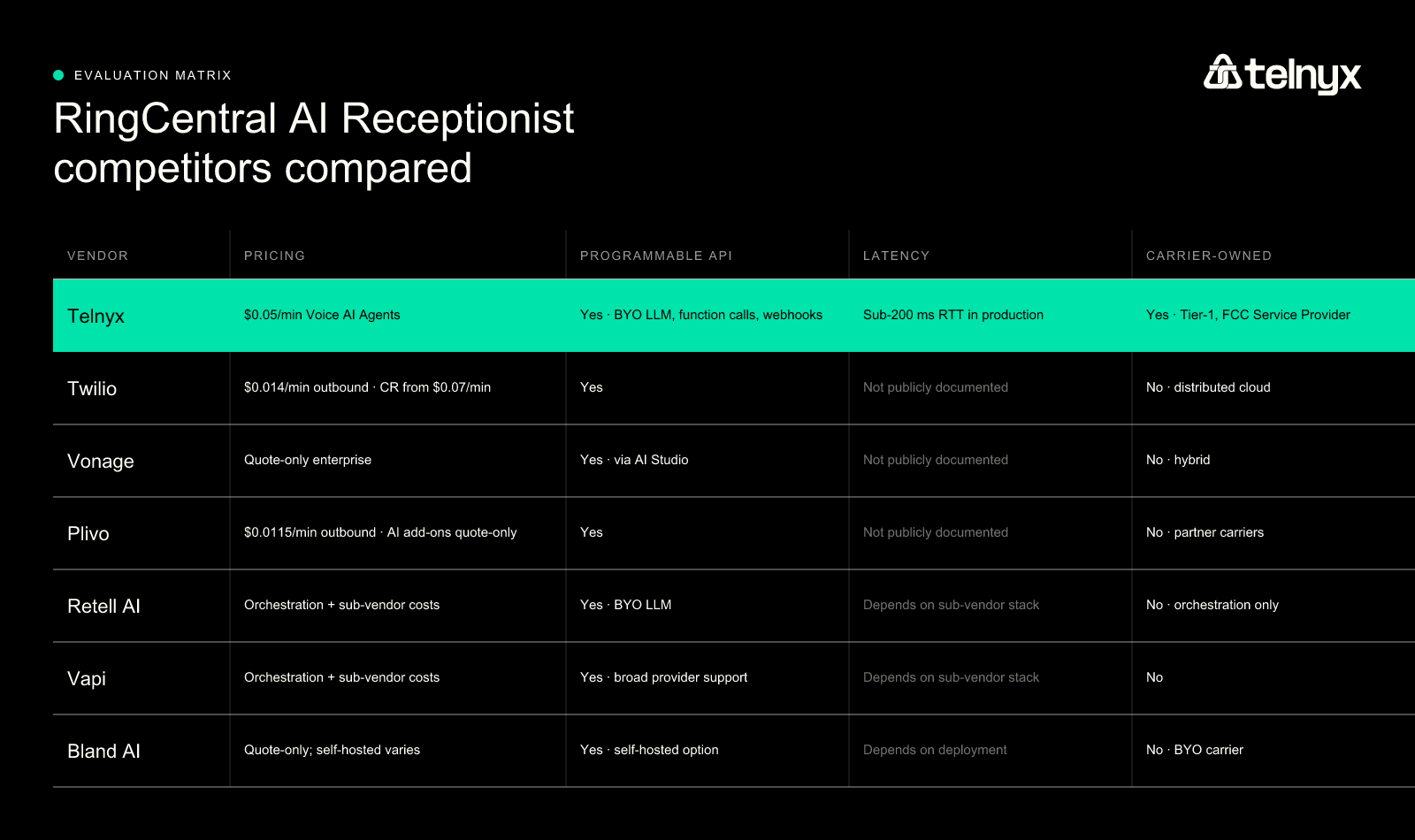
The right choice depends on what part of the stack the team wants to own. Carrier-owned voice plus a voice AI agent layer on one contract: Telnyx. A CPaaS contract with an AI overlay layered on top: Twilio, Vonage, Plivo. Orchestration that composes a sub-CPaaS, LLM, STT, and TTS: Retell AI, Vapi. Self-hosted infrastructure for data residency or air gap: Bland AI.
| Platform | Best for | Why it made the list | Pricing |
|---|---|---|---|
| Telnyx | Production voice AI agents on a programmable carrier-owned network | Tier-1 carrier-owned voice network with STT, TTS, orchestration, and BYO LLM on one contract; sub-200 ms RTT in production | From $0.05/min for orchestration (STT and Telnyx-native TTS included) |
| Twilio | Programmable voice on the largest CPaaS developer platform | Mature voice APIs with broad carrier coverage and the largest CPaaS developer community | Voice from $0.014 per minute outbound; Conversation Relay from $0.07 per minute |
| Vonage | Enterprise UCaaS with voice AI service overlays | Established UCaaS vendor with Vonage AI Studio for voice agent workflows and enterprise-grade SLAs | Quote-only, custom enterprise pricing |
| Plivo | Cost-conscious developer voice with global PSTN reach | Competitive per-minute CPaaS rates with developer-first APIs and PSTN plus SIP coverage | Voice from $0.0115 per minute outbound (US); voice AI add-ons quote-only |
| Retell AI | Voice agent orchestration with evaluation and QA tooling | Production-grade orchestration with live-call observability, evaluation tooling, and BYO LLM support | Per-minute orchestration on top of sub-vendor LLM, STT, TTS, and telephony costs |
| Vapi | Developer prototyping with broad provider support | Open orchestration layer supporting most LLM, STT, and TTS vendors with a low-code workflow builder | Per-minute orchestration on top of sub-vendor costs |
| Bland AI | Self-hosted or on-premise voice AI for regulated industries | Self-hosted deployment option for data-residency and air-gapped requirements | Quote-only, varies by deployment model |
Each platform is profiled below.
RingCentral AI Receptionist (the incumbent)
What is RingCentral AI Receptionist? RingCentral AI Receptionist is a closed-config voice AI agent that sits inside RingEX. Admins configure it through the RingCentral UI. It handles inbound calls, routes based on configured workflows, and integrates with RingCentral CRM data. The LLM, STT, voice library, and call-routing logic are not exposed for substitution.
What RingCentral AI Receptionist costs. RingEX seat licensing runs from $20 to $45 per user per month on annual billing, depending on tier. AI Receptionist is sold as an add-on, with features billed separately on top of the seat license. RingCX, RingCentral's contact-center product, starts at approximately $65 per user per month and layers AI features through additional add-on subscriptions.
Where RingCentral AI Receptionist creates friction for voice AI agents:
- Closed-config: no BYO LLM, no programmable API for voice agent logic, custom voices limited to RingCentral's library.
- Pricing model: per-seat plus add-on billing scales linearly with users, not call volume. High-volume voice AI workloads cost more inside RingEX than per-minute alternatives.
- Latency: dependent on RingCentral's underlying carrier path; no published sub-200 ms commitment for voice AI agent flows.
1. Telnyx Voice AI Agents
The Telnyx voice AI agent platform integrates STT, LLM hosting, TTS, function calling, and the underlying voice network in one programmable API, replacing RingCentral AI Receptionist's closed config inside RingEX with a developer-grade platform on a Tier-1 carrier-owned network.
Summary. Tier-1 carrier-owned voice network with FCC Service Provider credentials. Engineering and ops teams ship voice AI agents with BYO LLM (OpenAI, Anthropic, custom), custom voices, real-time function calling, webhook actions, and live-call observability.
Best for. Engineering and ops teams building programmable voice AI agents that need carrier-owned voice infrastructure on a single contract.
Key strengths:
- Carrier-owned voice network: Tier-1 carrier with FCC Service Provider credentials and direct PSTN plus SIP coverage in 80+ countries.
- $0.05 per minute for Voice AI Agents orchestration on one contract, with STT and Telnyx-native TTS included; BYO LLM billed separately.
- Full programmable API: BYO LLM (OpenAI, Anthropic, custom), custom voices, real-time function calling, webhook actions, and live-call observability.
Limitations:
- Less brand-voice and emotive customization than dedicated voice cloning vendors.
- No fully no-code visual builder; deployment assumes engineering involvement.
Voice AI agent use cases:
- Per-minute pricing scales linearly to high-volume call workloads without per-vendor markup compounding.
- Inbound and outbound voice AI agents on the same platform with consistent caller ID, SLA, and audit log.
- Native integrations with major CRMs and helpdesks (Salesforce, HubSpot, Zendesk, ServiceNow) plus SIP trunking and BYO carrier.
Compliance posture. SOC 2 Type II, HIPAA, PCI DSS Compliant, ISO 27001, GDPR with EU-deployed infrastructure.
__[**Talk to our sales team**](https://telnyx.com/contact-us) about moving from RingCentral AI Receptionist to a developer-grade voice AI agent platform on a Tier-1 carrier-owned network.__
2. Twilio
Summary. The largest CPaaS developer platform, with mature programmable voice APIs and a layered Conversation Relay voice AI product. Voice runs on Twilio's distributed cloud infrastructure with broad global carrier coverage.
Best for. Teams already on Twilio Voice that want to add a voice AI agent layer through Twilio Conversation Relay or a partner orchestration vendor.
Key strengths:
- Largest CPaaS developer community, with mature documentation, SDKs, and a deep partner network.
- Broad global carrier coverage and mature voice routing.
- Layered Conversation Relay product for voice AI agent workflows on top of the existing Twilio Voice infrastructure.
Limitations:
- Distributed cloud infrastructure is hosted, not carrier-owned. The voice path adds hops compared to Tier-1 carrier-owned alternatives.
- Pricing is layered on top of voice per-minute rates, complicating TCO modeling.
Voice AI agent use cases:
- Voice billed from $0.014 per minute outbound (US, public rate); Conversation Relay from $0.07 per minute.
- Inbound and outbound voice through Twilio Programmable Voice with worldwide PSTN coverage.
- Native integrations with major CRMs, helpdesks, and contact-center platforms via Twilio Flex and partner integrations.
Compliance posture. SOC 2, HIPAA, PCI DSS, and GDPR.
3. Vonage
Summary. Enterprise UCaaS vendor with voice AI agent workflows via Vonage AI Studio. Strong enterprise SLAs and established large-account track record.
Best for. Enterprise teams already on Vonage UCaaS that want to layer voice AI agents through Vonage AI Studio.
Key strengths:
- Established enterprise UCaaS vendor with mature SLAs and named global references.
- Vonage AI Studio for voice agent workflow design and deployment.
- Mature programmable voice APIs through the legacy Nexmo platform.
Limitations:
- Quote-only enterprise pricing for voice AI; no public per-minute or per-seat rate card for AI Studio.
- Voice path runs across Vonage's distributed cloud and partner carriers, not a single Tier-1 carrier-owned network.
Voice AI agent use cases:
- Inbound and outbound voice through Vonage Voice API.
- Quote-only enterprise pricing on AI Studio plus per-minute voice rates billed separately.
- Native integrations with major CRMs and helpdesks through Vonage Connect.
Compliance posture. SOC 2 Type II, HIPAA, PCI DSS, ISO 27001, GDPR, and HITRUST.
4. Plivo
Summary. Cost-conscious developer-first CPaaS with competitive per-minute voice rates and global PSTN coverage. Voice AI add-ons exist but are not the platform's lead product.
Best for. Cost-conscious developer teams building voice agents with their own LLM and orchestration layer on top of Plivo Voice.
Key strengths:
- Competitive per-minute voice pricing with a public rate card.
- Developer-first programmable Voice API with PSTN and SIP coverage in 195+ countries.
- Lower-cost alternative to Twilio with a similar API surface for voice.
Limitations:
- Voice AI agent product is not the platform's lead offering; teams typically pair Plivo Voice with a third-party orchestration vendor (Retell, Vapi).
- No carrier-owned Tier-1 network; voice path runs through partner carriers and introduces additional network hops compared to owned-network alternatives.
Voice AI agent use cases:
- Voice from $0.0115 per minute outbound (US, public rate); voice AI add-ons quote-only.
- Inbound and outbound voice through Plivo Voice API with global PSTN coverage.
- Webhook-based integrations with most major orchestration and CRM platforms.
Compliance posture. SOC 2 Type 2, HIPAA, PCI DSS Level 1, ISO 27001, and GDPR.
5. Retell AI
Summary. Voice agent orchestration platform with strong evaluation, QA tooling, and live-call observability. Production track record across enterprise voice AI agent deployments.
Best for. Engineering teams that want production voice agent orchestration with strong evaluation tooling and BYO LLM support.
Key strengths:
- Live-call observability, transcript review, and replay debugging.
- Production track record across enterprise voice AI agent deployments.
- Voice agent evaluation and QA tooling for testing flows before production.
Limitations:
- BYO carrier and LLM required; the orchestration layer only, no carrier-owned network.
- Stack still depends on sub-vendors for telephony, LLM, and TTS, with separate billing and SLAs.
Voice AI agent use cases:
- Per-minute orchestration pricing layered on top of sub-vendor LLM, STT, TTS, and telephony costs.
- Inbound and outbound voice through CPaaS partner integrations (Twilio, Plivo, Telnyx).
- Native integrations with major CRMs and helpdesks.
Compliance posture. SOC 2 Type II, HIPAA, and GDPR (Retell platform); PCI DSS depends on sub-vendor selection.
6. Vapi
Summary. Developer-first voice agent orchestration with broad provider support across LLMs, STT, and TTS vendors. Fast to prototype with a low-code workflow builder.
Best for. Engineering teams that want to choose their own LLM, STT, and TTS vendors and need an orchestration layer to connect them with telephony.
Key strengths:
- Broad provider support covering major LLM, STT, and TTS vendors.
- Low-code workflow builder for fast prototyping.
- Active developer community and extensive documentation.
Limitations:
- Full stack spans multiple vendors with separate billing, SLAs, and audit logs.
- No native carrier infrastructure; telephony must be sourced from a CPaaS partner.
Voice AI agent use cases:
- Per-minute orchestration pricing on top of sub-vendor LLM, STT, TTS, and telephony costs.
- Inbound and outbound voice through partner CPaaS integrations.
- Webhook-based connections to most major CRM and helpdesk platforms.
Compliance posture. SOC 2 Type II, HIPAA (configurable), and GDPR (Vapi platform); PCI DSS depends on sub-vendor selection.
7. Bland AI
Summary. Self-hosted enterprise voice AI platform with infrastructure flexibility for regulated industries that require on-premise or air-gapped deployments.
Best for. Regulated enterprises that need self-hosted or on-premise voice AI infrastructure for compliance or data residency.
Key strengths:
- Self-hosted deployment option for on-premise or air-gapped infrastructure.
- Infrastructure flexibility supports custom compliance and data-residency requirements.
- Enterprise-focused positioning with dedicated implementation support.
Limitations:
- Heavier deployment and tuning lift than fully managed alternatives.
- Fewer third-party integrations than orchestration-only competitors.
Voice AI agent use cases:
- Self-hosted deployments for regulated industries requiring on-premise or air-gapped infrastructure.
- Inbound and outbound voice via integrated telephony or BYO carrier.
- API-based integration with major CRMs and helpdesks.
Compliance posture. SOC 2 Type II, HIPAA (with BAA), PCI DSS, and GDPR across all tiers.
RingCentral AI Receptionist alternatives pricing in 2026
The pricing breakdown splits into three models. Orchestration per-minute (Telnyx) publishes a $0.05/min base with STT and Telnyx-native TTS included; LLM and telephony billed separately. Orchestration plus sub-vendor (Retell, Vapi) charges an orchestration rate on top of separate LLM, STT, TTS, and telephony bills. Quote-only (Vonage, Bland, RingCX add-ons) requires a sales conversation before pricing is visible.
Telnyx publishes $0.05 per minute for Voice AI orchestration on a single contract, with STT and Telnyx-native TTS included. LLM and telephony are separate line items.
RingCentral RingEX runs $20 to $45 per user per month base, with AI Receptionist features billed as add-ons. RingCX starts at approximately $65 per user per month with AI features layered separately. The cost model is seat-based, not call-volume-based.
For teams running 10,000+ minutes of voice AI per month, Telnyx's per-minute model is structurally lower than RingEX's seat-licensing model plus AI add-ons. The cost gap widens with call volume because per-vendor markups compound across orchestration plus sub-vendor stacks.
| Vendor | Pricing model | Public rate? | Cost positioning |
|---|---|---|---|
| Telnyx | Orchestration + itemized models | Yes | From $0.05/min for orchestration (STT and Telnyx-native TTS included) |
| RingCentral | Per-seat (RingEX) plus AI add-ons | Partial | RingEX $20-45/user/mo base; RingCX $65+/user/mo plus AI add-ons billed separately |
| Twilio | Per-minute voice plus Conversation Relay | Partial | Voice from $0.014/min outbound; Conversation Relay from $0.07/min |
| Vonage | Quote-only enterprise | No | Quote-only AI Studio plus per-minute voice billed separately |
| Plivo | Per-minute voice plus quote-only AI add-ons | Partial | Voice from $0.0115/min outbound (US); voice AI add-ons quote-only |
| Retell AI | Orchestration plus sub-vendor | Partial | Orchestration rate plus separate LLM, STT, TTS, telephony costs |
| Vapi | Orchestration plus sub-vendor | Partial | Orchestration rate plus separate LLM, STT, TTS, telephony costs |
| Bland AI | Quote-only / self-hosted varies | No | Quote-only; self-hosted pricing varies by deployment |
Cost differences are large enough that voice AI agent decisions need to evaluate not just price, but how each vendor stacks up across the criteria below.
Evaluating RingCentral AI Receptionist alternatives
We evaluated each platform on five criteria that span all three layers: pricing transparency, programmable API plus BYO LLM support, end-to-end latency, compliance posture, and carrier-owned PSTN plus SIP infrastructure.
Per-minute pricing transparency on a full-stack platform
Voice AI pricing transparency varies sharply across the alternatives. Telnyx publishes a per-minute orchestration rate with STT and Telnyx-native TTS included; LLM and telephony billed as separate line items. Twilio publishes voice rates and prices Conversation Relay from $0.07 per minute. Plivo publishes voice rates but quotes voice AI add-ons separately. Retell and Vapi publish orchestration rates, but sub-vendor costs are out-of-band. Vonage and Bland are quote-only across the board. Public rate cards make TCO modeling possible at evaluation; quote-only pricing pushes the conversation into a sales cycle before buyers can compare.
Programmable API plus BYO LLM
The single largest distinction between RingCentral AI Receptionist and the alternatives in this list is the programmable API plus BYO LLM model. RingCentral AI Receptionist is closed-config inside RingEX. Telnyx, Twilio, Retell, Vapi, and Bland all expose programmable APIs for voice agent logic with BYO LLM support. Plivo and Vonage are partial: programmable Voice APIs exist, but voice AI agent layers are quote-only or partner-driven. For buyers who want to build a voice AI agent rather than configure a vendor's pre-built one, BYO LLM support is the architectural pivot.
Sub-200 ms end-to-end latency
Voice AI call quality degrades noticeably when end-to-end response latency exceeds approximately 800 ms. Peer-reviewed research on conversational turn-taking finds that humans typically maintain a 200 ms gap between speakers, and a 2023 review in the Journal of Cognition reports median turn-taking latencies under 300 ms across conversational corpora. The ITU-T G.114 recommendation for one-way voice delay sets 150 ms as the threshold for high interactive quality. Production voice AI deployments target sub-300 ms end-to-end RTT for natural turn-taking.
Telnyx co-locates LLM inference with voice infrastructure on its own Tier-1 carrier network, holding sub-200 ms RTT in production with sub-50 ms regional medians. Competitors that wrap third-party APIs or rent transit from partner carriers add 200 to 400 ms per network hop depending on region. The compounding effect across STT, LLM, TTS, and carrier-egress segments is what pushes turn-taking past the 800 ms threshold where callers start to disengage.
Compliance posture (HIPAA, SOC 2, ISO 27001, PCI DSS, GDPR)
SOC 2 is the B2B baseline. HIPAA matters for healthcare voice AI. PCI DSS matters for financial-services voice AI. ISO 27001 matters for global enterprise procurement. GDPR matters for EU customer data. Voice AI agent buyers running across multiple regulated verticals need all five on one vendor or accept the integration tax of stitching coverage from sub-vendors and partner carriers. Telnyx holds SOC 2 Type II, HIPAA with BAA, PCI DSS, ISO 27001, and GDPR coverage on a single contract.
Carrier-owned PSTN plus SIP infrastructure
The structural fact: voice AI agents run on a phone network, and the phone network's quality is the floor for voice AI agent quality. Telnyx operates a Tier-1 carrier network with FCC Service Provider credentials and direct PSTN plus SIP coverage in 80+ countries. Twilio, RingCentral, and most competitors rent transit from partner carriers. Lower-hop voice paths produce lower latency, fewer dropped calls, and cleaner audio for STT.
Frequently asked questions about RingCentral AI Receptionist competitors
How much does RingCentral AI Receptionist cost?
RingCentral AI Receptionist is sold as an add-on on top of RingEX seat licensing. RingEX runs $20 to $45 per user per month on annual billing, depending on tier. AI Receptionist features are billed separately and scale with users rather than call volume. RingCX, RingCentral's contact-center product, starts at approximately $65 per user per month with AI features layered through additional add-on subscriptions. Total cost depends on seat count plus add-on selection.
What is the difference between RingCentral AI Receptionist and a voice AI agent platform?
RingCentral AI Receptionist is a closed-config product inside RingEX. Admins configure pre-built workflows, voice prompts, and call-routing rules through the RingCentral UI. The LLM, STT, and TTS layers are not swappable. A voice AI agent platform like Telnyx Voice AI Agents ships a programmable API with BYO LLM, custom voices, real-time function calling, and webhook actions. Engineers build voice agents the same way they build any other API integration.
What is the best cloud communications vendor for AI voice agents like RingCentral's Agentic Voice?
For programmable voice AI agents on a carrier-owned network, Telnyx is the closest single-vendor match: per-minute orchestration with STT and Telnyx-native TTS included; LLM and telephony as itemized line items on one contract. Twilio offers a larger developer community. The right pick depends on whether the team prioritizes a single-vendor bundled stack or the broadest CPaaS partner network.
Which UCaaS providers compete with RingCentral on AI voice agents?
Vonage is the closest UCaaS-vs-UCaaS comparison through Vonage AI Studio for voice agent workflows on top of Vonage Voice. Twilio competes through Twilio Voice plus Conversation Relay, though Twilio is CPaaS rather than UCaaS. For teams that want programmable voice AI on a Tier-1 carrier network outside the UCaaS pricing model, Telnyx Voice AI Agents replaces seat licensing with $0.05 per minute orchestration pricing (STT and Telnyx-native TTS included; LLM billed separately) and exposes a full programmable API.
Which voice AI agent platform has the lowest latency for carrier-grade routing?
Telnyx co-locates LLM inference with voice infrastructure on its own Tier-1 carrier network and holds sub-200 ms end-to-end RTT in production with sub-50 ms regional medians. Platforms that rent transit from third-party carriers or wrap external APIs add 200 to 400 ms per network hop. For voice AI agents, the architectural choice that drives latency is whether LLM inference sits on the same network as the carrier voice path, or has to traverse the public internet between them.
Which platforms offer voice AI agents with PSTN and SIP integration?
Telnyx ships voice AI agents with native PSTN and SIP coverage in 80+ countries on a Tier-1 carrier-owned network. Twilio and Plivo offer programmable voice with broad PSTN coverage and voice AI agents through layered products. Vonage covers PSTN through the legacy Nexmo platform with AI Studio on top. Retell, Vapi, and Bland orchestrate voice AI agents on top of partner CPaaS for telephony, so PSTN and SIP coverage depends on the chosen sub-vendor.
Which voice AI agent platforms support multilingual business communication?
Telnyx Voice AI Agents support multilingual conversations through BYO LLM (OpenAI, Anthropic, custom models) and multilingual TTS voices, with PSTN coverage in 80+ countries for inbound and outbound calling. Twilio, Vonage, and Plivo support multilingual voice through partner TTS and STT integrations layered on their carrier coverage. Retell and Vapi inherit multilingual support from chosen sub-vendors. Multilingual quality is bounded by the underlying STT, LLM, and TTS models, not the orchestration layer.
Ready to build voice AI agents on a programmable carrier-owned platform?
Telnyx delivers per-minute orchestration with STT and Telnyx-native TTS included; LLM and telephony as itemized line items, sub-200 ms latency on a Tier-1 carrier network, a programmable voice API with BYO LLM, and HIPAA, SOC 2, ISO 27001, PCI DSS, and GDPR coverage. Engineering and ops teams build voice AI agents on infrastructure that scales with call volume instead of seat count.
__[**Talk to our sales team**](https://telnyx.com/contact-us) about how to get started.__
Share on Social