
Telnyx
Best voice AI for healthcare front-desk automation
How to choose HIPAA-ready Voice AI Agents for scheduling, intake, and verification, with ROI and integration checklists.

By Eli Mogul
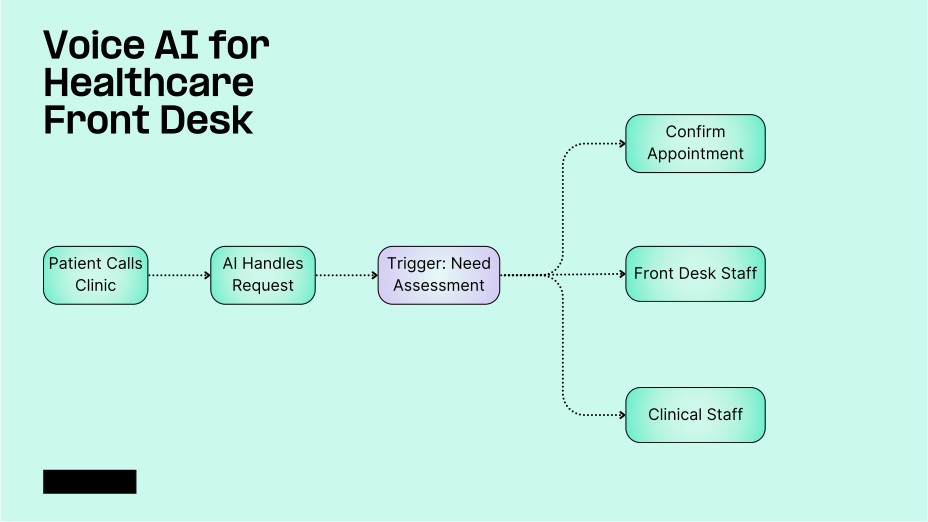
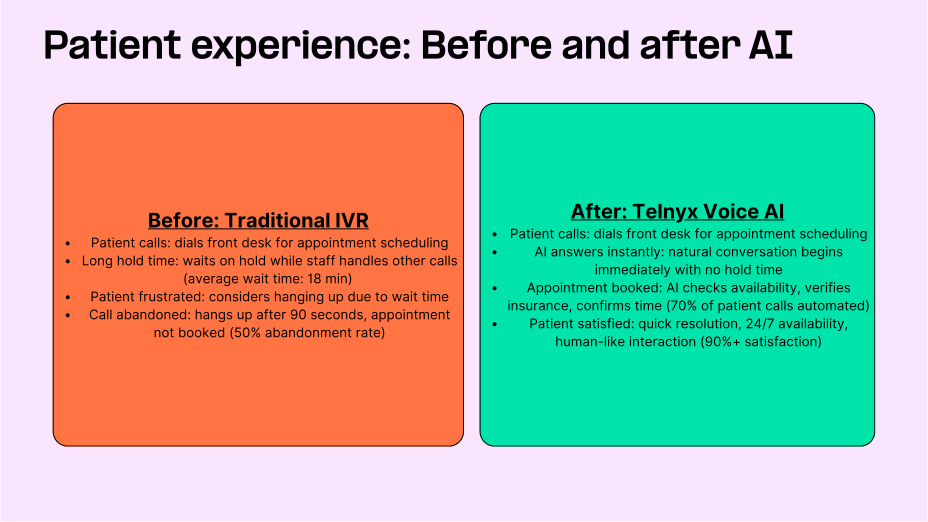
Healthcare contact centers face a breaking point. Half of callers abandon the line after waiting just 90 seconds, yet the number of healthcare administrators has grown more than 3200% since the 1970s, compared with just a 150% growth in physicians. Front-desk teams struggle to keep up with appointment requests, insurance verification, and patient intake while labor costs continue to climb.
Voice AI has matured to address this gap. AI voice agents now help offload up to 70% of front-desk call volume while lifting patient satisfaction above 90%. With sub-200 ms latency and EHR-friendly APIs, these systems can replace brittle IVRs and deliver human-like conversations that patients actually prefer.
But not all voice AI platforms are built for healthcare. This guide examines what matters when evaluating solutions for front-desk automation, from HIPAA compliance to telephony integration, and why infrastructure choices directly impact call quality and cost.
Why healthcare front desks are turning to voice AI now
Nearly 50% of healthcare professionals surveyed plan to adopt AI technologies soon for entering data, scheduling appointments, and performing research. The timing makes sense. Recent advances in large language models and speech synthesis have pushed voice AI accuracy to about 95% on medical terminology, with emotional recognition hitting 88%.
The economics are compelling, too. A 12-physician practice eliminated two full-time admin roles, saving $87k annually while extending service hours. Early adopters report 30% operational efficiency gains within six months of go-live. At scale, this matters, roughly five cents of every U.S. healthcare dollar is spent just collecting payment.
Patient sentiment supports automation. 8 in 10 Americans say AI can make healthcare more accessible and higher quality.
Core criteria for evaluating voice AI in healthcare
Before comparing vendors, define what success looks like for your front desk. Consider these technical and operational requirements:
HIPAA compliance and data controls
HIPAA-eligible hosting is table stakes. Look for platforms that offer Business Associate Agreements (BAAs), SOC 2 Type II attestation, and regional data residency options. Voice recordings and transcripts that contain protected health information (PHI) must stay within defined geographic boundaries, especially for multi-location health systems or international operations.
Telephony integration and call quality
Voice AI that can't connect to your existing phone infrastructure creates friction. Native PSTN access, SIP trunking support, and number provisioning on the same platform eliminate third-party integrations that add latency and failure points. Discover more about how real telephony support affects deployment in our comparison of 10 voice AI agents with PSTN features.
Call quality depends on two factors: network architecture and latency. Systems that colocate GPU inference with global telecom points of presence (PoPs) minimize the physical distance voice data travels, keeping round-trip times under 200 ms. This architecture difference is why some platforms sound natural while others feel robotic or delayed.
EHR and scheduling system APIs
Booking appointments or verifying insurance requires real-time access to patient records. REST APIs that connect to Epic, Cerner, Athenahealth, and other EHRs let voice agents confirm availability, check eligibility, and update records without manual intervention. Learn how AI in EHR systems improves healthcare workflows by automating data entry and reducing transcription backlogs.
Multi-turn conversation handling
Simple phone trees can answer FAQs. Front-desk automation needs agents that handle complex, multi-turn conversations, rescheduling appointments when the first option doesn't work, collecting insurance details across several prompts, or escalating to a human when situation requires it. Modular tools that let you define conversation flows, set fallback rules, and trigger transfers ensure the AI knows when to hand off.
Transparency and control
Black-box AI creates compliance risk. Platforms should surface confidence scores, transcription logs, and decision trails for every call. This visibility helps your team audit interactions, refine prompts, and demonstrate compliance during reviews. Explore conversational AI for customer service to see how real-time insights improve agent performance.
Key features comparison
| Feature | Why it matters | What to look for |
|---|---|---|
| Latency | Sub-200 ms response time keeps conversations natural; delays above 300 ms feel robotic and frustrate callers | Colocated GPU infrastructure with telecom PoPs; published latency benchmarks per region |
| HIPAA controls | BAA coverage and SOC 2 Type II protect PHI; regional data residency meets state-specific compliance requirements | Written BAA terms; audit reports; data center locations in required geographies |
| Telephony stack | Native PSTN and SIP trunking on the same platform eliminate integration points that add latency and cost | Licensed carrier status; number provisioning in required markets; direct PSTN access without third parties |
| EHR connectivity | REST APIs to scheduling and patient record systems enable booking, verification, and intake without manual steps | Pre-built connectors to major EHRs; webhook support for custom integrations; documented API rate limits |
| Live-agent fallback | Seamless transfer to human staff when AI reaches confidence thresholds or patient requests escalation | Configurable transfer rules; warm handoff with context; queue management integration |
How Telnyx solves healthcare front-desk automation challenges
Telnyx built voice AI on a private, global IP network that connects to the public switched telephone network (PSTN) in 100+ countries. This architecture matters because physics constrains latency. The further data travels, the longer conversations take, and the less natural they feel.
Colocated infrastructure for lower latency
We colocate dedicated GPUs directly adjacent to our global telecom PoPs. This placement keeps inference and speech synthesis physically close to the voice connection, minimizing round-trip time. When a patient calls to book an appointment, their voice travels minimal distance from the PSTN to our GPU to generate a response and back. The result: lower latency that sounds authentically human, conveying genuine emotion.
Other platforms run inference in centralized cloud regions, adding hundreds of milliseconds as voice data crosses the internet. That delay compounds with every turn in the conversation, creating noticeable lag.
Native PSTN and SIP trunking on one platform
Healthcare organizations often manage voice through legacy PBX systems or SIP trunks. Telnyx provides Voice API and SIP Trunking on the same platform as Voice AI Agents, so you can provision numbers, route calls, and deploy automation without juggling vendors.
Our Tier-1 network carries voice traffic on private fiber, bypassing the public internet for clearer audio and higher uptime. Learn how Telnyx's global telco infrastructure reduces jitter and packet loss on PSTN calls.
HIPAA-supporting controls and regional data locality
Telnyx offers BAA coverage for voice AI workloads and maintains SOC 2 Type II attestation. Regional deployments in North America, Europe, APAC, and LATAM let you keep PHI within required geographies. Call recordings, transcripts, and inference logs stay in the data center closest to your operation.
Full-stack control from PSTN to inference
Most voice AI platforms rely on third-party telephony providers, creating integration points that introduce latency and split responsibility. Telnyx owns the entire stack, from the licensed carrier network to GPU inference to voice synthesis. This full-stack ownership means:
- Fewer failure points: No handoffs between providers that break during outages
- Predictable costs: Transparent, per-minute pricing with no hidden telephony surcharges
- Unified support: One team troubleshoots voice quality, AI accuracy, and integration issues
Build and launch Voice AI Agents quickly on Telnyx with ultra-low latency and native telephony support.
Implementation checklist for healthcare voice AI
Deploying voice AI requires more than signing a contract. Use this checklist to guide your evaluation and rollout:
Before vendor selection:
- Document current call volume by type (scheduling, intake, verification, billing)
- Identify EHR and scheduling systems that require API integration
- Define HIPAA compliance requirements and data residency needs
- Establish baseline metrics: average handle time, abandonment rate, patient satisfaction
During evaluation:
- Request live demos with your actual call scripts and scenarios
- Test latency and audio quality from your locations and phone systems
- Review BAA terms and SOC 2 reports
- Confirm API availability for your EHR and confirm rate limits
At deployment:
- Start with one high-volume, low-complexity use case (e.g., appointment scheduling)
- Monitor transcription accuracy and confidence scores daily in the first two weeks
- Set fallback rules to transfer calls when confidence drops below defined thresholds
- Collect patient feedback through post-call surveys
Post-launch optimization:
- Analyze call logs to identify common failure modes
- Refine prompts and conversation flows based on actual patient interactions
- Expand to additional use cases once the first deployment stabilizes
- Track ROI metrics: labor hours saved, patient satisfaction, abandonment rate
For more detailed deployment strategies, read our guide on 10 best voice AI agents for healthcare in 2025.
What's next for healthcare voice AI
Voice AI will handle more complex workflows as models improve and EHR integrations deepen. Expect agents that triage symptoms, provide pre-visit instructions, and coordinate care across multiple providers. Outbound voice AI will automate appointment reminders, follow-up calls, and preventive care outreach at scale.
The platforms that win long-term will be those that own their infrastructure and can adapt quickly. Colocated GPU deployments and native telephony give Telnyx the architectural advantage needed to deliver sub-200 ms latency, HIPAA compliance, and transparent pricing as models and workloads change.
Healthcare contact centers don't need to choose between patient experience and operational efficiency. Voice AI delivers both when built on the right foundation. Start building on Telnyx's private, global network and see how full-stack control improves call quality and reduces costs.
Ready to build voice AI that actually works? Start your free trial and get $10 in credit to test our platform. Join developers from startups to Fortune 500 companies who trust Telnyx to power their voice AI applications.
Share on Social