
IoT
Edge computing examples: 12 real‑world use cases by industry
Real edge computing examples across healthcare, retail, logistics, and more, with quick sketches of how the stack fits together.

By Eli Mogul

Edge computing is no longer hypothetical. For workloads where latency, bandwidth, or data sovereignty matter, it’s becoming the default. Gartner projected in 2018 that by 2025, 75% of enterprise‑generated data would be created and processed outside traditional data centers or the public cloud, up from roughly 10% at the time, and that shift is now visible across nearly every industry.
Below, we break down 12 real edge computing examples, organized by industry, along with a quick‑reference comparison of where each fit shines. The goal is to help engineers, solutions architects, and operations leaders decide what belongs at the edge and what should stay in a central region.
What is edge computing
Edge computing processes data close to where it’s generated, rather than sending every packet back to a centralized cloud region. That proximity reduces round‑trip latency, lowers bandwidth costs, and helps keep sensitive data within required jurisdictions. The distinction between edge and cloud isn’t either‑or: most deployments are hybrid, with time‑sensitive logic running locally and heavier analytical workloads running centrally. For a deeper comparison of the trade‑offs, see our breakdown of edge computing vs. cloud.
Why edge computing matters right now
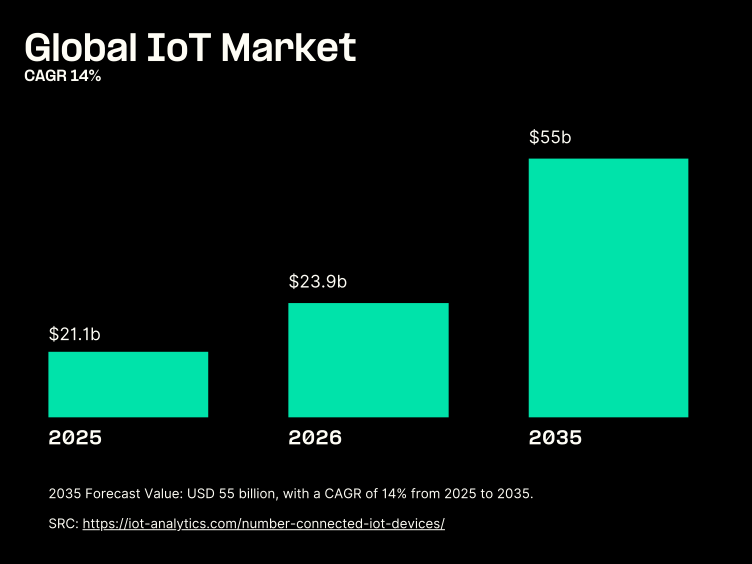
Three forces are driving adoption. First, AI and real‑time communications workloads are pushing latency budgets into the tens of milliseconds end‑to‑end. Second, the number of connected devices keeps climbing, IoT Analytics reports 18.5 billion connected IoT devices in 2024, with 21.1 billion forecast by the end of 2025 and 39 billion by 2030. Third, the economics of data breaches continue to worsen: the IBM Cost of a Data Breach Report 2025 put the global average breach cost at $4.88 million (a 10% year‑over‑year increase), strengthening the case for keeping sensitive data closer to its source.
Quick comparison: 12 edge computing examples at a glance
| Industry | Use case | What runs at the edge | Primary benefit |
|---|---|---|---|
| Healthcare | Remote patient monitoring | Vitals analysis; alerting | Faster clinical response |
| Manufacturing | Predictive maintenance | Sensor analytics; anomaly detection | Less unplanned downtime |
| Retail | Smart checkout and in‑store analytics | Computer‑vision inference; real‑time inventory updates | Faster checkout; fewer stockouts |
| Logistics | Fleet and asset tracking | GPS/telematics processing; event detection | Tighter routing; better ETAs |
| Financial services | Fraud detection at the point of transaction | Lightweight transaction scoring | Sub‑second fraud decisions |
| Energy and utilities | Smart grid management | Protection/control logic; outage response | Grid stability |
| Automotive | ADAS and autonomous driving | Sensor fusion; perception; planning | Real‑time safety decisions |
| Telecom and voice AI | Conversational AI agents | STT/ASR; on‑device inference; call control | Sub‑second response times |
| Agriculture | Precision farming | Soil/weather/yield analytics | Higher yields; lower inputs |
| Public sector | Smart city traffic and safety | Video analytics; signal control | Lower congestion; faster response |
| Gaming and media | Low‑latency streaming and cloud gaming | Edge rendering; content delivery | Smoother user experience |
1. Healthcare: Remote patient monitoring
Connected wearables and in‑home monitors generate continuous streams of vitals—heart rate, blood oxygen saturation (SpO2), glucose, fall detection. Sending every data point to a central cloud for analysis is both expensive and too slow for acute events. Edge nodes, often the device itself or a bedside gateway, can run anomaly detection locally and escalate only what matters to clinicians.
A material benefit is regulatory posture: keeping protected health information (PHI) within a regional boundary simplifies HIPAA/GDPR compliance and reduces blast radius in the event of an incident. IBM has reported healthcare as the costliest industry for breaches for the 14th consecutive year, at $9.77 million per incident.
2. Manufacturing: Predictive maintenance
Industrial IoT sensors on pumps, motors, and CNC machines produce far more data than most factories can usefully stream to a central cloud. Edge gateways on the factory floor run vibration and thermal anomaly models locally, catching early signs of bearing wear or alignment drift before failure.
Research frequently cites reductions of up to 50% in equipment downtime and 10–40% lower maintenance costs. Ensure the McKinsey citation matches the linked source; the current link appears to be a summary hosted by Körber. Deloitte case studies have documented pilots with ~80% reductions in unplanned downtime and around $300,000 in savings per asset. The common thread: decisions happen locally, and only aggregated signals go upstream.
3. Retail: Smart checkout and in‑store analytics
Retailers use edge computing to power computer‑vision checkout, shelf monitoring, and real‑time inventory tracking. A common architecture puts cameras and POS terminals in the store, a small edge server in the back office, and periodic syncs to a central cloud for reporting.
The compute must be local because a shopper won’t wait seconds for frames to round‑trip to a distant region and back. Local inference also keeps the store operating during a wide‑area network (WAN) outage. For broader context on where IoT fits in retail and other industries, see our guide on IoT solutions and use cases.
4. Logistics: Fleet and asset tracking
Trucks, containers, and pallets all produce telemetry. The raw feed is noisy in aggregate, but local processing turns it into actionable signals: geofence breaches, temperature excursions on cold‑chain loads, anomalous driving behavior. Edge gateways in the vehicle or at the depot filter and summarize before anything hits the cloud.
Our piece on IoT asset tracking for logistics walks through how real‑time visibility translates into fewer delays and tighter SLAs.
5. Financial services: Fraud detection at the point of transaction
Card‑present fraud decisions need to land within a few hundred milliseconds. Running every transaction through a distant, centralized model adds latency and creates a single point of failure. Banks increasingly push lightweight scoring models to the ATM, the branch, or a regional edge node, with heavier offline retraining in the cloud.
The financial‑industry breach cost average is $4.88 million, according to IBM’s 2024 report, about 22% above the global average. That, combined with PCI DSS obligations and data‑minimization principles, strengthens the case for processing transaction data locally where feasible.
6. Energy and utilities: Smart grid management
Smart meters, substation sensors, and distributed energy resources (DERs), rooftop solar, EV chargers, and storage require fast coordination. An outage needs to be isolated in seconds, not minutes, and a wind farm must ramp up or down with grid conditions. Edge nodes at the substation or feeder level run protection and control logic locally, with centralized systems handling planning and optimization over longer horizons.
This is one of the largest edge segments by revenue. Precedence Research reports that energy and industrial led the edge computing market in 2024, driven by smart‑grid deployments and renewable integration.
7. Automotive: ADAS and autonomous driving
An autonomous vehicle is essentially a rolling edge data center. Estimates vary widely, from roughly 1 GB of raw sensor data per second to several terabytes per day, depending on the sensor suite. None of that data can meaningfully round‑trip to the cloud before a braking decision is needed.
On‑vehicle compute handles perception, planning, and control, while vehicle‑to‑everything (V2X) edge nodes on roadside infrastructure extend perception beyond line of sight. Cloud supports fleet learning and HD‑map updates, but the safety loop remains on the edge. Expand ADAS on first use: advanced driver‑assistance systems (ADAS).
8. Telecom and voice AI: Conversational agents
Voice AI agents combine speech‑to‑text (STT), a large language model (LLM), text‑to‑speech (TTS), and telephony in one pipeline. If any stage adds tens of milliseconds of network hops, the conversation stops feeling natural. In our testing, users hung up up to 40% more often when agents took longer than one second to respond.
The edge play here is colocation: placing GPU inference in the same facility as the telephony point of presence (PoP), on a private IP backbone, so audio doesn’t traverse the public internet between stages. It’s the difference between a sub‑second turn and a two‑second pause. Our voice‑AI latency benchmark breaks down the numbers.
9. Agriculture: Precision farming
Farms are bandwidth‑constrained and often intermittent. Soil‑moisture sensors, weather stations, drone imagery, and irrigation controllers all generate data that must be acted on locally. Edge gateways at the barn or field aggregate and run local models (e.g., valve scheduling, early disease detection), with sync‑on‑connect patterns for cloud analytics over cellular or LoRaWAN backhaul.
10. Public sector: Smart cities
Traffic signals, public‑safety cameras, air‑quality sensors, and connected infrastructure benefit from local processing. A camera that detects an approaching ambulance and preempts a green light can’t wait for a centralized model to decide. Edge nodes at the intersection or at neighborhood aggregation points handle the fast loop.
Privacy is a binding constraint. Processing video locally and forwarding only metadata, counts, anonymized vectors, license‑plate hashes, can be the difference between an approved deployment and a blocked procurement.
11. Gaming and media: Cloud gaming and low‑latency streaming
Cloud gaming and live interactive streaming can’t tolerate the latency of a distant region for every frame. CDNs have always been a form of edge, but modern cloud‑gaming and interactive video stacks push rendering and encoding to edge PoPs close to the user. The same pattern shows up in augmented/virtual reality (AR/VR), sports betting, and live commerce.
12. Contact centers: Real‑time transcription, routing, and coaching
Modern contact centers are full of edge‑adjacent workloads. Real‑time transcription on active calls, sentiment scoring, live agent‑assist coaching, and dynamic routing all depend on low‑latency audio processing. Running those functions close to where the call terminates, rather than shuttling media to a distant region, keeps prompts timely and useful.
How to decide what belongs at the edge
A practical checklist for any workload:
- Latency budget. If a human‑perceivable response must land under ~300 ms, assume edge.
- Bandwidth cost. If raw telemetry volume is large but only a small fraction is actionable, filter locally.
- Data sovereignty. If regulations pin data to a region, put the processing there, too.
- Failure mode. If the site must keep working during a WAN outage, run the critical logic locally.
- Model size and update cadence. Light models that update infrequently suit the edge; giant foundation models stay central.
Most real architectures are hybrid: the edge handles the fast loop; the cloud handles the slow loop.
Where Telnyx fits
Telnyx colocates GPU infrastructure with its global telephony points of presence (PoPs) on a private IP backbone. For voice‑AI and real‑time communications workloads, STT, LLM inference, and TTS run in the same facility as call termination, so audio doesn’t traverse the public internet between stages. For teams building conversational AI, IoT connectivity, or anything that depends on a predictable latency budget, the architectural shortcut is real. See the voice‑AI latency benchmark and our guide to building great AI voice agents.
Edge computing isn’t a silver bullet, and most teams will keep using cloud regions for the heavy analytical lift. But for the 12 use cases above, and a growing list of others, keeping compute close to where the data lives is becoming the default.
Share on Social