Article 50 of the EU AI Act takes effect on 2 August 2026. The watermarking obligation falls on voice AI deployers, not vendors. Here's what compliance looks like.

Article 50 of the EU AI Act becomes enforceable on 2 August 2026. Every enterprise running generative voice AI in production in the EU will need to watermark that output and prove whether the audio is authentic or a deepfake. The obligation falls on the deployer, not the AI provider. Penalties reach €15 million or 3% of global annual turnover, whichever is higher.
This is the part most procurement teams are still working through: buying from a compliant vendor does not transfer the obligation. If your organization deploys voice AI agents in customer-facing workflows, you are responsible for the audit trail.
The May 2026 Digital Omnibus political agreement pushed the provider-side watermarking deadline under Article 50(2) to 2 December 2026, but the deployer obligations on deepfake disclosure remain until 2 August 2026. Formal adoption of the Omnibus is expected by July 2026.
Related articles
The UK is in scope too. Ofcom's Online Safety Act introduces parallel obligations on deepfake content with penalties up to £18 million. UK enterprises cannot treat this as an EU-only concern.
Who it covers - Any enterprise running AI-generated voice in production in the EU. The Act distinguishes between AI providers (the companies building the models) and AI deployers (the companies putting those models into production). Article 50 obligations land on the deployer.
What compliant looks like - Two capabilities are required. Watermarking generative voice output so it can be identified as AI-generated, and maintaining the ability to prove whether content is authentic or AI-generated on the inbound side. Detection capability matters as much as generation.
Who carries the burden - The deployer. Vendor compliance is necessary but not sufficient; the deploying enterprise needs to be able to demonstrate the chain of custody itself.
Penalties - Up to €15 million or 3% of global annual turnover, whichever is higher.
Effective date - 2 August 2026.
For regulated sectors, Article 50 sits alongside other obligations. Financial services deployments are already covered by DORA, which sets operational resilience requirements for ICT third parties, meaning finance and healthcare voice AI deployments face stacked compliance regimes, not a single one.
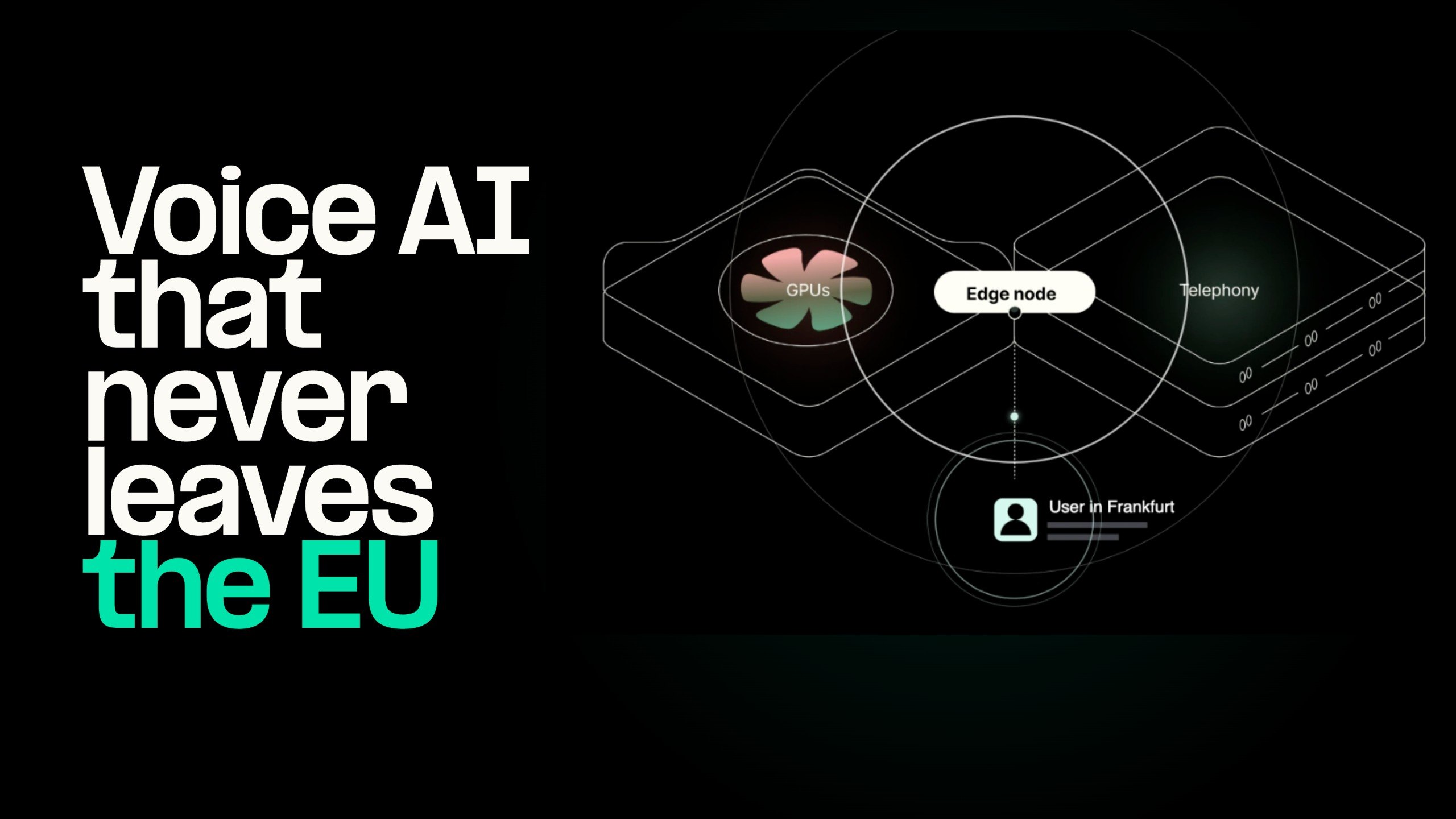
The most common voice AI architecture in production today stitches together separate vendors: speech-to-text from one, an LLM from another, text-to-speech from a third, telephony from a fourth, with watermarking bolted on at the application layer. (Internally, we call this a Frankenstack) It works in demos. It breaks under Article 50, for three structural reasons. See Telnyx CEO David Casem explain why in the clip below.
Sub-processor opacity: Each call out to a third party introduces a data flow that may or may not stay in the EU. Providers that claim European infrastructure often cannot guarantee where every individual request lands across every sub-processor in the chain. Under DORA and the AI Act, that opacity is a disqualifier on its own, not something you can remediate after procurement. EU data sovereignty requirements apply to the entire flow, not just the entry point.
Latency at every hop: STT to LLM to TTS to telephony, each hop adds latency, and in real-time voice, that compounds into noticeable lag. Compliance overhead added at the application layer makes this worse, not better.
Compliance gaps at the seams: Article 50 requires watermarking with a verifiable chain of custody. If the watermark is applied at the application layer, after audio has already flowed through multiple providers, the chain is broken before the watermark is ever applied. Auditors will look at the seams between providers, and the seams are where most stitched stacks fail.
A stitched stack is optimized for capability. Pick the best STT, the best LLM, the best TTS, and wire them together. Each component is best-in-class on its own benchmark.
An integrated stack, owned at the network layer, is optimized for trust and compliance. Watermarking, detection, and origin validation happen at the carrier interconnect, where the audio actually flows, rather than as an afterthought stamped on at the end. The chain of custody is intact by construction, not reconstructed after the fact.
Both are defensible engineering choices in the abstract. Under Article 50, DORA, and the realities of EU procurement, only one of them survives a serious audit.
Procurement teams evaluating voice AI vendors against Article 50 should be testing for a small number of things and asking the questions in writing.
In-region compute, end-to-end - Not just "EU data centers" as a marketing line. Every sub-processor's location matters. The question is where inference actually runs when a call hits production at 3 pm on a Tuesday. Frontier-grade models running in EU regions are now available, Kimi 2.5 and 2.6 and Qwen 235B are already live in EU data centers, with Mistral coming, so the trade-off between capability and locality has narrowed significantly.
There is less reason than there was twelve months ago to accept "the model runs in the US, but the front door is European."
Watermarking at the infrastructure layer - Application-layer watermarks degrade through codec transformations (G.711, EVS, modern telephony codecs), compression, and replay. By the time audio reaches the application layer, it has already been transformed. A watermark applied there can be lost in the next hop. Watermarks embedded at the carrier interconnect, below 8 kHz, where they resist filtering, persist through the full transformation chain.
Detection, not just generation - Article 50 obligations are bilateral. Outbound watermarking alone is insufficient; inbound deepfake detection on calls coming into your numbers matters equally. Ask what the detection latency is, and what the false-positive rate looks like on real production traffic.
A clear subprocessor map - Every third party in the data flow, every region they operate in, and a contractual commitment that the map will not change without notice. If a vendor cannot produce this in a procurement document, that is the answer.
Audit-ready logs - The deployer carries the burden of proof. Logs need to be retrievable, timestamped, and tied to the watermark such that a given piece of audio can be traced back to its origin model and its journey through the stack.
The shift this represents is clear: compliance is an architecture decision, not a paperwork exercise. The enterprises that have already moved are the ones treating Article 50 as an infrastructure decision rather than a legal one.
Article 50 enforcement begins 2 August 2026. For most enterprises with voice AI in production or in pilot, the architectural decisions that determine compliance need to be made well before then, procurement cycles in regulated sectors run six to twelve months, and remediation under a stitched stack is not a small project.
A stitched stack works in demos. It does not survive Article 50, DORA, and EU procurement under the new regime. Only an integrated stack does.
If you're working through a voice AI deployment in the EU and want to pressure-test your stack against Article 50, talk to our team. For the architectural side of this, chain of custody at the network layer, deepfake detection, and what trust infrastructure actually looks like in production, see our companion piece on trust in voice AI.
Want to go deeper on EU voice AI compliance?
Watch the full webinar with Telnyx CEO David Casem and Resemble AI CEO Zohaib Ahmed, or talk to our team about your specific deployment.
Watch the webinarTalk to us