
Wireless
Mobile voice infrastructure for enterprise AI agents
How programmable mobile voice puts enterprises in control of voice AI.

By Lucia Lucena
Artificial intelligence is no longer a future concept for voice. It's already operating in real-time conversations across customer support, operations, and enterprise workflows.
At the same time, a structural shift is underway at the network layer itself. Across the industry, carriers are embedding AI directly into their core infrastructure, through IMS evolution, 5G standalone deployments, and frameworks designed to move intelligence closer to the signal path. What used to sit on top of calls as a bolt-on application is being absorbed into the network fabric itself.
There's a critical distinction here. Embedding AI inside a network and giving enterprises full control to extend and operationalize it are two different problems. Feature-level AI and infrastructure-level control are not interchangeable, and the gap between them will determine which platforms win.
Why mobile voice infrastructure is still not programmable
Despite broad advances in cloud infrastructure, mobile voice has stayed stubbornly static. Calls still run inside carrier-controlled environments, AI still sits outside the call path, and enterprises have no visibility into what happens between dial and answer.
Newer approaches that introduce AI into telecom environments improve the experience at the edges (better transcription, smarter routing suggestions, post-call analytics), but the underlying model doesn't change. The call path stays closed, programmability stays limited, and without control of the voice path, AI remains a passenger in the conversation rather than an orchestrator of it.
Why layering AI on top of telecom fails enterprise voice
Most voice AI today is implemented as an overlay. Audio is processed externally, call control stays inside telecom systems, and routing and identity are never exposed to the AI layer. The result is a set of constraints that can't be engineered around: latency that compounds with every hop, fragmented control split across systems that weren't designed to talk to each other, no mechanism for real-time policy enforcement, and a ceiling on how much custom logic can be built into a call flow.
AI can participate in conversations, but it cannot orchestrate them.
The real barriers to enterprise voice AI are latency and trust
Two constraints make this a genuinely hard infrastructure problem, not a software one.
The first is physics. Real-time voice AI is a timing problem before it's a software problem. Every hop between the caller, the network, and the AI system compounds the delay. In text or async workflows, 300ms is invisible. In voice, it's an awkward pause that breaks the interaction. Sub-200ms round-trip is the minimum bar for natural conversation, not an optimization target you tune toward.
The second is trust. Enterprise voice, especially in financial services, healthcare, and regulated industries, requires an identity that can be asserted at the network layer, not reconstructed after the fact. SIM-level identity, A-level STIR/SHAKEN attestation issued as the originating carrier, in-call compliance enforcement, and end-to-end policy control cannot be retrofitted onto an overlay architecture. They have to be structural, which means they have to be owned by the platform issuing them across 30+ country telecom licenses.
Most current approaches introduce AI into the network but stop short of giving enterprises control over it. The AI is present, but the call path is still carrier-defined. Customization is constrained. The enterprise stays dependent on what the carrier exposes. That's a step forward from a pure OTT model, but it isn't infrastructure-level control.
What programmable mobile voice infrastructure actually looks like
The architectural answer requires owning the full stack. Programmability has to be the design principle from the ground up, instead of layered onto an existing carrier environment after the fact.
That's the model Telnyx is built on. Fully programmable mobile voice, with AI embedded directly in the call path and enterprise control over signaling, routing, identity, and policy, exposed through APIs rather than locked inside a carrier's system.
Telnyx owns and operates the global network, the SIM and eSIM layer, the IMS core, the voice infrastructure, 18 global PoPs, Telnyx Inference running at the edge, and the APIs that expose all of it to developers. That single operational domain is what lets AI operate inside live calls instead of alongside them, with real-time control over routing, identity, and policy, and calls that trigger workflows rather than just conversations.
The contrast with the Frankenstack model is structural. In a Frankenstack, telephony, AI, and identity come from separate vendors stitched together at the edges. Here, the enterprise controls how voice and AI operate together because one platform controls the whole call path. Mobile voice becomes a programmable platform, with the carrier-side decisions exposed as APIs the enterprise can call directly.
How AI-native mobile voice infrastructure works
The difference becomes clear when you look at how voice AI is deployed.
In a traditional architecture, a call leaves the telecom network, is processed by an external AI system, and then returns to the network before reaching the user. This introduces unnecessary routing, increases latency, and limits real-time control.
In an infrastructure-native model, AI operates directly within the telecom environment, in the media path, while enterprise systems connect in real time to support routing, decisioning, and workflows.
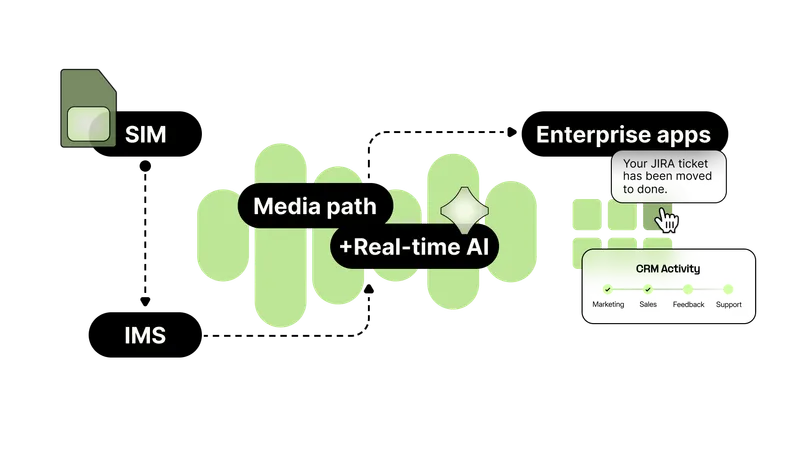
In this architecture, AI operates directly in the media path, SIM and IMS anchor identity and control, and enterprise systems integrate in real time. The result is fewer hops, lower latency, and direct enterprise control over how every call is handled.
What programmable mobile voice enables for enterprise AI
Programmable mobile voice infrastructure unlocks entirely new capabilities:
- AI agents answering calls from real SIM-based numbers
- Real-time decision-making within call flows
- Policy-driven routing based on identity and context
- Automated workflows triggered by live conversations
- Fully auditable, compliant mobile communications
These are infrastructure-level transformations of how enterprise voice works.
Why enterprise voice AI infrastructure can't wait
Three forces are converging at the same time. AI is moving into real-time interactions at a pace that outstrips most infrastructure roadmaps. Mobile has become the primary interface for enterprise work, not a secondary channel. And the expectation that infrastructure should be programmable, flexible, and API-accessible is now table stakes for any platform that wants enterprise adoption.
Voice is the one layer where all three of those forces collide, and where the underlying infrastructure has changed the least. That gap between what AI can do and what the voice layer allows it to do is where the next wave of enterprise differentiation will be won or lost.
The carriers embedding AI into their networks today are solving a real problem. But they are solving it for themselves, defining the features, setting the boundaries, and deciding what enterprises can and cannot do with the intelligence running inside their infrastructure. That dynamic has played out before. The cloud won by shifting control to the people building on top of it. Feature count had little to do with it.
The same shift is coming for voice. AI belongs inside the network, that part is settled. The contested decision is who gets to program it once it's there. Enterprises evaluating mobile voice architecture today get to answer that for themselves. Carriers who define the architecture first will answer it for them.
BETA
Ready to build AI-native voice workflows on infrastructure you control?
Telnyx Mobile Voice is currently in beta. Contact our sales team to learn more.
Share on Social


