
Insights and Resources
Building Voice AI Infrastructure at Scale
Scaling voice AI isn't the same as scaling a text chatbot. Voice requires real-time performance, carrier-grade reliability, and compliance controls that most cloud infrastructure wasn't designed to provide.

By Eli Mogul

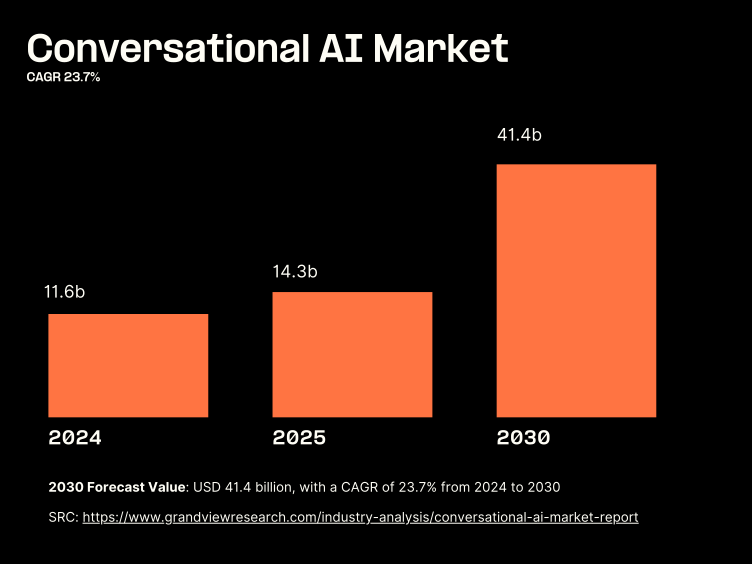
Voice AI has moved from pilot programs to production workloads. The conversational AI market is projected to grow from roughly $14 billion in 2025 to more than $41 billion by 2030, according to Grand View Research.
Gartner predicted that conversational AI deployments in contact centers would reduce agent labor costs by $80 billion by 2026, with 1 in 10 agent interactions fully automated. That timeline has arrived, and early results support the trend. Production voice agent implementations grew 340% year-over-year across more than 500 organizations in 2025, and the majority of businesses have now integrated or are actively deploying AI-driven voice technology in customer service.
But scaling voice AI isn't the same as scaling a text chatbot. Voice requires real-time performance, carrier-grade reliability, and compliance controls that most cloud infrastructure wasn't designed to provide. This guide breaks down the infrastructure requirements, architectural approaches, and deployment considerations for teams building voice AI at enterprise scale.
What voice AI infrastructure actually includes
Voice AI infrastructure is the full system required to run AI agents that communicate via voice. It combines several distinct layers working in concert:
AI/ML inference handles the language models that understand and generate responses. Voice processing covers speech-to-text (STT) and text-to-speech (TTS) conversion. Call handling manages SIP gateways, call routing, and session management. Low-latency networks provide private or optimized paths to minimize round-trip time. Compliance layers enforce encryption, data residency, and audit trails for regulated industries.
Unlike text-based chatbots, where 500ms response time is acceptable, voice AI demands infrastructure optimized for real-time responsiveness.
The latency problem (and why it matters more than you think)
Research across multiple studies shows that the natural gap in human conversation falls between 200 and 300 milliseconds. Exceed that window and users unconsciously perceive a delay. Push past 500ms and they notice it. Cross the one-second mark, and call abandonment rates spike by more than 40%.
Standard cloud inference through providers like AWS, Azure, or GCP introduces compounding latency across the pipeline:
- Network hop to the cloud region: 50 to 150ms
- STT processing: 100 to 300ms
- LLM inference: 350 to 1,000ms
- TTS synthesis: 90 to 200ms
- Network return: 50 to 150ms
That adds up to 640ms on the low end and well over 1.5 seconds under real-world conditions. For voice AI, that total is the difference between a conversation that converts and one that drives callers to hang up. Contact centers report that customers abandon calls 40% more frequently when response times exceed one second.
Three infrastructure approaches
Edge/local AI routes calls to nearby GPU devices for inference, achieving 50 to 100ms latency. This works well for speed and data privacy, but limits model size and introduces device management overhead.
Private network plus cloud routes calls through a dedicated telecom network to regional LLM clusters. Latency lands around 100 to 150ms with access to full-sized models. The tradeoff is higher cost and potential vendor lock-in.
Hybrid (recommended for most enterprises) combines an edge layer for quick initial responses with cloud resources for complex reasoning, all connected through private network infrastructure. This approach delivers 100 to 200ms latency while balancing performance, flexibility, and cost. It's the model most production deployments are converging on.
The hybrid approach lets teams handle simple, high-volume interactions at the edge while routing complex queries to larger models in the cloud. Private network connectivity between these layers keeps voice traffic off the public internet, reducing both latency and attack surface.
Critical infrastructure requirements
Low latency through colocation
Proximity between compute and telecom infrastructure is the single most impactful lever for reducing voice AI latency. When GPU clusters sit directly adjacent to telephony points of presence (PoPs), data doesn't have to cross multiple network hops before processing begins. This colocation approach is how platforms like Telnyx achieve sub-200ms round-trip times at scale.
Geographic deployment matters, too. If your users are in North America, your LLM inference must run on US infrastructure. For global deployments, routing a call from Asia to a US-based inference cluster can add 200 to 300ms of round-trip latency before any AI processing begins.
High availability
Voice calls don't queue the way web requests do. They either connect or they fail. Production voice AI systems should target 99.99% uptime with multi-region failover built in from day one. That means redundant infrastructure across geographies, automatic rerouting during outages, and health monitoring at every layer of the stack.
Audio optimization
Voice AI performance depends on audio quality as much as model quality. Use G.711 or Opus codecs optimized for speech recognition rather than general-purpose audio formats. HD voice codecs running at 16kHz eliminate the need for middleware and improve both STT accuracy and TTS naturalness.
Echo cancellation is non-negotiable, especially for speakerphone scenarios, and must operate within 50ms to avoid compounding latency.
Compliance for regulated industries
Healthcare and financial services have strict requirements around voice data handling. HIPAA mandates that protected health information (PHI) stay encrypted in transit and at rest, with data processing confined to specific geographic regions. GDPR imposes similar data residency requirements for EU citizens. Any platform handling voice AI in these sectors needs to support regional GPU deployment so conversation data stays within required jurisdictions without cross-border transfers. SOC 2 Type II certification, signed Business Associate Agreements, and configurable audit trails are table stakes.
McKinsey research indicates that 30 to 40% of claims call handling time in healthcare consists of dead air while agents search for information. AI voice agents can eliminate that inefficiency, but only if the underlying infrastructure meets compliance requirements from the start. Compliance isn't something you bolt on after deployment.
Architecture example: healthcare voice AI
A compliant deployment routes patient calls through encrypted SIP trunks to a routing engine that determines AI eligibility. Qualifying calls connect to a voice AI agent on private network infrastructure with regional LLM inference, while escalations hand off to live agents with full context.
All calls are recorded with consent in SOC 2-compliant encrypted storage. Transcription runs asynchronously to avoid real-time latency impact.
Performance benchmarks
Enterprise teams deploying voice AI should measure against concrete targets. The table below outlines the benchmarks that production systems should meet.
| Metric | Target | Why it matters |
|---|---|---|
| P50 latency (median) | 100 to 150ms | Keeps most interactions feeling natural and human |
| P95 latency (95th percentile) | 200 to 250ms | Prevents outlier calls from degrading experience |
| System availability | 99.99% | Voice calls fail immediately without graceful degradation |
| Call setup time | Under 2 seconds | First impressions determine whether callers stay or hang up |
| Packet loss | Under 0.5% | Audio artifacts from packet loss compound STT errors |
These benchmarks assume colocated infrastructure and private network connectivity. Platforms relying on public internet routing or multi-vendor stacks will struggle to hit these numbers consistently, especially under load.
Deployment considerations for production scale
Geographic distribution is the foundation. Deploy inference in every region where you have significant call volume. A single US-East deployment won't serve APAC users without introducing hundreds of milliseconds of latency.
Auto-scaling must handle traffic surges gracefully. Voice AI workloads can spike 10x to 100x during peak hours or seasonal events. Infrastructure needs to scale GPU capacity without degrading latency for active calls.
Fallback strategies protect the customer experience. If inference fails or latency exceeds thresholds, route to a human agent immediately. A caller stuck in silence while the system retries a failed API call is the worst outcome.
Cost modeling determines whether your deployment is sustainable. Voice AI infrastructure is compute-intensive, and pricing models vary significantly across providers. Platforms that bundle STT, TTS, and inference on owned infrastructure offer more predictable unit economics than multi-vendor stacks where costs compound across services.
Monitoring needs to be real-time and granular. Track end-to-end latency (not just per-component metrics), error rates, audio quality scores (MOS), and call completion rates. Twilio's latency benchmarking framework recommends measuring "mouth-to-ear turn gap" rather than platform-internal timing, since backend metrics systematically underreport the delay users actually experience.
Getting started
Measure your current infrastructure's latency baseline with real calls across your target geographies. Define your quality target: what MOS score is acceptable, and what P95 latency threshold will you enforce? Prototype in a single region with production-grade infrastructure, not a sandbox that hides real-world network conditions. Monitor aggressively, iterate on model selection and network topology, then scale horizontally by adding regions as call volume grows.
Voice AI infrastructure built today will serve as the foundation for enterprise AI communication over the next decade. Organizations that invest in owned infrastructure, private networking, and colocated compute now will have a structural advantage as voice becomes the primary interface between businesses and their customers.
Share on Social