
Voice
8 Voiceflow alternatives for production voice AI in 2026
When voice agents move from prototype to production, Voiceflow's cloud-only canvas hits limits: third-party telephony, per-editor pricing, no self-hosted option. The 8 best alternatives in 2026, compared.

By Osman Husain
What are the best Voiceflow alternatives in 2026?
The 8 best Voiceflow alternatives for production voice AI in 2026 are: Telnyx (carrier-owned voice infrastructure), Botpress (open-source self-hosted), Vapi (developer voice orchestration), Bland AI (self-hosted GPUs), Rasa (open-source enterprise), Sierra (CX agent platform), Cognigy (CCaaS omnichannel), and Kore.ai (enterprise voice + suite). Voiceflow remains a strong prototyping tool, but production voice AI requires infrastructure beyond its cloud-only model.
Why teams evaluate Voiceflow alternatives
Voiceflow's drag-and-drop canvas is real and useful. PMs and conversation designers ship first-pass agents fast.
Stakeholder demos work. The visual flow builder lowers the barrier to early-stage design without engineering involvement.
But concerns surface regularly on public forum threads, converging on the same pattern: "Voiceflow is still there and useful for quick prototypes or showing demos to clients. But once the requirement becomes a bit serious, it starts feeling limited." (Reddit discussion in r/AiAutomations.)
When product requirements shift from prototype to deployment, four bottlenecks push teams to evaluate Voiceflow competitors.
Voice depends on third-party telephony. Voiceflow routes calls through Twilio or Vonage, running on infrastructure it doesn't own.
That adds network hops, latency, and a separate per-minute bill that scales independently of Voiceflow's seat pricing.
Per-editor pricing plus credit exhaustion. Voiceflow charges per editor seat plus credit consumption per interaction.
Two failure modes show up at scale: per-editor cost penalizes building at scale, and the agent stops mid-conversation when credits run out.
No self-hosted deployment. For regulated industries (healthcare, fintech, financial services) that require single-tenant infrastructure or sovereign data residency, Voiceflow's cloud-only deployment is a hard block.
Production timelines that exceed initial expectations. Voiceflow's own production-migration guidance cites a 90-day implementation timeline for enterprise voice AI, on the company's own blog.
That timeline reflects real production work: error handling, integration testing, voice quality tuning, fallback logic. The "no-code, ship in minutes" framing sets a different expectation than the production work delivers.
Voiceflow is a design canvas that connects to someone else's telephony, runs in someone else's cloud, and meters its own seat-based usage. Production voice AI needs the telephony, inference, and orchestration owned by one operator.
The eight alternatives below address this gap in three ways: full-stack carrier infrastructure (Telnyx), production orchestration with developer flexibility (Botpress, Vapi, Bland, Rasa), and enterprise CX or CCaaS replacement (Sierra, Cognigy, Kore.ai).
The 8 best Voiceflow alternatives in 2026
The platforms below cover the architectures teams actually pick from when leaving Voiceflow for production. Telnyx is the only carrier-owned, fully managed option on the list.
The other seven span open-source visual builders, voice agent orchestration, self-hosted enterprise, brand-led CX, and CCaaS replacements.
| Platform | Best for | Key advantage vs Voiceflow | Pricing |
|---|---|---|---|
| Telnyx | Production voice AI on a fully managed Tier 1 carrier network | The only carrier-owned voice infrastructure on this list. Native voice + SMS + WhatsApp + email on one owned network. SOC 2 Type II, HIPAA, PCI DSS Compliant | From $0.05/min for orchestration (STT and Telnyx-native TTS included); LLM per token, SIP separate |
| Botpress | Self-hosted visual builder with developer flexibility | Open-source self-hosted deployment for regulated data; LLM-agnostic, 190+ integrations | Pay-as-you-go from free; Plus $89/mo; Team $495/mo; Enterprise custom; open-source self-hosted available separately |
| Vapi | Developer-first voice agent orchestration | Native voice agent orchestration with broad LLM/STT/TTS provider mix | $0.05/min base; production stack with SIP/LLM/STT/TTS climbs to $0.24-0.34/min |
| Bland AI | Self-hosted voice AI on dedicated GPU clusters | Self-hosted GPU infrastructure for sovereign data needs | Per-connected-minute model with separate billing for transfer time and SMS |
| Rasa | Open-source enterprise self-hosted | Production orchestration with native voice and self-hosted deployment; doesn't host customer data | Free Developer Edition; Enterprise custom |
| Sierra | Brand-level CX agent personalization | Production CX-grade agents with multi-agent coordination | Custom enterprise |
| Cognigy | Mature CCaaS replacement with omnichannel coverage | Voice + chat + messaging + email on one platform with established Genesys/Avaya partners | Custom enterprise (no public pricing) |
| Kore.ai | Enterprise voice + suite completeness | Self-service + agent assist + proactive outreach in one suite | Custom enterprise (no public pricing) |
Let's dive into each platform.
##1. Telnyx Voice AI
Summary. Telnyx runs production-ready voice AI on a Tier 1 carrier-owned network, with native SMS, WhatsApp, and email on the same infrastructure. It integrates STT, LLM orchestration, and TTS in one fully managed system replacing Voiceflow's hybrid model with enterprise-grade defaults.
Best for. Engineering-led ops teams migrating from Voiceflow's prototype canvas to production voice AI on carrier-grade infrastructure.
Key strengths:
- Full-stack platform. STT, TTS, LLM orchestration, and telephony on one platform.
- Owned infrastructure. Global private backbone, GPU clusters, and carrier network in-house. Sub-200ms RTT and HD call quality through fewer network hops and direct carrier peering.
- Itemized pricing on owned components. Voice AI orchestration at $0.05/min, with STT and Telnyx-native TTS included; open-weight LLMs at per-token rates on Telnyx-owned GPUs, SIP separate. No per-editor seats, no credit exhaustion.
- Enterprise compliance. SOC 2 Type II, HIPAA, PCI DSS Compliant, ISO 27001, GDPR with EU-deployed infrastructure.
- Native multi-channel + proven scalability. Voice + SMS + WhatsApp Business API + email natively on the same owned carrier network. The voice API powers millions of concurrent calls. Local numbers across 140+ countries with local calling in 80+, 17 PoPs. STIR/SHAKEN A-attestation on customer-owned numbers via carrier-owned SIP trunks.
Limitations vs Voiceflow:
- Voiceflow's visual canvas is faster for first-pass conversation design and stakeholder demos. Telnyx's builder is production-focused.
- No "design canvas only" tier. Telnyx is built for production from day one; teams that only want a prototyping environment without production infrastructure should stay on Voiceflow until the use case shifts.
Migration path from Voiceflow:
- Port flows to Telnyx voice AI agents using existing SDKs (Python, Node, Ruby, Go, Java, PHP, .NET) and SIP integration. Visual flow logic translates; conditional branches and integrations need re-implementation.
- Shift pricing from per-editor + credit to itemized per-component on owned infrastructure. Predictable monthly forecasting; no agents stopping mid-call.
- Add carrier-owned voice infrastructure: native PSTN, STIR/SHAKEN A-attestation, sub-200ms RTT. Voiceflow's Twilio/Vonage path is replaced.
Compliance posture. SOC 2 Type II, HIPAA, PCI DSS Compliant, ISO 27001, GDPR with EU-deployed infrastructure. Sub-200ms RTT.
__[**Speak with an expert**](https://telnyx.com/contact-us) to learn about how to migrate from Voiceflow or deploy enterprise-grade AI voice agents on a carrier-owned network.__
##2. Botpress
Summary. Botpress is an LLM-agnostic visual builder with broad provider integrations and an open-source self-hosted deployment path.
It is the closest direct alternative to Voiceflow's visual canvas, with the addition of self-hosted deployment for regulated data.
Best for. Teams that want Voiceflow's visual-builder experience plus self-hosted deployment for sovereign or regulated data.
Key strengths:
- LLM-agnostic visual builder with 190+ integrations
- Open-source self-hosted deployment option (Voiceflow is cloud-only)
- Active developer community
Limitations vs Voiceflow:
- Voiceflow's UX polish for non-technical users is stronger. Botpress feels more developer-first.
- Self-hosting requires DevOps investment that Voiceflow's cloud-only approach avoids.
Migration path from Voiceflow:
- Port flows from Voiceflow's canvas to Botpress's flow builder. Some logic patterns translate directly; others need rebuilding.
- Choose deployment target before migration: Botpress Cloud for managed convenience (Plus from $89/mo, Team from $495/mo, Enterprise custom), or open-source self-hosted for sovereign data.
Compliance posture. SOC 2 certified, GDPR compliant (per botpress.com legal page). HIPAA, ISO, and PCI not publicly listed.
##3. Vapi
Summary. Vapi is a developer-first voice agent orchestration platform with broad provider mix across LLMs, STT, and TTS vendors. Like other orchestration layers, Vapi depends on external CPaaS partners (Twilio, Telnyx, Vonage) for telephony.
Best for. Engineering teams that want maximum LLM/STT/TTS provider flexibility for voice agent prototyping and production.
Key strengths:
- Broad provider support across most major LLM, STT, and TTS vendors
- Low-code workflow builder for fast prototyping
- Active developer community and extensive documentation
Limitations vs Voiceflow:
- Voiceflow's visual canvas is better suited to non-developer conversation designers; Vapi assumes engineering bandwidth.
- Voiceflow handles chat alongside voice in one builder; Vapi is voice-first only.
Migration path from Voiceflow:
- Rebuild Voiceflow flows as Vapi assistants using the workflow builder. Voice-only scope; chat flows stay in Voiceflow or migrate elsewhere.
- Source telephony from a CPaaS partner (Twilio, Vonage, Telnyx). Carrier choice determines call quality, attestation depth, and per-minute telecom cost.
Compliance posture. SOC 2, GDPR, CCPA, PCI DSS v4.0.1 compliant (per Vapi trust center). HIPAA not publicly listed.
##4. Bland AI
Summary. Bland AI is self-hosted enterprise voice AI on dedicated GPU clusters. Routes voice through Twilio and SIP partners.
Strongest for teams that need single-tenant infrastructure for sovereign or regulated data.
Best for. Enterprise teams with strict data sovereignty requirements that mandate self-hosted GPU deployment.
Key strengths:
- Self-hosted GPU infrastructure for sovereign data needs (Voiceflow has no self-hosted option)
- Production-grade voice AI with named customers in regulated industries (Mutual of Omaha, Kin Insurance, Samsara)
- Flat per-connected-minute pricing on owned compute
Limitations vs Voiceflow:
- Bland's enterprise sales motion ("Talk to an Expert") is heavier than Voiceflow's self-serve sign-up.
- Bland is voice-only; Voiceflow handles chat and voice in one builder.
Migration path from Voiceflow:
- Rebuild Voiceflow flows in Bland's Conversational Pathways. Voice scope only.
- Add GPU operations responsibility (or pay Bland's hosted pass-through). Self-hosted deployment for sovereign data.
Compliance posture. SOC 2 Type 1 and Type 2, HIPAA, GDPR, PCI DSS 4.0.1 (per Bland trust center). ISO 27001 not publicly listed. For more options, see the Bland AI alternatives comparison.
##5. Rasa
Summary. Rasa is an open-source developer platform for enterprise AI agents. Self-hosted deployment with native voice via Voice Stream architecture (Twilio Media Streams, Jambonz, AudioCodes, Genesys).
Strong fit for regulated enterprises that outgrow Voiceflow's cloud-only model.
Best for. Enterprise engineering teams that need open-source / self-hosted deployment with production-grade orchestration.
Key strengths:
- Self-hosted / private cloud deployment for sovereign data; Rasa doesn't host customer data
- CALM dialogue manager: LLM interprets meaning, deterministic flows enforce business rules
- Voice Stream architecture: native voice across multiple telephony providers (not bolted on)
Limitations vs Voiceflow:
- Rasa requires engineering investment Voiceflow's drag-and-drop canvas avoids.
- No visual canvas as accessible to non-developer designers.
Migration path from Voiceflow:
- Rebuild flows as Rasa agents + skills + flows. Reusable conversation primitives replace per-editor seats.
- Add native voice via Rasa Voice Stream + your chosen ASR/TTS providers.
Compliance posture. Security controls aligned with ISO 27002 and ISO 27001 domains (not certified). Rasa doesn't host customer data; customer compliance posture flows from the customer's own self-hosted deployment.
##6. Sierra
Summary. Sierra is a brand-level CX agent platform built around a multi-agent constellation. Constellation here means multiple specialized agents that hand off context to each other, replacing single-bot CX with coordinated workflows.
Enterprise CX teams replace legacy chat or IVR with Sierra agents.
Best for. Brand-led CX teams replacing legacy chat or IVR with personalized AI agents at six-figure annual contract value.
Key strengths:
- Brand-level CX personalization with long-lived agent memory
- Multi-agent coordination (constellation model) for handoff between specialized agents
- Established enterprise references in e-commerce and brand-led CX
Limitations vs Voiceflow:
- Quote-only enterprise contract required. Voiceflow is more accessible for self-serve evaluation.
- Less developer-customizable than Voiceflow's open canvas; Sierra delivers a managed agent platform.
Migration path from Voiceflow:
- Move from per-editor + credit to enterprise annual contract.
- Hand off agent design to Sierra's implementation team; Voiceflow's flow logic informs but doesn't directly port.
Compliance posture. ISO/IEC 27001:2022, ISO/IEC 42001:2023, SOC 2, HIPAA, PCI DSS 4.0.1, GDPR, CCPA, CSA STAR, EU AI Act compliant (per trust.sierra.ai). Includes AI-specific standards (ISO 42001, EU AI Act).
##7. Cognigy
Summary. Cognigy is a mature CCaaS-replacement AI agent platform with omnichannel coverage across voice, chat, messaging, and email. Established enterprise customers across financial services, retail, and travel. Strong integration partners including Genesys, Avaya, and Cisco.
Best for. Enterprises replacing legacy contact-center stacks with omnichannel AI agents that span voice, chat, and messaging on one platform.
Key strengths:
- Mature contact-center swap-in with established enterprise references
- Omnichannel coverage on one platform (voice + chat + messaging + email)
- Strong integration partner network across Genesys, Avaya, and other CCaaS providers
Limitations vs Voiceflow:
- Quote-only enterprise contract required. Voiceflow is more accessible for mid-market self-serve evaluation.
- Voice infrastructure runs through third-party CPaaS partners; latency depends on the underlying carrier.
Migration path from Voiceflow:
- Rebuild Voiceflow flows as Cognigy flows. Integrate with existing CCaaS stack via Telnyx contact center AI for teams pairing CCaaS migration with carrier-grade voice.
- Add omnichannel scope: voice + chat + messaging + email all on Cognigy.
Compliance posture. SOC 2 Type II, ISO 27001, ISO 27701, ISO 42001:2023, HIPAA, PCI DSS (SAQ D Merchant), GDPR, CCPA, plus German/EU enterprise certifications (TISAX, BSI C5 Type II, AIC4) and CSA STAR CAIQ (per trust.cognigy.com).
##8. Kore.ai
Summary. Kore.ai is an enterprise voice + suite-completeness platform covering self-service, agent assist, and proactive outreach.
Strong fit for large enterprises needing a single vendor across multiple AI agent use cases.
Best for. Large enterprises consolidating self-service, agent assist, and proactive outreach on one AI agent platform.
Key strengths:
- Self-service + agent assist + proactive outreach in one suite
- Salesforce, SAP, ServiceNow integration depth
- Mature enterprise voice deployment with 10K+ concurrent voice calls supported
Limitations vs Voiceflow:
- Quote-only enterprise contract required. Different commitment level than Voiceflow's per-editor model.
- Suite-completeness comes with implementation complexity; Voiceflow's narrower scope is faster to deploy.
Migration path from Voiceflow:
- Rebuild Voiceflow flows in Kore.ai's builder. Integrate with existing CRM (Salesforce, SAP, ServiceNow).
- Expand scope from chatbot to self-service + agent assist + proactive outreach if relevant.
Compliance posture. SOC 2 Type II, HIPAA, GDPR, ISO 27001:2022, EU AI Act compliant (per kore.ai).
Evaluating Voiceflow alternatives
Voiceflow alternatives split into three architectural categories. Full-stack carrier-grade infrastructure (Telnyx). Production orchestration with developer flexibility (Botpress, Vapi, Bland, Rasa). Enterprise CX or CCaaS replacements (Sierra, Cognigy, Kore.ai).
We evaluated each on five criteria that span all three categories and address why production teams typically migrate away from Voiceflow.
Production readiness vs prototype performance
Voiceflow's drag-and-drop canvas optimizes for prototype velocity. Stakeholder demos work. Conversation designers ship first-pass agents fast.
Production performance is a different problem. Per buyer reports on r/AI_Agents: "The demo-to-production gap is massive (they claim 95% accuracy, you get 60%)."
Real users go off-script. Edge cases break flows. Voice quality suffers under load.
Production-grade alternatives invest in error handling, fallback logic, observability, and load behavior that prototype-focused tools don't need.
Migration from Voiceflow is often migration from "demo works, production doesn't" to "production works." Telnyx, Bland, Rasa, Sierra, Cognigy, and Kore.ai all target production scale.
Botpress and Vapi target a middle ground that lets engineering teams build production-grade agents on top of an orchestration layer.
Per-component pricing transparency at production scale
Voiceflow's per-editor + credit pricing model has a real failure mode that surfaced repeatedly in buyer threads: agents stop mid-conversation when credits run out.
The model penalizes scaling teams (each new editor adds cost) and decouples spend from value (credits exhaust regardless of conversation outcome).
Production voice AI works better on per-minute pricing on owned components, where cost scales linearly with calls.
Gartner predicts that by 2029, agentic AI will autonomously resolve 80% of common customer-service issues, driving a 30% reduction in operational costs.
Teams looking to capture that 30% should factor in whether per-call economics scale linearly or compound through stacked vendor margins and per-editor seats.
Single-vendor stack vs multi-vendor Frankenstack
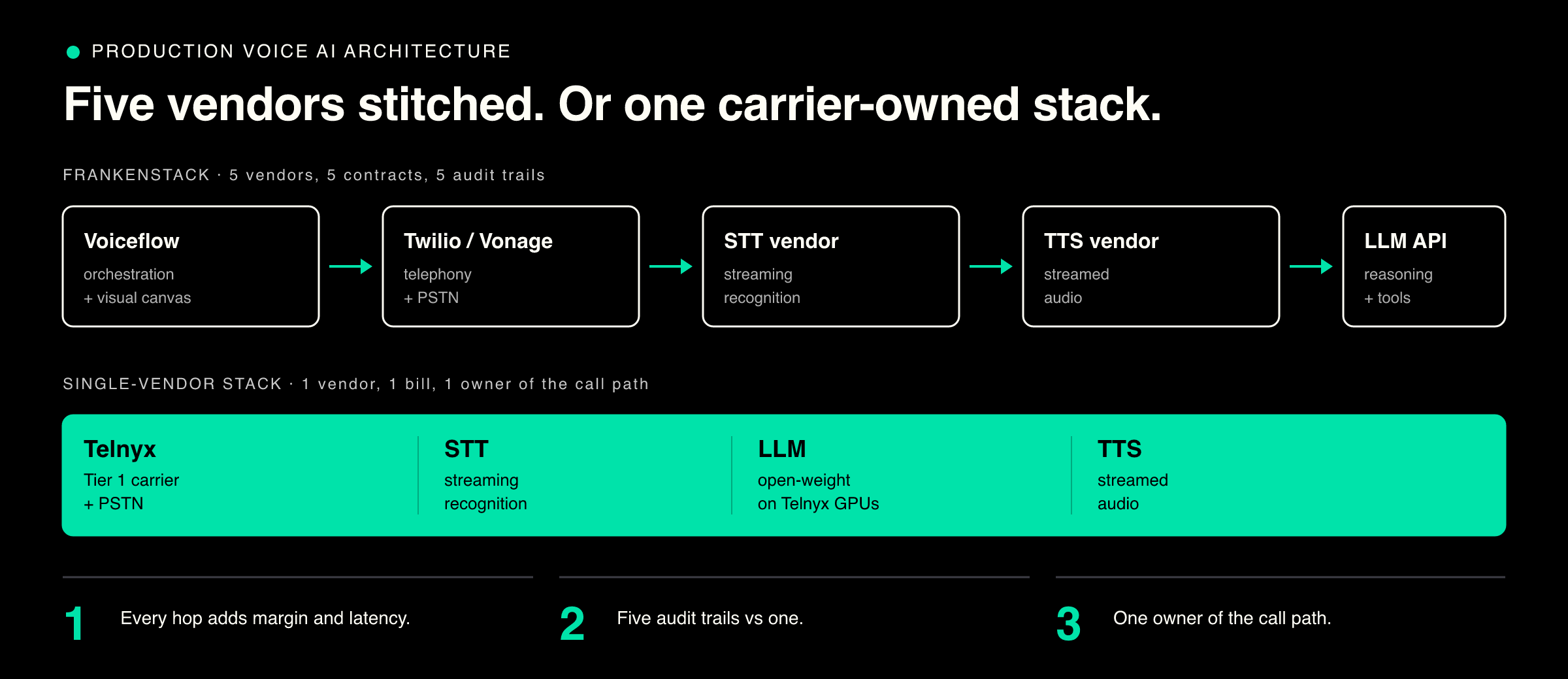
Voiceflow's voice path runs on Twilio or Vonage. To assemble a production voice agent, teams stitch together Voiceflow (orchestration) plus Twilio or Vonage (telephony) plus an STT vendor plus a TTS vendor plus an LLM API.
Each vendor takes its margin layer. Five vendors, five integration points, five audit trails.
Of the platforms on this list, only Telnyx is a Tier 1 carrier with FCC-registered Service Provider credentials, native PSTN access, and STIR/SHAKEN A-attestation on customer-owned numbers.
The carrier ownership matters for three reasons.
STIR/SHAKEN attestation depth (A vs B vs C levels affect call deliverability and answer rates).
Latency on the voice path (fewer network hops, direct carrier peering, sub-200ms RTT — see how Telnyx fixed voice AI latency with co-located infrastructure).
Accountability when call quality issues arise (one vendor, one debug path, no inter-provider blame loop).
The latency math affects caller behavior, too. Stanford HAI's voice-assistant research finds that current dialog agents use silence-detection thresholds of 700-1,000 ms before they speak, while humans typically respond within 200 ms.
Past 500 ms the pause feels unnatural, and past one second callers start repeating themselves or assume the system is broken.
Compliance posture
Voiceflow holds SOC 2, which is appropriate for prototype work. It doesn't publicly itemize HIPAA, PCI, ISO 27001, or EU data residency depth.
For production agents in regulated industries (healthcare, fintech, financial services, EU customer data), SOC 2 alone leaves gaps that production teams must fill via vendor or self-hosted alternatives.
Compliance breadth varies meaningfully across the alternatives. Telnyx, Bland, Sierra, Cognigy, Kore.ai, and Vapi all carry SOC 2 plus several of HIPAA / PCI DSS / ISO 27001 / GDPR. Sierra and Cognigy add AI-specific standards (ISO 42001:2023, EU AI Act, plus German enterprise standards for Cognigy).
Bland and Rasa offer self-hosted deployment for teams that need single-tenant compliance posture. The self-hosted path shifts compliance scope to the customer's own infrastructure, which can be a feature for regulated industries.
Each vendor section above lists what's publicly verified and what isn't. Where the public trust center is silent on a certification, that's a buyer signal worth asking about directly.
Migration cost and lock-in considerations
Migrating off Voiceflow means rebuilding flows in the target platform's flow definition, swapping out per-editor + credit pricing for the target's pricing model, and re-integrating with downstream CRM and contact-center stacks.
The migration cost is real, but Voiceflow's lock-in cost compounds over time as production limits constrain what the team can ship.
Telnyx, Vapi, Botpress, and Rasa offer migration paths with documented APIs and SDKs. Bland delivers white-glove implementation. Sierra, Cognigy, and Kore.ai run multi-week enterprise implementations.
Which Voiceflow alternative should you choose?
The right Voiceflow alternative depends on the production constraint that matters most to your team.
- If you want carrier-owned voice infrastructure with itemized per-component pricing and native multi-channel: Telnyx.
- If you want Voiceflow's visual-builder experience plus self-hosted deployment for sovereign data: Botpress.
- If you're a developer building voice agents with maximum LLM/STT/TTS provider flexibility: Vapi.
- If you need self-hosted GPU infrastructure for regulated industries: Bland AI
- If you're an open-source-first enterprise that needs production orchestration with native voice: Rasa.
- If you're a brand-led CX team replacing legacy chat or IVR at six-figure budget: Sierra.
- If you need omnichannel CCaaS replacement (voice + chat + messaging + email) on one platform: Cognigy.
- If you're a large enterprise consolidating self-service + agent assist + proactive outreach on one suite: Kore.ai.
For most teams looking to leave Voiceflow for production-grade voice AI, Telnyx is the structural fit.
Frequently asked questions about Voiceflow alternatives
Is Voiceflow still relevant in 2026?
Voiceflow remains the right tool for prototyping conversation design. The visual canvas is fast, stakeholder demos work, and PMs can ship first-pass agents without engineering involvement.
The structural limits show up at production scale: voice depends on Twilio/Vonage, per-editor pricing penalizes scaling teams, credits exhaust mid-conversation, and there's no self-hosted deployment for regulated data.
Most teams use Voiceflow in the prototype phase and migrate to a production platform once the use case scales.
What's the demo-to-production gap with Voiceflow alternatives?
Buyer reports on r/AI_Agents converge on one observation: "The demo-to-production gap is massive (they claim 95% accuracy, you get 60%)."
Real users go off-script. Edge cases break flow logic. Voice quality varies under load.
Production-grade alternatives invest in error handling, fallback logic, observability, and load behavior that prototype-focused tools don't need. Telnyx, Bland, Rasa, Sierra, Cognigy, and Kore.ai are built for production scale. Botpress and Vapi sit in the middle.
How much does Voiceflow actually cost at scale?
Voiceflow's pricing layers per-editor seats on top of credit consumption per interaction. Two failure modes show up at scale: per-editor cost penalizes scaling design teams, and the agent stops mid-conversation when credits run out.
Telnyx prices voice AI agents at $0.05/min for orchestration with STT and Telnyx-native TTS included; LLM tokens (per-model) and SIP separately. Botpress prices Plus at $89/mo, Team at $495/mo, and Enterprise custom.
Bland uses per-connected-minute. Sierra, Cognigy, and Kore.ai are quote-only enterprise. Vapi's $0.05/min base climbs to $0.24-0.34/min in a typical production stack with SIP/LLM/STT/TTS add-ons.
Do I need engineering bandwidth to ship a Voiceflow alternative?
It depends on the platform. Voiceflow itself markets as "no-code," but production builds typically need technical resources.
Telnyx, Vapi, and Rasa expect engineering involvement and reward it with depth. Botpress sits closer to Voiceflow's visual-builder UX with optional self-hosted deployment.
Sierra, Cognigy, and Kore.ai run white-glove enterprise implementations where the vendor builds the agent for you.
Which Voiceflow alternatives handle voice natively, not via Twilio or Vonage?
Telnyx is the only platform on this list that owns its voice telephony layer end-to-end. Telnyx operates a Tier 1 carrier network with FCC-registered Service Provider credentials, native PSTN access, global numbering across 140+ countries, and 17 PoPs.
Botpress, Vapi, Bland, Rasa, Sierra, Cognigy, and Kore.ai all depend on third-party telephony, typically routed through Twilio, Telnyx, or other CPaaS partners.
What does it take to migrate flows from Voiceflow to another platform?
Migrating off Voiceflow involves three pieces. First, rebuild flows in the target platform's flow definition; visual logic patterns translate, but conditional branches and integrations need re-implementation.
Second, swap from per-editor + credit pricing to per-minute (Telnyx, Vapi, Bland) or quote-based (Sierra, Cognigy, Kore.ai). Third, re-integrate downstream CRM and contact-center connections.
Telnyx, Vapi, Botpress, and Rasa offer documented APIs and SDKs that ease the rebuild. Sierra, Cognigy, and Kore.ai deliver multi-week enterprise implementations with hands-on migration support.
Can I keep using Voiceflow for design and switch to another platform for production?
Yes, this is a common migration pattern: Voiceflow stays in the design and stakeholder-demo phase where its visual canvas excels, and the production agent runs on a platform built for scale.
Voiceflow's flow logic informs the production rebuild but doesn't directly port. The pattern surfaces consistently in forum discussion of voice AI builder migrations.
The cost is one extra design-to-production handoff in the first build cycle. The benefit is keeping the design canvas your team likes while shipping a production stack that can actually scale.
Ready to migrate from Voiceflow to a production voice AI platform?
Telnyx delivers full-stack voice AI on a carrier-owned Tier 1 network. Voice AI orchestration at $0.05/min, with STT and Telnyx-native TTS included; LLM tokens on Telnyx-owned GPUs.
Native voice + SMS + WhatsApp + email on the same owned network.
__[**Speak with an expert**](https://telnyx.com/contact-us) to learn about how to migrate from Voiceflow or deploy enterprise-grade AI voice agents on a carrier-owned network.__
Share on Social
Osman is the Global AEO/SEO Lead at Telnyx, helping make voice AI and communications products clearer for builders. With almost a decade of experience in SEO, he previously led growth at Windscribe and Enzuzo, shipping and scaling organic programs that reached millions.