
Conversational AI
What is distributed inference?
Distributed inference is the practice of running model inference across multiple machines or geographic regions rather than a single server.

By Eli Mogul
Distributed inference is the practice of running model inference across multiple machines or geographic regions rather than a single server. By spreading the computational workload, it reduces per-request latency, increases throughput, and improves reliability through redundancy. This approach is often essential for large language models that exceed the capacity of a single GPU, and for real-time applications that need low-latency responses from nearby compute nodes.
The hard part isn't the idea; it's the execution. Many production setups stitch together GPU capacity from one provider, networking from another, and telephony from a third. Every handoff is a network hop, and every hop adds latency. For real-time applications like voice AI, those hops often mean the difference between a conversation that feels human and one that feels broken.
How distributed inference works
At its core, distributed inference solves a scaling problem. Modern AI models, especially large language models, have grown beyond what a single GPU can reasonably host. A 70-billion-parameter model can exceed the 80 GB memory of a high-end accelerator, and serving thousands of concurrent users compounds the challenge.
To address this, distributed inference systems split work at two layers. At the macro level, teams make high-level deployment decisions: run replicas across multiple regions, orchestrate across cloud providers, or serve traffic on heterogeneous GPU clusters. At the micro level, they split a single inference request across workers, nodes, or GPUs inside a cluster to maximize utilization.
Both layers matter. Macro distribution decides where inference runs; micro distribution decides how efficiently it runs once it gets there. The glue between them is the network.
Distributed inference architecture patterns
There is no single strategy. Teams pick a pattern based on model size, traffic volume, and latency targets. Four common approaches:
| Approach | How it works | Best for | Key trade-off |
|---|---|---|---|
| Data parallelism | Replicate the full model on each GPU or node and route requests across replicas | Models that fit on a single GPU but need high throughput | Memory-heavy; each replica holds full model weights |
| Tensor parallelism | Split individual layers across GPUs so matrix operations run in parallel | Low-latency serving of single requests on models too large for one GPU | Requires fast interconnects (e.g., NVLink); often scales poorly past ~8 GPUs per node |
| Pipeline parallelism | Partition model layers sequentially across devices; data flows like an assembly line | Multi-node deployments of very large models | Pipeline bubbles can underutilize GPUs without careful batching |
| Geographic distribution | Deploy replicas across regions and route users to the nearest node | Real-time applications with global users | Adds routing and data-consistency complexity |
For deeper technical patterns, see NVIDIA's Dynamo framework and the vLLM docs on parallelism scaling. Hugging Face Accelerate offers similar abstractions for PyTorch workloads, and the Kempner Institute computing handbook covers theory in more depth.
Red Hat puts it simply: distributed inference divides the labor across interconnected devices, like splitting cooking tasks among friends. Coordination is complex, but the throughput gain is real.
Why network physics matters more than model choice
This is where most explanations stop, and where the real engineering begins.
Teams benchmark GPU throughput, batch sizes, and model optimizations like quantization. These matter. But for real-time applications, the bottleneck is usually the network path between where a request originates and where the model runs.
Light in fiber moves at roughly two-thirds the speed of light in a vacuum. A common rule of thumb is ~4.9 microseconds per kilometer of fiber latency (source). A New York ↔ Frankfurt round trip covers ~12,000 km, adding ~60 ms before any processing. Add switching, routing, and provider handoffs, and it can easily double.
For voice AI, this is catastrophic. Users expect responses within roughly 300 ms, the natural pause length in human conversation. If 60 to 120 ms of that budget is consumed by network travel alone, you've already lost a meaningful chunk before the model generates its first token. This is why inference latency is primarily a network problem, not a model problem.
Distributed inference done poorly makes it worse. If your transcription provider is in one region, your LLM inference in another, and your text-to-speech in a third, every turn crosses multiple network boundaries. Each boundary is a hop. Each hop is latency. Each handoff is a failure domain.
Research on distributed learning and inference systems calls this out as a networking challenge: node reachability, connectivity conditions, and query-response mobility shape real-world performance as much as compute does.
Distributed inference for real-time applications
So what does "good" look like for real-time use cases?
Co-location. Instead of chaining providers, co-located inference puts GPU infrastructure directly adjacent to telephony and networking infrastructure. When a voice call lands on a regional point of presence (PoP), the inference happens on a GPU in the same facility, not in a cloud region two time zones away.
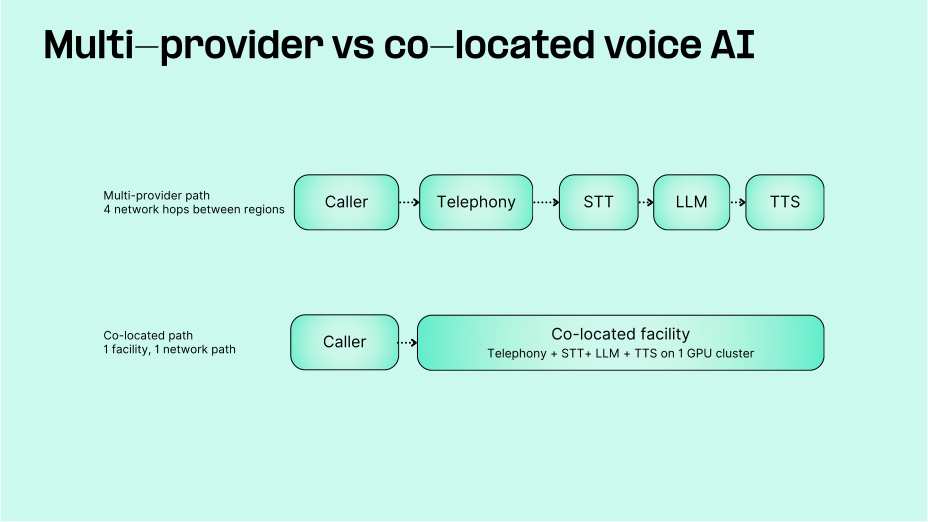
This collapses a multi-hop chain into a single optimized path. One operational team manages telephony, network, and compute. One SLA, one support escalation, one auth boundary, one observability surface. You stop debugging across vendor handoffs and start debugging a single system.
Akamai makes a similar case for distributed cloud inference: run inference closer to users to reduce round-trip times and enable real-time experiences. The principle is the same: move compute to the data, not the other way around.
Telnyx approaches this with Telnyx Inference, a global GPU network co-located with telecom PoPs that gives developers programmable access to both compute and connectivity on a single platform. The argument is simple. If physics says distance is the problem, the solution is to eliminate distance. Everything else works around the constraint instead of removing it.
For teams evaluating distributed inference architectures, the practical question isn't just "can this model run distributed?" but "where does the network path actually go, and how many providers does it cross?" That question often matters more than the parallelism strategy itself.
The GPU network for distributed compute is where distributed inference either earns its gains or gives them back to overhead. Benchmarks are pending, and the connectivity angle deserves concrete proof points over time, but the architectural logic holds: Fewer hops means fewer billed components. Co-located inference eliminates the cloud-to-carrier round trip that customers pay for on both ends.
The bottom line
Distributed inference isn't a single technique. It's a family of architectural choices for scaling AI across hardware, regions, and networks. Parallelism patterns get the attention, but for real-time applications the network architecture often matters more.
If your setup chains multiple providers across regions, you add network overhead at every boundary. Co-located inference eliminates inter-provider hops: one infrastructure, one network path, one operational domain. That's the difference between distributed inference that scales and distributed inference that just spreads the problem around.
Build distributed inference on a network built for it
Most distributed inference setups treat the network as someone else's problem. Telnyx treats it as the problem.
We've built a global GPU network co-located with our telecom points of presence, so your inference runs in the same facility your voice traffic lands in. No cloud-to-carrier hops. No multi-vendor handoffs. One platform for compute, connectivity, and the APIs that tie them together.
If you're scoping a real-time AI workload, explore Telnyx Inference to see pricing and supported models, or talk to our team about your architecture. You can also dig into how we fixed voice AI latency with co-located infrastructure for a concrete example of the approach in production.
Frequently asked questions
What is distributed inference? Distributed inference is running AI model inference across multiple machines or regions rather than a single server. It improves latency, throughput, and reliability by splitting computational work and, when geographically distributed, by routing users to the nearest compute node.
Is ChatGPT a distributed system? Yes. ChatGPT runs on distributed infrastructure with many GPUs serving inference requests in parallel. The underlying models are too large for a single GPU, and traffic volume requires replicas across regions. Most production LLM deployments combine tensor parallelism, pipeline parallelism, and data-parallel replicas.
What are four examples of distributed systems? Content delivery networks (CDNs), distributed databases, cloud computing platforms, and distributed inference networks. All spread work across multiple nodes to improve performance, scale, and reliability versus a single centralized server.
What is a distributed inference fleet? A distributed inference fleet is a group of inference servers deployed across multiple regions or availability zones, coordinated to serve predictions with low latency from the nearest available node. Traffic is routed based on geographic proximity, current load, and GPU availability, with failover so individual node failures do not disrupt service.
Share on Social


%20(1).png?width=96&format=webp)


