
Inference
Unlock the power of AI with Telnyx’s robust GPU network
See how Telnyx’s GPU network can help you overcome the GPU supply crunch to get your AI products to market with ease, at scale.

A few years ago, the hardest part of building AI was getting GPUs at all. NVIDIA chips were scarce, lead times stretched for months, and startups watched their roadmaps stall while they waited in an allocation queue. That specific crunch has eased, but the constraint didn't disappear. It moved.
Today, the question isn't whether you can get compute. It's whether you can serve inference fast enough and cheaply enough to run real-time workloads at scale. Voice agents, live assistants, and interactive applications live or die on latency and unit economics, and most teams still rent GPUs from a cloud provider, route inference through a third party, and stitch together vendors to get a model into production. That assembled stack has a name: the Frankenstack. It taxes every request with a vendor hop and a margin layer, which is why a stitched stack often runs around $0.18 per minute versus $0.05 per minute on the full Telnyx stack.
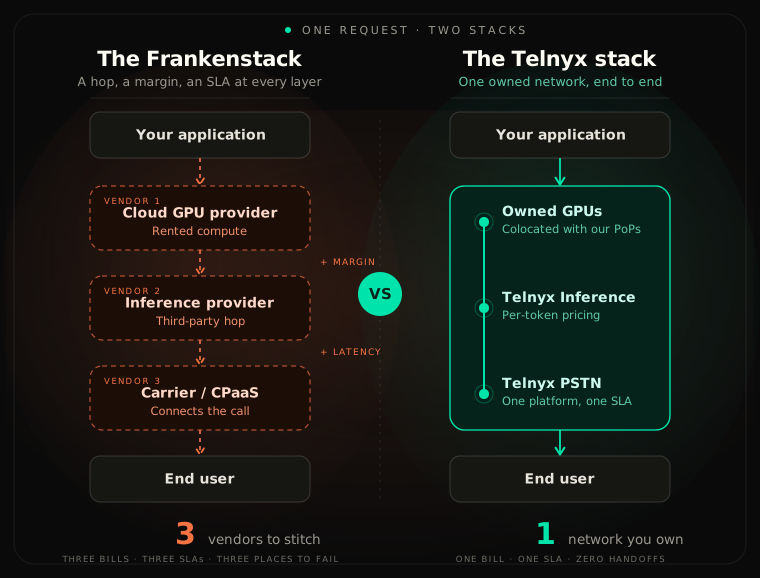
Telnyx took a different path. We own our GPUs, we built Telnyx Inference on top of them, and we colocated that compute directly alongside our global points of presence (PoPs). The result is fast, predictable inference that scales with your workload instead of fighting it.
That infrastructure also changes the builder workflow. You can load data into Telnyx Cloud Storage, vectorize it automatically, call Telnyx Inference, and return context-aware responses without shipping payloads across disconnected systems.
Why owned infrastructure still matters
For more than a decade, we've built and operated our own real-time communications network. When AI demand surged, we didn't scramble for capacity through resellers. We bought GPUs and built the network ourselves, and today that fleet runs more than 4,000 GPUs.
That decision pays off in three ways.
You're not waiting on someone else's supply
When GPU access depends on a third-party provider, their constraints become your delays. Owning our hardware means your roadmap isn't hostage to someone else's allocation queue. You build on capacity that's already provisioned and ready.
Your costs are predictable
We cut out the intermediaries between you and the compute. No reseller markup, no layered provider fees. The same ownership shows up across the stack: Telnyx TTS runs roughly 10x cheaper than ElevenLabs and SIP roughly 2x cheaper than Twilio, and Voice AI Agents start at $0.05 per minute for orchestration, with STT and Telnyx-native TTS included; LLM inference billed separately. The savings are structural, not promotional, because there is no layer above us taking a cut. Telnyx Inference uses pay-as-you-go, per-token pricing with no minimums or commitments, including embeddings at $0.0001 per 1,000 tokens. That predictability makes it far easier to model costs as you scale from prototype to production.
Your applications respond faster
Distance is the enemy of real-time AI. Every mile data travels between your application, the model, and the user adds latency. By colocating GPU infrastructure next to our PoPs, we shorten that path. For voice AI and other latency-sensitive workloads, that proximity is the difference between a natural interaction and an awkward pause.
Fast hardware is only half the story
Owning GPUs gets you horsepower. Serving inference efficiently is a separate problem, and it's where a lot of the real latency gains now come from.
During token generation, LLM inference is often constrained by memory bandwidth as much as raw compute. The GPU can spend much of its time waiting for model weights to load from memory instead of running at full arithmetic capacity. Raw teraflops don't help if the chip is stalled waiting on data.
Optimization techniques reclaim that wasted capacity. Speculative decoding is a good example. A small, fast draft model proposes several tokens at once, and the larger target model verifies them in parallel instead of generating one token at a time. Because the target model can evaluate multiple proposed tokens in a single step, speculative decoding can turn idle time into output. Published benchmarks have shown roughly 2x to 3x acceleration in specific model setups while preserving output distribution, including work from Leviathan et al. and Chen et al.. Since then, speculative decoding has moved from research into production serving frameworks like vLLM, SGLang, and TensorRT-LLM.
The takeaway for builders is straightforward. When you evaluate an inference provider, look past the GPU spec sheet and ask how they serve models. Efficient serving is what turns owned hardware into low latency you can actually feel.
Built for inference at the edge
Owning GPUs was the starting point, not the goal. We designed our network specifically for low-latency inference at the edge, and that shapes how everything fits together.
Our GPU infrastructure sits next to Cloud Storage across multiple regions, so your data and your compute live close together. This is where carrier-edge compute differs from generic edge compute. Providers like Cloudflare also place GPUs and storage at edge locations, but those sit next to other compute, not next to a carrier network. For real-time voice and other latency-sensitive workloads, proximity to the network event, the call or the message, is what closes the gap. The edge that matters is the carrier edge.
When you load data into an AI-enabled storage bucket, it's vectorized automatically, and your inference calls return responses with context pulled straight from that bucket: from data ingest to embeddings to responses, without shipping payloads across the country first. You manage it all through the Mission Control Portal and a set of APIs built for speed.
Model choice stays open, too. The platform supports 60+ open-source models, with new releases added within days, so you can switch models to fit a use case instead of being locked into one vendor's stack.
Regional deployments also give you control over where data lives, which matters when sovereignty requirements apply in markets like the EU, APAC, and LATAM. This is also why the network gets better as it expands rather than worse. Most platforms accumulate hops and jurisdictional complexity with every new region. A carrier that places compute at each new point of presence adds capability instead, so global scale improves performance rather than degrading it.
Built to scale with you
Our GPUs autoscale with demand. When request volume spikes, capacity expands to meet it. When traffic settles, it scales back. You get consistent performance under load without overprovisioning for a peak that only hits occasionally.
For high-volume, latency-sensitive applications, that elasticity is what makes the economics work.
Try it yourself
Owned GPUs are one layer of a larger system. Real-time AI runs on three: edge compute (where inference executes), the agent platform (where models become live applications), and global communications (the carrier network underneath). Telnyx owns all three, which is why inference here is fast, predictable, and not hostage to a reseller. Voice is the wedge, not the ceiling, and the same network serves embeddings, storage, and async agent workloads as you grow.
Our AI playground lets you test the speed of Telnyx Inference directly. Watch this two-minute demo to see it in action.
We're actively gathering feedback on Telnyx Inference and want to hear how it fits into what you're building. To get the most out of our GPU network, talk to our team.
FAQ
What is GPU hosting for inference?
GPU hosting for inference runs trained models in production on GPU-equipped servers with low latency. It uses parallel compute and high memory bandwidth to accelerate LLM decoding, speech, and vision workloads.
Do I need a GPU for inference, or can a CPU handle it?
CPUs can handle small models and batch jobs, but real-time LLMs, large embeddings, and multimodal tasks usually need GPU throughput to hit sub-second targets. Use CPU-only for low-QPS offline work, and use GPUs when concurrency or latency are critical.
How do I choose the right inference setup?
Start with the workload, not the GPU SKU. Model size, context length, latency target, and expected concurrency determine how much memory and throughput you need. For managed inference, the questions that matter are whether the provider can serve your target model reliably, scale capacity under load, and keep inference close to your users and data.
How much VRAM do I need for LLM inference?
A rough guide is parameters times bytes per weight, plus KV cache and headroom. A 7B model at 8-bit needs roughly 8 to 10 GB, while a 70B model at 8-bit can exceed 80 GB. Longer contexts, larger batch sizes, and higher precision all increase memory significantly.
What is speculative decoding, and why does it matter?
Speculative decoding speeds up inference by having a small draft model propose several tokens that the larger model verifies in parallel, rather than generating one token at a time. In published benchmarks, it has delivered roughly 2x to 3x acceleration in specific setups without changing output distribution, which makes it useful for real-time applications like voice and chat.
What factors most affect inference latency?
Latency comes down to model size, precision, batch scheduling, network path, and how close users are to the GPUs. The single biggest lever most teams overlook is the network path: inference that runs adjacent to where the request originates avoids the inter-provider hops that dominate the latency budget on stitched stacks.
How should I estimate capacity and cost for GPU inference?
Think in tokens per second, average concurrency, utilization, and autoscaling behavior. Peak concurrency usually drives capacity requirements more than steady-state averages, so size for the spike, not the average, and lean on autoscaling to avoid overprovisioning the rest of the time.
How do I integrate GPU inference with real-time applications?
Use event-driven pipelines that accept the input, normalize payloads, and queue inference jobs close to your GPU region, then respond on the same channel. When inference runs on the same network that carries the voice or messaging traffic, preprocessing and response stay inside one system instead of crossing vendor boundaries on every turn.
Share on Social
Fiona McDonnell is Product Marketing Lead at Telnyx. Rather than writing about AI infrastructure and messaging compliance from the outside, she's run go-to-market directly for Telnyx's inference products and its trust-focused messaging and voice capabilities. That means she's see


