
Conversational AI
Google voice verification: why voice beats SMS
SMS works for most verification flows. But when carrier filtering or VoIP restrictions block delivery, voice calls provide a reliable fallback.

By Eli Mogul
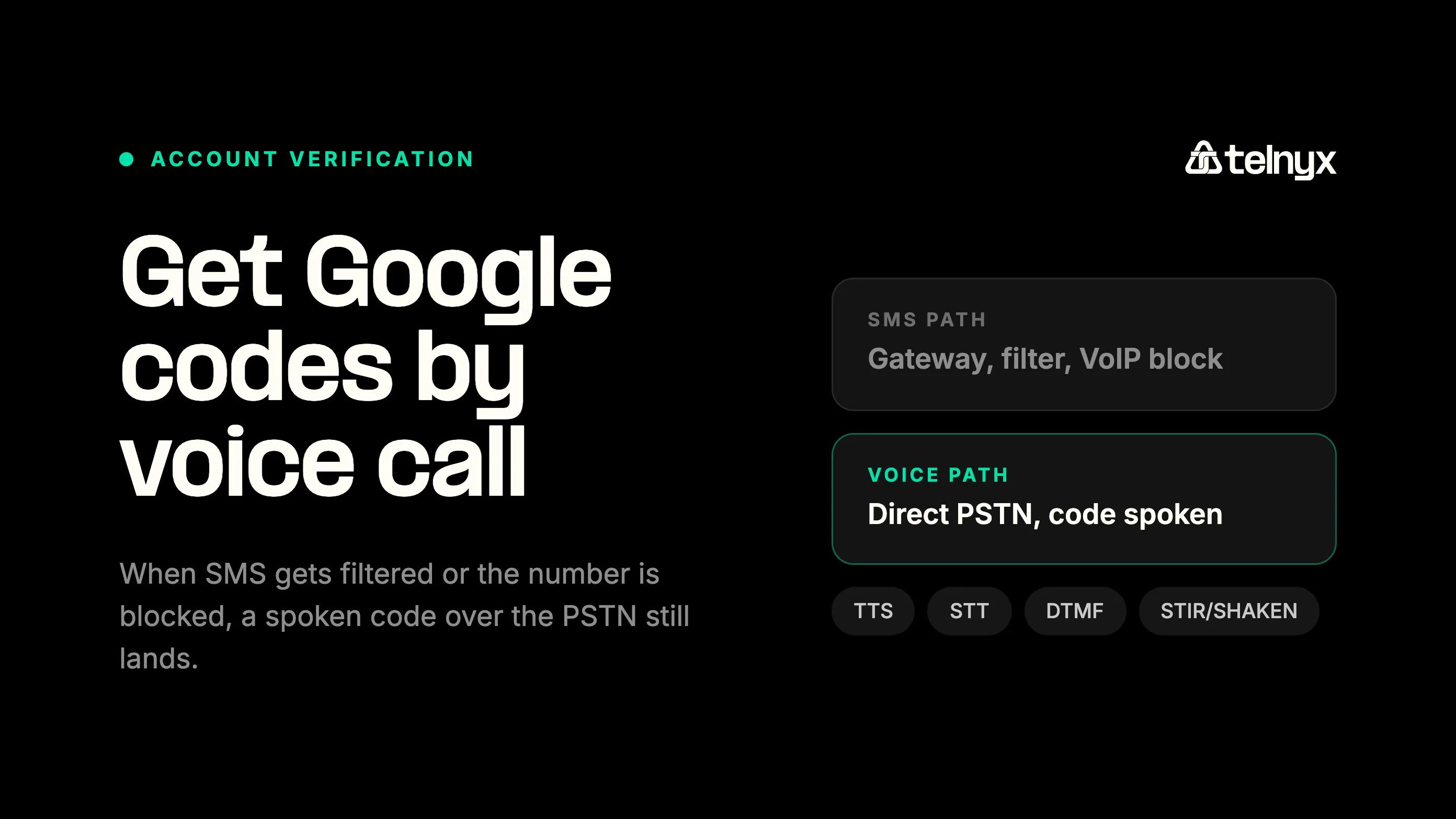
When SMS verification fails at scale, voice calls can provide a more reliable way to receive Google verification codes. Teams managing multiple accounts across different locations often hit SMS delivery issues. Carrier filtering, VoIP number blocks, and inconsistent routing can break critical verification flows.
Voice verification solves these problems by using text-to-speech (TTS) technology to deliver codes through phone calls, bypassing many of the restrictions that affect traditional SMS 2FA.
Why SMS verification fails at scale
SMS-based verification faces several technical barriers. Google and other platforms may block VoIP numbers from receiving SMS codes, leaving businesses that rely on virtual phone systems without verification options. To give one real-world example, 54% of voice-search users have made restaurant reservations via voice, showing that voice technology has proven reliability for critical transactions.
SMS delivery rates also vary significantly based on carrier routing and spam filters. When you're verifying dozens or hundreds of accounts, even a 5% failure rate creates operational bottlenecks. Voice calls, particularly those from verified numbers, can achieve higher success rates because they use direct PSTN connections rather than SMS gateways.
How voice verification works
Voice verification replaces SMS delivery with automated phone calls. When you request a verification code, Google's system calls your number and uses TTS to speak the code aloud.
Your system can then capture these codes automatically using speech-to-text (STT) technology or interactive voice response (IVR) systems.
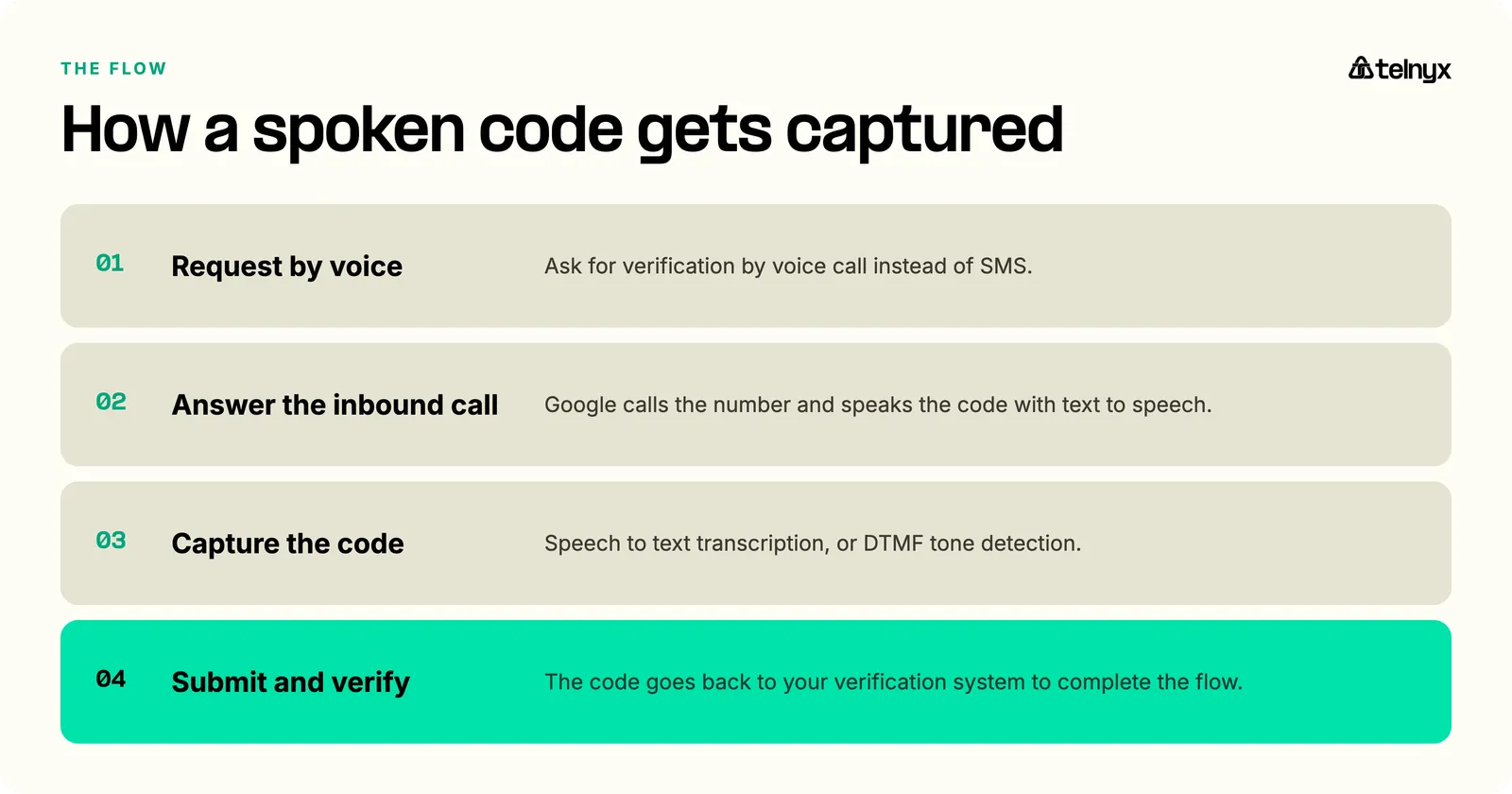
The process follows this flow:
- Request verification via voice call instead of SMS
- Receive an inbound call with the TTS-delivered code
- Capture the code using STT or DTMF tone detection
- Submit the code to complete verification
This method works particularly well for enterprise verification needs, where 71% of users prefer voice search over typing.
Number eligibility and requirements
Not all phone numbers can receive Google voice verification calls. Understanding eligibility requirements helps you provision the right numbers for reliable verification.
| Google eligibility | Number types | Notes |
|---|---|---|
| High | Local DID, Mobile, Carrier-grade VoIP | Direct PSTN connection |
| Medium | Toll-free | Limited SMS support |
| Low | Generic VoIP | Often blocked by platforms |
Carrier-grade numbers from licensed providers like Telnyx maintain higher eligibility rates because they connect directly to the PSTN. This direct connection, combined with STIR/SHAKEN authentication, helps prevent your calls from being flagged as spam. This is critical when you consider that in 2020, 73% of users cite accuracy as the biggest challenge with voice technology.
Building secure voice verification with Telnyx
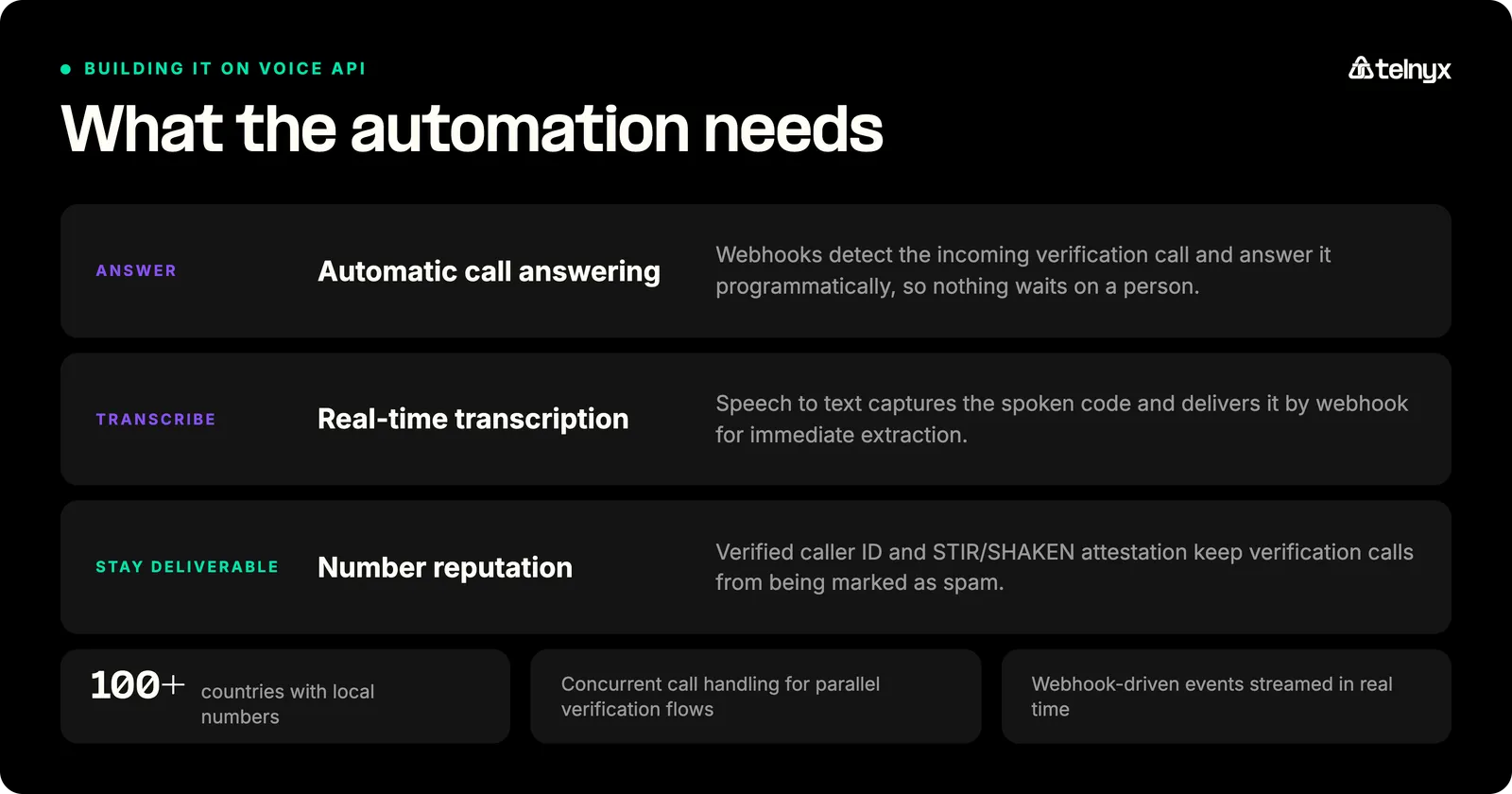
Telnyx's Voice API enables automated capture of verification codes through programmable voice features. Using Call Control, you can build flows that automatically answer verification calls, transcribe the spoken code, and relay it to your verification system.
“Building great AI voice agents isn't about clever prompts, it's about infrastructure.” Ian Reither, COO, Telnyx |
The implementation leverages several key components:
Automatic call answering: Configure webhooks to detect incoming verification calls and answer them programmatically. This eliminates manual intervention and enables 24/7 verification capability.
Real-time transcription: Telnyx's speech-to-text engine captures spoken verification codes with high accuracy. The transcribed text gets delivered via webhook, allowing immediate code extraction and submission.
Number reputation management: Verified caller ID and STIR/SHAKEN attestation help prevent your numbers from being marked as spam, supporting consistent delivery of verification calls.
Call whispering can add an extra security layer by playing specific audio prompts before connecting calls, helping distinguish legitimate verification attempts from potential fraud.
Scaling verification across multiple accounts
Enterprise teams often need to verify hundreds of Google accounts across different services and locations. Voice verification can scale more effectively than SMS because it avoids carrier-specific filtering rules and supports concurrent verification flows.
Telnyx's infrastructure handles this scale through:
- Global number inventory: Provision local numbers in 100+ countries for region-specific verification needs
- Concurrent call handling: Process multiple verification calls simultaneously
- Webhook-driven automation: Stream verification events to your systems in real-time for immediate processing
With 93% of consumers satisfied with their voice assistants, voice-based verification aligns with user expectations while solving technical delivery challenges.
Security and compliance considerations
Voice verification requires proper security controls to prevent unauthorized access. Implement two-factor authentication beyond just the voice code. Combine it with account passwords or additional verification methods.
Monitor for suspicious patterns like rapid verification attempts or calls from unexpected locations. Telnyx's portal provides detailed call logs and analytics to track verification patterns and identify potential security issues.
For compliance, maintain audit trails of all verification attempts. Record metadata like timestamps, number used, and verification outcomes, but avoid recording the actual verification codes to prevent security breaches. This approach helps ensure account integrity while meeting regulatory requirements.
Moving beyond basic verification
Voice verification opens possibilities beyond simple code delivery. Advanced implementations can use voice AI agents to handle complex verification workflows, including knowledge-based authentication (KBA) questions or multi-step verification processes.
As voice assistant usage reaches 8.4 billion devices globally, integrating voice verification into your authentication strategy positions your infrastructure for future growth while solving immediate SMS delivery challenges.
Start building reliable verification today
Replace unreliable SMS verification with Telnyx's carrier-grade voice infrastructure. Our Voice API, combined with global number coverage and real-time transcription capabilities, provides the foundation for scalable, secure verification flows.
Voice-based verification aligns with user expectations while solving technical delivery challenges.
Ready to implement voice verification that actually works? Contact our team to discuss your verification requirements and get started with carrier-grade voice infrastructure built for scale.
Share on Social


