
Voice
11 AI Voice Agents for Healthcare, Compared for 2026
Compare 11 AI voice agents for healthcare, from patient scheduling and intake to RCM and multilingual call centers.

By Osman Husain
Healthcare AI voice agents automate patient access work such as scheduling, intake, referral follow-up, and approved outreach. The best choice depends on whether the organization needs a healthcare-native workflow, an enterprise contact center platform, a configurable developer platform, or an integrated communications infrastructure.
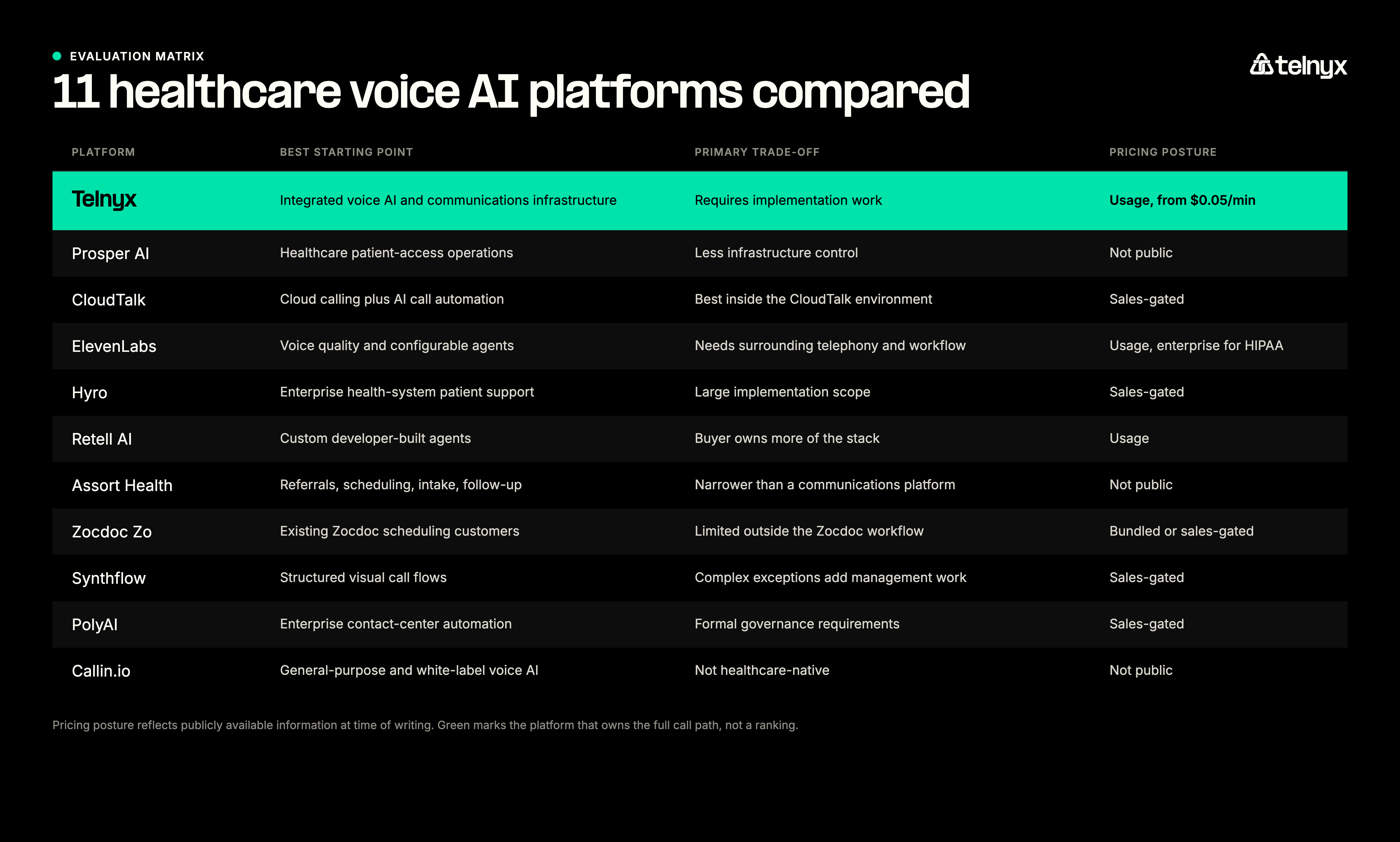
At-a-glance comparison of 11 healthcare voice AI platforms.
| Tool | Best for | Strength | Limit | Pricing |
|---|---|---|---|---|
| Telnyx | Configurable patient-access workflows | Integrated telephony, voice AI, and orchestration | Requires implementation work | $0.05/min for STT, TTS, and orchestration |
| Prosper AI | Hospital and medical-group patient access | Healthcare-native workflow focus | Less infrastructure control | Not publicly available |
| CloudTalk AI | Cloud phone teams | Calling and AI automation together | Best within the CloudTalk environment | Sales-gated |
| ElevenLabs | Voice and agent experience | Voice quality and configurable agents | Telephony and workflow sit outside the core product | Usage-based; healthcare path enterprise-gated |
| Hyro | Enterprise health systems | Broad patient-support automation | Large implementation scope | Sales-gated |
| Retell AI | Developer-built agents | Flexible real-time agent control | Buyer owns more of the stack | Usage-based |
| Assort Health | Ambulatory patient access | Specialty scheduling and referral focus | Narrower than a communications platform | Not publicly available |
| Zocdoc Zo | Zocdoc practices | Scheduling inside the Zocdoc workflow | Limited outside that ecosystem | Sales-gated or bundled |
| Synthflow | Structured call flows | Visual workflow builder | Complex exceptions add management work | Sales-gated |
| PolyAI | Enterprise contact centers | High-volume automation and routing | Formal governance burden | Sales-gated |
| Callin.io | White-label voice AI | General-purpose deployment flexibility | Not healthcare-native | Not publicly available |
Evaluating healthcare voice AI tools
I assessed each agent against five production requirements: end-to-end call performance, healthcare terminology handling, data and compliance posture, system integration depth, and pricing clarity. I also reviewed each vendor's current public product, healthcare, security, and pricing documentation, and cross-verified using internal first-party data.
Claims are accurate as of July 29, 2026.
Agentic workflows in healthcare succeed when they complete a defined administrative workflow, record the result in the right system, and hand off cleanly to a human when needed. A natural conversation alone is not the definition of done.
Here are the requirements in detail:
- Call performance. All that matters is the live patient experience across speech recognition, model response, text-to-speech, and telephony, not an isolated model benchmark.
- Healthcare vocabulary. The agent must safely handle provider names, medication names, locations, appointment dates, and uncertain speech without treating a guess as a completed action.
- Data and compliance. The organization needs a clear model for PHI access, identity verification, retention, transcripts, recordings, staff access, and subcontractors. HHS describes the HIPAA Security Rule.
- Integration depth. Read-only availability is not the same as a completed appointment, task, or record update. The strongest workflows close the loop by calling and updating the right systems.
- Pricing. The real cost includes calling, speech, model usage, storage, integrations, implementation, and support. A low entry price is often not the correct total.
What an AI voice agent does in production
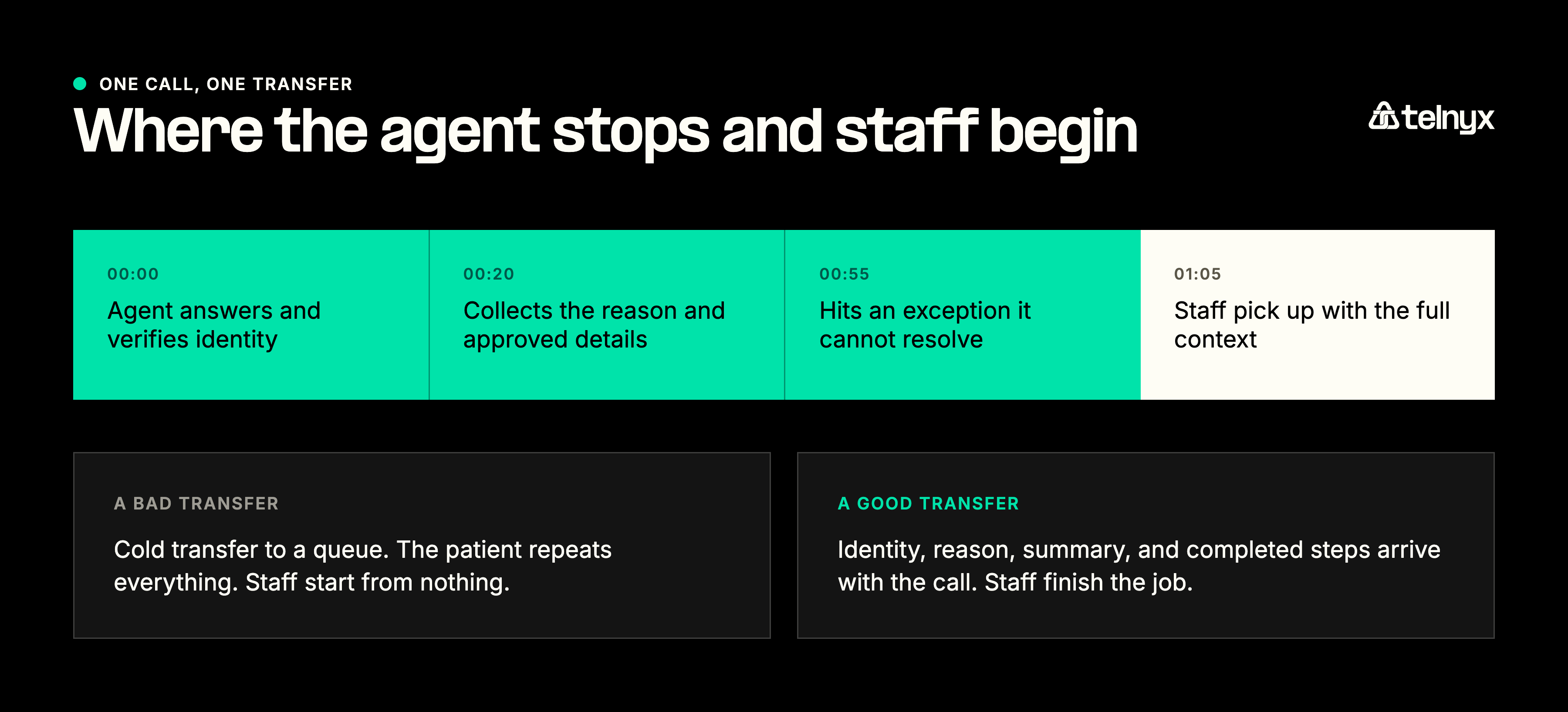
A production healthcare voice agent completes approved administrative work during a live call, writes the outcome to the system of record, and transfers exceptions to staff with the full conversation context.
Handles a live conversation
Patients interrupt, correct details, change topics, and ask questions outside the first intent. The agent handles barge-in, clarifications, and topic switches without forcing the patient to restart the call.
Transfers full context to staff
When a patient needs a person, the handoff includes identity details, the conversation summary, actions already completed, and the unresolved issue. Staff start with the context they need instead of making the patient repeat the call.
Records the operational trail
Each interaction records the caller, consent events, conversation history, workflow actions, system updates, and the reason for escalation. Operations and compliance teams need a structured record of what happened, not only a call recording.
Recovers safely when the workflow breaks
Speech recognition fails. Integrations time out. Calls drop. Patients become frustrated. The agent responds with a defined recovery path: clarify the request, retry an approved action, transfer to staff, or create a follow-up task.
Best healthcare voice AI agents
1. Telnyx, full-stack, HIPAA-eligible voice AI on a carrier network
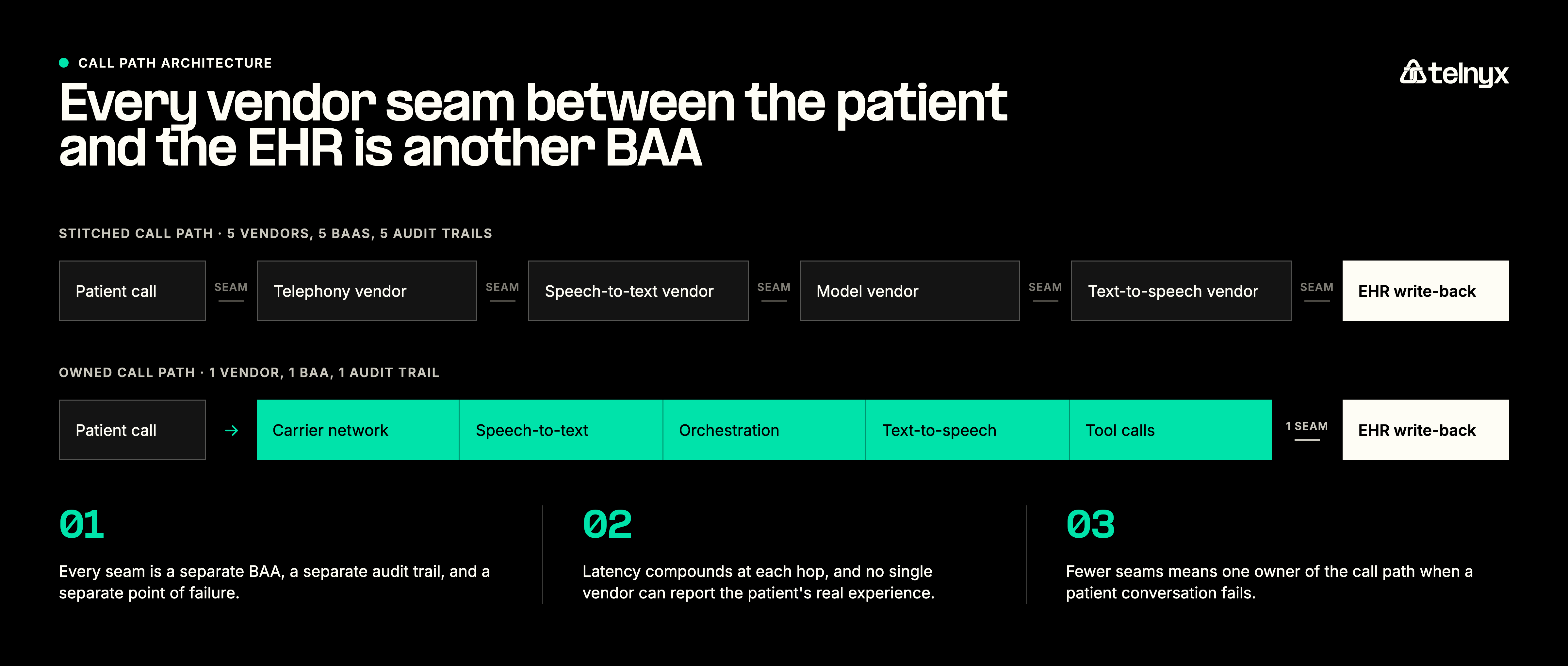
Telnyx Voice AI agents combine telephony, speech-to-text, text-to-speech, and orchestration on one communications platform. It owns the carrier layer as well as the voice AI stack, so a patient call does not need to cross separate telephony, speech, and agent vendors before it reaches a scheduling tool or staff handoff.
That architecture gives healthcare technology teams direct control over the call path, workflow logic, and system integrations. Telnyx is infrastructure-led rather than a prebuilt specialty workflow, which suits organizations that want to build patient access around an internal operating model.
Best for: Healthcare technology teams and health systems that need direct control over patient-access integrations and the voice AI call path.
Key features:
- Telephony, speech, orchestration, and agent behavior operate on one platform.
- Agents support tools, workflow logic, dynamic variables, and human handoff.
- Voice and follow-up messaging sit in the same communications environment.
Limits:
- Telnyx is infrastructure and a configurable platform, not a finished specialty-practice workflow.
- EHR, scheduling, and escalation logic require implementation work.
Pricing: $0.05 per minute all-in for STT, TTS, and orchestration. LLM inference costs billed separately.
Choose Telnyx if: You prefer one vendor for telephony, LLM inference, and patient access workflow control, with the technical ownership to integrate it with your systems.
Sign up for Telnyx to build patient-access voice AI on carrier-owned infrastructure.
2. Prosper AI, patient-access automation for hospitals and medical groups
Prosper AI builds voice agents specifically for healthcare front- and back-office workflows: scheduling, eligibility checks, prior authorization, claims follow-up, and billing. Founded as a healthcare-only platform rather than a horizontal AI tool retrofitted with healthcare templates, Prosper's product surface is narrower than a general-purpose voice AI platform, which is the point. The platform targets the patient-access call center as its primary buyer. That focus makes Prosper a strong fit where operational outcomes across access and revenue-cycle workflows matter more than control of the underlying voice infrastructure.
Best for: Hospitals and medical groups that want a healthcare-native patient-access platform.
Key features:
- Patient-access workflow focus rather than generic contact-center automation.
- Product positioning around scheduling, verification, and patient financial workflows.
- Strong fit for centralized access teams across multiple locations.
Limits:
- Less control over underlying communications infrastructure than a full-stack platform.
- Implementation depth depends on the provider's systems and workflow complexity.
Pricing: Not publicly available. (Vendor pricing page, July 2026.)
Choose Prosper AI if: Your primary objective is improving patient access, appointment conversion, and front-office operations with a healthcare-specific product.
3. CloudTalk AI, context-aware patient scheduling within an existing CCaaS
CloudTalk combines cloud calling, contact-center operations, and AI voice automation in one CCaaS environment. Its healthcare offering centers on answering inbound calls, handling routine scheduling conversations, and routing patients to the right team without forcing staff to work across separate phone and AI products. The platform fits organizations that already run or are replacing a cloud phone system and want automation to live inside that operating environment. It is a contact-center product first, not an EHR-native patient-access platform.
Best for: Multi-location practices standardizing on CloudTalk for cloud phone operations.
Key features:
- Cloud calling and AI call automation operate in the same environment.
- Inbound call handling and routing are core use cases.
- Fits organizations replacing an existing cloud phone system.
Limits:
- The strongest fit depends on adopting the CloudTalk calling environment.
- Deep EHR write-back and specialty workflow design are not the core product story.
Pricing: Sales-gated for healthcare deployments. (Vendor pricing page, July 2026.)
Choose CloudTalk if: Your patient-access team needs a cloud phone platform and voice automation together, not a separate voice AI infrastructure layer.
4. ElevenLabs, voice quality layer for outbound healthcare communications
ElevenLabs is best known for text-to-speech, and its conversational-agent product extends that voice layer into interactive phone and web experiences. For healthcare teams, its appeal is a highly controlled voice and agent experience, supported by an enterprise path that includes a BAA for eligible customers and Zero Retention Mode for sensitive workloads. ElevenLabs does not replace the broader patient-access stack. Telephony, scheduling integration, workflow rules, and staff escalation still sit in the surrounding architecture.
Best for: Teams that prioritize voice quality and want to control the conversational-agent layer.
Key features:
- High-quality synthetic voices and configurable agents.
- HIPAA-oriented enterprise deployment path for eligible customers.
- Flexible fit for voice-led patient communication experiences.
Limits:
- Telephony, workflow orchestration, and EHR integration sit outside the core product.
- Zero Retention Mode limits parts of the post-call analytics experience.
Pricing: Usage-based; healthcare requirements are enterprise-gated. (Vendor pricing page, July 2026.)
Choose ElevenLabs if: Voice quality and agent behavior are your differentiator, and your team already owns the surrounding calling and workflow architecture.
5. Hyro, enterprise health-system patient-journey orchestration
Hyro builds enterprise conversational AI for healthcare operations across voice, web, messaging, and mobile. Its product is designed around the health-system patient journey, from routine access questions and appointment management to contact-center automation across multiple service lines. Hyro is built for organizations that need one governed automation program rather than a standalone scheduling agent. That breadth brings formal implementation and governance work, but it also matches the operating reality of large hospital systems.
Best for: Large health systems building a broad patient-support program.
Key features:
- Healthcare-first product focus.
- Patient-support automation across several channels.
- Enterprise fit for complex contact-center operations.
Limits:
- Broad deployments require formal change management.
- The platform is heavier than a small practice or limited pilot requires.
Pricing: Sales-gated enterprise pricing. (Vendor pricing page, July 2026.)
Choose Hyro if: You need enterprise patient-support automation across several service lines and have a team ready to own governance and operations.
6. Retell AI, drag-and-drop voice agent builder with custom LLM support
Retell AI is a developer-oriented real-time conversational AI platform for teams building custom voice agents. It gives engineers direct control over prompts, tools, call flows, model choices, and the application logic surrounding each conversation. Retell publishes healthcare materials and supports a compliance-focused deployment path, but it remains a platform rather than a finished patient-access product. Healthcare teams use it when they want to own the agent design and accept responsibility for the surrounding telephony, data, and integration choices.
Best for: Healthcare teams with in-house engineers building custom real-time voice workflows.
Key features:
- Flexible agent prompts, tools, and workflow logic.
- Real-time voice-agent platform for custom implementations.
- Healthcare materials and a compliance-focused deployment path.
Limits:
- The buyer owns more of the application architecture.
- Telephony, models, tools, and data handling may span several providers.
Pricing: Usage-based. (Vendor pricing page, July 2026.)
Choose Retell AI if: Your engineering team wants maximum control over a custom agent and accepts responsibility for the surrounding stack.
7. Assort Health, specialty-specific scheduling for ambulatory groups
Assort Health builds voice AI for ambulatory healthcare, where referrals, specialty scheduling, intake, and follow-up create a constant workload for patient-access teams. Its product focuses on the detailed operational rules that determine whether a scheduling automation actually helps, including specialty routing and referral follow-through. That healthcare-specific scope is its advantage over a general voice-agent builder. Assort is narrower than a communications platform by design, and it fits groups whose largest access problem sits inside specialty operations.
Best for: Ambulatory groups and specialty practices with scheduling and referral bottlenecks.
Key features:
- Healthcare-specific patient-access focus.
- Referral, specialty scheduling, intake, and follow-up workflows.
- Closer to provider operations than a horizontal voice AI platform.
Limits:
- The product is narrower than a general communications platform.
- Specialty rules and EHR workflows still drive implementation complexity.
Pricing: Not publicly available. (Vendor pricing page, July 2026.)
Choose Assort Health if: Your primary problem is patient access inside a specialty or ambulatory workflow, not general-purpose voice infrastructure.
8. ZocDoc Zo, 24/7 conversational scheduling tied to ZocDoc booking
Zo is Zocdoc's AI phone assistant, built to extend the Zocdoc booking experience to inbound calls and after-hours coverage. It handles routine appointment conversations inside the same ecosystem that practices use for patient acquisition and online scheduling. That connection makes Zo simple to place for an existing Zocdoc customer. It also defines the boundary of the product: Zo is a scheduling extension for the Zocdoc environment, not a general patient-access platform spanning every system a health organization uses.
Best for: Practices already using Zocdoc for patient acquisition and scheduling.
Key features:
- Phone scheduling within the Zocdoc environment.
- After-hours patient-call coverage.
- Tight link to Zocdoc's patient-acquisition workflow.
Limits:
- The product is narrow outside Zocdoc scheduling.
- It is not a standalone cross-system patient-access platform.
Pricing: Sales-gated or bundled through the Zocdoc commercial relationship. (Vendor pricing page, July 2026.)
Choose Zocdoc Zo if: Your practice already relies on Zocdoc and wants its booking workflow to extend to patient phone calls.
9. Synthflow, no-code voice agent builder for small practices
Synthflow is a no-code voice-agent builder for organizations that need structured call automation without building an application from scratch. Its healthcare workflow materials cover scheduling, intake, follow-up, and after-hours coverage, while its visual builder gives operations teams a direct way to shape the conversation flow. The product is strongest where the process is stable and the exception path is clear. Complex specialty logic, deep EHR write-back, and unpredictable patient conversations still demand significant implementation ownership.
Best for: Small and mid-sized practices with a structured workflow and a clear operations owner.
Key features:
- Visual workflow builder for voice-agent design.
- Scheduling, intake, follow-up, and after-hours workflows.
- Faster launch path than a custom voice application.
Limits:
- Complex exceptions make visual workflows harder to manage.
- Deep EHR integration and specialty logic increase implementation work.
Pricing: Sales-gated for healthcare deployments. (Vendor pricing page, July 2026.)
Choose Synthflow if: You need a structured healthcare call flow in production without building a custom agent platform from scratch.
10. PolyAI, enterprise multilingual contact-center voice AI
PolyAI builds enterprise voice AI for high-volume contact centers. In healthcare, the platform focuses on routine patient conversations, intent handling, routing, and human transfer across complex service lines. PolyAI belongs in this comparison because large health systems need more than a basic appointment bot: they need a voice program that handles volume, language variation, and contact-center operations without degrading the patient experience. It is a serious enterprise deployment, not a lightweight practice tool.
Best for: Enterprise health systems with high call volume and multilingual patient-support requirements.
Key features:
- Enterprise voice-agent and contact-center focus.
- High-volume automation, routing, and transfer workflows.
- Healthcare-specific enterprise materials.
Limits:
- Formal implementation and governance requirements.
- Too heavy for a small practice or a narrow pilot.
Pricing: Sales-gated enterprise pricing. (Vendor pricing page, July 2026.)
Choose PolyAI if: Your health system needs large-scale patient call automation and already operates a mature contact-center program.
11. Callin.io, behavioral health and chronic-care between-session support
Callin.io is a general-purpose conversational voice AI and white-label platform. The product gives teams a configurable base for branded voice experiences, but its public materials do not document a healthcare-specialized behavioral-health or chronic-care workflow. That distinction matters. Callin.io is an option for a technically mature organization building a tightly bounded outreach program; it is not a default choice for PHI-bearing patient access or a substitute for a healthcare-specific operating model.
Best for: Teams with strong internal technical and compliance ownership building a tightly controlled outreach workflow.
Key features:
- General-purpose conversational voice AI.
- White-label deployment options.
- Control over branding and application design.
Limits:
- No publicly documented healthcare-specialized behavioral-health or chronic-care workflow.
- Healthcare workflow design, compliance controls, and governance sit heavily with the buyer.
Pricing: Not publicly available. (Vendor pricing page, July 2026.)
Choose Callin.io if: You have a tightly defined outreach workflow and the internal ownership to adapt a general voice AI platform to healthcare requirements.
Why healthcare voice AI is now an operational reality
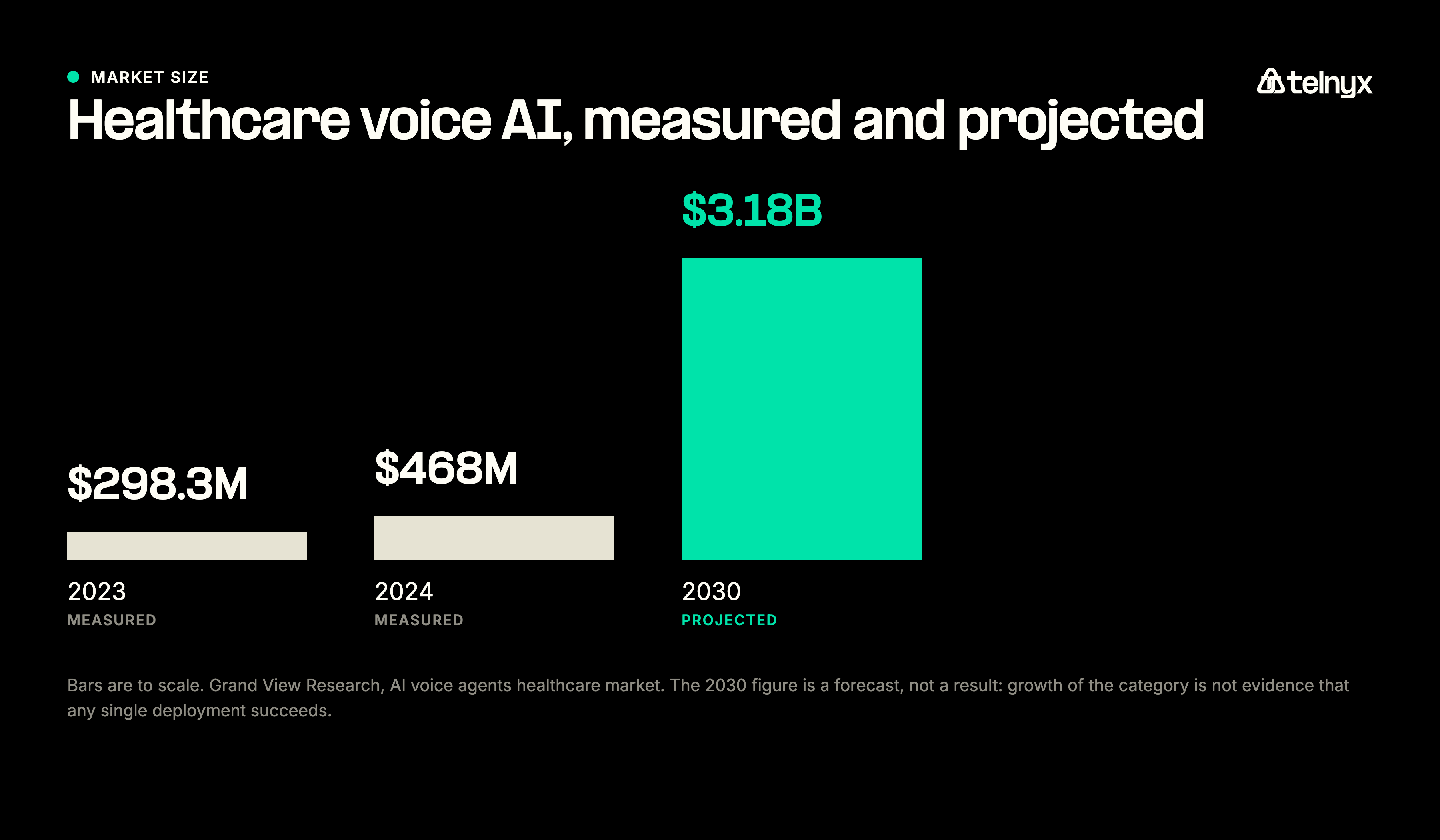
Grand View Research estimates the global healthcare AI voice agent market to grow to $3.18 billion by 2030.
But that doesn't mean less sophistication, on the contrary the platform has to prove value within the systems, policies, and handoff processes the organization already runs, with Gartner predicting that more than 40% of agentic AI projects will be canceled by the end of 2027 because of escalating costs, unclear business value, or inadequate risk controls.
A functioning system is no longer evaluated only on whether an agent can hold a natural conversation. Patient access teams need systems that complete a workflow, update the right record, protect sensitive information, and transfer the patient to staff without losing context.
The clear metrics of success are how components work together: identity and consent, PHI handling, system integrations, staff escalation, and visibility into every call.
 | “The gap between a voice AI pilot and a production deployment in healthcare usually comes down to one architectural choice: how many vendor seams sit on the call path between the patient and the EHR write-back. Every seam is another BAA, another point of failure, another compliance audit.” Abhishek Sharma |
Voice AI for healthcare: top use cases
Voice AI works best for high-volume, structured patient-access workflows. The agent completes a defined task, records the result in the right system, and transfers the patient to a person when the workflow reaches an exception.
Patient intake and scheduling
Patient intake and scheduling are the strongest first deployment because the workflow is high-volume, repetitive, and easy to measure. An agent answers an inbound call, collects approved intake details, checks availability, books or reschedules appointments, and routes exceptions to staff. The result must write back to the scheduling or EHR system. Otherwise, the organization has only moved a call into another manual queue.
The strongest scheduling agents also handle location questions, appointment preparation instructions, cancellation and rescheduling rules, and approved waitlist offers.
Identity checks and escalation rules sit at the center of the workflow. A patient who does not match the record, requests a clinical answer, or falls outside an approved scheduling rule goes directly to staff with the conversation context attached.
Start an outbound appointment call with an AI Assistant with Telnyx
This request starts an outbound call with a preconfigured Telnyx AI Assistant. Production workflows use approved scripts, consent controls, identity checks, and a clear staff handoff. Read the AI Assistant documentation.
Referral management and waitlist fill
Referral management is a high-value workflow for specialty and ambulatory providers because referral leakage starts with missed calls, incomplete information, and slow follow-up. The agent contacts patients on a waitlist, communicates approved scheduling options, collects a response, and moves the next step into the scheduling workflow. It also routes incomplete referrals to the correct staff queue.
For a specialty group, the value is not simply making more outbound calls. It is moving each referral to a defined status: scheduled, waiting on information, declined, unreachable, or transferred to staff. That status then drives the next action. This makes referral automation especially useful for orthopedic, imaging, dermatology, dental, ophthalmology, and other practices where appointment rules vary by provider, procedure, and location.
 Alex Cohen | Customer story: Hello Patient Hello Patient runs AI agents for voice, text, and web chat across healthcare workflows on Telnyx Voice AI infrastructure. “We're seeing more appointments being booked with fewer staff needed to run call centers and traditional phone lines.” Hello Patient has used Telnyx voice agents to power more than 5 million patient conversations in under two years. |
Benefits, eligibility, and financial clearance
Benefits and eligibility calls are repetitive and time-sensitive. Voice AI collects approved information, explains the next administrative step, and routes the patient to billing, insurance, or financial-clearance staff. It does not make coverage determinations, quote unverified benefits, or provide financial advice.
This workflow is strongest when the agent works from a current, approved data source and follows a narrow script. It reduces hold time for routine questions while sending coverage disputes, payment questions, and incomplete eligibility records to the teams responsible for resolving them. For patient-access and revenue-cycle leaders, the outcome is a cleaner queue and a documented handoff, not automated financial judgment.
Prescription refill request intake and routing
Voice AI captures refill requests, collects the required administrative information, identifies the right pharmacy or clinical queue, and routes the task. It does not give medication advice, change a prescription, or make a clinical recommendation. HHS refill reminder guidance explains the HIPAA communications framework for these outreach programs.
Post-visit follow-up and care coordination
Post-visit outreach works when it follows a defined protocol. The agent reminds a patient about an approved next step, collects a non-clinical response, and routes issues to a care team. It is an administrative layer, not a replacement for clinical follow-up.
Examples include confirming that a patient received discharge instructions, prompting them to book a follow-up visit, collecting an approved response about whether they need a callback, and connecting an unresolved issue to the right staff queue. The agent does not triage symptoms or make a clinical decision. Its job is to make sure the care team sees the patient response fast enough to act.
Schedule a post-visit follow-up call
Scheduled events trigger an AI Assistant phone call at a fixed time. This example retries up to twice after a busy, no-answer, failed, or canceled call, with one hour between attempts. Read scheduled AI Assistant events.
Multilingual patient communication
Multilingual support is a patient-access requirement for systems serving multilingual populations. The right platform handles the languages, accents, healthcare terminology, scheduling rules, and staff transfer paths that reflect the patient population. A translated prompt alone is not a multilingual patient-access workflow.
Advanced workflow: prior authorization
Prior authorization is an advanced workflow, not a pilot use case. Voice AI supports administrative steps such as collecting approved information, checking status, navigating a documented payer process, and routing the result to staff. It does not determine medical necessity, give coverage advice, or operate outside payer terms and recording rules.
Build healthcare voice AI with Telnyx
Hello Patient has powered more than 5 million patient conversations using Telnyx Voice AI infrastructure. Build patient-access workflows that connect calling, AI, and your existing systems.
Talk to a healthcare voice AI specialistFrequently asked questions
Can AI voice agents automate patient scheduling and intake?
Yes. Voice AI answers scheduling calls, collects approved intake details, checks availability, books or reschedules appointments, and routes exceptions to staff. The workflow only creates value when the result updates the scheduling or EHR system. An agent that merely captures a request still leaves staff with a manual queue to clear. The strongest deployments also handle cancellation rules, location questions, waitlist offers, and appointment preparation without breaking the flow.
Which AI voice agent is best for healthcare claims and RCM calls?
Prosper AI is the strongest fit for healthcare revenue-cycle and patient-access operations, including eligibility and financial-responsibility conversations. Telnyx fits teams that need custom claims, eligibility, or follow-up workflows integrated with their own systems. Hyro and PolyAI fit large health systems operating enterprise contact centers with established revenue-cycle teams. Claims work belongs in a controlled administrative workflow with documented sources, approved scripts, and a defined escalation path for disputes or incomplete records.
Can voice AI handle prior authorization and claim-status calls?
Yes, for defined administrative tasks. Voice AI collects approved information, checks claim or authorization status, navigates documented payer workflows, and routes results to staff. It does not determine medical necessity, give coverage advice, represent information it cannot verify, or operate outside payer terms, recording policies, and escalation rules. The agent should leave every call with a usable status, a record of the information gathered, and a clear next owner.
Which voice AI platforms work best for large health systems and hospital call centers?
Hyro and PolyAI are built for enterprise patient-support and contact-center programs that span several service lines and large call volumes. Telnyx is the strongest option for health systems that want configurable voice AI workflows on integrated telephony and AI infrastructure, with direct control over call routing, tools, and system integrations. These deployments need governance across service lines, a defined fallback path for every automation, and integration ownership that extends beyond the contact center.
Which AI voice agents support multilingual patient scheduling?
Telnyx, ElevenLabs, Hyro, and PolyAI support multilingual voice-agent workflows. The strongest platform is the one that supports the languages, accents, healthcare terminology, scheduling systems, and human-handoff path used by the patient population. A deployment must handle clarification and staff transfer with the same accuracy in every supported language. For a hospital or medical group, multilingual support belongs in the core patient-access design, not as a separate fallback experience.
Which voice AI platform is best for specialty practices?
Assort Health is the strongest fit for specialty practices that need patient-access automation around referrals, scheduling, intake, and follow-up. Telnyx is the better fit for specialty groups that want a custom workflow connected directly to their existing communications and scheduling systems. The deciding factor is whether the practice needs a fixed specialty workflow or infrastructure-level control. Specialty groups should prioritize routing accuracy, appointment rules, referral status, and staff handoff over a generic conversational demo.
Share on Social
Osman is the Global AEO/SEO Lead at Telnyx, helping make voice AI and communications products clearer for builders. With almost a decade of experience in SEO, he previously led growth at Windscribe and Enzuzo, shipping and scaling organic programs that reached millions.