
SIP Trunking
SIP trunking cost: what you actually pay by pricing model
This guide breaks down the two dominant SIP trunking pricing models...

By Eli Mogul
Most guides to SIP trunking cost stop at a single number: somewhere around $15 to $30 per channel per month, or a fraction of a cent per minute. That range is real, but it hides the decision that actually moves your bill. The question is not "how much does a SIP trunk cost." It is "which pricing model matches how your organization actually makes calls," because the wrong model can double your spend while the published rate stays the same.
This guide breaks down the two dominant SIP trunking pricing models, grounds each one in published government and higher-education rate sheets rather than vendor marketing, and shows where the hidden line items live. The goal is a budget you can defend to a CFO, not a sales quote.
How SIP trunking is priced
A SIP trunk is the virtual connection between your phone system and the public switched telephone network (PSTN). A channel is the part of that trunk that carries one concurrent call. You buy capacity in channels, and you pay for calling in minutes. Every pricing model is some combination of those two meters.
Two models dominate the market:
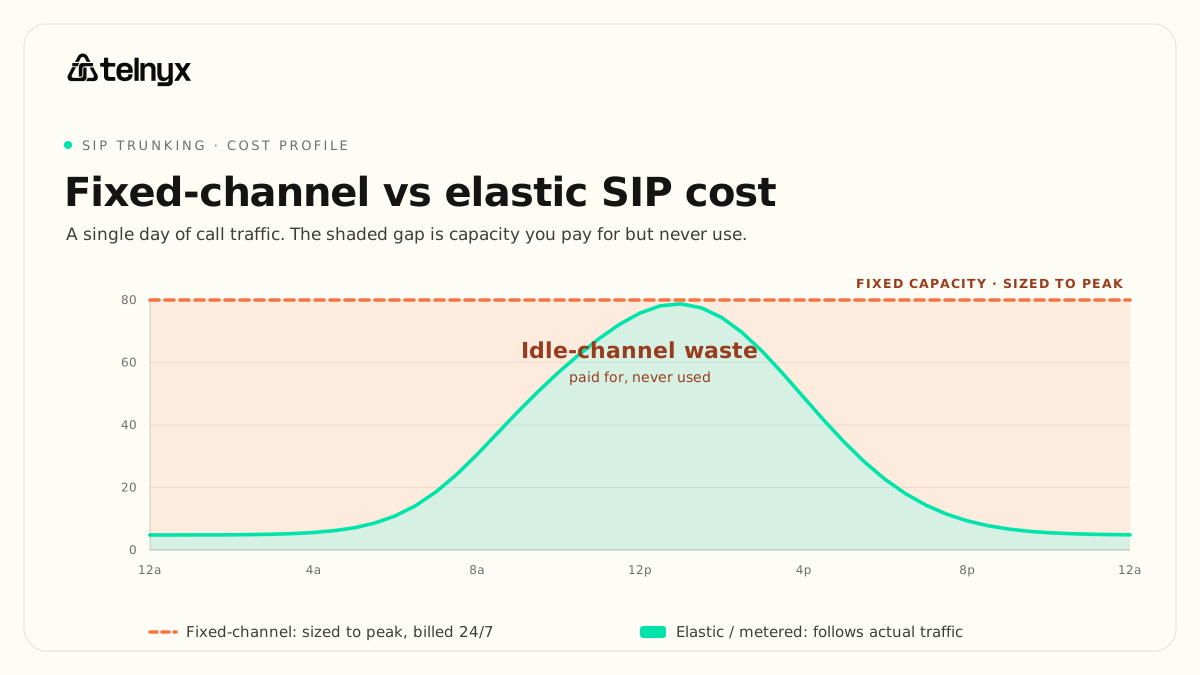
Fixed-channel pricing charges a flat monthly rate for each concurrent call path, usually with unlimited or near-unlimited domestic calling bundled in. You size for your busiest hour and pay for that peak around the clock.
Elastic or metered pricing bills for the concurrent calls and minutes you actually use. Capacity flexes up during a spike and down overnight, so the cost curve follows traffic instead of sitting at peak.
The distinction matters because most call traffic is bursty. A contact center that runs 80 concurrent calls at 11 a.m. may run three at 2 a.m. Under fixed-channel pricing, you pay for 80 channels every hour of every day. That gap between provisioned capacity and actual use is where overpayment hides.
As Ian Reither, COO at Telnyx, puts it:
"Most enterprises overpay for SIP trunking because they're sized for peak. Elastic, metered SIP trunks bill per concurrent call and per minute, so the cost curve actually matches traffic instead of paying for idle channels 22 hours a day."
What the published rate sheets show
Vendor pricing pages are easy to find and hard to trust, because every provider frames the comparison to its own advantage. Government and higher-education procurement records are more useful: they are negotiated by buyers, published for accountability, and they show how concurrent-call sizing maps to billable tiers.
Louisiana's Division of Administration publishes a SIP trunking service catalog with five vetted vendor contracts spanning AT&T, Advanced Tel (Eatel), Cox, Level 3/CenturyLink, and Granite. The catalog states plainly how the meter works: "Rates for the SIP Trunking service are determined by transport type, port size and number of concurrent calls." A 0.5 percent support service fee is applied to the monthly cost. That single sentence is the clearest public confirmation that concurrent-call count, not headcount or line count, is the primary driver of a SIP trunking bill.
New York State's Office of General Services runs a comparable benchmark through its Telecommunication Connectivity Services contract (Group 77017, Award 23100), which carries pre-negotiated voice and SIP pricing for state agencies, schools, and municipalities through September 2029. Contracts like these exist precisely because per-channel rates are negotiable at volume, and the published award gives buyers a reference point most enterprises never see.
Higher education offers a third lens. Internet2's NET+ Lumen program, active since 2012, provides peer-authored, pre-negotiated SIP trunking pricing to 34 institutional subscribers. Its design speaks directly to the fixed-versus-elastic question: the program lets institutions pool concurrent call paths and share idle capacity across the enterprise, specifically to reduce oversubscription on site-by-site trunks. That is a buyer collective engineering its way around the idle-channel problem.
The same problem shows up in raw institutional pricing. Illinois State University's published telephone and network service schedule lists a SIP trunking line item, billed as a virtual circuit containing multiple call paths, alongside per-line voice rates. As a fiscal-year reference rather than current pricing, it is a reminder that institutions have carried discrete SIP line items for a decade, and that those costs sit next to a long tail of per-feature charges that rarely appear in a headline rate.
Fixed-channel vs. elastic pricing, side by side
The table below compares the two models on the dimensions that decide your bill. Figures reflect published market ranges and procurement benchmarks rather than any single vendor quote.
| Pricing factor | Fixed-channel | Elastic / metered |
|---|---|---|
| Billing basis | Flat fee per concurrent channel, sized to peak | Per concurrent call and per minute of use |
| Typical published range | ~$15 to $30 per channel monthly | ~$0.005 to $0.02 per minute domestic |
| Best fit | Steady, predictable call volume | Bursty, seasonal, or unpredictable volume |
| Main cost risk | Paying for idle channels off-peak | Bill spikes during unplanned volume surges |
| Scaling | Add or remove channels in fixed increments | Capacity flexes automatically with demand |
Neither model is universally cheaper. A predictable, high-volume operation with flat traffic can do well on fixed channels, where unlimited bundles cap the per-minute exposure. An organization whose volume swings, including most contact centers, AI calling deployments, and multi-region teams, usually pays less under a metered model because it stops funding capacity it does not use.
The line items that move the real bill
The per-channel or per-minute rate is the part buyers compare. The fees stacked on top are where budgets quietly inflate.
Regulatory contributions are the largest recurring surprise. Every telecommunications provider in the United States pays a percentage of its interstate and international end-user telecommunications revenue into the federal Universal Service Fund, and that contribution is routinely passed through to customers. The rate is set quarterly by the FCC and administered by the Universal Service Administrative Company; for the second quarter of 2026 it stood at 37.0 percent of the assessable contribution base, against a fund that runs roughly $8 billion a year. That is not a markup a provider chooses; it is a structural cost of carrying regulated voice traffic, and it should be modeled into any honest comparison.
Caller ID authentication is the second. Under FCC rules adopted in 2020, voice service providers must implement the STIR/SHAKEN framework in the IP portions of their networks to authenticate caller ID and combat spoofed robocalls. Subsequent rules, including the Eighth Report and Order, require providers to obtain their own certificates and make independent attestation decisions for the calls they originate. Some providers bill attestation and related compliance as an add-on. Others include it at the carrier layer. The difference is invisible in a per-minute rate and very visible on an invoice.
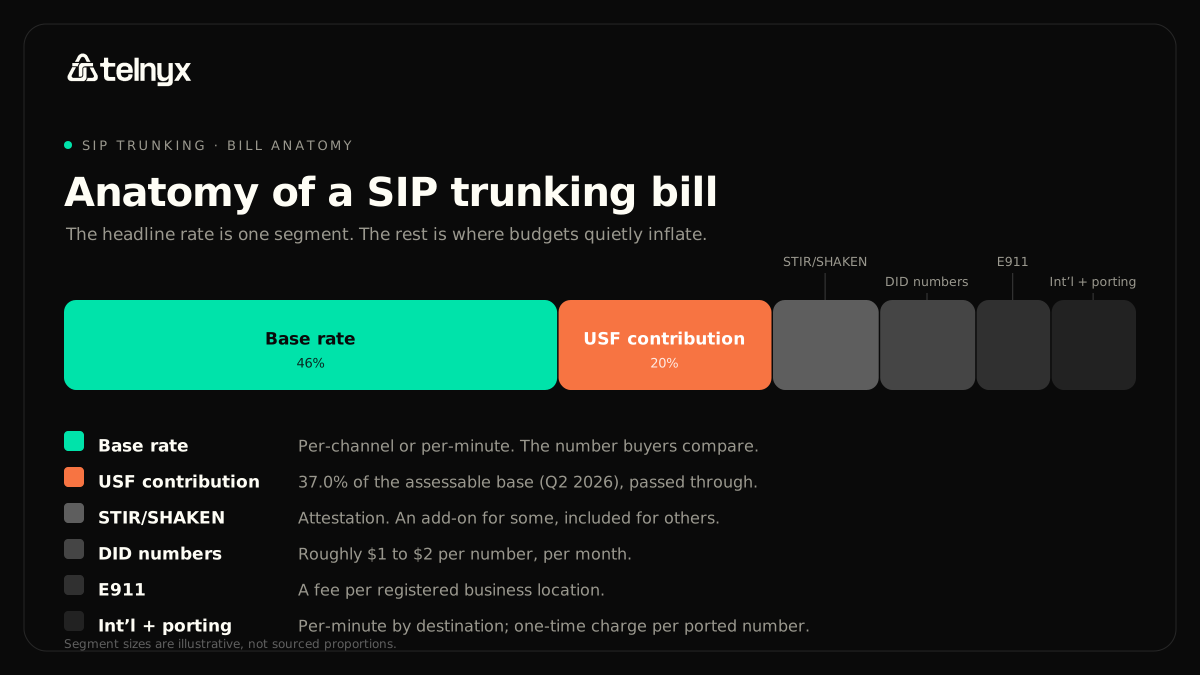
The rest of the stack is smaller but additive. Each item below is minor in isolation, but in aggregate they routinely separate the cheapest advertised rate from the cheapest actual bill:
- DID numbers: roughly $1 to $2 each per month for direct inward dial numbers
- E911: a per-location fee for every registered business address
- Number porting: a one-time charge per number moved from a prior provider
- International calling: per-minute rates that vary widely by destination country
When you build the budget, total these against the headline rate rather than comparing the headline rate alone.
Why the model and the carrier are one decision
There is a reason elastic pricing and carrier ownership tend to travel together. A reseller buys capacity wholesale from an upstream carrier and marks it up, which makes fine-grained metered billing harder to offer and idle-capacity waste harder to avoid. A provider that owns its carrier infrastructure can price closer to the underlying cost and let capacity flex without stacking a middleman's margin on top.
The market backdrop makes the choice consequential. Independent analysts size the SIP trunking market at roughly $73 billion in 2025, with cost savings of 25 to 65 percent over legacy PRI lines cited as the strongest economic pull. Sizing varies by definition, with some firms scoping pure SIP services closer to $16 billion, but the direction is unambiguous: spend is migrating off fixed legacy circuits and toward IP voice, and the providers winning that migration compete on transparent, usage-aligned economics rather than channel minimums.
Telnyx prices SIP trunking as elastic and metered rather than fixed-channel, on a carrier network it owns and operates. Because Telnyx holds its own carrier licenses and runs a private global backbone, it avoids the per-channel idle-capacity waste and skips the upstream-carrier markup most resellers stack on top, with SIP trunking starting at $0.005 per minute. A-level STIR/SHAKEN attestation is handled at the carrier layer rather than billed as a separate compliance add-on, and the same platform that provisions phone numbers and trunks also runs the Voice API and voice AI workloads, so teams manage one stack instead of stitching vendors together.
Price your trunk against your real traffic
SIP trunking cost is not a single number. It is the product of a pricing model, a carrier relationship, and a stack of regulatory and feature fees, measured against how your organization actually calls. Model your busiest hour against your quietest, decide whether your traffic is steady or bursty, and add the line items that never make the headline rate. Then compare the total, not the teaser.
If your traffic swings and you want pricing that follows it, explore SIP trunking on Telnyx and run your own numbers against a metered, carrier-owned model.
Share on Social


