AI scalability is an AI system's ability to grow with more data, compute, and model size without losing performance. How it works and how to scale.

Updated September 2026
AI scalability is a system's ability to handle more data, more users, and larger models without losing performance or running past its budget. It is what separates a model that works in a notebook from one that serves millions of requests in production. A system scales well when doubling the work costs roughly double the resources, and scales badly when the cost curve bends upward faster than the workload.
Quick answer: AI scalability is the ability of an AI system to keep its performance and efficiency as its workload grows, whether the growth is in data, concurrent users, or model size. It has three dimensions, data, compute, and model, and two directions, scaling out across more machines or scaling up to more powerful hardware. Scalable AI is this property of a system; it is not Scale AI, the data-labeling company.
AI scalability breaks down into three resources that grow on their own clocks: the data an AI system trains and runs on, the compute it consumes, and the size of the model itself. Handling all three as demand rises, while keeping performance and cost predictable, is what makes a system scalable. A system can scale on one dimension and stall on another, which is why scalability is a property of the whole stack, not the model alone.
This content was generated with the assistance of AI. Our AI prompt chain workflow is carefully grounded and preferences .gov and .edu citations when available. All content is reviewed by a Telnyx employee to ensure accuracy, relevance, and a high standard of quality.
AI scalability matters because a model that performs well in a demo can fall over under real load, and retrofitting scale later costs far more than designing for it from the start. A prototype answering one request at a time says nothing about how the same model behaves at ten thousand concurrent requests, where memory, latency, and cost all move at once.
The gap is easy to underestimate. A support assistant that replies in a second for one tester can take ten seconds under real traffic, or cost many times more per reply, if nothing behind it was built to scale.
The stakes are economic as much as technical. When a system scales poorly, each new user or each larger model costs more than the last, so the budget grows faster than the usage. Scalable systems keep that relationship close to linear, which is what makes an AI product viable past its first users.
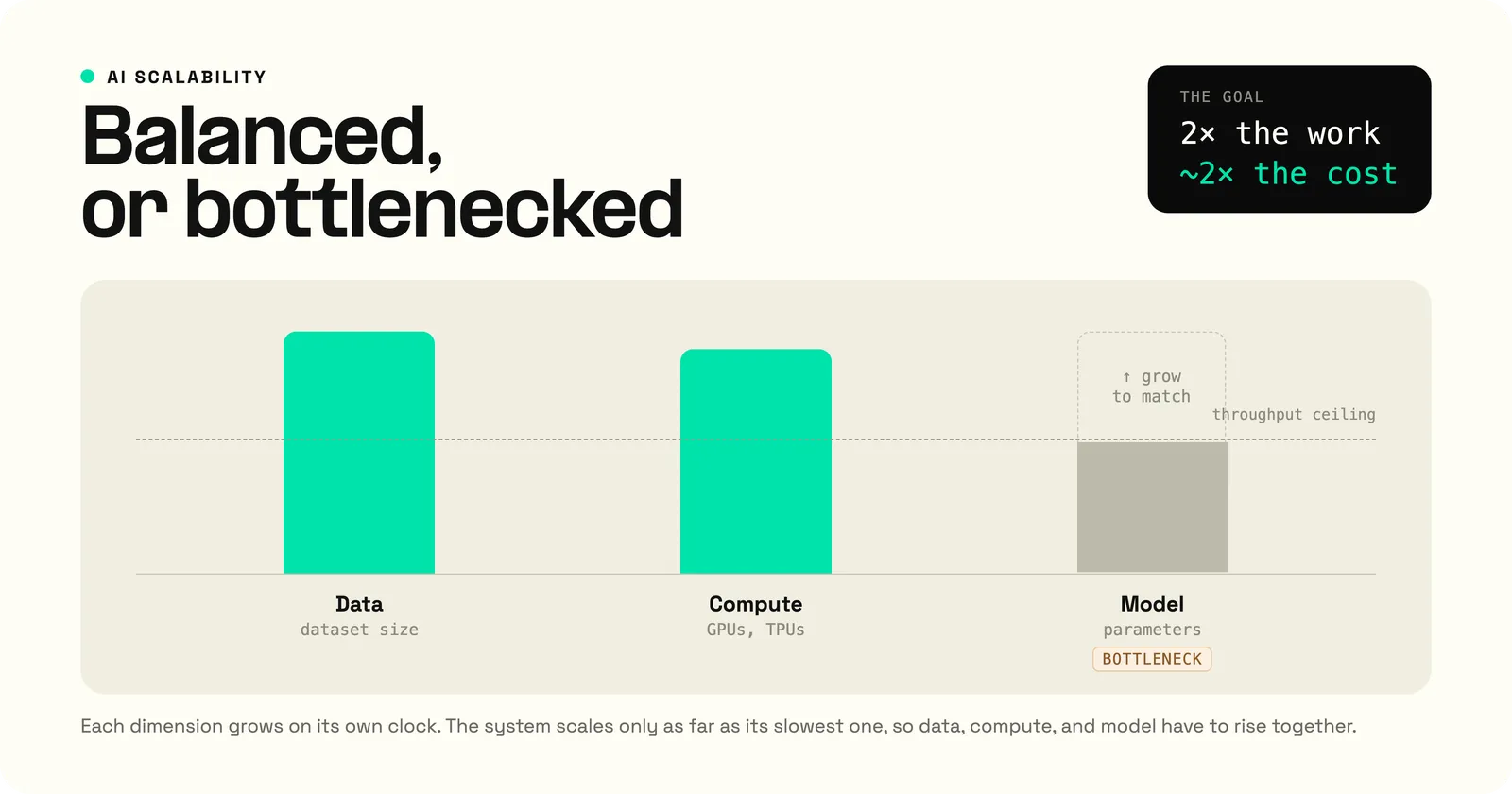
AI scalability works by growing three resources in step so that none of them becomes the bottleneck: data, compute, and model capacity. Data scalability is the ability to ingest and process larger datasets. Compute scalability is the ability to add processing power, usually more GPUs or TPUs, as demand rises. Model scalability is the ability to grow the model's parameters and still train and serve it in acceptable time.
Scaling laws describe how these move together. Kaplan and colleagues showed that a language model's performance improves predictably as model size, dataset size, and compute rise in the right proportion. The follow-on Chinchilla result sharpened the ratio, finding that most large models were undertrained: for a fixed compute budget, smaller models trained on more data often beat larger ones. Scaling is a balancing act, not a matter of making one number bigger.
Concretely, taking a model from one billion to one hundred billion parameters is not just a larger file. It needs proportionally more training data to fill that capacity, more accelerators to train in a workable time, and more memory to serve each request. Move one dimension without the others and the laggard becomes the bottleneck.
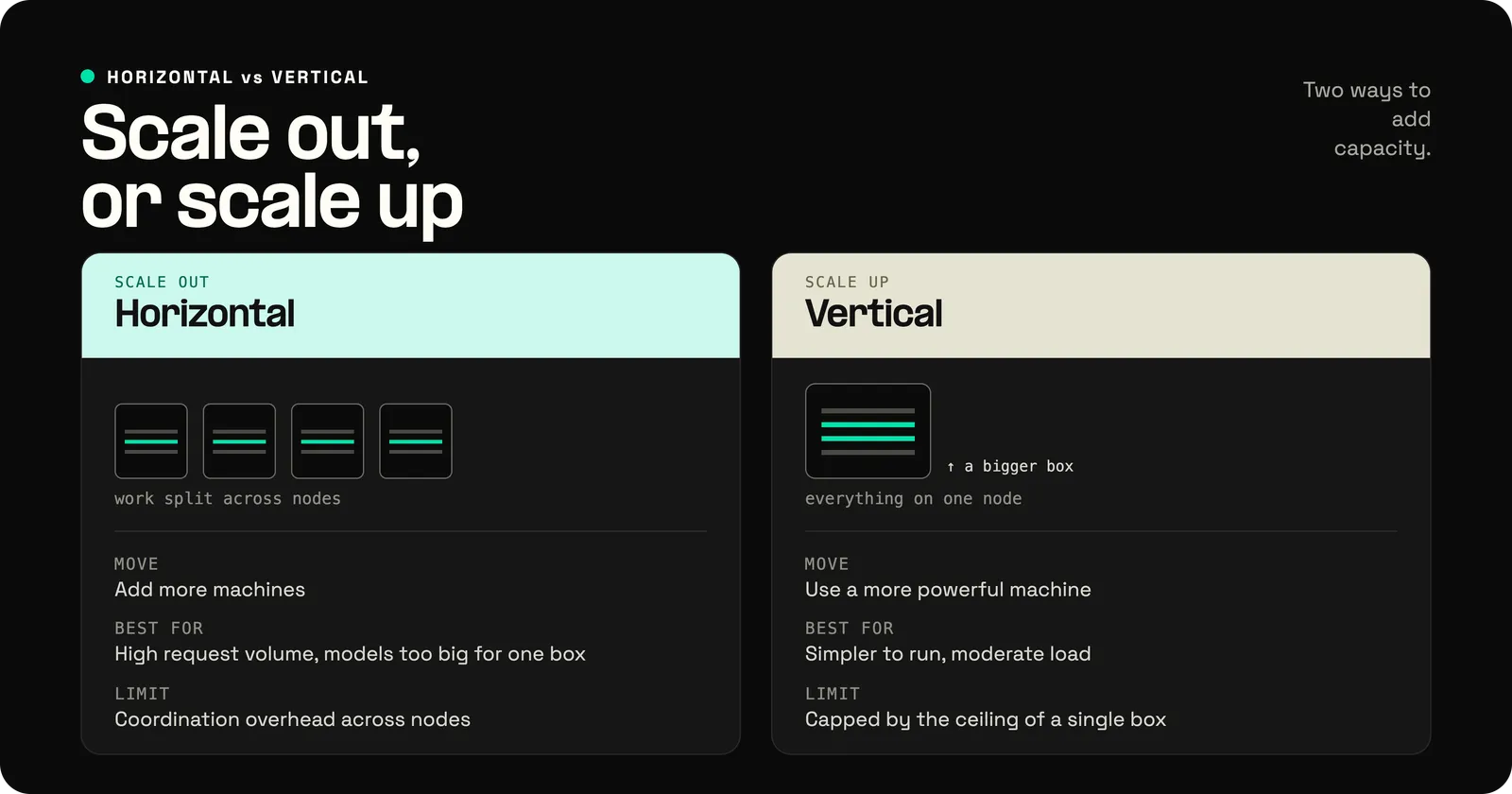
Scaling an AI system happens in one of two directions, and most production systems use both. Horizontal scaling, or scaling out, adds more machines and splits the work across them. Vertical scaling, or scaling up, replaces a machine with a more powerful one, such as a GPU with more memory. Scaling out handles large request volumes and very large models that no single machine can hold; scaling up is simpler to operate and often cheaper until you hit the ceiling of one box.
Training at scale relies on splitting work across many accelerators. Data parallelism copies the model onto many GPUs and TPUs and feeds each a different slice of data; model parallelism splits a single model too large for one device across several. The largest training runs combine the two, so one group of devices holds a split model and many such groups run in parallel. A mixture of experts scales the parameter count without scaling the cost of every forward pass, because each input activates only a few of the model's expert subnetworks.
Serving at scale is its own problem. Inference systems batch requests, cache repeated work, and route traffic across replicas to keep latency stable as concurrency climbs. Running all of this reliably in production is the job of MLOps, the practices that automate training, deployment, and monitoring so a system can grow without a proportional growth in manual work. The compute underneath it, and its cost and cooling, is the domain of AI hardware and the data center that houses it.
Efficiency techniques scale a system by cutting the cost per request instead of adding hardware. Quantization stores a model's weights in lower precision so it fits on smaller or fewer accelerators. Distillation trains a compact model to copy a larger one, keeping most of the quality at a fraction of the serving cost. Both let a system handle more traffic on the same budget, which is often cheaper than scaling out.
The main challenge of scaling AI is cost, because compute, memory, and energy rise with every dimension you grow. Training a frontier large language model can run into millions of dollars in compute alone, and serving it multiplies that across every request, so scaling decisions are budget decisions first.
Data is the second constraint. The Chinchilla result implies that high-quality training data, not just compute, limits how far a model can usefully scale, and the supply of fresh, high-quality text is finite. Latency is the third: as a system spreads across more machines, coordinating them adds overhead, and past a point adding hardware returns less than it costs.
The bill is not only money. Large-scale training and serving draw heavy electricity and generate heat, so the power and cooling available in the data center become limits of their own on how far a system can scale.
Does AI have a scaling problem? Not a single one, but a set of ceilings. Performance still improves with scale, but the gains per dollar shrink, data becomes the binding limit before compute does, and the energy and hardware needed to keep going grow faster than many budgets can. The frontier has shifted from raw scale toward efficiency, getting more from the same compute rather than simply buying more.
Scalability is the ability of a system to handle more work without breaking or slowing down. For AI, that means keeping performance steady as data, users, or model size grow, and doing it without the cost rising faster than the workload.
Common examples include training a single model across hundreds of GPUs, and serving a chatbot to millions of users by adding server replicas. Another approach grows a model's parameter count with a mixture of experts, so cost rises more slowly than capacity. Each adds resources in a way that keeps performance predictable.
Horizontal scaling adds more machines and splits the work across them, which suits high request volumes and very large models. Vertical scaling replaces a machine with a more powerful one, which is simpler to run than adding machines but capped by the limits of a single box. Most large AI systems combine the two.
AI faces several scaling ceilings rather than one problem. Performance still improves as models grow, but the improvement per dollar shrinks, high-quality training data runs short before compute does, and energy and hardware costs climb steeply. This is why recent work focuses on efficiency, such as compute-optimal training and sparse models, over raw size.
No, the two are unrelated. Scalable AI describes an AI system's ability to grow with demand. Scale AI is a company that provides data labeling and model evaluation. The terms share search results because they share words, not meaning.