
Networking
AI cloud: what it is and how to architect one for 2026
An AI cloud is cloud infrastructure designed around the demands of training and serving AI models rather than...

By Eli Mogul
The cloud that enterprises bought a decade ago was built to store files and run web apps. The cloud they need now has to train and serve models, keep regulated data inside national borders, and respond fast enough for a live voice conversation. That is a different machine, and the market has a name for it: the AI cloud.
The shift is not marginal. Worldwide spending on AI is forecast to reach $2.52 trillion in 2026, a 44% increase year over year, according to Gartner, with AI infrastructure adding $401 billion in spending as providers build out the foundations. Most of that growth traces back to infrastructure, particularly AI-optimized servers projected to rise 49%. Demand is also broadening past the early adopters. The Federal Reserve's April 2026 analysis of Census Bureau data found that about 18% of US firms had adopted AI by the end of 2025, with adoption climbing fastest in the finance and professional-services sectors.
This guide defines the AI cloud for the people who have to build and run one: CTOs, VP-level engineering leaders, ML infrastructure leads, and the architects who answer to them. It covers what separates an AI cloud from a general-purpose cloud, the four properties that matter in 2026, and the architectural choice that decides whether your unit economics and latency work in your favor or against you.
What is an AI cloud?
An AI cloud is cloud infrastructure designed around the demands of training and serving AI models rather than general-purpose compute. The distinction is not branding. Traditional cloud workloads are bursty and stateless, and a few hundred milliseconds of variability rarely matters. AI workloads, especially inference for real-time applications, are sustained, GPU-bound, and latency-sensitive in ways that expose every seam in the underlying network.
Three layers define the stack. The compute layer runs the GPUs and accelerators that execute training and inference. The data layer handles the storage, vectorization, and retrieval pipelines that feed models their context. The network layer carries data between the user, the model, and the rest of the application, and for real-time AI it is frequently the largest single contributor to end-to-end latency, not the model itself.
Most discussions of the AI cloud stop at the first two layers because that is where hyperscaler product pages stop. The network layer is where the harder problems live, and where the architecture you choose has the most lasting consequences.
Why the AI cloud is its own category in 2026
Four forces have pushed the AI cloud from a marketing label into a distinct architectural category. Each one reshapes a decision a buyer used to make on autopilot.
Sovereignty has become a procurement requirement. Worldwide sovereign cloud infrastructure-as-a-service spending is forecast to total $80 billion in 2026, a 35.6% increase, with European spending rising 83% to $12.6 billion, per Gartner figures reported by Data Center Dynamics. The drivers are geopolitical: organizations outside the US and China want data and AI workloads to stay inside their own borders. For an AI cloud, that means region-aware deployment is no longer a premium feature. It is a baseline expectation and increasingly a legal one. Telnyx offers EU data residency as a structural property of its network-anchored architecture, with compute and data remaining inside the EEA for EU-region deployments.
Security is now a federal-policy conversation. In December 2025, a joint subcommittee of the US House Committee on Homeland Security held a hearing on the quantum, AI, and cloud landscape, with testimony from Anthropic, Google, Quantum Xchange, and Seven Hill Ventures. The hearing placed AI cloud security squarely inside critical-infrastructure policy, a signal that the controls around AI compute are being treated as a national concern rather than a vendor checkbox.
The telecom network is becoming part of the stack. The GSMA's framework on AI products and services in the AI-centric telco describes operators moving past internal efficiency to offer GPU-as-a-service, sector-specific models, and AI marketplaces built on their own infrastructure, data, and APIs. The implication for buyers is that the network underneath an AI workload is no longer a neutral pipe. It can be a source of differentiation or a tax.
Power and cost are now design constraints. US data centers consumed 183 terawatt-hours of electricity in 2024, more than 4% of the country's total, according to Pew Research Center's analysis of International Energy Agency data, with AI servers drawing several times the power of standard systems. The IEA's own analysis puts global data-center electricity use at roughly 415 terawatt-hours in 2024 and growing about 12% a year, accelerated by the high power density of AI servers. The economics compound: analysis from Brookings notes that large AI developers have driven power-purchase-agreement prices up sharply as they compete for clean energy. Compute is no longer something an architect can treat as someone else's problem to budget for. Where it sits, what it costs to run, and how efficiently it serves each request all flow back into the design.
These four forces share a common thread: they all make the network layer (where data travels between user, model, and regulator) a first-class architectural concern, not an afterthought. The deployment model you choose determines whether that layer works for you or against you.
AI cloud deployment models compared
Not every AI cloud looks alike. The deployment model determines where data lives, who controls the GPUs, and how predictable the bill is. The table below maps the four patterns enterprises actually use in 2026.
| Deployment model | Data location | GPU control | Best fit |
|---|---|---|---|
| Public AI cloud | Hyperscaler regions | Rented, shared | Bursty training, experimentation |
| Private AI cloud | Owned or dedicated facilities | Fully controlled | Regulated data, predictable workloads |
| Sovereign AI cloud | Inside a specific jurisdiction | Region-pinned | Government, regulated industries |
| Network-anchored AI cloud | Carrier PoPs near the user | Owned, co-located | Real-time voice and inference |
The first three are familiar. The fourth is where the network layer stops being an afterthought, and it is worth understanding why.
Export controls shape where GPUs can sit
For any AI cloud that spans borders, US export controls are now a design input, not just a legal footnote. They affect which GPUs can be deployed in which countries, and who can be allowed to access them. The regime is also unsettled, so the safest planning assumption is that specifics will keep moving.
A short history clarifies the current state. The Biden administration's Framework for Artificial Intelligence Diffusion, published in January 2025, would have imposed a tiered, country-by-country licensing structure on advanced AI chips and certain model weights. It never took effect. The Bureau of Industry and Security (BIS) rescinded it on May 13, 2025, two days before its compliance date, eliminating the tiered model. A replacement final rule took effect January 15, 2026, shifting certain advanced chips destined for China and Macau from presumption of denial to case-by-case review, subject to strict supply, security, and testing conditions. Congress is separately weighing legislation, including the proposed GAIN AI Act, that could tighten controls again. As of mid-2026, this is a live policy area rather than a settled one.
Underneath the churn, a few obligations have stayed constant and matter most for AI cloud architects:
The Export Administration Regulations continue to control advanced computing chips under classifications such as ECCN 3A090 and 4A090, regardless of which licensing posture is in effect. Entity List restrictions continue to bar dealings with specific named organizations and, in some cases, their affiliates. And the catch-all controls in Part 744 reach infrastructure-as-a-service: an operator can face license requirements when there is "knowledge" that compute will be used to train models for restricted end users or parties headquartered in certain countries. That last point is why due diligence on who actually accesses your GPUs, not just where they are physically located, is now part of running a cross-border AI cloud.
The practical implication is that physical region and access control are compliance surfaces, not just performance and latency choices. Knowing which jurisdiction a GPU sits in, and being able to demonstrate who can reach it, is the same architectural property that drives sovereign AI versus data residency decisions. None of this is legal advice, and the rules change quickly. Treat it as orientation and confirm your specific obligations with export-control counsel.
The network-anchored AI cloud
Most AI clouds inherit a hidden cost. The GPUs sit in a cloud region, the application sits somewhere else, and inference travels the public internet between them. Every hop adds DNS resolution, routing delays, and queueing. For batch training, that overhead is invisible. For a live voice agent working inside a sub-second latency budget, it is often the difference between a natural conversation and an awkward one.
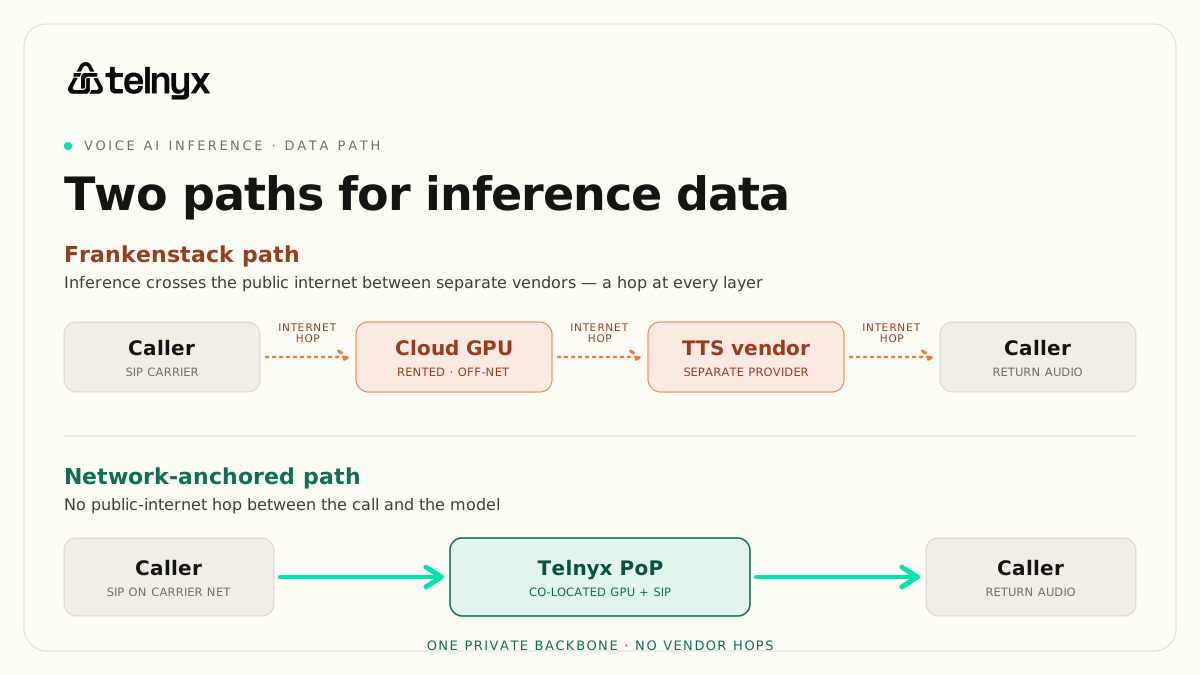
Telnyx took the opposite path. We own our GPUs, built Telnyx Inference on top of them, and co-located that compute directly alongside our global points of presence. The same private backbone that carries a telephone call also reaches the inference hardware, so there is no public-internet hop between the call and the model.
"We started at Layer 0. Carrier licenses, private backbone, GPUs at the edge. Edge inference only works when the GPU lives next to the network."
- Ian Reither, COO, Telnyx
That architecture is not theoretical. Telnyx operates colocated GPU infrastructure across global points of presence, connected by a private carrier backbone, and the inference GPU network runs a fleet of more than 4,000 GPUs. Because the network and the compute are owned end to end, both latency and per-token cost are controlled in-house rather than bought from a chain of vendors, each adding a margin. The same redundancy that keeps voice traffic online also protects AI workloads. When a major hyperscaler outage took down large parts of the internet in late 2025, Telnyx multi-cloud infrastructure rerouted across independent nodes and alternate providers without significant customer disruption.
What this means for your architecture
The 2026 AI cloud is defined less by raw compute and more by where that compute sits relative to your data, your users, and your regulators. A few principles follow from that.
Treat the network as a first-class design decision, not plumbing. PwC's 2026 Digital Trends in Operations survey of 767 US operations leaders found that 91% believe AI and cloud technologies let organizations leapfrog more mature competitors, yet only 27% have fully embedded an AI strategy across business units. Integration complexity, not model quality, topped their list of reasons technology investments fall short. The teams that win are the ones that reduce the number of seams between components rather than adding them.
Make region-awareness structural. If data residency depends on a premium add-on rather than the physical location of your hardware, sovereignty becomes a recurring negotiation instead of a property of the system. The cleaner approach is an architecture where compute already lives in the regions your users and regulators care about.
Own the layers that decide unit economics. Inference is an operating expense that scales with your success, which means a per-request margin you do not control compounds against you as you grow. The teams that stay solvent are the ones that control the stack their inference runs on, from the GPU to the network underneath it.
For a deeper architectural walkthrough, see our private cloud AI infrastructure guide, which covers open-weight models, vLLM, and Kubernetes orchestration for regulated teams. For the economics in detail, our breakdown of AI training vs. inference explains why owning the inference stack decides your cost per minute.
Build your AI cloud on infrastructure you control
The AI cloud is not a hyperscaler product you rent and hope scales. It is a stack where the compute, the network, and the inference engine work as one system, and where you control the latency and the unit economics at the same time. Telnyx built that stack from Layer 0 up: owned GPUs colocated with a global carrier network, region-aware by design, and priced because we own it rather than rent it. Talk to our team to see how a network-anchored AI cloud fits what you are building.
Share on Social