
Inference
AI inference hardware: how to match chips to your workload
AI inference hardware spans GPUs, TPUs, ASICs, NPUs, and FPGAs, each optimized for a different workload type and deployment scenario.

By Eli Mogul
What is AI inference hardware
AI inference hardware is the physical computing infrastructure that runs a trained AI model on new data to produce a prediction, generation, or classification. It executes the forward pass of a model in production, turning an input like a prompt or an audio clip into an output like a completion or a transcript. This is distinct from training hardware, which runs the far more expensive forward and backward passes that teach a model in the first place.
Inference runs on several classes of silicon. GPUs handle most production workloads thanks to their parallel cores and mature software. TPUs are Google's custom accelerators tuned for tensor math. ASICs like AWS Inferentia2 are fixed-function chips built for one job. NPUs bring inference to edge and on-device use, and FPGAs offer reconfigurable logic for specialized acceleration. Inference has different requirements than training because it is latency-sensitive, often runs at lower precision, and must stay up under real production traffic. Our guide to hardware for ML covers the CPU, GPU, and TPU foundations if you want the primer first.
AI inference vs training hardware requirements
Training and inference stress hardware in opposite directions. Training is throughput-bound. It runs large batches at high precision such as FP16, BF16, or FP32, often for weeks across thousands of interconnected accelerators, and it tolerates high latency because no user is waiting. Inference is latency-bound. It runs small batches or single requests, frequently at reduced precision such as FP8 or INT8, and it has to answer in milliseconds under strict uptime requirements.
Precision is the clearest divide. Training needs numerical headroom to converge, so it leans on wider formats. Inference can quantize down to FP8 or INT8 with minimal quality loss, which cuts memory use and raises throughput. Reliability is the other divide. A training run can checkpoint and restart after a failure, but a production inference endpoint that drops requests loses revenue and trust. Many modern chips such as the H100 and H200 handle both jobs, but the optimization choices differ. There is also a workload split worth naming early: online inference processes one request at a time for time-sensitive uses like chat and voice, while batch inference processes large groups where immediate responses are not required.
"In the agent era, latency, reliability, and compliance aren't nice-to-haves, they are the product."
Ian Reither, COO at Telnyx
Types of AI inference hardware
Each hardware class trades generality for efficiency in a different way. Choosing well starts with knowing what each is good at and where it falls short.
GPUs for inference
GPUs are the default for production inference. Thousands of parallel cores handle the matrix multiplication at the heart of neural networks, and a deep software ecosystem of CUDA, TensorRT-LLM, and vLLM makes them straightforward to deploy. NVIDIA leads with the H100 and H200 and the newer Blackwell generation. AMD competes with the MI300X, which pairs 192 GB of HBM3 with an open ROCm stack. The main limitation is cost and power draw at the high end.
TPUs for inference
Google's Tensor Processing Units are ASICs purpose-built for tensor math and tightly integrated with TensorFlow and JAX. The latest generation, TPU v7 "Ironwood", was designed for the age of inference and delivers 4.6 petaFLOPS of FP8 compute with 192 GB of HBM3e per chip. The catch is availability. TPUs are cloud-only through Google Cloud, so you cannot buy them or run them on-prem.
ASICs and custom silicon
Fixed-function accelerators strip away everything a chip does not need for inference. AWS Inferentia2 uses NeuronCore-v2 engines and a configurable FP8 type to deliver cost-efficient inference, though it is tied to AWS and the Neuron SDK. Intel Gaudi 3 offers 128 GB of HBM2e and an open software stack that competes on cost-efficiency against NVIDIA. At the extreme end, Cerebras builds wafer-scale systems that keep an entire model in on-chip SRAM for ultra-large-model inference, a niche but notable option for specific workloads.
NPUs and edge accelerators
Neural Processing Units bring inference to phones, cameras, vehicles, and other devices where power and space are tight. They prioritize low wattage and on-device privacy over raw throughput. When a model has to run close to where data is generated, this is the class you reach for. Our explainer on edge inference covers the tradeoffs in depth.
FPGAs for custom acceleration
Field-Programmable Gate Arrays are reconfigurable chips whose logic can be rewired for a specific model or pipeline. That flexibility makes them a fit for custom inference paths, low-latency signal processing, and networking or telecom acceleration where a fixed-function ASIC would be too rigid and a GPU too general. The tradeoff is effort. FPGAs demand specialized hardware-description skills and longer development cycles than the software-driven GPU workflow, so they stay a specialist choice rather than a default.
Matching workloads to hardware
This is the section that matters most. Buying a GPU by brand recognition wastes money. Profiling your workload and matching it to the spec that actually bottlenecks it does not. Five common inference workloads map to five different priorities.
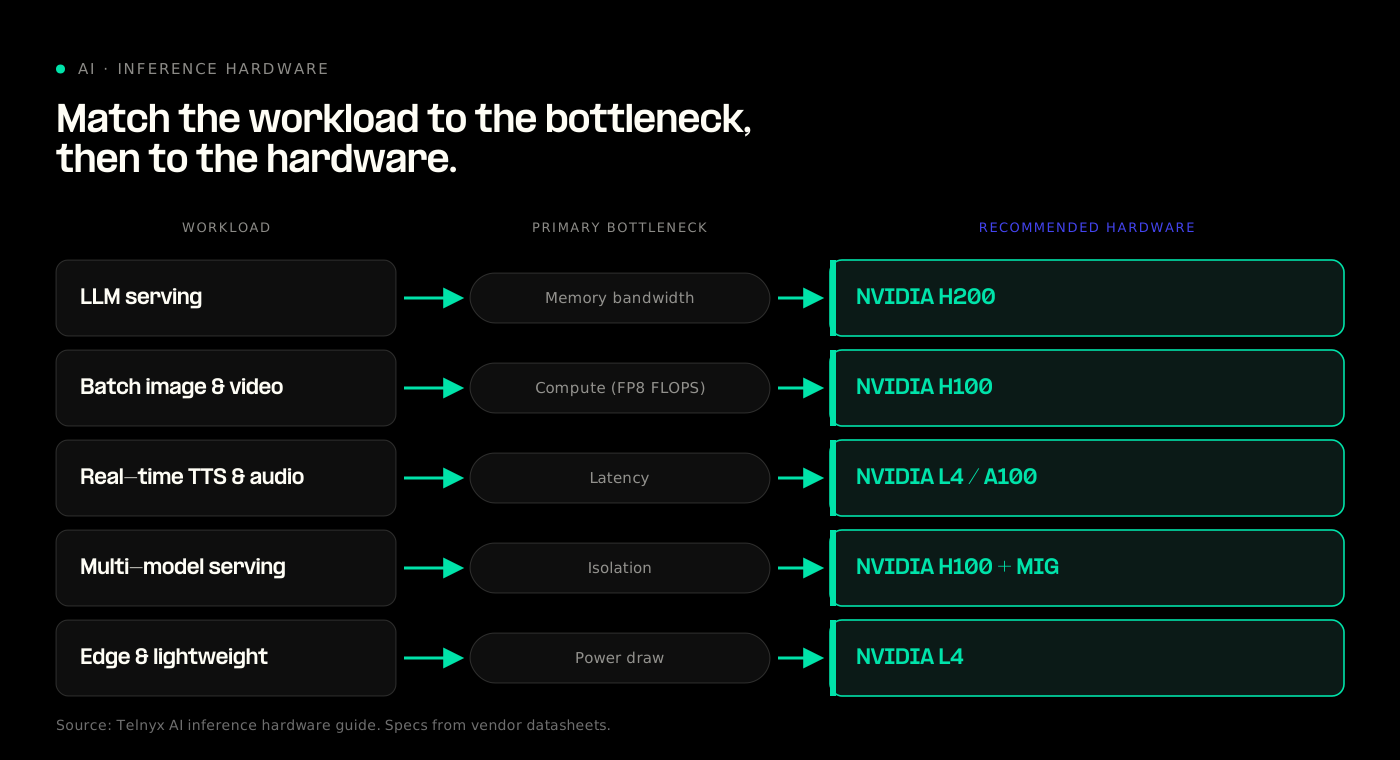
LLM serving is memory-bandwidth-bound. Generating each token requires reading the full model weights and the growing key-value cache from memory, so bandwidth and VRAM capacity decide throughput. This is why the H200 pulls ahead of the H100 despite identical compute, and NVIDIA's own TensorRT-LLM benchmarks show the H200 delivering up to 1.9x the inference performance of the H100 on Llama 2 70B, driven entirely by its faster HBM3e memory.
Batch image and video generation is compute-bound. These models saturate the tensor cores rather than the memory bus, so FP8 and FP16 FLOPS matter more than bandwidth. Real-time text-to-speech and audio are latency-bound. Here the goal is the lowest possible per-request response time, which often makes a smaller, cheaper card the smarter buy than a flagship. This is the profile behind conversational Voice AI, where a slow response breaks the interaction. Multi-model serving is isolation-bound, where the ability to partition a GPU cleanly, for example with NVIDIA MIG, lets you host several models without contention. Edge and lightweight inference is power-bound, where a low-wattage card such as the NVIDIA L4 at 72W wins on efficiency.
Accelerator specs that matter for inference
Five numbers do most of the work when you compare inference accelerators: memory capacity, memory bandwidth, low-precision compute, interconnect, and power. Memory capacity sets the largest model and batch you can hold. Bandwidth sets token throughput for LLM serving. FP8 and INT8 compute set throughput for compute-bound work. Power draw sets your operating cost and cooling load.
The table below compares leading inference accelerators on the figures that decide workload fit. All specs are drawn from vendor datasheets and product briefs.
| Accelerator | Memory | Memory bandwidth | FP8 compute (dense) | Typical power (TDP) |
|---|---|---|---|---|
| NVIDIA H100 SXM | 80 GB HBM3 | 3.35 TB/s | 1,979 TFLOPS | 700 W |
| NVIDIA H200 SXM | 141 GB HBM3e | 4.8 TB/s | 1,979 TFLOPS | 700 W |
| NVIDIA L4 | 24 GB GDDR6 | 300 GB/s | 242 TFLOPS* | 72 W |
| AMD MI300X | 192 GB HBM3 | 5.3 TB/s | 2,615 TFLOPS | 750 W |
| Google TPU v7 (Ironwood) | 192 GB HBM3e | 7.4 TB/s | 4,614 TFLOPS | 600 W (reported) |
| Intel Gaudi 3 | 128 GB HBM2e | 3.7 TB/s | 1,800 TFLOPS** | up to 900 W |
Figures are peak dense throughput except where noted, and reporting conventions vary by vendor, so treat cross-row FP8 comparisons as directional. *The L4 delivers 242 dense FP8 TFLOPS, or 485 TFLOPS with sparsity enabled. **Intel reports 1,800 TFLOPS as a combined FP8 and BF16 figure rather than a standalone dense FP8 number. The H100 and H200 share the same Hopper die and compute, so the H200's advantage on LLM serving comes from memory, not FLOPS.
Beyond specs: infrastructure considerations
Specs are necessary but not sufficient. The factors that most often derail a production deployment sit around the chip, not on it.
Supply stability comes first. Flagship accelerators carry long lead times, and a plan that assumes you can add capacity next week rarely survives contact with the market. Data sovereignty comes next. Regulated workloads in the EU, APAC, and LATAM may require that data and inference stay within a region, which turns hardware location into a compliance decision rather than a performance one. The software stack is the third factor. Standing up CUDA, cuDNN, TensorRT-LLM, or vLLM and keeping them tuned is real ongoing engineering work. Node topology is the fourth. NVLink and InfiniBand bandwidth between accelerators determine how well large models shard across devices. Elastic scaling is the last. Traffic that spikes and falls needs capacity that follows it, not fixed hardware sized for the peak.
This is where the case for managed infrastructure lands. Telnyx addresses the latency and sovereignty problems at the architectural level by colocating owned GPU infrastructure directly adjacent to its global telephony points of presence. Physical distance is a hard constraint on real-time voice AI, and colocation shrinks the distance data has to travel between the network and the model. Regional deployments keep data in-region for sovereignty, and running open models next to voice infrastructure means audio can enter, get processed, and return without leaving the platform.
Optimization techniques that change hardware requirements
Software can move the hardware goalposts. Before you size a cluster, know that a handful of techniques can make cheaper silicon viable.
Quantization is the biggest lever. Moving from FP16 to FP8 roughly halves the memory a model needs with minimal quality loss, which can let a model fit on a smaller card or free room for a larger batch. Continuous batching, introduced with vLLM's PagedAttention, packs new requests into a running batch instead of waiting for the previous one to finish, and the original research showed multiple-fold throughput gains over static batching on the same hardware. Speculative decoding uses a small draft model to propose tokens that the target model verifies in one pass, which NVIDIA's TensorRT-LLM benchmarks show can lift LLM throughput by roughly 2x to 3x without changing output quality. Framework choice matters too, since TensorRT-LLM and vLLM make different tradeoffs between raw speed and flexibility. Applied together, these techniques change the buy-versus-rent math by lowering the hardware floor for a given workload.
Buying hardware vs managed inference
The decision comes down to total cost of ownership against operational fit. Buying hardware means paying upfront for the accelerators, then absorbing the ongoing costs of power, cooling, data center space, software stack maintenance, and the engineering time to scale it all. Managed inference replaces that with per-token or per-hour pricing and no procurement cycle.
Buying makes sense in three cases: consistent high-volume workloads that keep expensive hardware busy enough to justify the capital, data sovereignty rules that mandate on-prem or specific regions you control, and specialized models that need custom silicon. Managed inference makes sense for variable traffic that would strand fixed capacity, for speed to market when you cannot wait on lead times, and for avoiding hardware lock-in while the accelerator market moves this fast.
Telnyx sits on the managed side with an architecture most managed providers cannot match. Where a generic inference API rents capacity from a third-party cloud, Telnyx Inference runs on owned GPU infrastructure colocated with a carrier-grade telephony network that spans 100+ countries and 30+ licensed markets. The API is OpenAI-compatible, so there is no CUDA setup or software stack to stand up. An open-source LLM library lets you run and swap leading open models with no proprietary price tag and no vendor lock-in. The bigger differentiator is scope: the same platform gives you programmable access to the PSTN, so a voice application can provision numbers, run inference, and connect calls in one place, rather than stitching a telephony vendor to a separate inference vendor.
Skip the hardware procurement cycle. Run inference on Telnyx-owned GPU infrastructure with an OpenAI-compatible API. Explore Telnyx Inference
Try it yourself: run inference on Telnyx
Managed inference removes the hardware decision entirely. There is no GPU to procure and no CUDA to configure, just one API call. Because the endpoint is OpenAI-compatible, you can point the standard OpenAI client at Telnyx and run a chat completion in a few lines of Python. Here is what that looks like in practice:
Swap in any model from the library, and the hardware underneath is already provisioned and tuned. See the Inference docs for the full API reference and current model list.
Choosing the right AI inference hardware
The framework holds across every team. Profile your workload first to find its real bottleneck, whether that is memory bandwidth, compute, latency, isolation, or power. Match that bottleneck to the spec that governs it rather than to the brand on the box. Then evaluate the infrastructure factors around the chip, and only then decide whether to own the hardware or rent it as a managed service.
The right move depends on who you are. Technical leads should benchmark on their own workloads before committing capital. Procurement teams should compare total cost of ownership, not just the sticker price per GPU-hour. Startup teams should start with an API and migrate to dedicated capacity only when traffic justifies it. In every case, the winning approach is to let the workload lead the decision.
Start running inference in minutes, not weeks. Explore Telnyx Inference
Frequently asked questions
What is the best hardware for AI inference? There is no single best option. The right choice depends on your workload. LLM serving is memory-bandwidth-bound, which favors the NVIDIA H100 and H200. Batch image generation is compute-bound, where FP8 FLOPS lead. Real-time text-to-speech is latency-bound, where a smaller card like the L4 is often more cost-efficient. Edge inference is power-bound, where the L4 at 72W excels. Profile your workload first, then match it to specs.
Is AI inference better on CPU or GPU? GPU is better for most production inference. GPUs have thousands of parallel cores that handle matrix multiplication far more efficiently than CPUs. CPUs remain viable for small models, edge deployments, and cases where a dedicated GPU is not justified, and they handle general-purpose work alongside inference.
What chips are used for AI inference? Inference uses GPUs (NVIDIA H100, H200, Blackwell; AMD MI300X), TPUs (Google TPU v7 Ironwood), ASICs (AWS Inferentia2, Intel Gaudi), NPUs for edge devices, and FPGAs for custom acceleration. GPUs dominate production because of their parallel architecture and mature software ecosystem of CUDA, TensorRT-LLM, and vLLM.
What is the difference between AI training and inference hardware? Training hardware prioritizes throughput and high-precision compute such as FP16, BF16, and FP32 with large batches, running for weeks across many accelerators. Inference hardware prioritizes latency and lower-precision compute such as FP8 and INT8 with small batches, plus production-grade reliability and scaling. Many modern chips handle both, but the optimization choices differ.
How do software optimizations change hardware needs? Quantization to FP8 roughly halves memory use, continuous batching raises throughput several times over on the same hardware, and speculative decoding lifts LLM throughput by roughly 2x to 3x. Together they lower the hardware floor for a given workload, which can make cheaper accelerators viable and shift the buy-versus-rent decision.
Share on Social