
Voice
The 8 best voice AI orchestration tools for live phone calls (2026)
The orchestration layer decides whether a voice agent survives production. We compare eight tools, from open-source frameworks to full-stack platforms, on what each owns, how it handles latency, and what it actually costs.

By Osman Husain
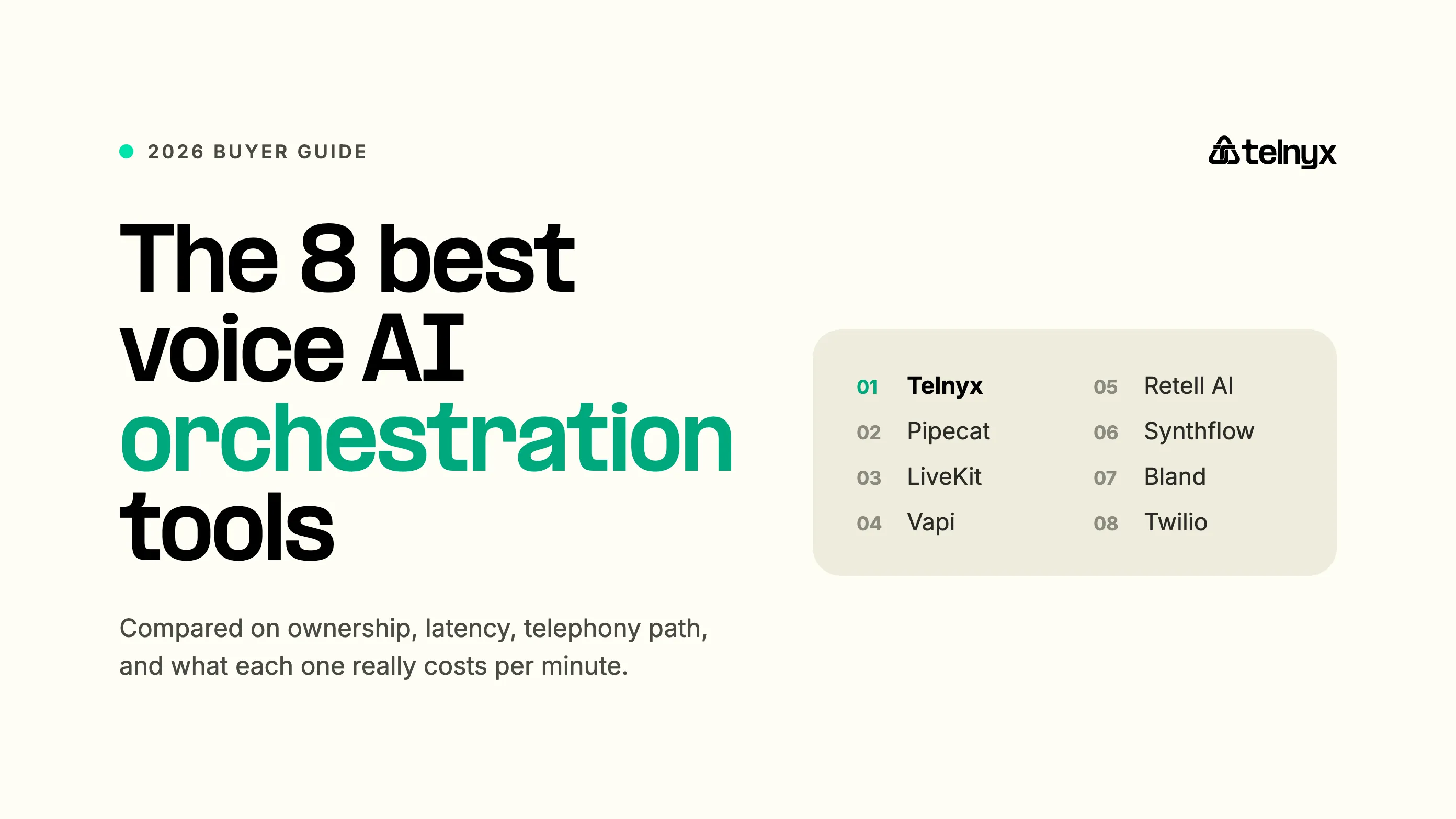
Quick answer: Voice AI orchestration platforms coordinate the speech-to-text, LLM, and text-to-speech loop that lets an AI voice agent hold a real phone conversation. The strongest options range from open-source frameworks to managed platforms, but have one thing in common: they're able to span the end-to-end voice AI stack:
- Telnyx: best for running agents, models, and telephony on one owned network
- Pipecat: best open-source framework for custom pipelines
- LiveKit Agents: best for WebRTC-native and multimodal apps
- Vapi: best for developer control with bring-your-own models
- Retell AI: best for no-code contact center agents
- Synthflow: best for enterprise no-code with agency white-labeling
- Bland: best for self-hosted model stacks in regulated industries
- Twilio ConversationRelay: best for teams already built on Twilio
A voice agent that works in a demo and one that survives a production environment with real humans on the line are two different systems. The orchestration layer is the crucial factor between a pilot and enterprise deployment: moving audio between speech recognition, a language model, and speech synthesis fast enough that the caller never complains.
This guide compares the 8 best orchestration tools for AI voice agents in 2026, covering what each offers, how it handles latency, and its cost. It covers open-source frameworks, managed platforms, self-hosted stacks, and carrier-integrated options for a well-rounded decision.
What is voice AI orchestration?
Voice AI orchestration coordinates speech-to-text, language models, and text-to-speech in real time, enabling an AI voice agent to listen, think, and respond during a live interaction. The pipeline itself is simple: audio comes in, STT transcribes it, an LLM decides what to say, TTS speaks it. Orchestration is what keeps things moving.
That work includes turn detection (knowing when the caller has finished speaking), interruption handling (stopping the agent mid-sentence when the caller barges in), conversation state, tool and API calls, fallback handling when a pipeline stage fails, and bridging the whole loop inside a phone network. General AI orchestration patterns apply here, but voice adds a constraint text never has: the answer must start in well under a second.
Frameworks like Pipecat and LiveKit Agents give you the loop as open-source code. Platforms like Vapi, Retell, and Synthflow run the loop for you. Telnyx and Twilio attach the loop to a carrier network, and Bland sells the loop with the models inside it.
Quick note: This resource specifically compares the top tools for orchestration alone. Our roundup of the best voice AI agents is the resource to read when you want to compare platforms for end-to-end AI phone calls.
Evaluating voice AI orchestration tools
Evaluation methodology
Each tool was assessed on six criteria, weighted towards factors that matter in a production environment:
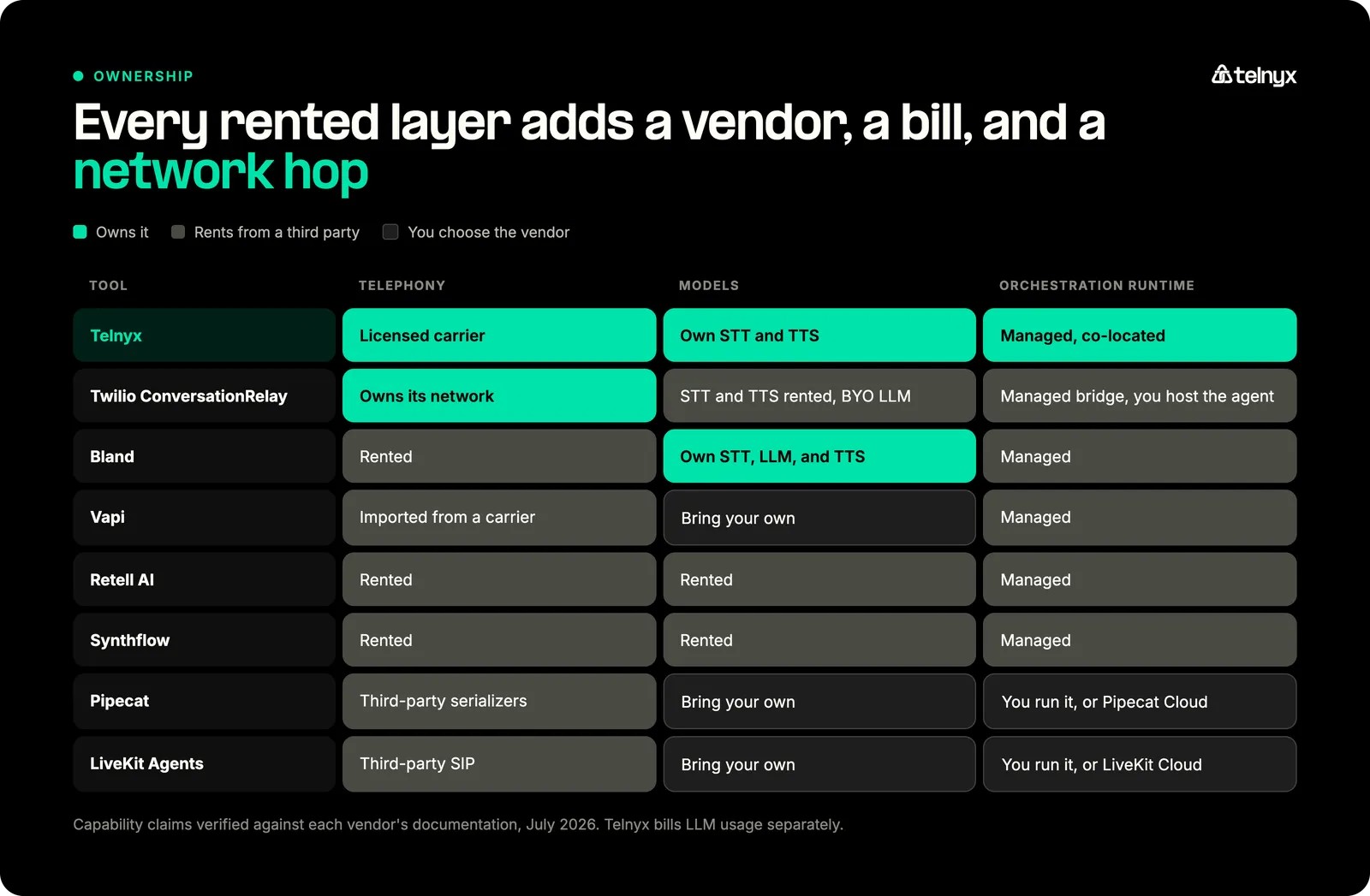
- Ownership. What the tool owns versus rents: the models, the inference hardware, and the telephony. Every rented layer adds a vendor, a bill, and a network hop.
- Latency handling. How the tool manages the per-stage time budget, from turn detection through the first synthesized syllable.
- Telephony path. How calls reach the agent: native carrier, SIP trunking, or an imported third-party account, plus support for numbers, transfers, and DTMF.
- Model flexibility. Whether you can swap STT, LLM, and TTS vendors or are locked to the tool's choices.
- Deployment model. Open-source self-host, managed cloud, or self-hosted enterprise stack.
- Pricing transparency. Published per-minute rates and what they actually include.
Top voice AI orchestration platforms
Quick comparison guide.
| Tool | Best for | Strength | Limit | Pricing |
|---|---|---|---|---|
| Telnyx | Full-stack agents on one owned network | Owns carrier network and co-located inference | Thinner drag-and-drop builder than Retell | $0.05/min for STT, TTS, and orchestration; telephony from $0.002/min; LLM separate |
| Pipecat | Custom open-source pipelines | Largest plugin catalog (~30 STT, ~29 LLM, 40+ TTS) | No built-in analytics; you run production | Free (BSD-2-Clause); Pipecat Cloud from $0.01/min |
| LiveKit Agents | WebRTC-native and multimodal apps | Audio-native turn detection in 14 languages | Key features gated to LiveKit Cloud | Free (Apache-2.0); Cloud from $0/mo, agent minutes $0.01/min overage |
| Vapi | Developer control, BYO models | Testing and observability tooling | Platform fee stacks on pass-through model and telephony costs | $0.05/min platform fee; models and telephony at cost |
| Retell AI | No-code contact center agents | Transparent per-component pricing | Rents telephony and models; voice and chat only | From ~$0.07/min assembled ($0.055 infra + TTS + LLM); US telephony $0.015/min |
| Synthflow | Enterprise no-code, white-label | Agency subaccounts with rebilling | Sales-led only; SIP gated to Enterprise | Enterprise from $30,000/year; no self-serve pricing |
| Bland | Self-hosted model stacks | Owns its STT, LLM, and TTS models end to end | Rents telephony; plan caps on concurrency | $0.11 to $0.14/min all-in, plus $299 to $499/mo on higher plans |
| Twilio ConversationRelay | Teams already on Twilio | Carrier network plus BYO LLM | You host the agent logic; costs assemble across layers | $0.07/min, on top of voice, STT/TTS, and your LLM |
1. Telnyx: full-stack voice AI orchestration on an owned network
Telnyx Voice AI Agents run on infrastructure that Telnyx owns end-to-end: the licensed carrier network that calls travel on, the GPU inference co-located with it, and the orchestration layer between them. That changes the system's structure: on Telnyx's voice AI agent platform, the audio loop never leaves the network to reach a model.
Best for: teams consolidating telephony, models, and orchestration onto one provider, especially at scale or under strict compliance requirements.
Key features:
- Telnyx Voice AI Agents bundle real-time orchestration, STT, and TTS with a no-code agent builder and API control
- Inference runs co-located with telephony points of presence, with sub-200ms round-trip latency in production
- Compliance posture: SOC 2 Type II, HIPAA, PCI DSS Compliant, ISO 27001, GDPR with EU-deployed infrastructure
Limits:
- The visual builder is thinner than other providers on this list; complex flows lean on the API
- Acceptable-use policy restricts some outbound use cases, like aggressive cold-calling patterns
Pricing: $0.05/min for STT, TTS, and orchestration on a single contract. Telephony runs at $0.002/min via Call Control or WebRTC, plus SIP trunking fees. LLM usage is billed separately.
Customers typically save 45% when switching from another provider to Telnyx's full stack platform.
Choose Telnyx if: you want the entire call path, from phone number to model output, on one network with one bill and one SLA.
Spin up a voice AI agent on Telnyx to see how the owned-network stack handles a live call.
2. Pipecat: the open-source framework with the widest model support
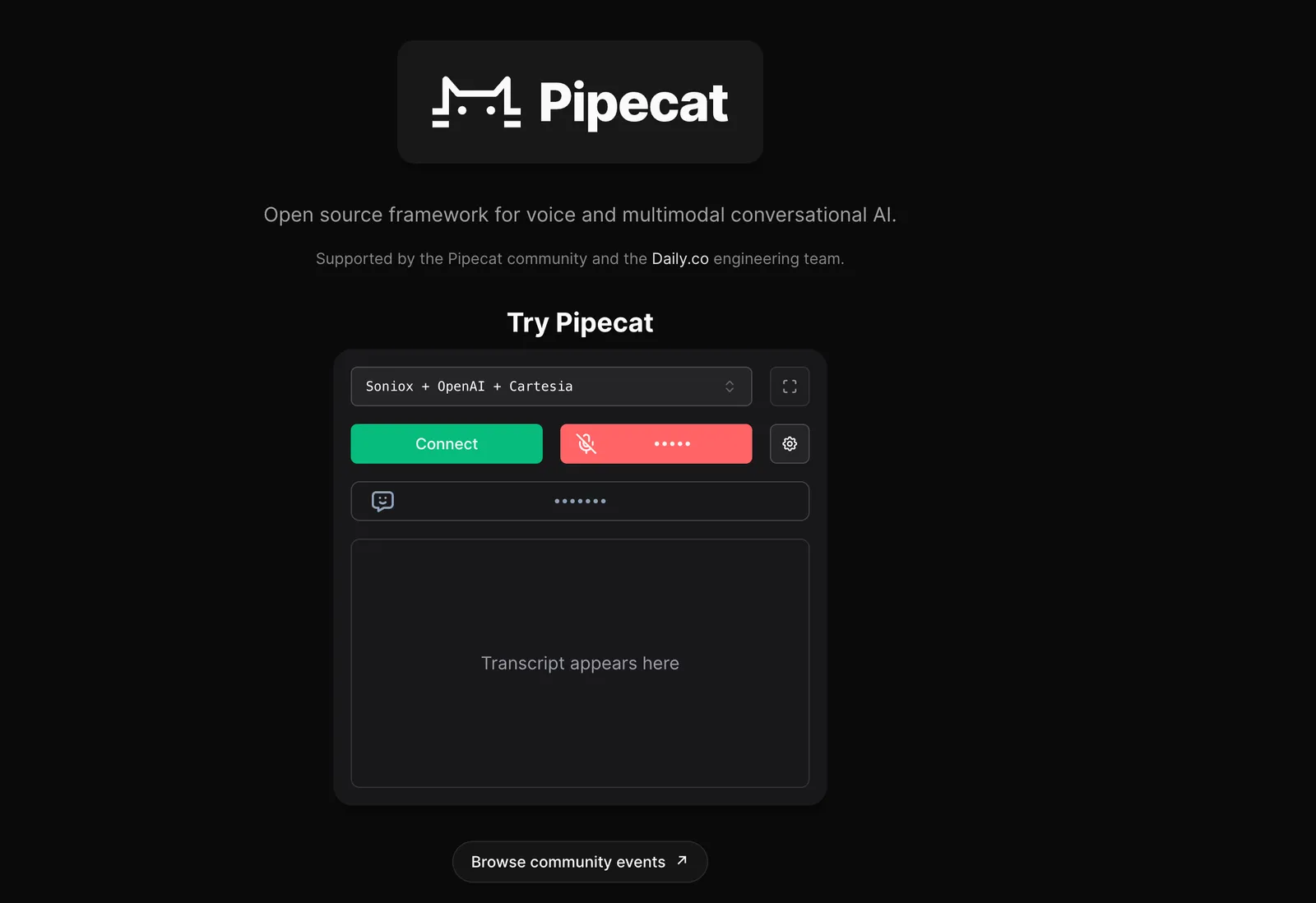
Pipecat is an open-source voice agent framework in Python, built by Daily for composing real-time voice and multimodal agents as pipelines. It has grown to roughly 13.8k GitHub stars under a BSD-2-Clause license.
Best for: engineering teams that want full control of every pipeline stage without platform fees.
Key features:
- The largest documented plugin catalog in the category: roughly 30 STT, 29 LLM, and 40+ TTS providers, all swappable
- Local ML turn detection (Smart Turn v3) runs as the default end-of-turn strategy without a hosted dependency
- Multi-agent handoff and structured conversation flows shipped into the core package in 2026
Limits:
- No built-in analytics or monitoring dashboard; observability comes from third-party integrations
- Production hosting, scaling, and telephony provisioning are your responsibility unless you pay for Pipecat Cloud
Pricing: the framework is free and open source. Pipecat Cloud, the managed hosting service from Daily, starts at $0.01 per agent-minute with AI service costs billed to your own keys.
Phone calls reach Pipecat via documented telephony serializers for six providers, including Telnyx, over TeXML and WebSocket media streaming.
Choose Pipecat if: you prefer open-source frameworks and want vendor neutrality at every layer.
3. LiveKit Agents: WebRTC-native orchestration for voice and beyond
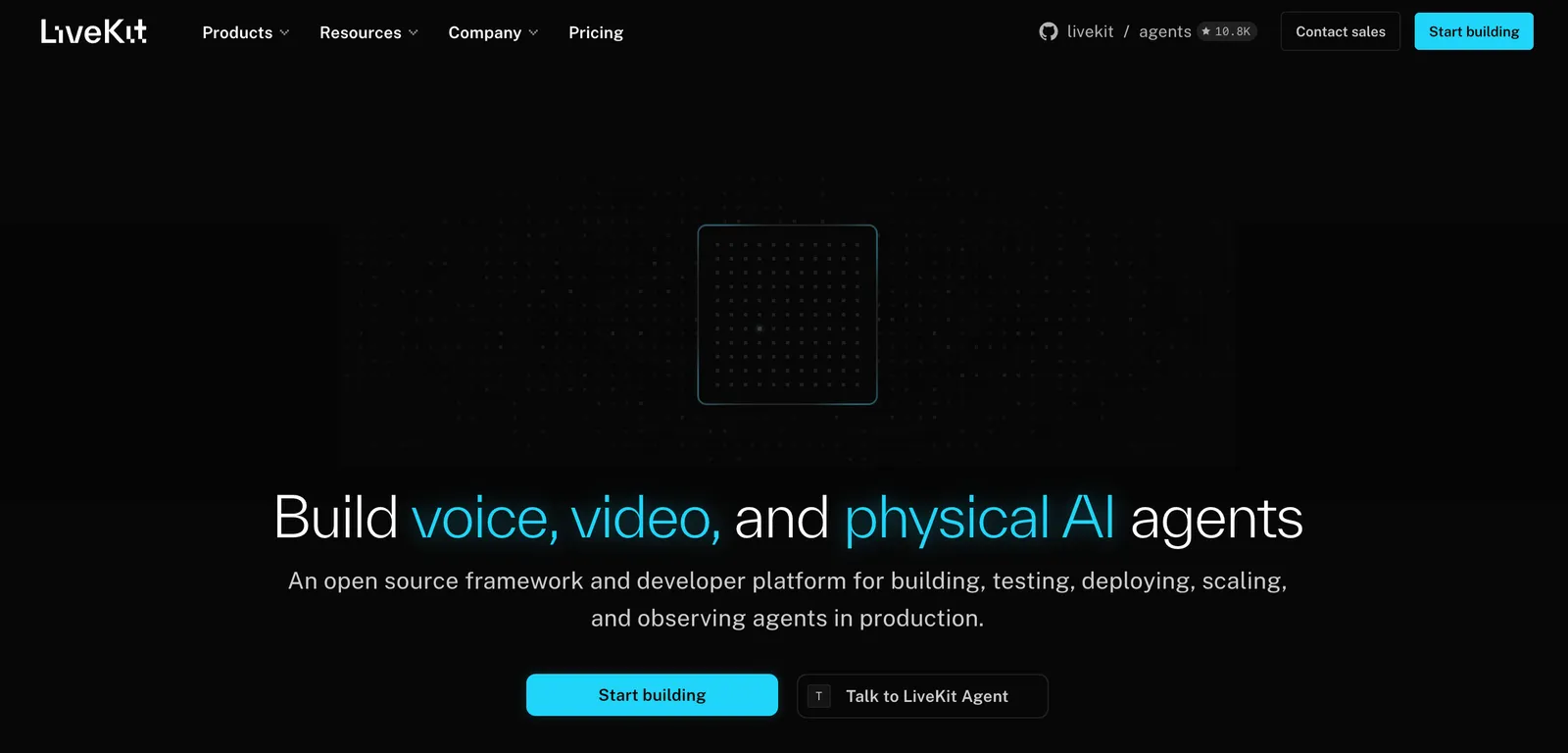
LiveKit Agents is an open-source agent framework built on the LiveKit WebRTC infrastructure, with Python and Node.js SDKs, and roughly 11.6k GitHub stars under Apache-2.0. It's a natural fit when the same agent serves browsers, mobile apps, and phone calls.
Best for: WebRTC-native products that need voice agents across app and telephony surfaces.
Key features:
- Audio-native turn detection model covering 14 languages, reading intonation and rhythm rather than transcripts alone
- A documented catalog of roughly 34 STT, 26 LLM, and 48 TTS integrations, plus hosted model access through LiveKit Inference
- SIP support with compatibility-tested providers including Telnyx, with DTMF, transfers, and encrypted trunks
Limits:
- The strongest pieces are cloud-gated: enhanced noise cancellation and the full turn-detection model require LiveKit Cloud
- LiveKit SIP does not support SIP REGISTER, which constrains some PBX-style setups
Pricing: self-hosting is free. LiveKit Cloud starts at $0/month with 1,000 agent session minutes included, then $50/month and $500/month tiers, with agent minutes at $0.01/min in overage.
Teams that want the same framework without the fee treadmill can run agents on LiveKit on Telnyx, which hosts LiveKit agents on Telnyx-owned infrastructure with built-in telephony and co-located models.
Choose LiveKit Agents if: your product already uses WebRTC or needs a single agent codebase across web, mobile, and phone.
4. Vapi: developer-first orchestration with maximum composability
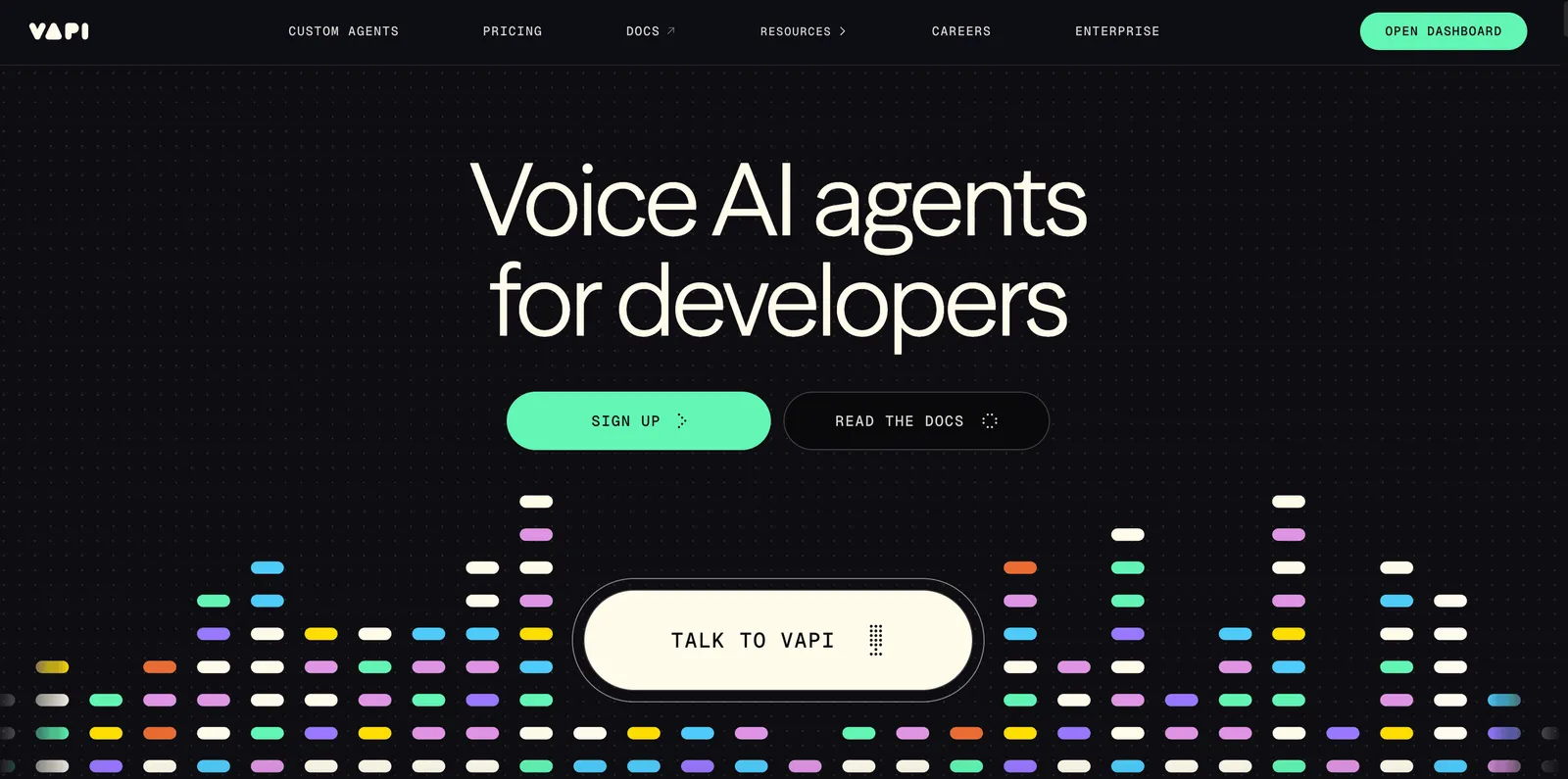
Vapi is a managed orchestration platform built for engineers who want to compose their own stack: bring any STT, LLM, and TTS, and Vapi runs the loop. Its testing and observability tooling, including evals, simulations, and test suites, is the most mature in the managed category.
Best for: engineering teams that want managed infrastructure without giving up model choice.
Key features:
- Bring-your-own-model composability across every pipeline stage, with API, CLI, MCP, and SDK access
- First call in under five minutes on a native number, with production SIP import afterward
- Evals, call simulations, and scorecards built into the platform
Limits:
- The platform fee sits on top of pass-through model and telephony costs, so per-minute economics stack as volume grows
- Code-first by design: Vapi retires its Workflows visual builder on August 18, 2026, in favor of API-first primitives, so non-developer teams should look elsewhere
Pricing: $0.05/min platform fee for hosted calls, with STT, LLM, TTS, and telephony passed through at cost or free with your own API keys. Ten concurrent lines are included; HIPAA compliance is a $2,000/month add-on.
Vapi does not own telephony; numbers and SIP trunks are sourced from carriers, and its documentation lists Telnyx as a supported provider.
Choose Vapi if: you want a managed control plane and full model freedom.
5. Retell AI: no-code orchestration for contact center teams
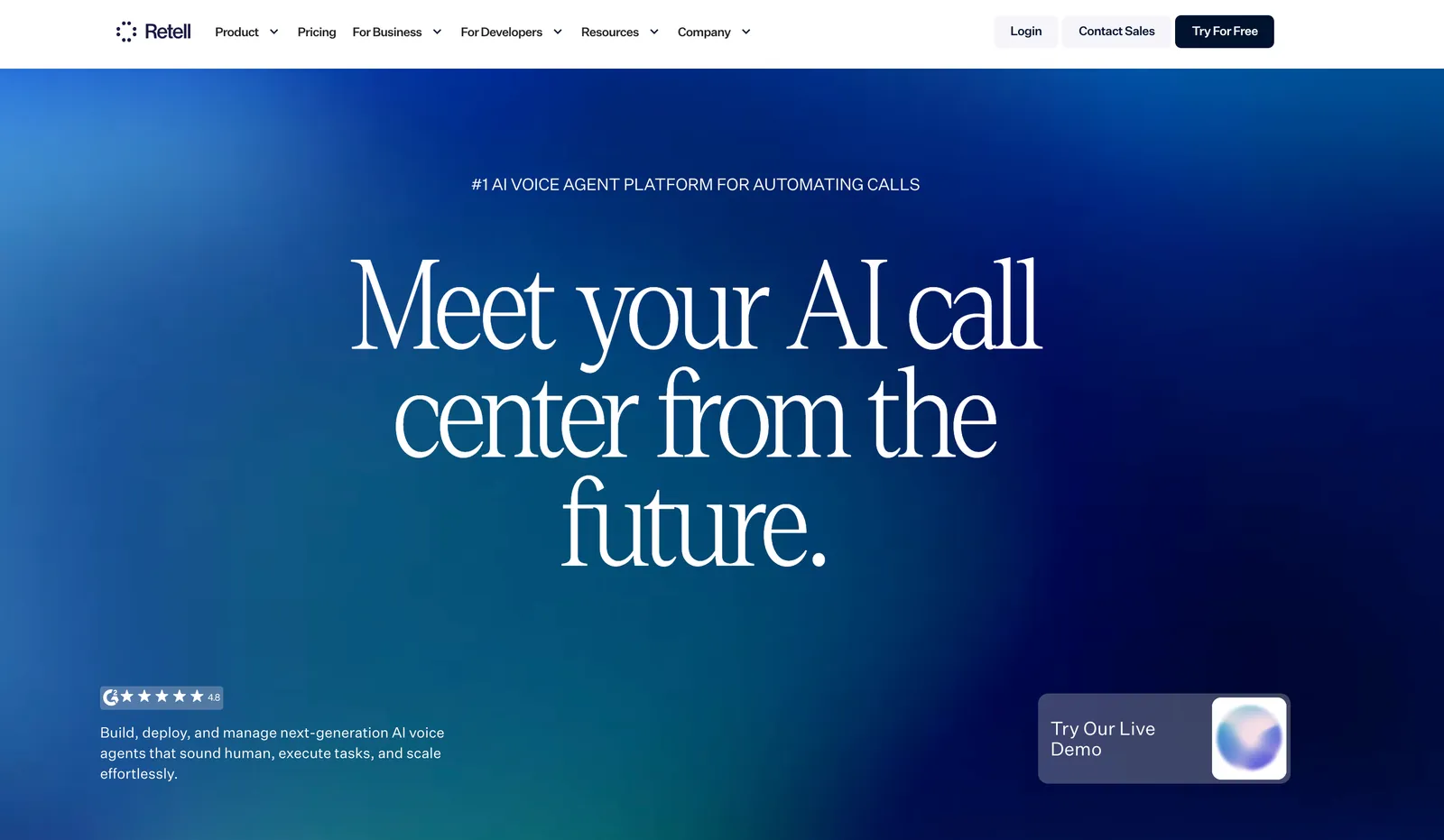
Retell AI packages voice agent orchestration behind a visual drag-and-drop builder aimed at operations and CX teams. A working phone agent takes minutes rather than sprints, and its per-component pricing is the most transparent in the managed category.
Best for: ops and CX teams that need a production agent live this week without engineering lift.
Key features:
- Visual conversation flow builder with testing tools, built for non-developers
- Granular published pricing per component: infrastructure, TTS, LLM, and telephony each priced separately
- 20 free concurrent calls on pay-as-you-go, with no platform fee
Limits:
- Retell rents both telephony and models, so every call crosses multiple vendors under the hood
- Channels stop at voice and chat; SMS and email journeys live elsewhere
Pricing: voice infrastructure runs $0.055/min, Retell TTS $0.015/min, LLMs from $0.003/min (GPT-5 nano) to $0.16/min, and U.S. telephony $0.015/min through the bundled option, so a typical assembled agent lands between roughly $0.07 and $0.13 per minute depending on configuration.
Choose Retell AI if: speed to production matters more than owning the stack does.
6. Synthflow: enterprise no-code with agency white-labeling
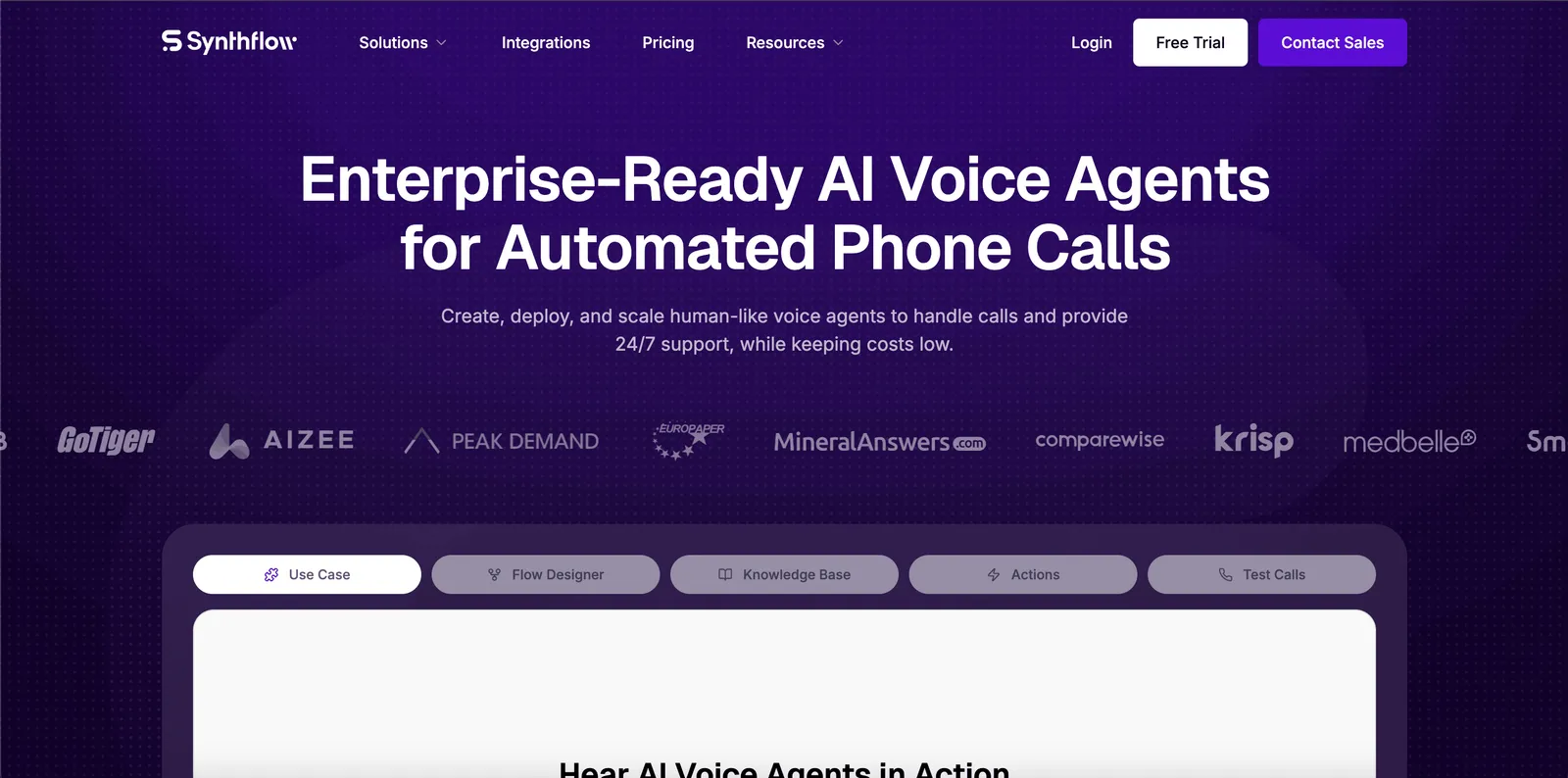
Synthflow is a Berlin-built no-code voice AI platform that moved decisively upmarket in 2026: its published pricing now starts at $30,000 annually, sales-led only. What it offers for that is a managed agent operation, from visual flow design to a full white-label program for agencies and resellers.
Best for: enterprises and agencies that want managed no-code agents with subaccounts, rebilling, and branding control.
Key features:
- Visual flow designer with industry templates, voicemail detection, and SMS follow-ups
- White-label stack with subaccounts, custom domains, and Stripe-based rebilling where agencies set their own prices
- Model selection per agent across the GPT-5 family plus a proprietary conversation-tuned model
Limits:
- No self-serve tier or published per-minute pricing remains on the live pricing page
- Bring-your-own SIP or PBX integration requires the Enterprise plan
Pricing: Enterprise plans start at $30,000 per year, with pricing based on volume, concurrency, telephony, and integrations.
Choose Synthflow if: you run an agency or enterprise CX program.
7. Bland: self-hosted models for regulated enterprises
Bland has a unique approach: it owns its entire AI model stack, running its own STT, LLM, and TTS, so call data never routes through third-party model vendors. But that means it loses the flexibility that other APIs on this list offer.
Best for: regulated, high-volume enterprises that need model sovereignty with white-glove delivery.
Key features:
- Owns its STT, LLM, and TTS models end to end, with no pass-through model costs and one all-inclusive per-minute rate
- Enterprise posture: Bland cites SOC 2 Type II, HIPAA, PCI DSS, and GDPR certifications (Bland site, July 2026)
- A stress-testing framework for validating agents before they take real traffic
Limits:
- Bland is not a carrier: it rents telephony, so the network layer stays a third-party dependency
- Plan caps constrain scale: 10 to 100 concurrent calls and 100 to 5,000 calls per day below Enterprise
Pricing: Start runs $0.14/min pay-as-you-go with no platform fee; Build is $0.12/min plus $299/month; Scale is $0.11/min plus $499/month; Enterprise is custom.
Choose Bland if: data sovereignty over the model layer outweighs ownership of the telephony layer, and you want delivery handled for you.
8. Twilio ConversationRelay: orchestration for existing Twilio estates
ConversationRelay is the managed bridge between the Twilio carrier network and your AI application: a TwiML verb opens a WebSocket to your server, Twilio handles STT and TTS at the edges, and your code decides what the agent says. It reached general availability in May 2025 (per the Twilio changelog).
Best for: teams already running voice on Twilio that want to add an AI agent without replatforming.
Key features:
- Orchestration by TwiML:
<Connect><ConversationRelay>streams the conversation to your WebSocket server in real time - STT through Google or Deepgram and TTS through Google, Amazon, or ElevenLabs, selected per call
- Full access to the Twilio number inventory, SIP trunking, and compliance surface
Limits:
- Bring-your-own-LLM is mandatory; you host and scale the agent server yourself
- The $0.07/min rate sits on top of voice minutes, STT/TTS, and your LLM bill, so all-in cost assembles across layers
Pricing: ConversationRelay costs $0.07/min, plus Twilio voice from $0.0085/min inbound and $0.014/min outbound, plus your model costs (Twilio pricing pages, July 2026).
Choose Twilio ConversationRelay if: your telephony already lives on Twilio and your team is comfortable owning the agent runtime.
 | "The failure mode is the network hop you forgot to account for. Your TTS engine might synthesize in 150ms, but if it has to hop to a separate telephony provider, get re-encoded, and delivered to the caller, you've blown your budget. When TTS, telephony, STT, and inference are all on one network, there's a single path from synthesis to delivery." Dr. Sonam Gupta, Developer Advocate, Telnyx |
Latency budgets in voice AI orchestration
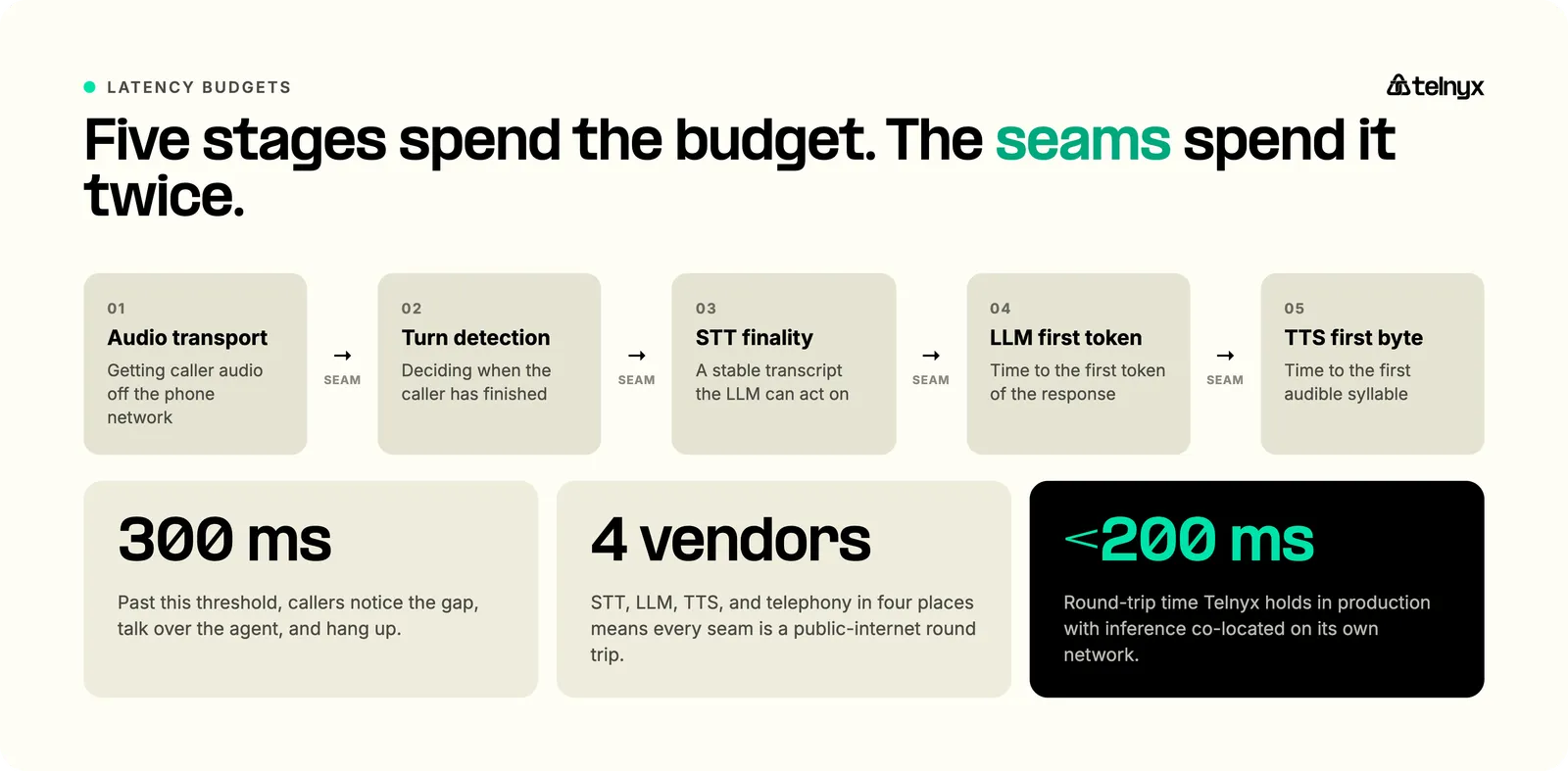
Telnyx's published guidance on orchestration platforms puts the latency threshold at around 300ms: beyond it, callers notice the gap, talk over the agent, and hang up. Every orchestration decision is really a decision about where that budget gets spent.
The budget splits across five stages, and orchestration touches all of them:
Voice AI latency budget by stage.
| Stage | What spends the budget | What good orchestration does |
|---|---|---|
| Audio transport | Getting caller audio off the phone network into the pipeline | Keeps media on one network instead of relaying across providers |
| Turn detection | Deciding when the caller has finished speaking | Uses audio-native models instead of fixed silence timers |
| STT finality | Producing a stable transcript the LLM can act on | Streams partial transcripts so the LLM starts early |
| LLM first token | Time to the first token of the response | Routes to fast models and starts TTS before the answer completes |
| TTS first byte | Time to the first audible syllable | Streams synthesis instead of waiting for full sentences |
The stage most teams cannot tune is the one between vendors. When STT, LLM, TTS, and telephony are hosted by four different providers, each stage is a round trip over the public internet.
That is the structural argument for consolidation: Telnyx runs co-located inference on the same network where calls terminate, which is how it holds sub-200ms round-trip times in production. For measured comparisons across vendors, read our voice AI latency comparison.
Open-source frameworks attack the same problem differently: Pipecat and LiveKit Agents both ship local turn-detection models precisely because a hosted turn detector adds a network hop to the most latency-sensitive stage.
The telephony layer under voice AI orchestration
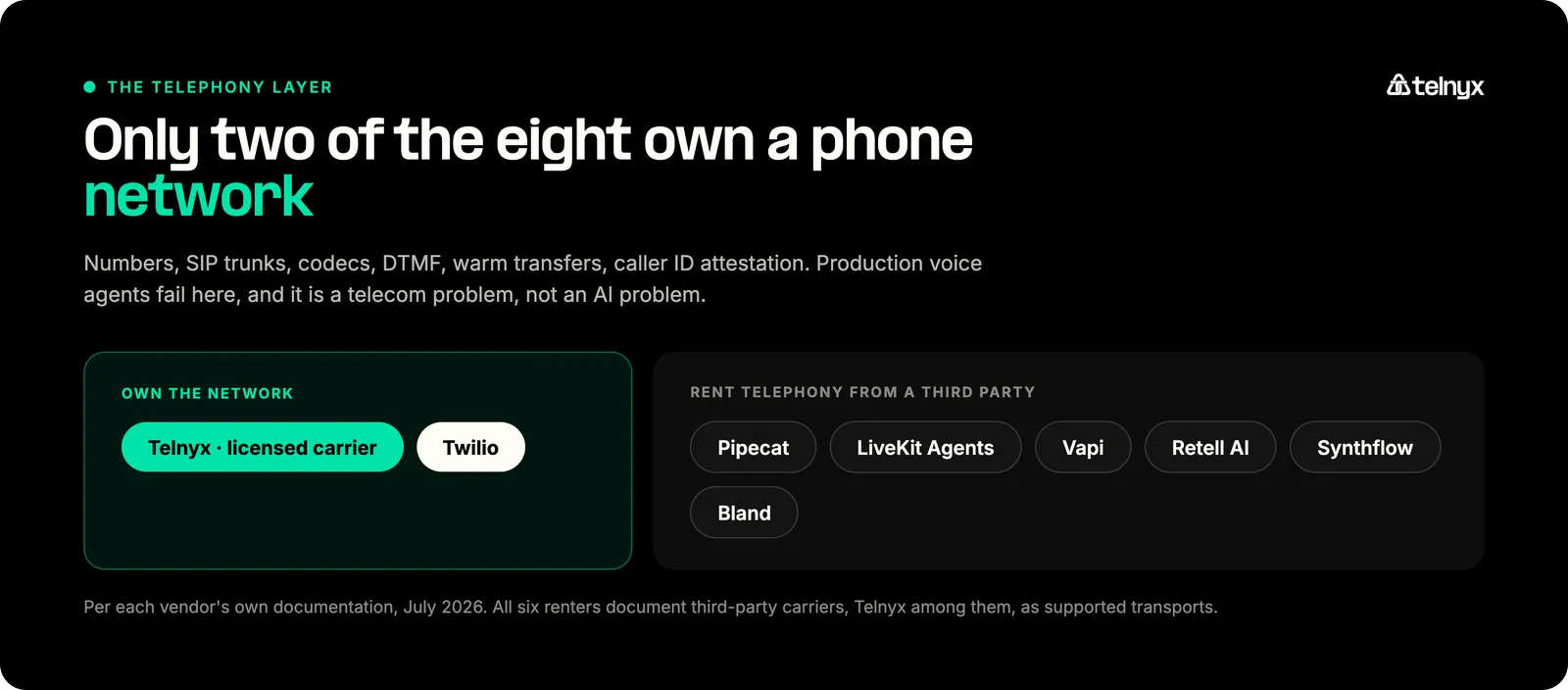
Every tool on this list eventually meets a phone network, but only two of the eight own one outright. Telnyx operates as a licensed carrier; Twilio owns its network. Pipecat, LiveKit Agents, Vapi, Retell, Synthflow, and Bland all route calls through third-party telephony, with their documentation listing the carriers they support.
That layer is where production voice agents actually fail. Number provisioning, SIP trunk configuration, codec negotiation, DTMF handling, warm transfers to humans, and caller ID attestation are telecom problems, not AI problems. An agent that reasons brilliantly still loses the call if its audio arrives as 8kHz or if its outbound number gets flagged as spam.
 | "A great model on a fragile call path still feels fragile. For production voice agents, the network does not just carry the experience. It shapes the experience." James Whedbee, VP of Engineering, Telnyx |
This is why an AI voice agent API with SIP support beneath the orchestration layer matters most for low-latency and call handling. Telnyx's Voice API provides call control, real-time media streaming, and global numbers that several frameworks on this list do not.
The framework docs bear this out: LiveKit includes a dedicated Telnyx trunk guide, Pipecat ships a Telnyx serializer, and Vapi and Retell both publish Telnyx SIP setup guides.
The practical takeaway: choose your orchestration tool on its merits, but budget real engineering time for the telephony path, because the phone network is not optional.
Choosing the right voice AI orchestration tool
Deciding how to build an AI voice agent starts with the deployment model.
Open-source frameworks trade platform fees for engineering ownership. Managed platforms buy you speed and charge for it by the minute. Self-hosted stacks trade delivery costs for sovereignty, and an infrastructure owner (like Telnyx) collapses vendors, hops, and bills into a single layer.
- Choose Telnyx if you want the end-to-end voice AI stack, telephony included, on one network with one bill.
- Choose Pipecat if you have an infrastructure team and want maximum model freedom in open source.
- Choose LiveKit Agents if your agent must serve browsers, mobile devices, and phones from a single codebase.
- Choose Vapi if your engineers want a managed control plane with bring-your-own everything.
- Choose Retell AI if a CX team needs a production agent this week without code.
- Choose Synthflow if you white-label voice agents for clients and want built-in rebilling.
- Choose Bland if the model layer must be sovereign and delivery must be white-glove.
- Choose Twilio ConversationRelay if your voice estate already runs on Twilio and you can host the agent runtime.
Three things to consider before signing:
- Avoid no-code platforms when your use case needs advanced custom workflows, because the prototype won't hold up to a production environment.
- Avoid open-source frameworks when no one on the team owns the production infrastructure, because the framework is free but the technical implementation is not.
- Treat pilot-scale pricing as provisional. Per-minute rates that look affordable at demo volume diverge once platform fees, pass-through model costs, and telephony charges stack at production volume.
Teams building deeper agent logic, like model-level SDKs from OpenAI or LangChain's voice support, can pair those with any transport-layer tool here, since they solve reasoning, not telephony.
See voice AI on a network you own
Telnyx runs STT, TTS, and orchestration on its own carrier network, with co-located inference holding round-trip latency under 200ms. Bring your use case and we will walk the call path end to end.
Book a demoFrequently asked questions
What is voice AI orchestration?
Voice AI orchestration is the coordination layer that connects speech-to-text, a language model, and text-to-speech into a single real-time loop, enabling an AI agent to hold a spoken conversation. It handles turn detection, interruptions, conversation state, tool calls, and the bridge to the phone network, keeping total response time inside a conversational pause.
What is the difference between Pipecat and LiveKit Agents?
Pipecat is a Python-first framework with the widest model plugin catalog and local turn detection, best for fully custom pipelines. LiveKit Agents is built on WebRTC infrastructure, so it excels when a single agent serves browsers, mobile apps, and phone calls, but its strongest features are tied to LiveKit Cloud. Both are open-source and document Telnyx as a telephony option.
Do I need an orchestration framework or a voice AI platform?
Choose an orchestration framework, like Pipecat or LiveKit Agents, when you need custom behavior at any pipeline stage. Choose an orchestration platform like Telnyx when speed matters more than control. Platforms differ in what they own: Telnyx runs orchestration, models, and telephony on its own network, while most others orchestrate on top of rented layers.
What is the best open-source stack for strict data privacy?
Pipecat and LiveKit Agents both self-host, keeping audio and transcripts within your infrastructure. Pair either with self-hosted models and a carrier that supports regional data residency, and note the cloud-gated features you give up: the LiveKit hosted turn detector and enhanced noise cancellation, or managed scaling from Pipecat Cloud. Bland offers a commercial self-hosted model stack for regulated buyers.
How long does it take to build an AI voice agent?
Building an AI voice agent takes minutes to get a first call working on a managed platform, and days to weeks to reach production. No-code builders can ship a working agent the same day, while framework builds on Pipecat or LiveKit Agents typically run weeks once telephony provisioning, testing, and failure handling enter scope. The initial build is not lengthy, it's testing AI voice quality, hops, and latency that's the defining factor.
How does orchestration affect voice agent latency?
Orchestration decides how many networks a conversation crosses. Each stage handoff between separate vendors adds a round trip, and those hops, not model speed, usually dominate the budget once response time matters. Consolidated stacks cut hops by co-locating inference with telephony; open-source frameworks cut them with local turn detection and streaming between stages.
Share on Social
Osman is the Global AEO/SEO Lead at Telnyx, helping make voice AI and communications products clearer for builders. With almost a decade of experience in SEO, he previously led growth at Windscribe and Enzuzo, shipping and scaling organic programs that reached millions.


