
Inference
Kimi K3, live on Telnyx Inference
Kimi K3, the first 2.8 trillion parameter open-source model, is live on Telnyx Inference. Frontier-class coding and reasoning at $2.70/1M input tokens on GPU infrastructure we own. No cloud markup, no vendor lock-in.

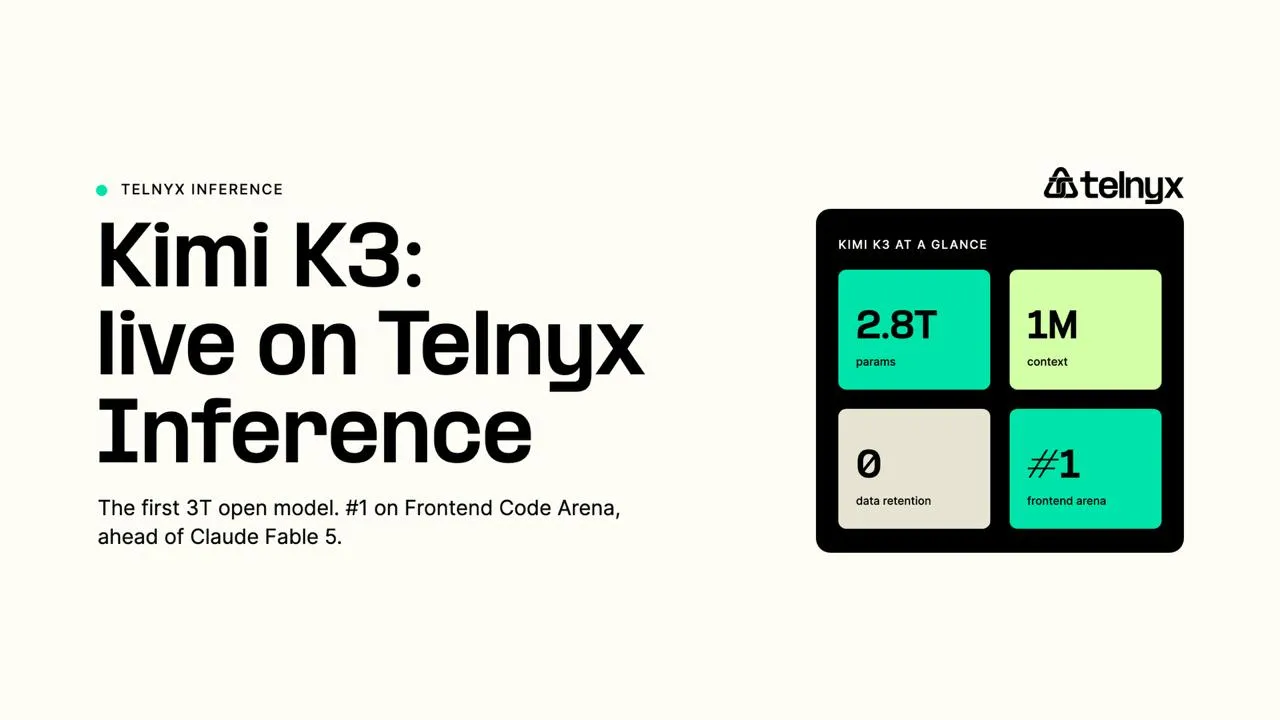
Kimi K3 from Moonshot AI is here, and it is the first open-source model to crack 2.8 trillion parameters. It is available now on the Telnyx Inference API, running on GPU infrastructure we own across four continents.
Why Kimi K3 is making waves
K3 is the first open-source model in the 3-trillion-parameter class. On benchmarks for coding, reasoning, and agentic knowledge work, it performs at frontier level, trailing only the most powerful proprietary models from Anthropic and OpenAI.
The jump from Kimi K2 to K3 is a 2.5x improvement in scaling efficiency. A 1M token context window. Native vision capabilities across text, image, and video input. Configurable reasoning effort (low, high, max). Function calling, dynamic tool loading, and JSON schema constrained output for agentic workflows.
In practice, that means K3 can sustain multi-hour engineering sessions with minimal human supervision, navigate large codebases, and orchestrate terminal tools. In Moonshot's own testing, an early version of K3 built MiniTriton, a compact GPU compiler, from scratch. It designed a chip for its own nano model in a single 48-hour autonomous run. It completed a computational astrophysics reproduction in two hours that would normally take one to two weeks of expert researcher time.
This is not a lab demo. It is a working model doing real engineering work at scale.
What it means for open-source
For the past two years, the narrative has been that open-source AI trails frontier labs by a wide margin. K3 challenges that. A 2.8T parameter open model competing with Claude Fable 5 and GPT 5.6 Sol on reasoning and coding benchmarks is not a curiosity. It is evidence that the gap is closing, and closing fast.
The competitive advantage in AI is shifting from who builds the smartest model to who builds the infrastructure that decides where every request runs. K3 is proof that the model side of that equation is solving itself. The open-source community is not far behind the frontier labs. In some benchmarks, it is already there.
That has implications for every team building with AI. If model quality is converging, then the decisions that matter are the ones you make before inference begins: which model, which provider, which region, which price. Infrastructure becomes the differentiator.
Why Telnyx is the right choice for K3
A 2.8T parameter model with a 1M token context window needs serious hardware. Moonshot recommends supernode configurations with 64 or more accelerators. Not every provider can run that.
Telnyx owns GPU infrastructure on four continents: US, EU, APAC, and Dubai. We don't rent cloud instances from hyperscalers to run workloads on. We use our hardware, our network, our SLA.
Throughput. When you own the infrastructure, you control the bottleneck. K3 on our hardware delivers the throughput the model was designed for, without a cloud provider in the middle adding latency and taking margin.
Pricing. No cloud provider markup baked into every token. The per-token price reflects what it actually costs to run the model, not what it costs to rent someone else's hardware plus their profit.
| Token Type | Price per 1M tokens |
|---|---|
| Cached Input | $0.27 |
| Input | $2.70 |
| Output | $13.50 |
Prompt caching is enabled by default. For workloads with repeated prompt prefixes or multi-turn agent sessions, cached input pricing drops the effective input cost by 90%.
For comparison, Claude Fable 5 input pricing is $10.00/1M tokens and output is $50.00/1M. GPT 5.6 Sol is $5.00/1M input and $30.00/1M output. Kimi K3 on Telnyx is 2-4x cheaper than the leading proprietary models across input and output.
In-region by default. Your prompts and completions stay where your users are. US, EU, APAC, with Dubai live for inference. That is architecture, not a configuration option you pay extra for.
One vendor, one SLA. Compute, network, and inference on one owned stack. One margin, one phone call when something breaks. No finger-pointing between your model provider and your cloud provider.
Get started
Kimi K3 is available on the Telnyx Inference API.
API endpoint: https://api.telnyx.com/v2/ai/chat/completions
Model ID: moonshotai/Kimi-K3
Context: 1M tokens
Reasoning effort: low, high, max (default: max)
The API is OpenAI-compatible, so you can swap Kimi K3 into existing workflows with a base URL and credential change. No re-architecture.
Read the docs to get started, or try it in Mission Control.
Share on Social
Fiona McDonnell is Product Marketing Lead at Telnyx. Rather than writing about AI infrastructure and messaging compliance from the outside, she's run go-to-market directly for Telnyx's inference products and its trust-focused messaging and voice capabilities. That means she's see


