
WhatsApp Business API
The best WhatsApp API providers in 2026
The 9 best WhatsApp API providers of 2026, ranked: each one's fee on top of Meta's, WhatsApp calling support and the team it suits best.

Takeaways
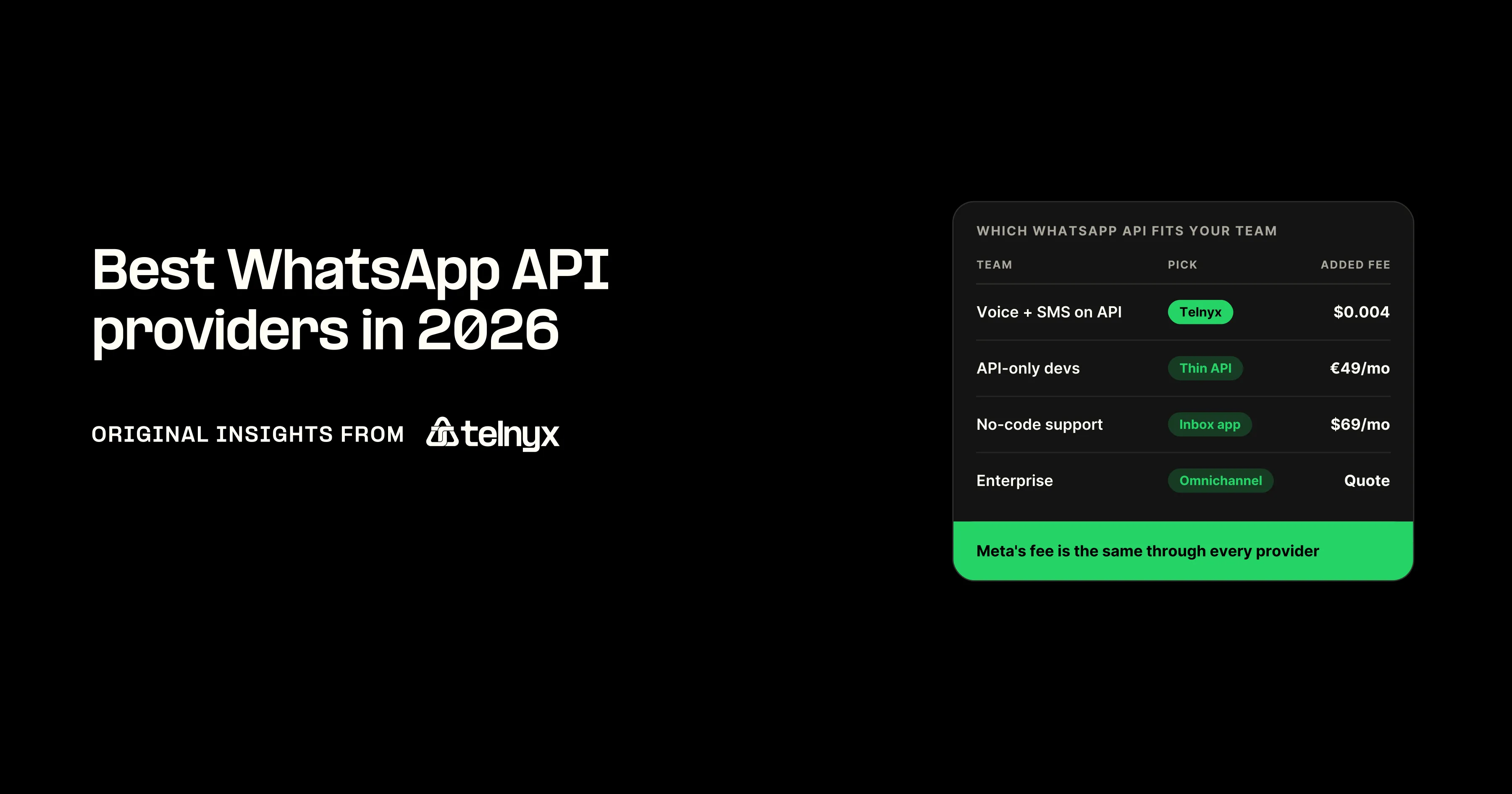
The best WhatsApp API provider depends on who builds and runs it: Telnyx if your voice or SMS already runs on an API (WhatsApp messages and calls on the same number, from $0.004 per message, no monthly subscription), 360dialog for the thinnest API-only layer, respond.io or Wati for support teams that want a no-code inbox, and Infobip for enterprise omnichannel.
- Meta charges the same per-message fee through every provider, so the only price that differs between them is the fee the provider adds on top.
- Shortlist official Meta Business Solution Providers only, because unofficial bulk senders that run on WhatsApp Web get numbers banned.
How we ranked these WhatsApp API providers
All eight are official Meta Business Solution Providers, ranked on four buyer questions, in order:
- Can WhatsApp messages and calls run on the number that already carries the team's voice and SMS?
- Does the provider publish its own fee on top of Meta's?
- Can developers start through an API, software development kits (SDKs) and self-serve onboarding?
- Can a team without developers run it?
The first question carried the most weight, because it decides whether WhatsApp adds a second vendor, number and invoice.
Meta's per-message fee is left out of every price because it is identical through every provider, per Meta's WhatsApp pricing page.
The order is an editorial ranking, not a benchmark, and a lower-ranked provider can be the better pick for its labeled use case. The providers were not tested hands-on: facts come from each vendor's docs and pricing pages, checked 6 and 8 October 2026, and prices are comparison points, not quotes.
The best WhatsApp API providers at a glance
WhatsApp API providers by best fit and key trade-off, October 2026
| Vendor | Best for | Key trade-off |
|---|---|---|
| Telnyx | Teams that already run voice or SMS on an API | No ready-made shared team inbox or chatbot builder for teams without developers |
| Twilio | Developers who want SDKs in seven server languages | One Twilio account holds one WhatsApp Business Account, so several brands need several accounts |
| Infobip | Enterprises rolling out WhatsApp alongside many other channels | No published price, so getting a quote means talking to sales first |
| 360dialog | API-only teams that want a flat per-number licence | No channel besides WhatsApp, and low volume may not cover a flat licence |
| Gupshup | Teams messaging customers in India and Southeast Asia | Built for customers in the region, and existing Cloud API code does not carry over to its own send format |
| Bird | Pairing WhatsApp with email and SMS marketing | Bird-managed numbers cannot hold two-way conversations, and there is no high-volume batch sending |
| respond.io | Support teams that want a no-code omnichannel inbox | Cannot keep a WhatsApp API provider a team already uses, and Starter has no API access |
| Wati | Small teams that want WhatsApp broadcasts and a shared inbox | Built around the Wati inbox, not for driving WhatsApp from a team's own systems |
1. Telnyx: Best for teams that already run voice or SMS on an API
Telnyx's WhatsApp Business API puts WhatsApp messages and calls on one Telnyx number alongside public switched telephone network (PSTN) calling and SMS, with one set of analytics. Onboarding is Embedded Signup with the team's own Meta Business Manager, so admin access and a valid payment method come first.
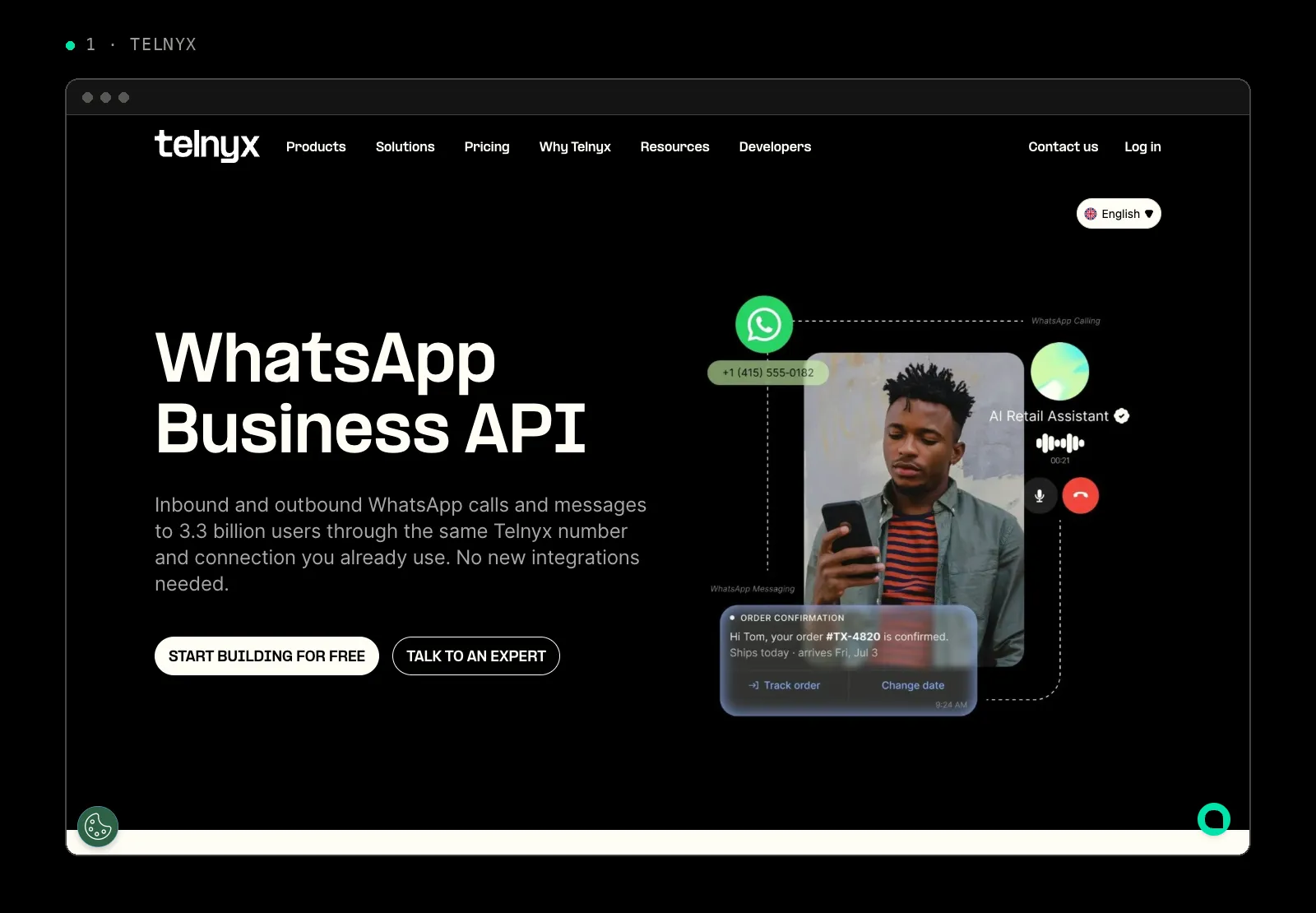
Telnyx's WhatsApp page, October 2026.
Best for: API teams already carrying voice or SMS, with MMS (picture messaging), RCS (Rich Communication Services), verification and numbers in 130+ countries on the same account.
Key features:
- An inbound call lands on the Voice API, Session Initiation Protocol (SIP) or TeXML connection already in use, such as a business SIP trunking connection picked from a dropdown, with no separate SIP or WebRTC stack.
- An outbound call dials [email protected], and an AI Assistant answers inbound WhatsApp voice calls.
- Messaging is one endpoint, POST /v2/messages/whatsapp, with samples in Python, Node, Go, Java and Ruby, and templates go to Meta for approval from the portal.
Limits:
- There is no ready-made shared team inbox or chatbot builder for teams without developers.
- On a virtual number, verification should run by voice call, since Meta rates SMS one-time passcodes (OTPs) to voice over internet protocol (VoIP) numbers "Not Recommended" and voice OTP "Standard".
Pricing: Telnyx lists $0.004 per message and $0.0025 per minute on business-initiated calls, plus Meta's fees, with no monthly subscription and automatic volume discounts. Meta fees and platform cost arrive on one invoice.
Choose Telnyx if the team wants WhatsApp on a number it already owns, which Bring Your Own Number (BYON) imports.
2. Twilio: Best for developers who want SDKs in seven server languages
Twilio adds WhatsApp to its Programmable Messaging API, on the same account as SMS, RCS, voice, SIP trunking, email, video and Verify. Its server-side SDKs cover C#/.NET, Java, Node.js, PHP, Python, Ruby and Go, and the Conversations API runs back-and-forth threads across WhatsApp, SMS, MMS and web chat.
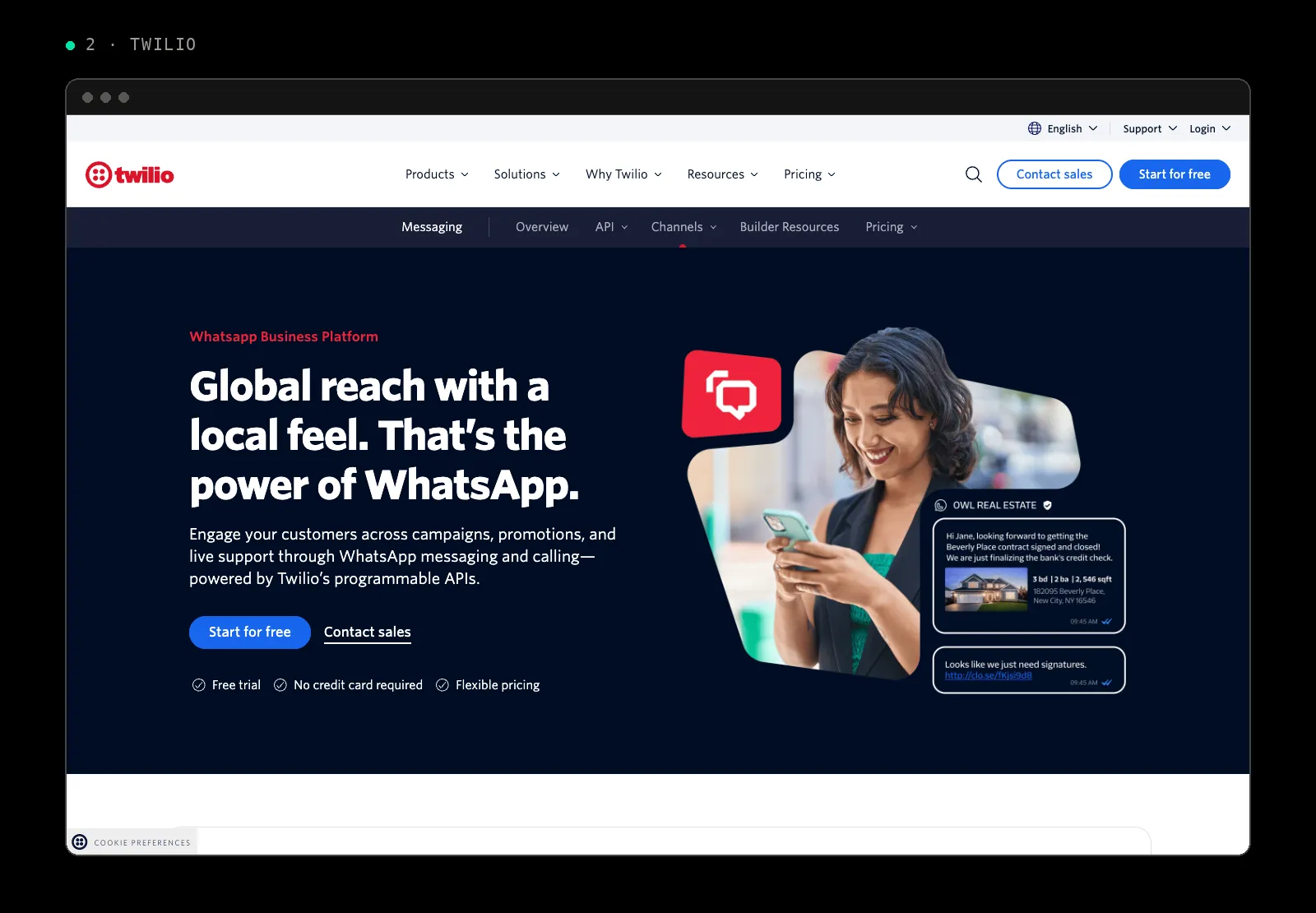
Twilio WhatsApp page, October 2026.
Best for: development teams that already build on Twilio channels and want WhatsApp in the same codebase.
Key features:
- WhatsApp Business Calling runs on the same account, priced per minute for inbound and outbound calls.
- Direct customers register senders through Self Sign-up or the Senders API, and software vendors go through the WhatsApp Tech Provider Program.
- Twilio Studio, a low-code visual builder, lets a team without developers drag widgets onto a canvas to build messaging flows, and its tutorials include a WhatsApp customer support menu.
Limits:
- The sandbox reaches only people who sent the join code, expires three days after joining and sends at most one message every three seconds.
- One Twilio account holds one WhatsApp Business Account (WABA), so several brands means several accounts. A non-Twilio number must receive Meta's verification code by SMS or voice, so interactive voice response (IVR) or outbound-only lines fail registration.
Pricing: Twilio lists $0.005 per message, inbound or outbound, and $0.005 per minute for WhatsApp calls, plus Meta's fees, with no monthly fee. A message that ends in a Failed status carries a $0.001 processing fee, and Studio is priced separately from the messages it sends.
Choose Twilio if the team runs a single brand and wants a free trial that needs no credit card.
3. Infobip: Best for enterprises rolling out WhatsApp alongside many other channels
Infobip sells WhatsApp as one channel of a cloud communications platform that also carries SMS, email, Viber, voice, WebRTC, RCS and video. Teams use it through the API, integrated with CRM and support tools, or through the Infobip web interface with no integration work.
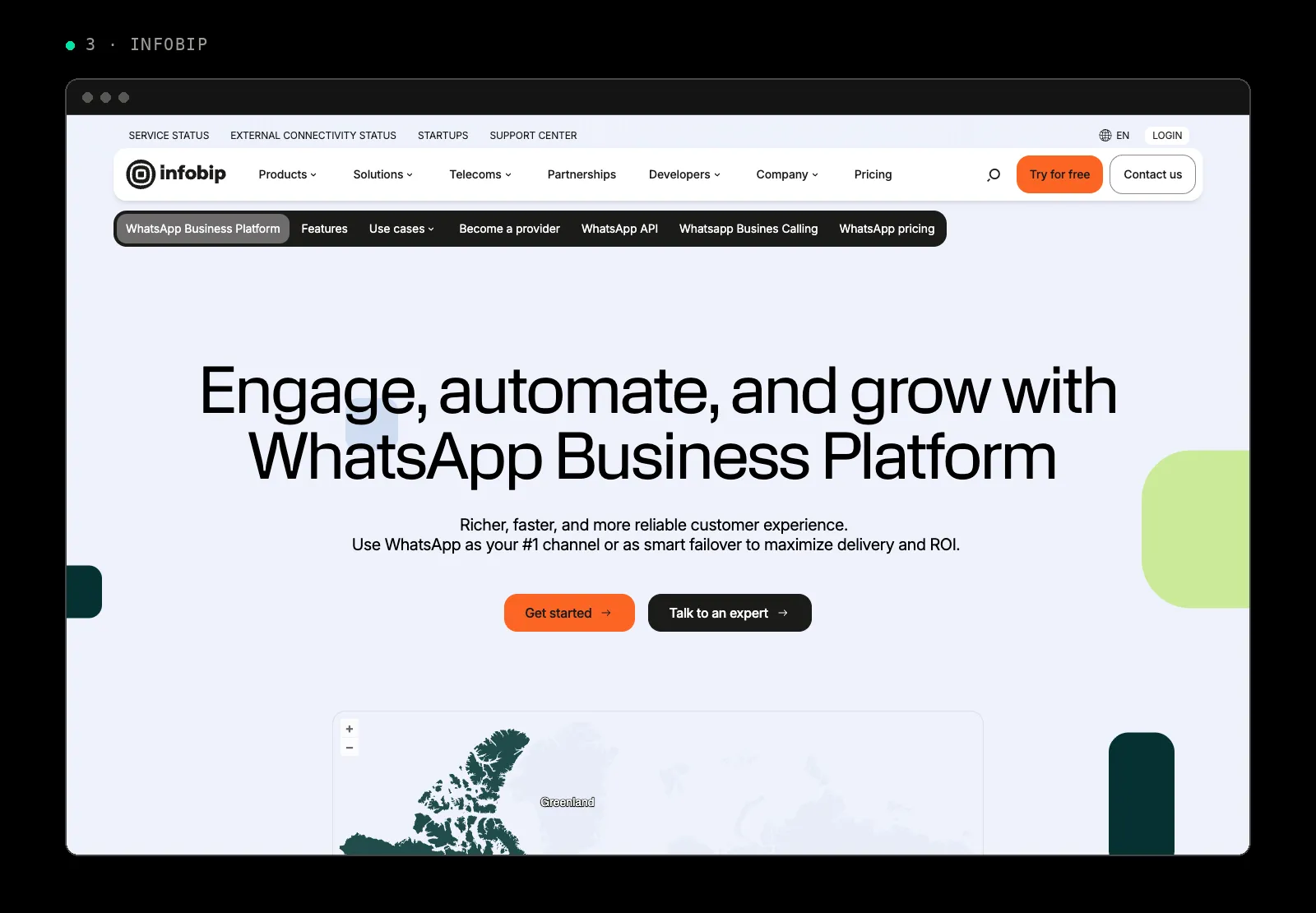
Infobip WhatsApp page, October 2026.
Best for: enterprises that want WhatsApp, other channels and a contact center under one contract, with bulk campaigns from the same platform.
Key features:
- Conversations, the Infobip cloud contact center, adds queues, routing and agent assignment, so agents without developers work WhatsApp from a web interface or a mobile app, with supervisor and agent roles.
- Answers builds, tests and deploys AI chatbots, and Flows guide users through custom WhatsApp journeys, with flow definitions an AI agent can generate.
- WhatsApp senders register in the Infobip web interface, every account calls the API on its own base URL, xxxxx.api.infobip.com, and client SDK libraries cover backend integration.
Limits:
- The 60-day free trial messages one verified number only, and the shared test sender goes once the free messages run out.
- WhatsApp calling is an agent-desk feature inside Conversations: an approved call must be placed within 7 days and inbound calls need a waiting strategy.
Pricing: Not published as a separate provider fee. Infobip charges per message, shows estimated prices by destination in an online calculator, sets custom plans with sales, and lists WhatsApp calling without a public call price.
Choose Infobip if the organization wants one quote that bundles WhatsApp with the agent desk, chatbots and broadcast tooling.
4. 360dialog: Best for API-only teams that want a flat per-number licence
360dialog hosts WhatsApp numbers on Meta's Cloud API and charges a flat licence per number, with no per-message markup. WhatsApp is its only channel, and partner tools from its marketplace can sit on top while the business keeps ownership of the number.
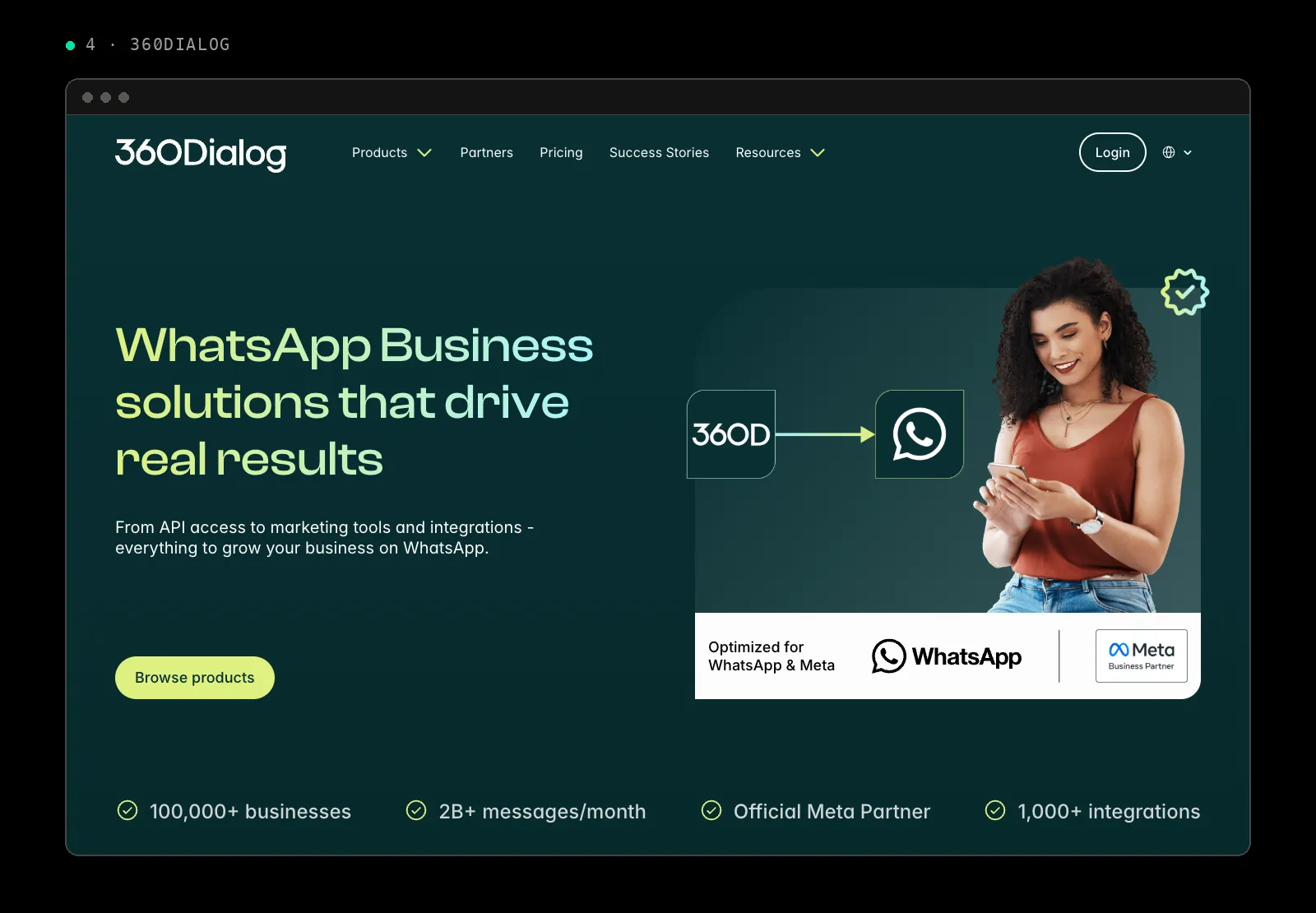
360dialog WhatsApp page, October 2026.
Best for: developer teams whose volume per number makes a flat fee cheaper than per-message pricing.
Key features:
- The Regular plan includes 24/7 human support, a first response within 4 hours, a direct Meta escalation path, and Zapier, Make and n8n integrations.
- Premium adds a 30-minute first response, business verification in 48 hours and Inbox, Sendout, Automation and Measurement add-ons, so a team without developers can answer from an inbox.
- WhatsApp calling runs through Cloud API Calling on the team's own SIP or WebRTC setup, per its docs, and is not listed on the pricing page.
Limits:
- The sandbox credential comes from sending START to a WhatsApp number and allows 200 messages to one fixed recipient.
- Throughput above 80 messages a second costs EUR 249 per channel per month and is offered only after 50,000 unique customers in 7 days.
Pricing: 360dialog lists EUR 49 per number per month on Regular, EUR 99 on Premium and EUR 500 on Scale, plus Meta's fees, with no per-message markup. Scale adds up to 1,000 messages a second and dedicated migration support. Card payment of licence invoices adds a 4% fee.
Choose 360dialog if the team wants to own its number and change front-end tools later, which 360dialog supports through partner tools with no lock-in.
5. Gupshup: Best for teams messaging customers in India and Southeast Asia
Born in India, Gupshup runs offices in India and Indonesia and sells WhatsApp alongside Instagram, SMS and RCS. It has the lowest published per-message fee on this list, and it reports 50,000+ customers and 120 billion+ messages a year.
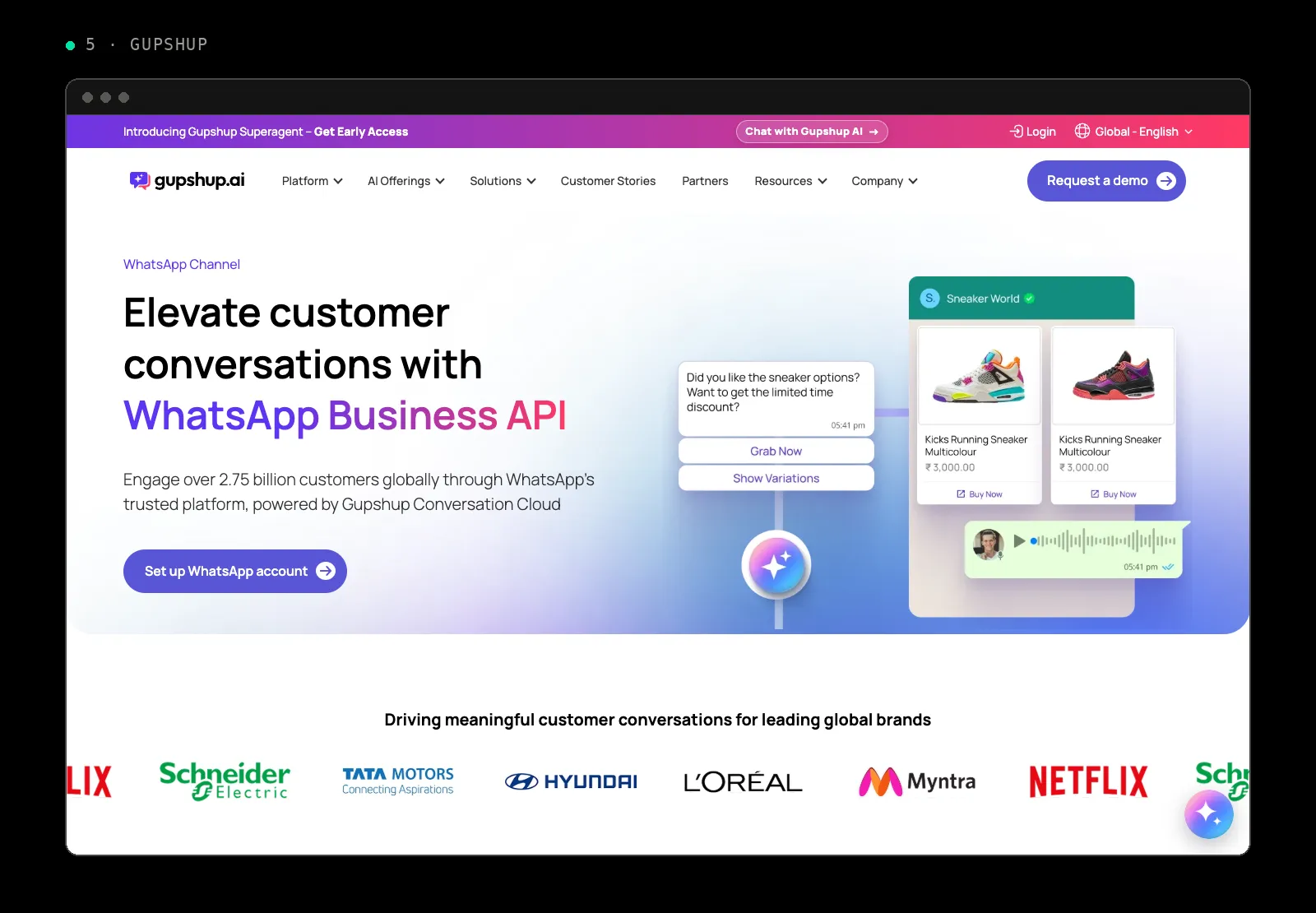
Gupshup WhatsApp page, October 2026.
Best for: regional teams that want a provider with offices in India and Indonesia and a self-serve console.
Key features:
- Bot Studio, a canvas-based bot builder, and ready integrations for Salesforce, Zoho Desk, Freshdesk, Microsoft Dynamics 365, WooCommerce and Zapier give a team without developers a way in.
- Business-initiated WhatsApp calls bill in 6-second pulses, calls customers start carry no WhatsApp fee, and conversations from click-to-WhatsApp ads carry no WhatsApp fee for the first 7 days.
- The sandbox tests the API from a shared Indian number, including media and interactive messages, with charges deducted from the account wallet.
Limits:
- The send API is a Gupshup-only form-encoded format with source, destination and src.name fields, not Meta Cloud API JSON, so Cloud API code does not port as-is.
- Wallet top-ups run from $10 to $10,000, credits are non-refundable, and the sandbox draws on the same wallet.
Pricing: Gupshup lists $0.001 per template or session message, incoming or outgoing, with Meta's fee billed at actuals and no monthly fee. Calls cost $0.0001 per second, and media above 64KB carries no Gupshup fee.
Choose Gupshup if the team sends high message volumes and wants the provider fee kept to a tenth of a cent per message, with an enterprise console to move to later.
6. Bird: Best for pairing WhatsApp with email and SMS marketing
Bird sells WhatsApp beside email, SMS, Apple Messages, voice and Verify, each product billed separately from one prepaid balance. Its WhatsApp product covers templates, numbers, two-way messaging, Flows, Commerce, calling, marketing and AI agents. Free tiers cover several products, and SMS and WhatsApp are billed separately.
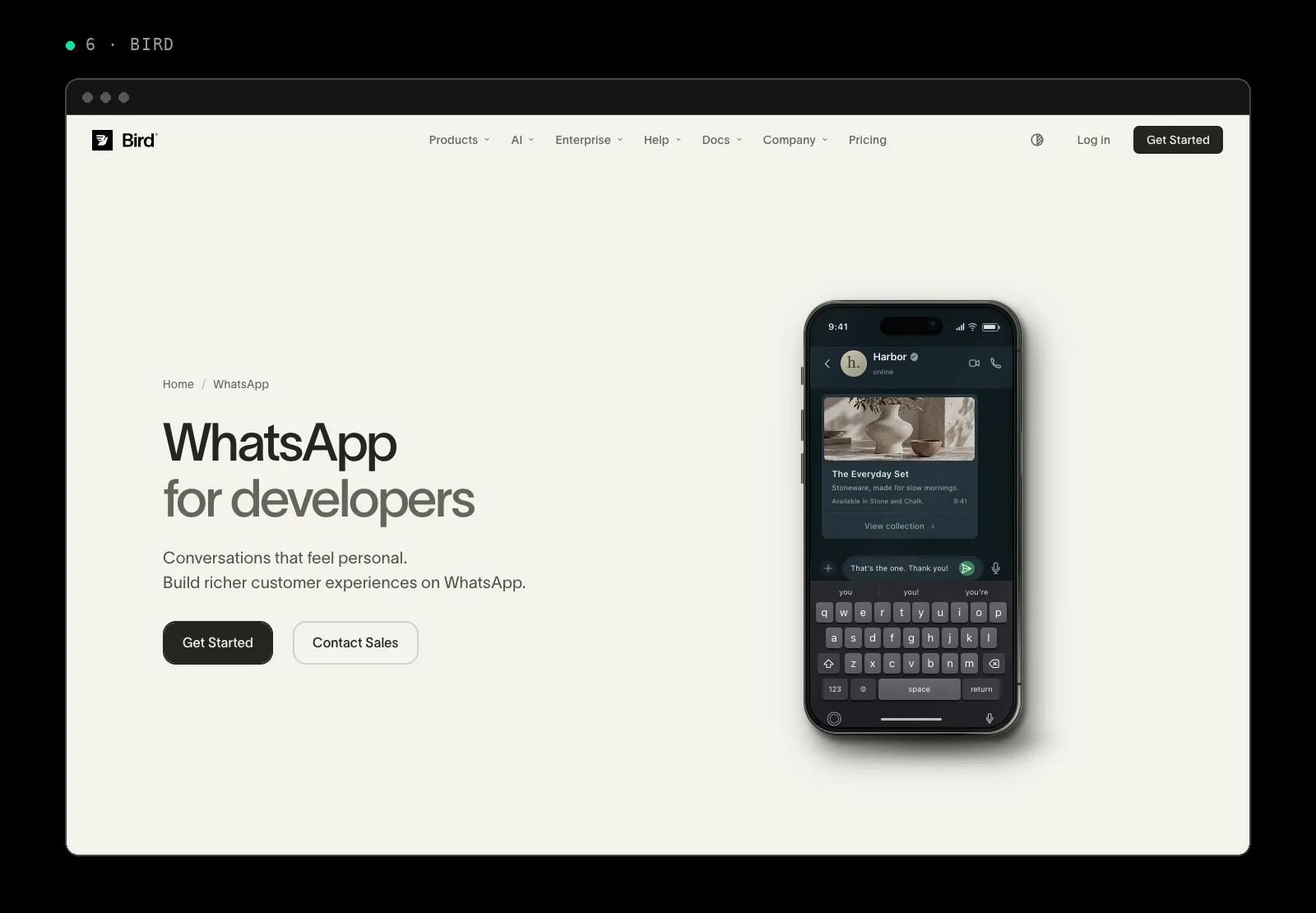
Bird WhatsApp page, October 2026.
Best for: marketing teams that run email and SMS campaigns and want WhatsApp sends and replies in the same tool.
Key features:
- The free Bird Inbox is shared-inbox software, so a support team without developers can answer WhatsApp, with channel message charges applied.
- Bird voice adds numbers, SIP trunking, browser calling and call sequences on the same account as WhatsApp calling.
- Bird publishes SDKs, a command-line tool and migration guides from Twilio, Infobip, 360dialog and Wati, plus guides for WhatsApp groups, click-to-WhatsApp ad attribution and opt-out keyword rules.
Limits:
- Bird-managed numbers can send Bird catalog templates without the team's own WABA but cannot receive replies.
- There is no batch endpoint, and the rate limit is shared across the organization, so a second API credential adds no capacity.
Pricing: Bird lists $0.005 per US marketing message plus Meta's fees, charged from a prepaid balance, and its processing fee applies even where Meta charges nothing. A send with too little balance is accepted with HTTP 202, then rejected when Bird tries to charge it. Volume pricing comes through sales.
Choose Bird if the team plans two-way conversations on its own WhatsApp number rather than a Bird-managed one, which can only send.
7. respond.io: Best for support teams that want a no-code omnichannel inbox
respond.io is an inbox first: it pulls WhatsApp, Messenger, Instagram, TikTok, email and VoIP calling into one agent view. Since 3 February 2025 it no longer connects Twilio, 360dialog, Bird or Vonage WhatsApp APIs, so it must be the team's provider as well as its inbox.
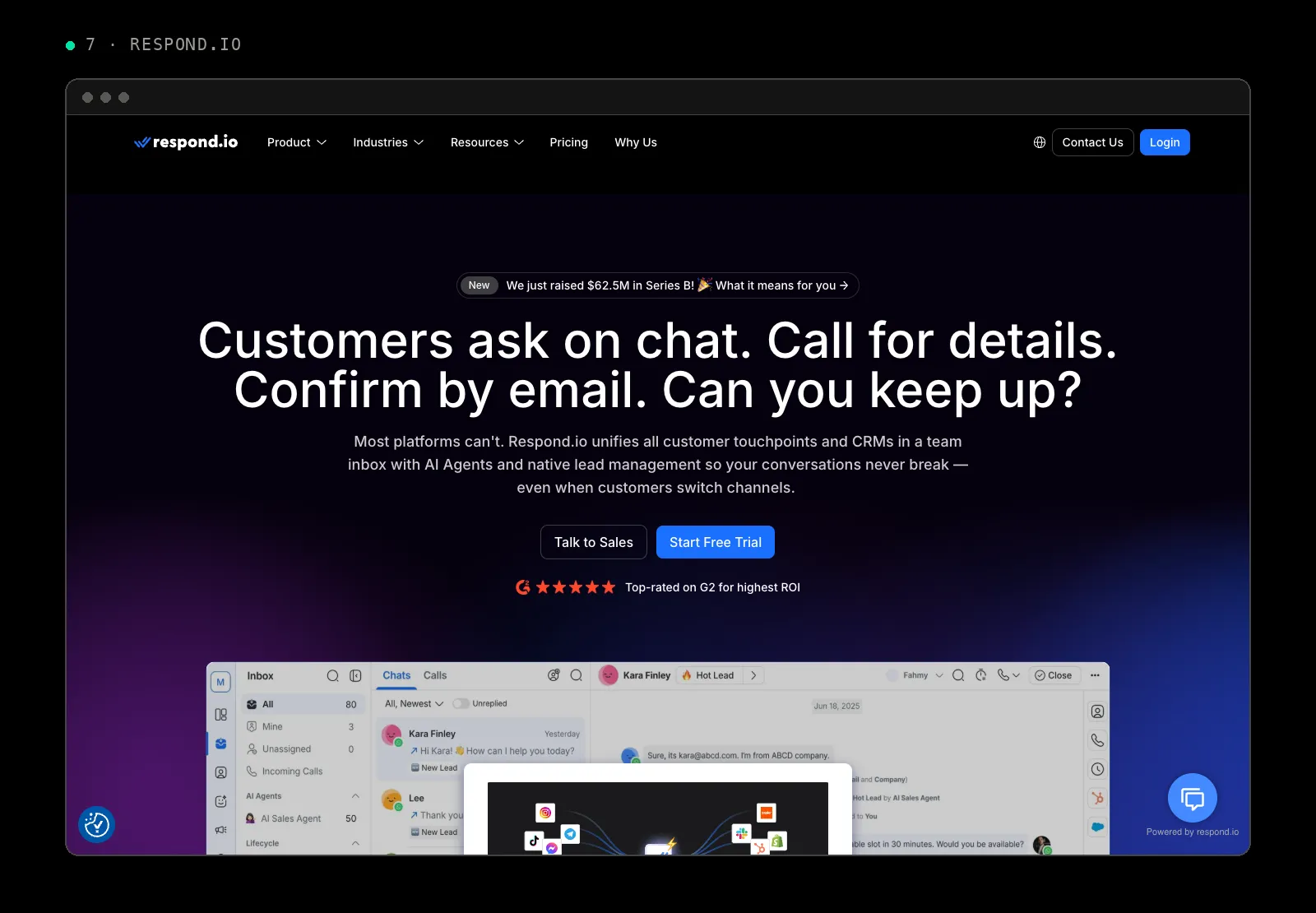
respond.io WhatsApp page, October 2026.
Best for: support and sales teams that run WhatsApp chats and calls from an inbox with no developers involved.
Key features:
- A no-code workflow builder automates conversations triggered by incoming messages and ad responses, with pre-built templates, and workflows move between workspaces by import and export.
- AI Agents answer, tag and follow up on conversations, escalate calls to a human agent, and summarize every call, with call analytics on volume, answer rates and duration.
- The Developer API is available only on Growth ($159 a month) and above. An n8n integration connects hundreds of apps, and contacts import in bulk from a CSV file.
Limits:
- WhatsApp calling is in beta and needs a 2,000 business-initiated conversation limit and a $10 minimum balance.
- Starter, built for users who handle chats themselves, has no API access, and chat automation and AI start on Growth.
Pricing: respond.io lists $79, $159 or $279 a month (Starter, Growth, Advanced, monthly billing), extra users at $12 to $24 a month, and no markup on WhatsApp fees. Plans count Monthly Active Contacts, anyone the business messaged or called that month.
Choose respond.io if the team is ready to move its number off another provider to get the inbox, AI agents and call handling in one place.
8. Wati: Best for small teams that want WhatsApp broadcasts and a shared inbox
Wati packages the official WhatsApp API with a team inbox, broadcast campaigns and no-code chatbots on a monthly plan. Setup carries no fee and includes help with blue tick verification, and the Business plan runs several WhatsApp numbers with round-robin chat assignment.
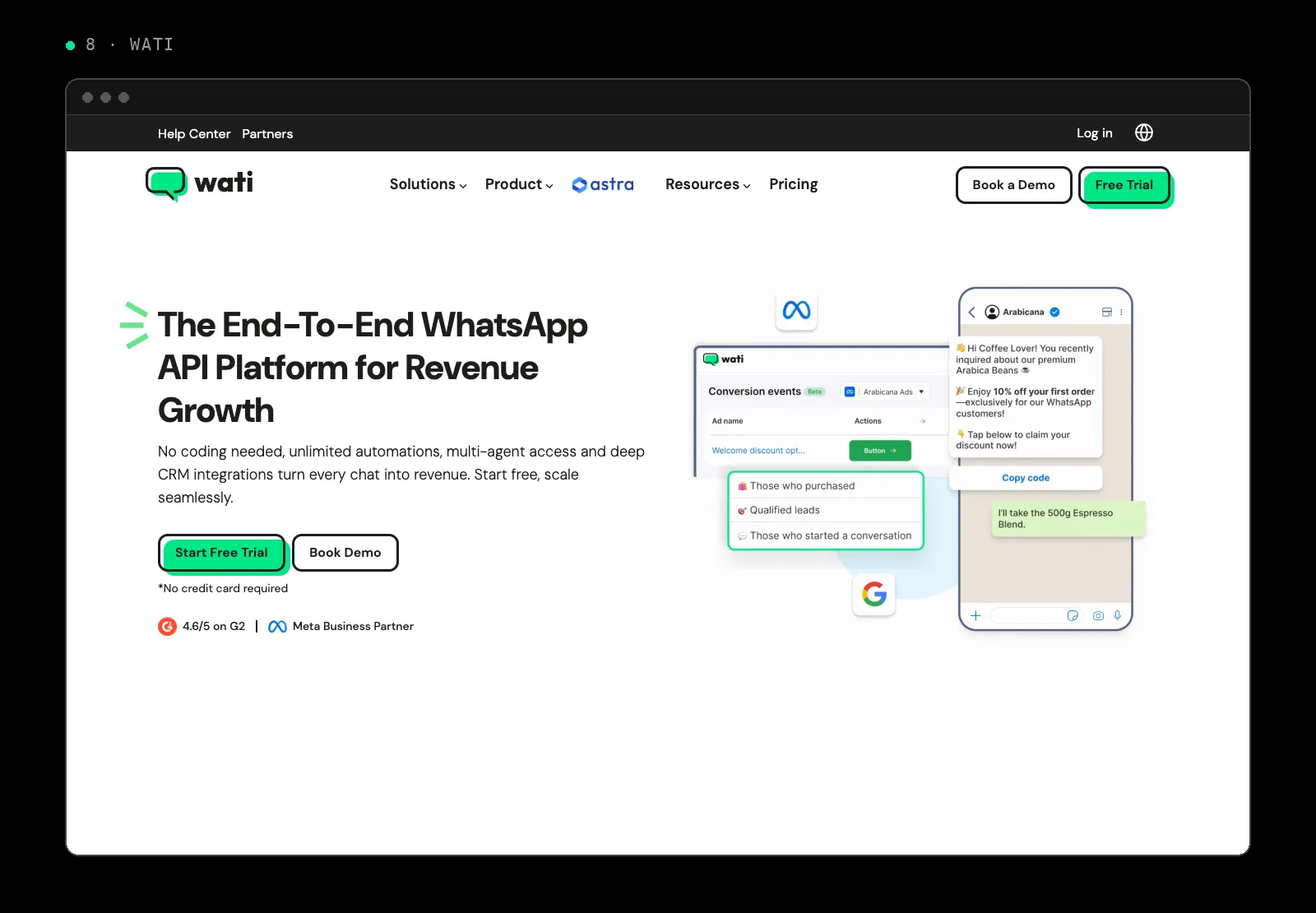
Wati WhatsApp page, October 2026.
Best for: small marketing and support teams that send broadcasts and answer replies in one place without code.
Key features:
- The inbox handles WhatsApp messages and WhatsApp Business Calling alongside Facebook, Instagram, TikTok, a web widget and wa.me links.
- No-code chatbots and a chatbot library automate replies, and Pro adds forms, lead qualification and automatic routing to teams.
- The API allows 10,000 calls a month on Growth, with no rollover, 200,000 on Pro and 20 million on Business, which sends up to 4,000 messages a minute.
Limits:
- The 7-day trial can only message the account owner's own number and cannot submit templates for approval.
- Growth connects one channel and includes 3 users with no extra seats, 15,000 broadcasts a month and no webhooks, and sendTemplateMessage is throttled at 30 per 10 seconds on Growth, 60 on Pro and 100 on Business.
Pricing: Wati lists $69, $149 or $349 a month (Growth, Pro, Business, monthly billing, US), extra users at $24 to $69 a month on Pro and Business, and message charges on top at Wati rate-card prices. Astra AI Agents are an add-on priced separately, and Business adds volume discounts.
Choose Wati if the team sells on Shopify and wants abandoned-cart and order templates and WhatsApp Catalog ready to send.
Best WhatsApp API provider by use case and region
Three situations change the pick: notifications and one-time passcodes, low volume at a small business, and markets outside the US. Each opens with its pick from the ranking and what Telnyx offers there.
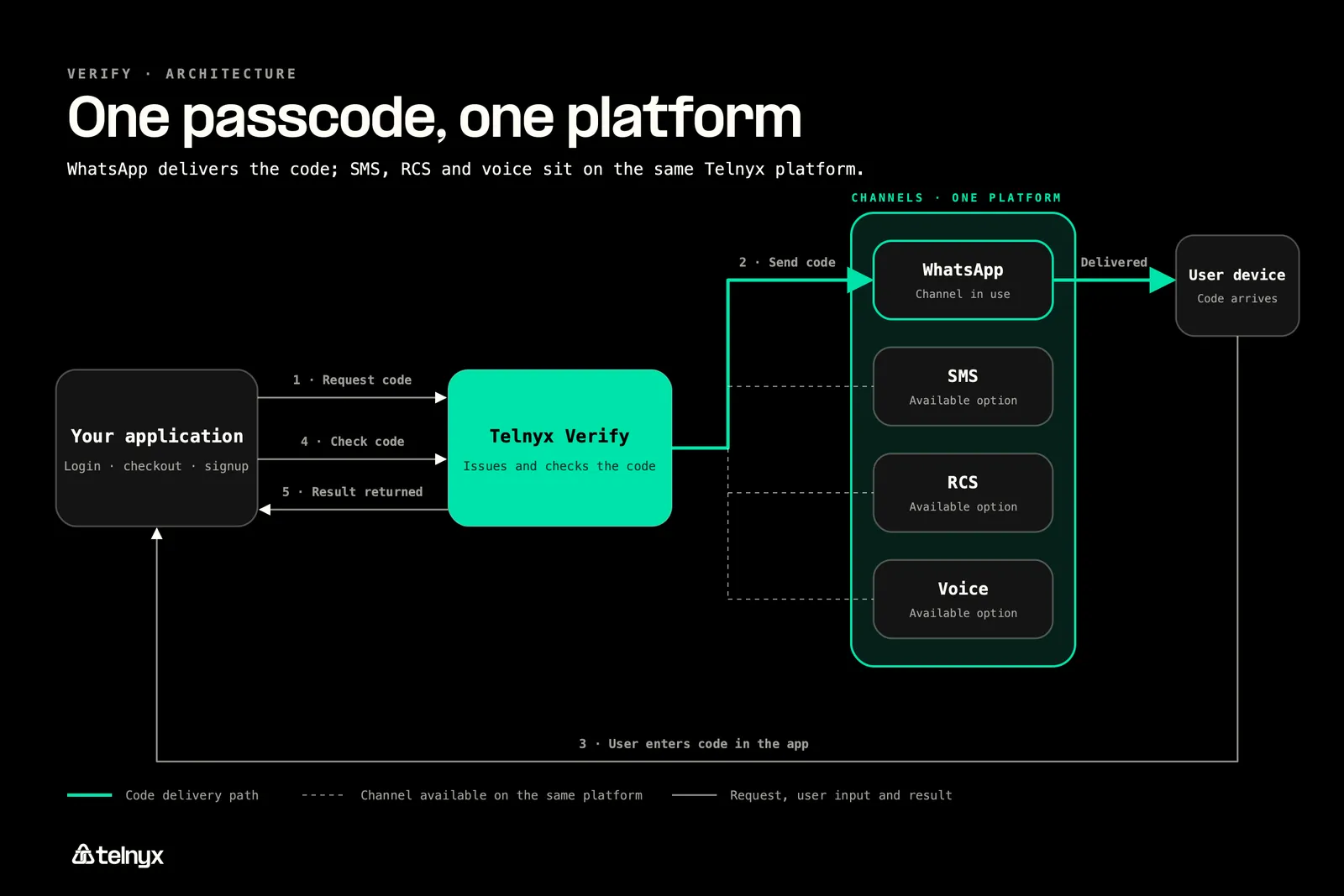
One Verify integration covers WhatsApp, SMS, RCS and voice, so users without WhatsApp still get their code.
Best WhatsApp API for customer notifications and OTPs
Pick: Telnyx. Notifications need no inbox, only a template sent from the system that already knows the order, so the usage-billed provider that already holds the business's SMS number is the shortest path.
Utility templates carry order confirmations, shipping updates and appointment reminders for retail and e-commerce brands, and the customer sees the verified business name instead of an unknown number.
Restaurants run bookings and order-ready pings on the same template path. Meta's WhatsApp messaging limits set how many unique recipients a number can message in 24 hours, so a new number starts in a low tier and grows with quality.
90%+ open rates on WhatsApp utility notifications, Telnyx's published figure for the channel.
The order-tracking example below, in Python from the Telnyx code examples repository on GitHub and checked against the Telnyx SDK, sends a WhatsApp message on every status change and answers customer replies about the order with a model on Telnyx.
These are the lines that pick the text and send it, with the imports, Flask app and environment variables they need.
Install the dependencies with pip install flask requests and set TELNYX_API_KEY, WHATSAPP_NUMBER and MESSAGING_PROFILE_ID before running it.
One-time passcodes go out on authentication templates through the Telnyx Verify API, which sends a code over WhatsApp, the SMS API, RCS or voice from one integration, so a user without WhatsApp still has a channel for the code. The OTP example in the same Telnyx code examples repository shows the start and check calls.
Affordable WhatsApp API access for small businesses
Pick: Telnyx. Meta's fee is fixed, so "cheap" is decided by the provider fee, and at low volume the cheapest structure is usage-based billing with no subscription and no seats, from $0.004 per message.
Meta's side helps too: the first 1,000 free-form service replies per business phone number each month cost nothing, then $0.0034 each in the US.
A flat licence like the 360dialog one pays off only once per-message fees would exceed it. A small e-commerce store in Hong Kong, or anywhere else, that already sends SMS order updates on Telnyx adds WhatsApp on the same number and invoice, and its e-commerce contact center stays on one bill.
Note: Provider fees only, Meta's fee excluded. 1,000 messages a month cost $4 on Telnyx and $5 on Twilio, against a flat EUR 49 a month on the 360dialog Regular plan. At 10,000 messages a month, $40 on Telnyx and $50 on Twilio against the same flat licence.
Best provider for WhatsApp Business API in the US, APAC and the Gulf
Pick: Telnyx in the US and the Gulf, Gupshup as the Asia-Pacific (APAC) specialist. Meta prices every billed message by the recipient's country, and no provider changes that. What does change by region is whether the provider can supply or import a local number and where its support and template approvals are handled.
Telnyx supplies local numbers in 130+ countries with telephony points of presence (POPs) worldwide, which is phone-number coverage rather than a WhatsApp country list, and Bring Your Own Number imports an existing WhatsApp number so one number carries WhatsApp, SMS and voice.
In the EU, WhatsApp Business in Europe covers the region's consent and data rules. For Kuwait and the rest of the Gulf, the first check is a local or imported number.
Three questions settle a non-US market with any provider:
- Can the provider supply, or import, a local number in this country?
- Is WhatsApp calling live on that number?
- Are support and template approvals handled in the team's time zone?
How to choose the best provider to integrate WhatsApp Business API
Each pick fits a different buyer situation:
- A team with developers and voice or SMS already on an API starts with Telnyx: WhatsApp goes on the number and connection that already carry its calls and texts, so there is no second vendor, number or invoice.
- A team already building on Twilio channels can add WhatsApp there. The Telnyx vs Twilio comparison covers the two voice APIs.
- A developer team with no voice or SMS API and no need for an inbox looks at 360dialog, whose flat licence beats a per-message fee above roughly 10,000 messages per number a month, or at Gupshup for traffic in India and Southeast Asia.
- A team with developers that also wants an agent workspace and chatbot builder takes Infobip, after getting the per-message markup in writing.
- A marketing team that already runs email and SMS campaigns adds WhatsApp on Bird.
- A support team with no developers picks respond.io or Wati. Meta's fee is the same through them, so plan price and inbox features decide.
Two warnings. A flat per-number licence is the wrong pick for a low-volume sender, because per-message fees stay below it. An inbox-first tool is the wrong pick for a team that sends from its own back end, because API access sits on higher plans.
With a shortlist, three criteria decide which provider to sign, and a short checklist covers the move from a current provider.
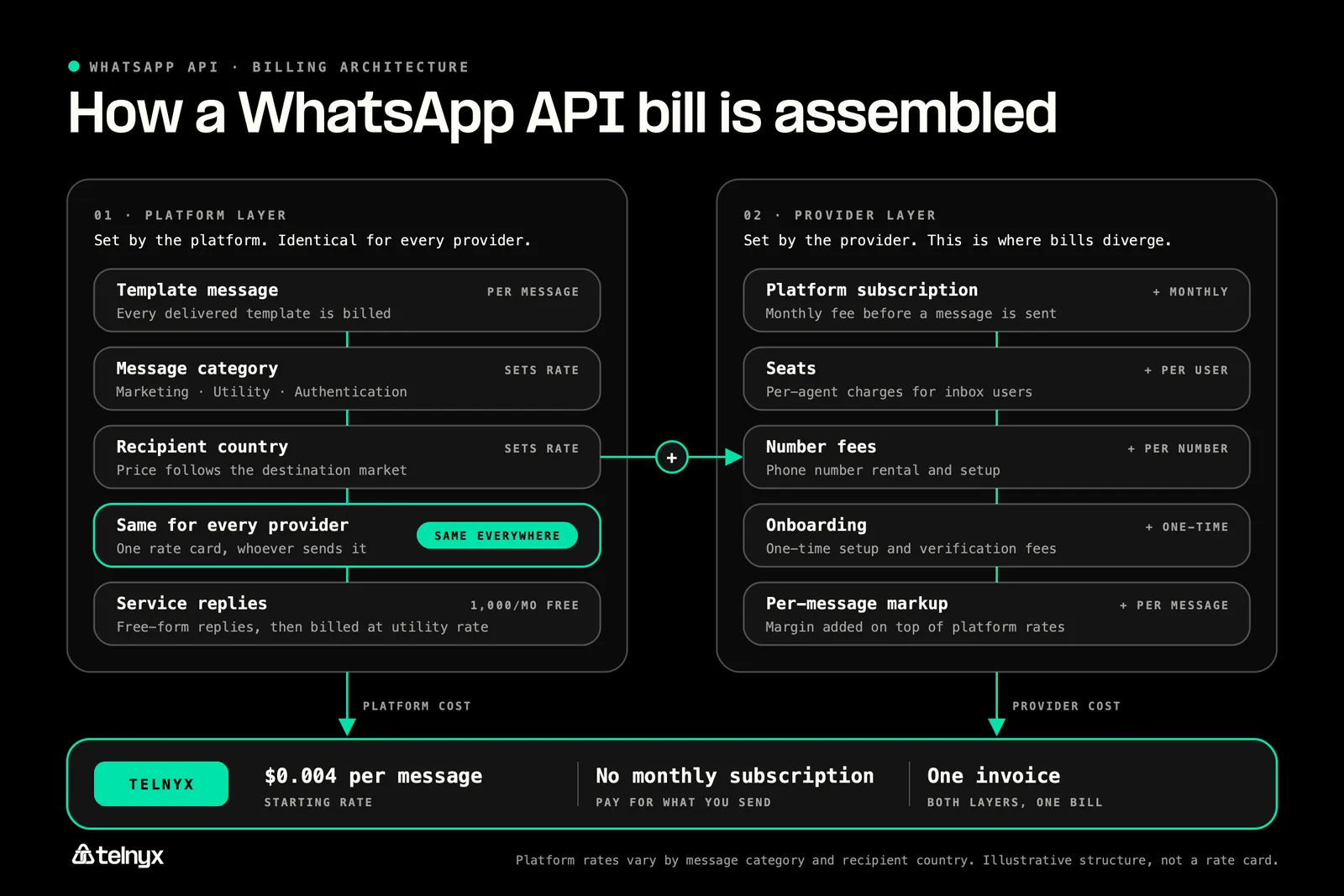
Meta's fee is the same with every provider; only the provider layer changes the bill.
The three criteria that decide the shortlist
- Official Meta access. Check the provider in the Meta partner directory.
- How the provider fee is built. The provider fee is the only comparable price, so ask for the rate card with Meta's fee separated and look for subscription, per-seat, per-number and onboarding fees and any markup.
- Whether WhatsApp messaging and calling share the number and connection a team already runs. Ask where a WhatsApp call lands.
Red flags for an unofficial provider: it asks the buyer to scan a QR code, promises unlimited sending for a flat fee, says Meta approval is unnecessary, or cannot say who handles template approvals. The free WhatsApp Business App, with 256 contacts per broadcast, is a phone app and offers no API.
The full fee breakdown is in WhatsApp Business API cost. On Telnyx the layer is usage-based, $0.0025 per minute on business-initiated calls, no monthly subscription, with Meta fees and platform cost on a single invoice and automatic volume discounts as volume grows.
On Telnyx a WhatsApp-enabled number carries PSTN, SMS, WhatsApp messaging and WhatsApp calls. Inbound WhatsApp calls route to the existing SIP, Voice API or TeXML connection, and calling connections are created automatically when calling is toggled on.
What to check before switching providers
A switch means Meta business verification again under the business's own Business Manager, a number that is eligible to move, templates re-approved, automations rebuilt against the new API, and a test before cutover.
On Telnyx, Embedded Signup from Mission Control handles verification and links the WhatsApp Business Account, Bring Your Own Number imports the existing WhatsApp number, and BYON numbers get the same inbound calling treatment as Telnyx-provisioned numbers.
Switching checklist for a WhatsApp API provider move
| Step | What breaks if skipped | How it works on Telnyx |
|---|---|---|
| Meta business verification | Templates and sending stay blocked under the new provider | Embedded Signup from Mission Control, no tool switch |
| Number import | The business loses the number customers already have saved | Bring Your Own Number keeps the existing WhatsApp number |
| Template re-approval | Notifications fail until Meta approves the templates again | Submit templates for Meta approval from the portal |
| Calling routing | Inbound WhatsApp calls ring nowhere | Toggle calling on and pick a SIP connection in Mission Control |
| Test before cutover | A failed verification or template surfaces on live traffic | Send a template and place a call on the new number first |
Best WhatsApp API provider FAQ
Add WhatsApp to the number already in use
Create a free account, link a Meta Business Manager through Embedded Signup in Mission Control, and send the first WhatsApp template from the number that already carries the team's calls and texts.
Start building for freeShare on Social
Deniz is a Senior Product Marketing Manager at Telnyx with 10 years of experience in technology and healthtech marketing. She previously led go-to-market initiatives at Philips Healthcare, Vodafone, and The Coca-Cola Company. Originally from Türkiye and based in Amsterdam, she ho


