
Verify API
Caller ID name (CNAM): how your business name reaches the phone
Caller ID name (CNAM) is the text carriers show beside your number. See how the CNAM database works, how to register a name, and how to check yours by API.

Takeaways
Caller ID name (CNAM) is the name of up to 15 characters that the recipient's carrier looks up for your number and shows beside it. The name is not sent with your call.
- You can read the exact name the CNAM database holds for any US number with one Number Lookup API request, so you stop guessing what customers see and stop waiting days to test from a colleague's phone.
- CNAM does not apply on toll-free numbers, on calls outside the US and Canada, or on SIP-to-SIP (Session Initiation Protocol) calls, where the display name in the SIP From header shows instead.
- STIR/SHAKEN attests that you are entitled to the number. CNAM only labels it, and neither one removes a 'Spam Likely' tag.
What is caller ID name (CNAM), and is it the same as caller ID?
When your call reaches a customer, their phone shows either your number alone, such as +1 312 555 0100, or the number with a business name above it. That name is your caller ID name (CNAM), a label of up to 15 characters stored against your number. Some carriers call it Caller Name Presentation, or CNAP.
Is CNAM the same as caller ID? No. Caller ID is the number. CNAM is the name your customer's carrier looks up for that number when your call arrives.
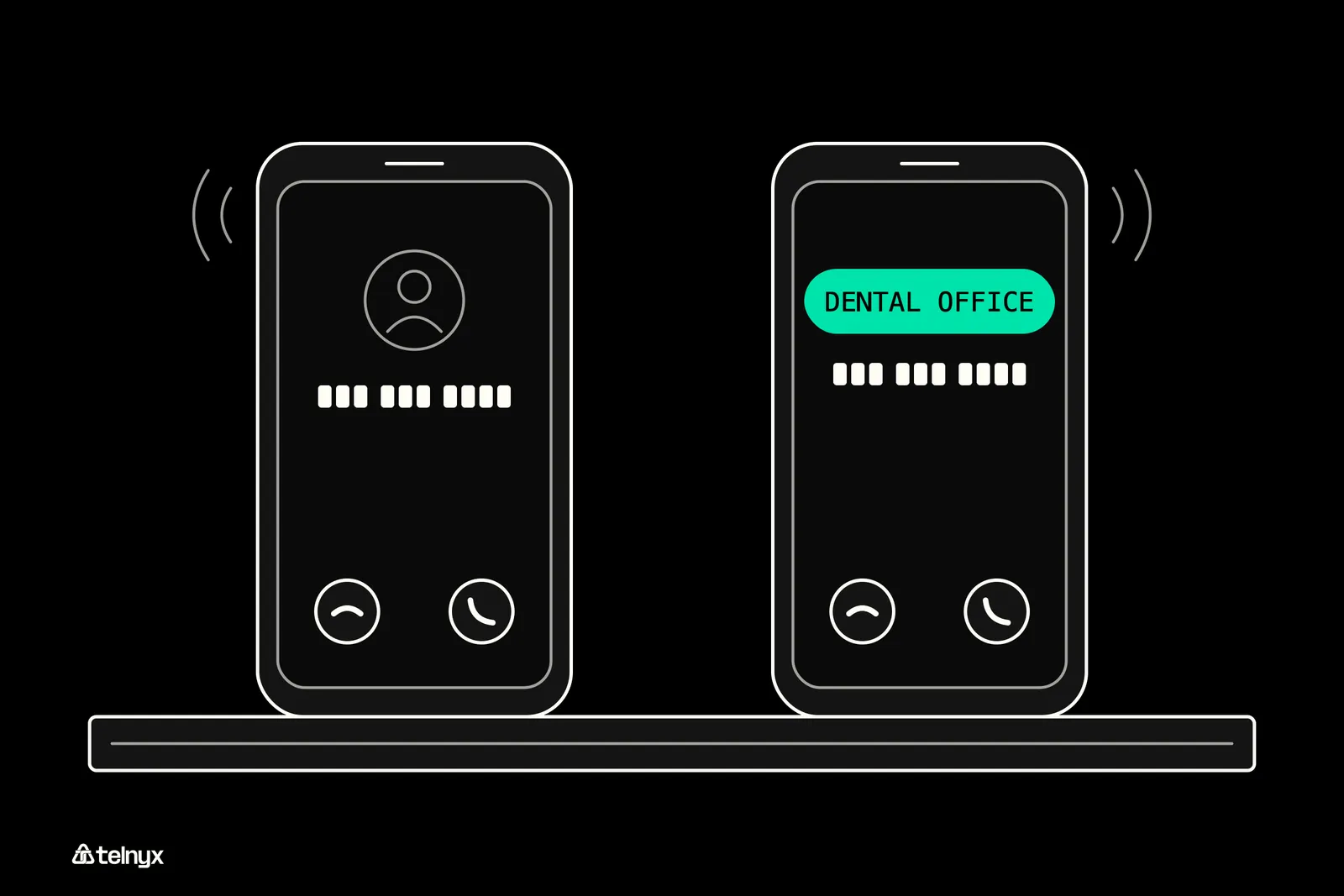
Same call, two screens: the number is Caller ID, the name above it is CNAM fetched by the recipient's carrier.
Caller ID shows the number, CNAM shows the name
In US networks you do not send the name. Your carrier sends only the number, and the receiving carrier queries a name database with it. That is why a registered name shows on one carrier and not another: each terminating carrier decides whether and where to look.
What 'restricted' and 'not available' mean on the screen
If you block name delivery, your customer's phone shows 'restricted'. If the lookup fails, such as a database timeout, it shows 'not available'. An empty record leaves the bare number.
Caller ID vs. CNAM
| Caller ID (CLID) | CNAM | |
|---|---|---|
| What it carries | Your number | Your name |
| Who supplies it | Your network, in call signaling | Recipient's carrier, by database lookup |
| Length | Full E.164 number | Up to 15 characters |
| Where it works | Worldwide | US and Canada public switched telephone network (PSTN) |
| What the phone does | Matches it against contacts | Displays it if no contact matches |
See the name your numbers carry
One Number Lookup request returns the stored CNAM for any US number, before your customers see it.
How the CNAM database works when a call arrives
The carrier that issued your number writes the name into its CNAM record. Carriers share those records with several CNAM database providers. When your call lands, the recipient's carrier dips a CNAM database or the Line Information Database (LIDB) for the calling number and pays a per-dip fee. The handset then shows a saved contact name first, the CNAM result second, and any spam label on top of both.
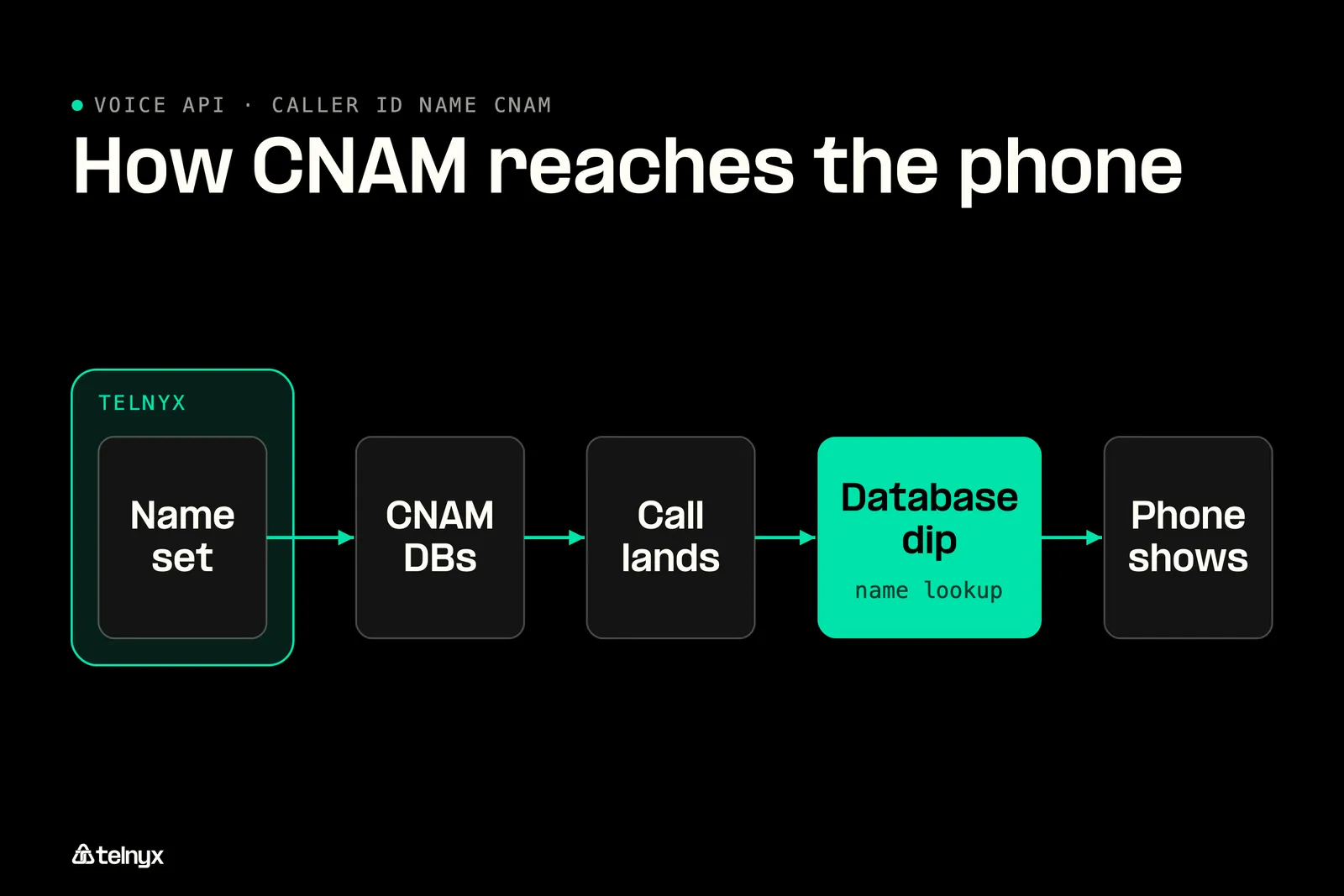
The name never travels with your call: the recipient's carrier dips a CNAM database and pays per lookup.
Who feeds the national caller ID name database
There is no single FCC-run database. The 'national caller ID name database' your name lives in is a set of carrier-owned and third-party databases. A CNAM registry provider copies your issuing carrier's record and sells dips to the carriers that terminate your calls. If you dial into Canada, the originating carrier sends the name with the call.
The CNAM dip: who looks up the name and who pays
Every dip on one of your calls costs the terminating carrier money. Wholesale dips run about $0.002 to $0.006 each, which comes to $200 to $600 per 100,000 calls, according to Wikipedia's Calling Name Presentation entry. To cut that bill, some carriers skip the dip or serve a cached result from an earlier lookup. That is the first cause of a wrong or blank name on your calls.
Why one number shows different names on different phones
Check these three causes in order before you open a ticket:
- The terminating carrier skipped the dip and used cached data, so the phone shows what the number carried months ago.
- The database owner holds a stale record, so every carrier that dips it gets the old name.
- Someone spoofed your number, so the lookup returned your name on a call you never made. The FCC's Truth in Caller ID rules cover that case.
Incumbent local exchange carriers (ILECs) usually hold the most accurate data because they issued most of the records. A name that is right on an ILEC landline and wrong on a mobile points at that carrier's cache.
CNAM vs. STIR/SHAKEN: why a display name is not CNAM authentication
A registered CNAM does not stop your calls being labeled spam, and STIR/SHAKEN does not make your name appear. CNAM is a name the recipient's carrier dips, the record a Number Lookup returns. STIR/SHAKEN, the FCC-mandated framework, cryptographically attests the calling number: your originating carrier signs it and the terminating carrier verifies it. 'CNAM authentication' does not exist, because no layer verifies the name.
The three layers side by side
| Layer | What it shows and where it travels | Who acts and the limit |
|---|---|---|
| CNAM | A name label, from a database | Recipient carrier dips. 15 characters |
| STIR/SHAKEN | Number attestation, in the SIP Identity header | Originating carrier signs, terminating verifies. Number only |
| Branded caller ID / RCD | Name, logo, call reason, in SIP signaling | Originating side attaches, supporting handsets render |
What STIR/SHAKEN attestation verifies
STIR/SHAKEN attests your number at one of three levels, described on the FCC call authentication page:
- A, full attestation: your carrier knows you and confirms you may use the number.
- B, partial attestation: your carrier knows you but has not verified the number.
- C, gateway attestation: your carrier only knows where the call entered its network.
Branded caller ID and Rich Call Data: the friendly name that travels with the call
Branded caller ID and Rich Call Data (RCD) carry your name, logo and call reason in SIP signaling, under Alliance for Telecommunications Industry Solutions (ATIS) and SIP Forum specifications, so the name travels with the call instead of being dipped. Your customer sees it only on a handset and carrier that support RCD.
How 'Spam Likely' labels relate to CNAM
Carriers compare your number against blocklists and call-pattern analytics, and apps such as Verizon Call Filter print the result over whatever the dip returned. High volume, short calls and unanswered dials from your Telnyx phone numbers feed those analytics, so a number shows 'Spam Risk' or 'Scam Likely' with a valid name. Your 10DLC (10-digit long code) brand registration covers texts only and does nothing for a voice label. A ported number keeps its labels, so run a number portability check first. Clear a label through the analytics providers, or through traceback for illegal traffic, the work the Industry Traceback Group does.
Note: Re-registering a correct CNAM changes nothing about a 'Spam Likely' label. Fix your call patterns and attestation instead.
CNAM Caller ID Instructions
You register the name with the carrier that holds the number, and the recipient's carrier displays it after the record propagates. If your pool spans four carriers you file four registrations. For contact center solutions running several hundred thousand dials a day, CNAM belongs in your carrier contract as a per-number attribute.
Which path gets your name displayed?
- US or Canadian local number: register CNAM with the carrier that holds the number. Receiving carriers query its 15-character name record each time you call.
- Toll-free number such as 800 or 888: skip CNAM and look at branded caller ID or Rich Call Data (RCD). Carriers run no name lookup on toll-free calls.
- Calling customers in another country: use an in-country local number instead. CNAM lookups run only on US and Canadian networks, so a CNAM name never shows abroad.
- SIP-to-SIP call between platforms: set the display name in the SIP From header. No database lookup happens, so the far end shows whatever you send, unverified.
Choosing a name that fits in 15 characters
You get 15 characters including spaces. Your carrier stores the name in uppercase, and it may contain only the letters A-Z, the digits 0-9 and spaces. Punctuation, ampersands and accented letters are stripped or rejected, so you cannot register 'ACME DENTAL & CO.' but 'ACME DENTAL CO' goes through.
If one of your teams registers 'ACME DENTAL' and another 'ACME DNTL', half your numbers look like a different company. Pick one abbreviation and use it on every number in the pool, and match the name customers already know from your website and invoices.
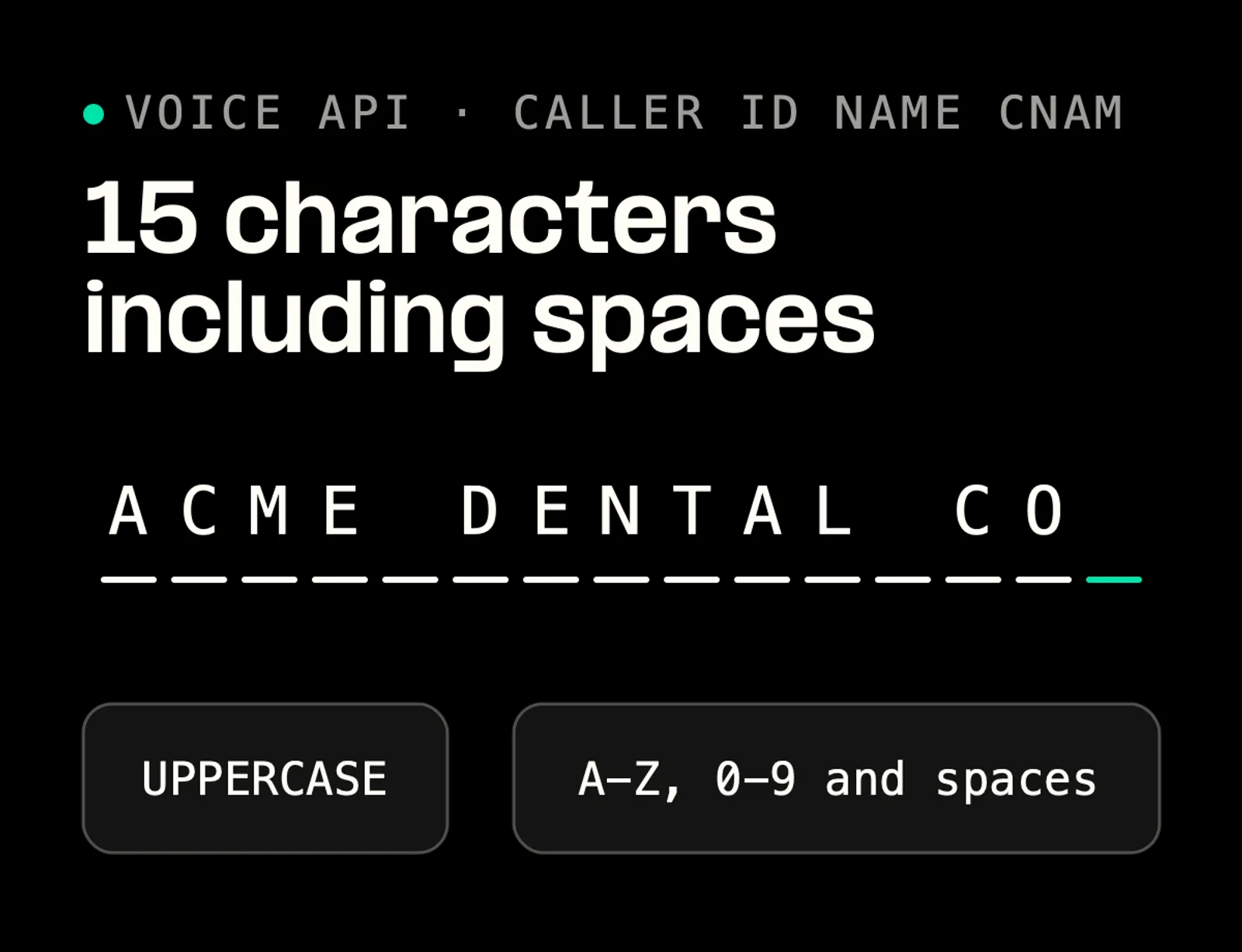
A CNAM name is 15 uppercase characters including spaces, so pick one abbreviation and use it on every number.
What to send for CNAM registration
At most providers a CNAM registration or name change is a ticket rather than a self-serve edit. Send three things: the list of numbers, pulled from the list your phone numbers endpoint, the requested name, and proof of business identity, the same evidence your carrier needs for 10DLC brand registration and an Industry Traceback Group traceback.
Propagation takes days and varies by carrier. Before you port a pool, run a number portability check and plan the re-registration, since the record stays with the losing carrier. Telnyx documents the request in the support article caller ID vs CNAM.
Where CNAM does not apply: toll-free, international and SIP-to-SIP
Check this list before you file:
- Toll-free numbers carry no CNAM record. Use branded calling or RCD on them.
- Calls over the phone network only. On a SIP-to-SIP call your customer's phone shows the SIP From display name, which nobody verifies.
- US and Canada only, so dial international customers from local in-country Telnyx phone numbers.
- Register before your campaign date and confirm with Number Lookup.
How to check CNAM for your own number
Run these three checks in order, cheapest first.
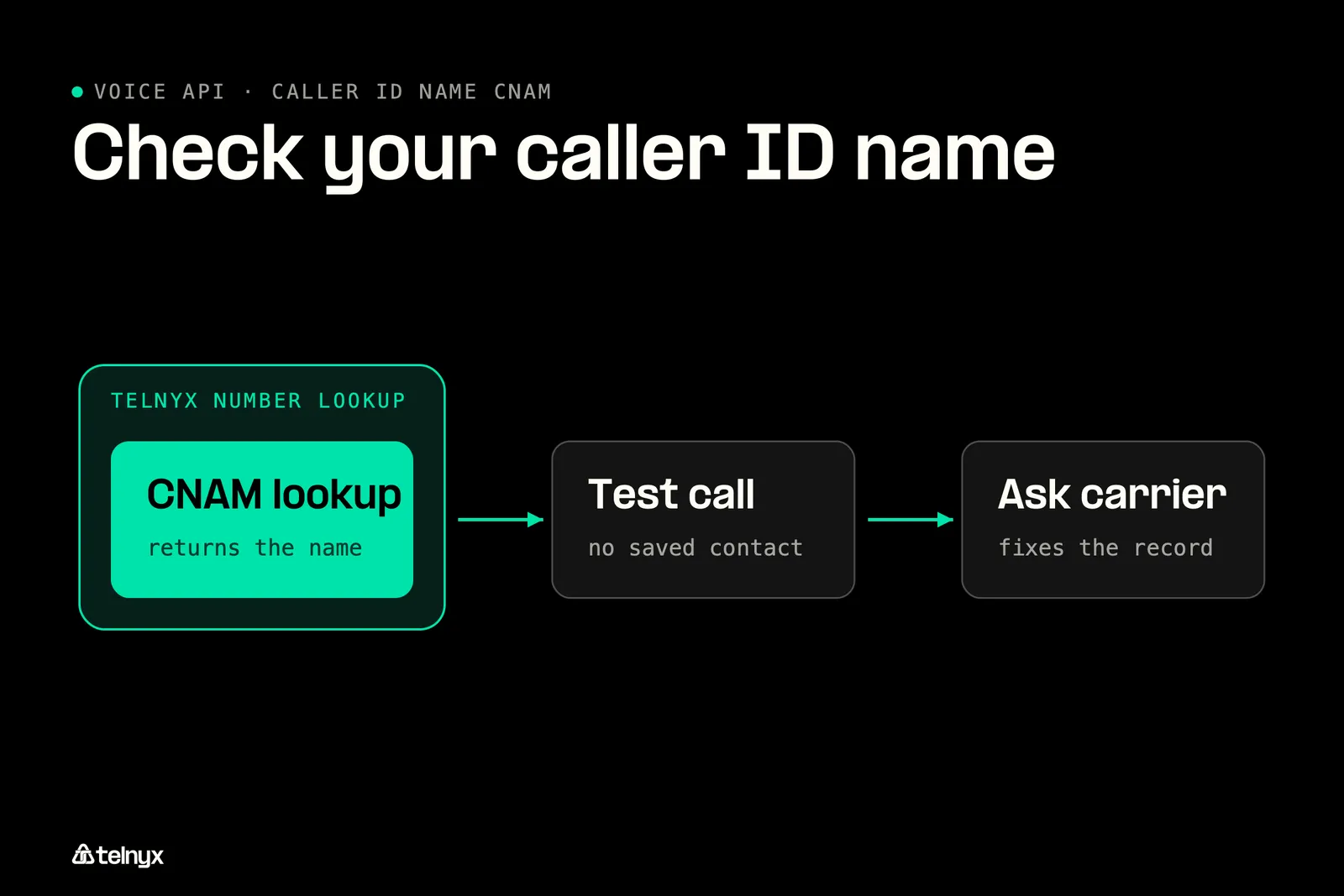
Check your CNAM cheapest first: a lookup, then test calls, then a carrier ticket only if the name is wrong.
Run a CNAM lookup with Telnyx Number Lookup
Telnyx Number Lookup, the CNAM checker, returns the stored name or an empty record when none exists. The Number Lookup API reference documents the GET request with the caller-name type. Before a campaign, list your phone numbers and look up each one, as sales and marketing teams do.
Test on a mobile and a landline
Your mobile checks saved contacts first, and its carrier app may swap in a label, so a saved contact or a spam tag can hide a correct CNAM. A landline shows the dipped name directly. Call them on different carriers from a phone with no contact entry for your number.
Spam label on the test mobile: a carrier app such as Verizon Call Filter has overwritten the name. Check that app's label for your number before you open a CNAM ticket.
When the name is wrong
A name correct on one carrier and blank on another points to a skipped dip or a cached record. An old company name on every carrier points to a stale record at the database owner, so the correction goes to the carrier that holds the number, which a number portability check confirms. A name right on your test calls but wrong on calls your contact center never placed points to spoofing, which the Industry Traceback Group traces to its source. Attach the lookup result to the ticket.
Setting the name your Telnyx numbers show
The name your customers see is set on your Telnyx phone numbers and checked with Number Lookup from the account that also handles 10DLC brand registration. The support article Caller ID outbound vs CNAM separates the two records, the caller ID management page covers setting the name, and the CNAM in Canada release note covers calls into Canada, which are handled differently. Telnyx vs Twilio compares the two voice APIs, and the branded calling reference example on GitHub takes branded calling profiles past 15 characters.
Caller ID name (CNAM) FAQ
Read the name your numbers carry
One Number Lookup request returns the exact name the CNAM database holds for any US number, so you stop guessing what customers see and stop waiting days to test from a colleague's phone.
Run a CNAM lookupShare on Social
Deniz is a Senior Product Marketing Manager at Telnyx with 10 years of experience in technology and healthtech marketing. She previously led go-to-market initiatives at Philips Healthcare, Vodafone, and The Coca-Cola Company. Originally from Türkiye and based in Amsterdam, she ho


