
Messaging
RCS Business Messaging Pricing How It Works and What to Expect
RCS business messaging pricing depends on message type, destination, volume, and carrier. Learn how pricing works and what to ask providers before you commit.
Takeaways
- RCS business messaging pricing depends on five factors: message type, destination and carrier, message volume, session windows, and advanced features.
- Basic text-only RCS messages often cost about the same as SMS. Rich media messages run 20 to 30% higher. Conversational sessions are roughly double the SMS rate but include a 24-hour window for unlimited replies, as of July 2025.
- Most major RCS providers bill per delivered message, as of July 2025. If a device cannot receive RCS, the message falls back to SMS and you pay the SMS rate.
- Providers that own their network have fewer markup layers than resellers, which makes pricing more predictable.
- Ask seven questions before you sign: billing basis, fallback costs, carrier pass-through fees, session pricing, volume discounts, setup fees, and compliance costs.
How RCS Business Messaging Pricing Works
RCS business messaging pricing is a per-message or per-session cost model that varies by message type, destination, carrier, volume, and provider. Unlike SMS, which carriers price as a flat rate per 160-character segment, RCS charges scale with the richness of the content. A plain text RCS message costs about the same as an SMS. A rich card with images and buttons costs more. A conversational session with a 24-hour reply window costs the most per message but often the least per customer interaction. Most major RCS providers bill only for messages delivered to the recipient's device, as of July 2025.
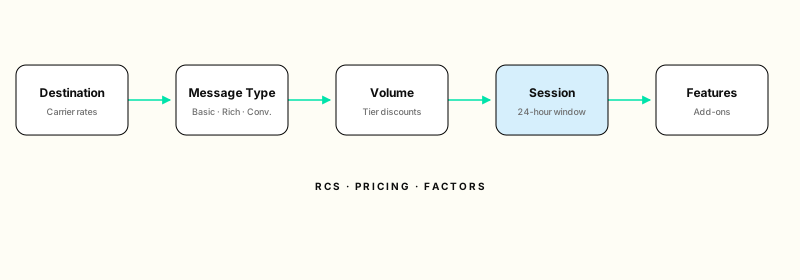
Five factors determine what you pay:
- Destination and carrier. Local operator agreements set the base rate for each country and network.
- Message volume. Higher monthly volume unlocks tiered discounts with most providers.
- Message type. Basic text is cheapest. Rich media and conversational messages cost more.
- Session window. Conversational pricing covers a 24-hour window of two-way exchanges, which lowers the effective cost of interactive use cases.
- Advanced features. Chatbots, automation, and CRM integrations add platform costs on top of message fees.
RCS Message Types and Their Pricing Impact
Message type is the biggest pricing lever you control. RCS business messaging supports messages up to 3,072 characters with rich media, compared to SMS's 160-character plain text, and providers price each tier of that capability differently.
The table below shows the three common message types and their cost implications, based on publicly published pricing frameworks as of July 2025.
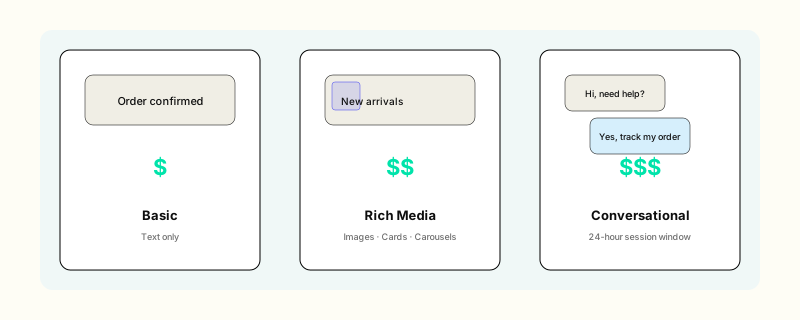
| Message type | What you get | Cost relative to SMS |
|---|---|---|
| Basic | Plain text up to 3,072 characters, delivery and read receipts | About the same as SMS |
| Rich (Single) | Images, video, rich cards, carousels, suggested replies | Around 20 to 30% higher |
| Conversational | Two-way session, unlimited exchanges within a 24-hour window | Roughly double per message, session included |
Basic messages fit one-way notifications like order confirmations and delivery alerts. Rich messages suit promotions and product launches where an image or carousel earns the extra cost. Conversational pricing changes the math for support and commerce, since one session fee covers an entire back-and-forth that would rack up per-message charges on SMS.
Note that these tiers apply to business-initiated messaging through a verified sender agent, not peer-to-peer chat. The distinction matters for budgeting, and standard vs business RCS explains it in detail.
Start sending RCS messages with TelnyxRCS business messaging with smart fallback, unified billing, and direct carrier connections. Explore RCS on the Telnyx platform.
Get started with RCSRCS Pricing vs SMS Pricing
RCS costs more per message than SMS in most markets. That is the wrong number to optimize. The right number is cost per outcome, whether that outcome is a click, a reply, or a completed purchase. A comparison of the two channels makes the tradeoff clear.
| Factor | RCS | SMS |
|---|---|---|
| Character limit | 3,072 with rich media | 160 plain text |
| Billing basis | Per delivered message or per session | Per message segment sent |
| Media support | Images, video, carousels, buttons | Text only |
| Sender identity | Verified brand name and logo | Numeric sender |
| Reach | Devices with RCS support and data | Every mobile phone |
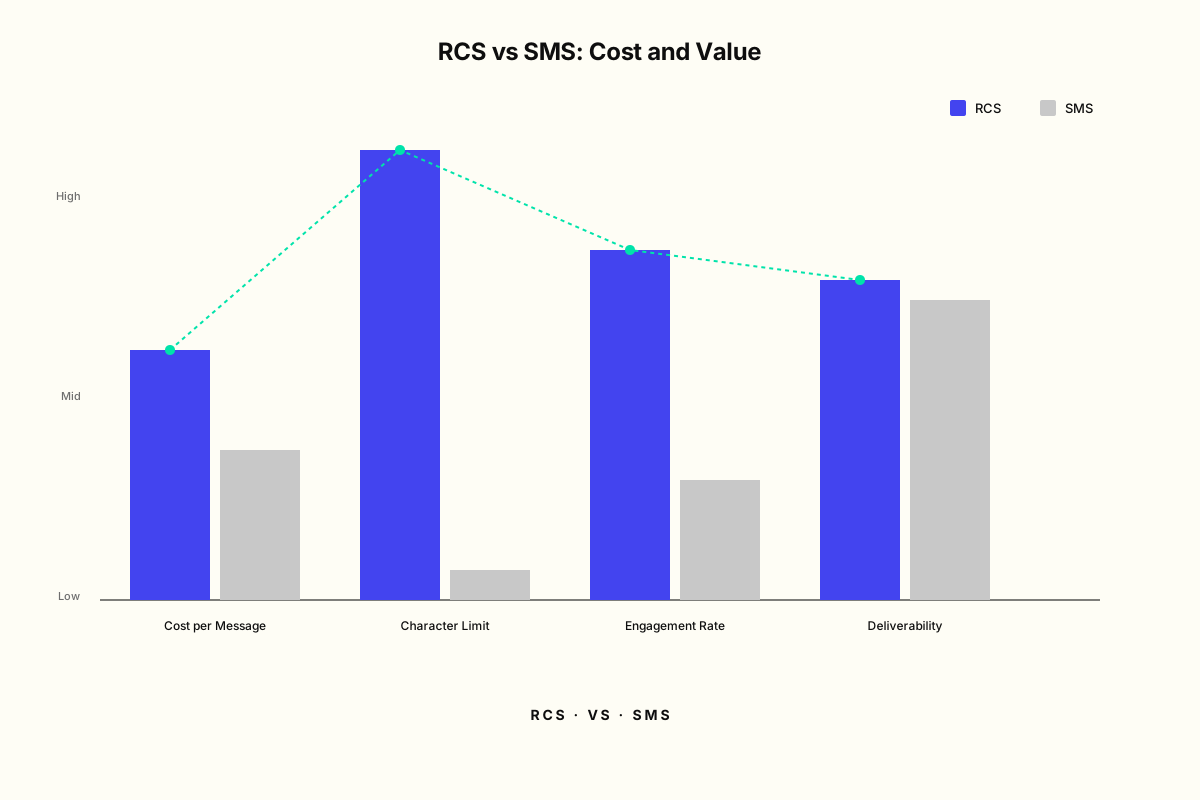
Two details in that table carry real budget weight. First, RCS is billed on delivery, so an undelivered message costs nothing. Second, a single RCS message contains 19 times as many characters as one SMS segment, so long messages that would split into multiple billed SMS segments fit within one RCS charge.
The channels work best together. Read SMS vs RCS for a full capability comparison, and SMS and RCS for how teams run both from one platform. A programmable SMS API with direct carrier connections handles the fallback traffic and keeps every recipient reachable.
What to Ask an RCS Provider About Pricing
These seven questions will help you understand whether the pricing model fits your business.
Is billing per message sent or per message delivered? Delivery-based billing means undelivered messages cost nothing. Confirm which model applies.
What happens when a message falls back to SMS? Ask whether fallback messages bill at the SMS rate and whether fallback happens automatically or requires separate integration work.
Are carrier pass-through fees itemized or bundled? Bundled fees hide markup. Itemized fees let you see what the carrier charges and what the provider adds.
How is conversational pricing structured? Confirm the session window length, what counts as a session, and whether agent-initiated and user-initiated sessions price differently.
What volume discounts apply, and at what tiers? Get the tier thresholds in writing so you can model costs as volume grows.
Are there setup fees, monthly minimums, or agent verification charges? One-time and recurring platform fees change the total cost of ownership beyond the per-message rate.
What compliance and verification costs apply? Google requires verified sender agents for all RCS Business Messaging. Budget for sender registration, brand vetting, and ongoing compliance with carrier acceptable use policies. Ask whether the provider handles verification or charges separately for it.
Choosing an RCS Provider for Your Business
Architecture drives price. Every intermediary between your application and the carrier adds a markup layer, and most messaging providers resell connectivity they buy from aggregators. Telnyx operates its own telephony network and holds direct carrier relationships, which removes those reseller layers and makes pricing more predictable at scale.
Platform consolidation matters too. Telnyx runs RCS on the same platform as SMS, voice, and AI, with unified billing across all of them. You provision phone numbers from the same portal and API you use to send messages, so there is no second vendor to reconcile invoices against. Many providers bundle carrier fees into a single opaque rate, as of July 2025. Telnyx itemizes them.
Fallback strategy is the third test. Smart fallback from RCS to SMS means messages always deliver. When a recipient's device lacks RCS support or data connectivity, the platform routes the message over SMS automatically and bills it at the SMS rate. Your delivery rate stays high and your spend matches what actually reached a handset.
Three important factors when comparing providers:
- Network ownership. Direct carrier connections mean fewer markups and fewer points of failure than resold routes.
- Omnichannel integration. One API and one bill for RCS, SMS, and voice beats stitching together separate vendors.
- Fallback handling. Automatic fallback within the platform beats building and maintaining your own retry logic.
Try RCS Business Messaging Yourself
The fastest way to evaluate RCS is to send a rich card. This Flask example uses the Telnyx Send Message API to deliver an RCS rich card with a title, description, media, and suggested reply buttons.
The full working example, including an AI-powered product catalog with carousels, lives in the Telnyx code examples repo. Clone it, set your API key, and you can send your first rich card in minutes.
Get Started with RCS Business Messaging
RCS pricing rewards buyers who understand the model. Match message types to use cases, bill on delivery, use conversational sessions for two-way traffic, and pick a provider whose architecture keeps markup out of your rate. Telnyx gives you RCS, SMS fallback, and unified billing on a network it operates, with pricing quoted for your specific volume and destinations.
Ready to add RCS to your messaging strategy?Talk to an expert about pricing for your volume. Contact Telnyx for a custom quote.
Talk to an expertFAQs
How much does RCS business messaging cost? RCS business messaging pricing varies by provider, message type, destination, and volume, as of July 2025. Basic text-only RCS messages are often priced similarly to SMS. Rich media messages with images, videos, or carousels typically cost about a third more. Conversational RCS, which includes a 24-hour session window for unlimited two-way exchanges, is roughly twice the per-message SMS cost but can be more cost-effective for interactive customer support. Contact providers for current rates.
Is RCS more expensive than SMS? RCS messages cost more per message than SMS because carriers charge higher pass-through fees for the richer protocol. RCS messages can drive better engagement rates than SMS in industry benchmarks, which justifies the higher price.
How is RCS business messaging billed? RCS is typically billed per message successfully delivered to the end user's device. Messages that cannot be delivered because the device lacks RCS support or data connectivity are not charged. Most providers also offer volume discounts and session-based pricing for conversational use cases.
Share on Social

Serhii Omelchenko
Global AEO/SEO Manager
Serhii is Global AEO/SEO Manager at Telnyx, based in Amsterdam, he is focused on making communications infrastructure findable and credible across both traditional search and AI-driven discovery. He previously led SEO and GEO strategy for some of the world’s most recognized consu


%20(1).png?width=96&format=webp)

