
Email API
Building an Ecommerce Email Automation Strategy
Ecommerce email marketing drives $45 for every $1 spent. Learn the campaigns that convert, why delivery infrastructure matters, and how owning your email stack beats reselling.
Takeaways
- Ecommerce email marketing returns $45 for every $1 spent in retail and ecommerce (Litmus, State of Email).
- Behavior-triggered emails like cart abandonment and post-purchase flows outperform batch-and-blast campaigns on revenue per recipient.
- Deliverability is now a compliance problem. Gmail and Yahoo enforce authentication and spam complaint thresholds, and unauthenticated senders get blocked.
- Most ecommerce email stacks are Frankenstacks. An ESP like Klaviyo sends through rented infrastructure like SendGrid, adding layers between your store and the inbox.
- Owning your email infrastructure means one API for transactional and marketing email, one bill, and direct control over deliverability.
What Is Ecommerce Email Marketing
Ecommerce email marketing is the practice of using email to drive revenue for an online store through targeted, behavior-triggered messages. It covers two categories. Marketing emails are promotional. They include welcome series, product launches, and win-back campaigns. Transactional emails are operational. They include order confirmations, shipping alerts, and receipts. Both categories run on the same underlying infrastructure, and both directly affect revenue.
There are more than 4.5 billion email users worldwide (Statista), and the global email marketing market is projected to reach $17.9 billion by 2027 (QY Research, growing at 13.3% CAGR from $7.5 billion in 2020).
Why it matters: Email is the only revenue channel an ecommerce brand can own outright. Social reach is rented and paid search is auctioned. Your email list and the infrastructure that delivers to it are assets you control.
The distinction between marketing and transactional email is operationally important. Providers, mailbox operators, and regulators treat them differently. Mixing them on one sending stream damages the deliverability of both. Separating them, ideally on one platform with distinct streams, protects your transactional messages while giving marketing campaigns room to scale.
Types of Ecommerce Emails That Drive Revenue
Not all emails earn the same. Behavior-triggered messages sent to one person at the right moment outperform scheduled campaigns sent to everyone at once. Here are the core email types every ecommerce store should run.
| Email Type | Trigger | Revenue Impact |
|---|---|---|
| Cart abandonment | Cart created, no checkout | Strong direct recovery revenue (18.2% conversion rate, Klaviyo 2025) |
| Order confirmation | Purchase completed | 60-70% open rate (MailerToGo 2025), cross-sell surface |
| Shipping alerts | Fulfillment events | Builds trust, reduces support tickets |
| Welcome series | New signup | Sets lifetime engagement baseline |
| Post-purchase | Order delivered | Drives reviews and repeat purchases |
| Win-back | 60-90 days inactive | Recovers lapsing customers cheaply |
| Browse abandonment | Product viewed, no cart | Captures early purchase intent |
Cart abandonment emails recover revenue that was one click from closing. The shopper already chose the product. A timely reminder, sometimes with an incentive, brings back a portion of those lost carts. Cart recovery emails achieved 18.2% conversion rate in 2025 (Klaviyo), and 43% of recovered carts happen within the first hour (WorldMetrics). Order confirmations and shipping alerts are operational, but customers open them at 60 to 70% rates (MailerToGo 2025), higher than any marketing email. That attention is a cross-sell and retention surface.
$45
returned for every $1 spent on ecommerce email marketing
Litmus, State of Email (retail and ecommerce)
A welcome series sets the tone for the entire customer relationship. Subscribers are most engaged in the first days after signup, so a three-to-five email sequence introducing the brand, best sellers, and a first-purchase offer outperforms later campaigns. Welcome emails average 68.59% open rate, 4x higher than regular campaigns (Campaign Monitor 2024), and a three-email series generates 90% more orders than a single welcome email (Omnisend 2024). Post-purchase flows keep that momentum. A delivery follow-up, a review request, and a replenishment reminder turn one-time buyers into repeat customers.
Customer expectation: 91% of shoppers want to hear from companies they do business with via email (Bit.ai email marketing statistics compilation).
Win-back emails target customers who have gone quiet for 60 to 90 days. They cost almost nothing and reactivate buyers you already paid to acquire. Browse abandonment emails work one step earlier in the funnel than cart recovery. A shopper viewed a product but never carted it. A light-touch reminder captures that intent before it fades.
Cart Abandonment Email Strategies
Timing decides whether a cart recovery email works. Send the first email within one hour of abandonment, while the purchase intent is still warm. Waiting a day reduces recovery rates. The shopper has moved on or bought elsewhere. Personalize the message with the exact cart contents, product images, and a direct link back to checkout. Generic reminders get ignored.
Structure the recovery as a three-email series rather than a single message.
- Email one, 1 hour after abandonment. A simple reminder with cart contents and a checkout link. No discount yet.
- Email two, 24 hours later. Address common objections. Shipping costs, return policy, sizing. Add social proof.
- Email three, 48 to 72 hours later. Introduce an incentive if margins allow. A discount code or free shipping closes fence-sitters.
Infrastructure warning: A cart abandonment email that lands in spam recovers nothing. Recovery revenue depends on inbox placement, and inbox placement depends on your delivery infrastructure, authentication, and sender reputation. The best-written recovery sequence fails silently if the pipe underneath it is unreliable.
Subject lines should be direct and specific. Reference the product by name. Questions and urgency work when honest, and fail when manufactured. For carts that email does not recover, a second channel helps. Brands that pair email with SMS for abandoned carts reach shoppers who ignore their inbox.
Transactional Emails Customers Expect
Transactional emails have high open rates relative to marketing email. Order confirmations hit 60 to 70% open rates (MailerToGo 2025), against a 35% median for marketing campaigns (MailerLite 2025). Customers actively look for them. An order confirmation that arrives instantly builds trust. One that arrives late, or never, triggers panic, support tickets, and chargebacks. These messages are infrastructure-dependent in a way marketing emails are not. If your email API provider has a delivery incident, your customers feel it within minutes.
That is the argument for owning the delivery layer instead of renting it. When you control the infrastructure, you control deliverability, latency, and failover. Here is what sending an order confirmation looks like through a direct API.
The same send works from any stack with a single HTTP request.
Shipping notifications and delivery updates follow the same pattern, triggered by fulfillment events. Send them promptly and consistently. Customers who trust your operational emails engage more with your marketing ones.
Why Email Infrastructure Matters for Ecommerce
Most ecommerce teams evaluate email marketing tools. Klaviyo, Mailchimp, Omnisend. Few evaluate the infrastructure underneath those tools. That is where deliverability, cost, and reliability are actually decided. Klaviyo and Omnisend are ecommerce-focused ESPs built on rented delivery infrastructure. SendGrid, now owned by Twilio, resells email infrastructure to thousands of platforms. Telnyx owns its infrastructure end to end.
The difference shows up in three places. First, cost. Each intermediary layer in the delivery chain adds its own pricing, and you pay for every layer whether you see the line item or not. SendGrid charges $89.95/month for 300K emails on Pro (ToolRadar 2026), while Amazon SES charges $0.10 per 1,000 emails. The gap widens at higher volumes and with add-ons like dedicated IPs and email validation. Second, control. When delivery degrades on rented infrastructure, your vendor files a ticket with their upstream provider while your revenue waits. Third, fragmentation. Running marketing email through one vendor and transactional email through another means two integrations, two bills, and two places for data to fall out of sync.
| Approach | Provider Example | Tradeoff |
|---|---|---|
| ESP on rented infrastructure | Klaviyo, Omnisend | Markup stacked on markup, no delivery control |
| Infrastructure reseller | SendGrid (Twilio) | Delivery control sits with the upstream owner |
| Owned infrastructure | Telnyx | Direct delivery control, one API, one bill |
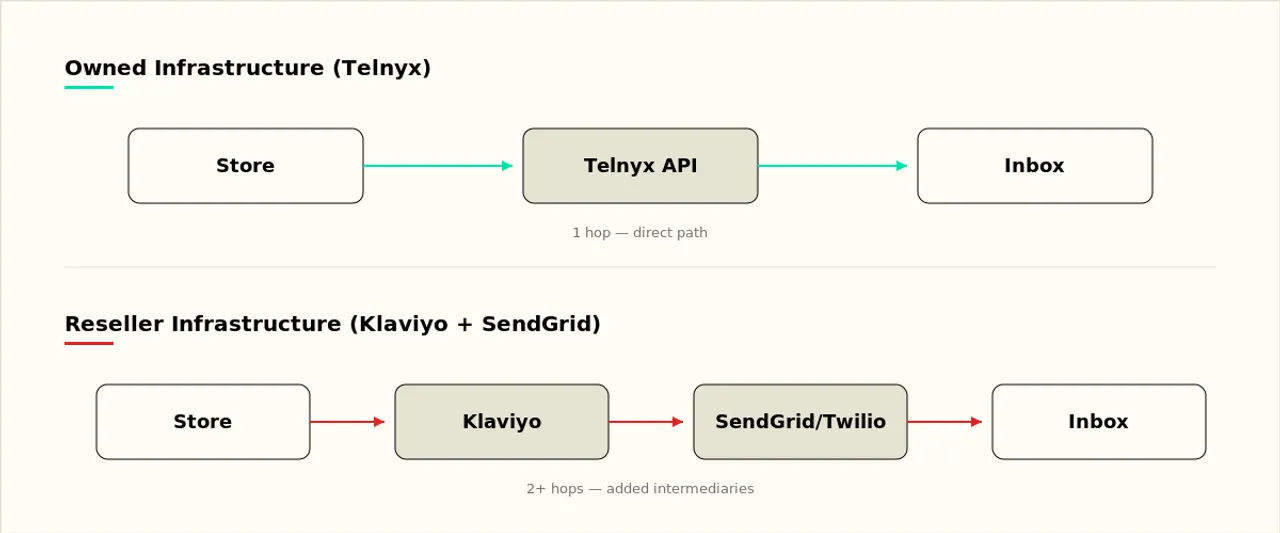
The stitched-together stack is the default because it grew that way, not because it works best. Every handoff between vendors adds latency and a failure point. Meanwhile, acquiring customers keeps getting more expensive. Ecommerce customer acquisition costs are up 40% since 2023 (Ringly.io 2026). When acquisition costs rise, retention channels like email carry more of the revenue load, and the infrastructure behind them deserves the same scrutiny as your payment processor. Our guide to the Email API breaks down how to evaluate providers on ownership rather than feature checklists.
Email Deliverability Requirements in 2026
Since early 2024, Gmail and Yahoo have enforced bulk sender requirements. These are not suggestions. Senders who fail them get filtered or blocked outright. The requirements are specific. Authenticate with SPF, DKIM, and DMARC. Offer one-click unsubscribe. Keep spam complaint rates below 0.3%, and aim for 0.1% to stay clear of the threshold.
The stakes are visible in the placement data. Gmail inbox placement sits at 87.2%, down from 89.8% in early 2024 (Validity 2025 Email Deliverability Benchmark Report). Microsoft properties sit at 75.6%, and roughly 1 in 4 emails sent to Yahoo, AOL, Hotmail, and Outlook fail to reach the inbox (GlockApps, January 2024). Filtering is getting stricter, not looser.
Deliverability checklist for 2026:
- Publish SPF, DKIM, and DMARC records for every sending domain
- Add one-click unsubscribe headers to all marketing email
- Keep spam complaints below 0.3%, target 0.1%
- Separate transactional and marketing sending streams
- Warm new domains and IPs gradually over 4 to 6 weeks
- Remove hard bounces and chronic non-openers on a schedule
Deliverability stays at 97 to 99% for properly authenticated senders on Gmail (AISend Email Deliverability Benchmark 2026). Authentication is a competitive advantage, not table stakes.
Two practices matter beyond authentication. Separate your transactional and marketing streams so a promotional campaign that draws complaints cannot drag down your order confirmations. And warm new domains gradually, starting with your most engaged recipients, so mailbox providers build a positive history before you scale volume.
Related: Reputation is earned slowly and lost fast. The same principles apply to SMS delivery.
Ecommerce Email Segmentation and Personalization
Segmentation is how you stop sending everyone everything. The four segments that matter most for ecommerce are purchase history, browsing behavior, lifecycle stage, and email engagement. A first-time buyer, a VIP repeat customer, and a subscriber who has never purchased should not receive the same message. Engagement-based segments also protect deliverability, because sending less to unengaged recipients lowers your complaint and bounce rates.
Personalization goes far beyond a first name in the subject line. Product recommendations based on purchase history, browse abandonment triggers based on viewed items, and dynamic content blocks that swap by segment all outperform static campaigns. The results are measurable. NA-KD increased customer lifetime value by 25% with cross-channel personalization (Insider case study).
25%
increase in customer lifetime value from cross-channel personalization at NA-KD
Insider case study
There is an infrastructure angle here too. Segmentation data has to flow from your store to your email platform to your delivery provider before a personalized message can send. Every handoff adds latency and a place for data to break. Fewer layers means fresher data at send time and fewer silent failures.
Building an Ecommerce Email Automation Strategy
Automation turns email from a campaign calendar into a revenue system. Every automated flow has three parts. A trigger, which is the customer behavior that starts the flow. Timing, which is the delay between trigger and send. And series structure, which is the number and sequence of messages. The four flows every store needs are the welcome series, cart abandonment series, post-purchase series, and win-back series.
Build them in this order.
- Pick your stack and wire the data. Connect store events to your email platform. Order created, cart abandoned, product viewed, delivery confirmed.
- Establish your deliverability baseline. Authenticate domains, separate streams, warm sending infrastructure before volume ramps.
- Launch the core flows. Welcome, cart abandonment, post-purchase, win-back. Simple versions first.
- Scale segmentation and personalization. Add dynamic content, recommendations, and lifecycle segments once the basics convert.
- Optimize continuously. Test timing, subject lines, and incentives against revenue per recipient, not opens.
Note: Automation reliability is delivery reliability. An automated flow that triggers correctly but sends through degraded infrastructure fails invisibly. Monitor delivery events, not just trigger events. A flow is only working if the messages reach inboxes.
Here is a working cart abandonment flow. A webhook fires when a cart is abandoned, and a three-email series is scheduled at 1 hour, 24 hours, and 48 hours.
Close the loop by subscribing to delivery events. Bounces and spam complaints should feed back into your suppression lists automatically.
For a deeper walkthrough of flow design and trigger logic, see our guide to sending email via API. If email is part of a broader messaging strategy, SMS marketing campaigns and mass text messaging can extend reach beyond the inbox.
How to Measure Ecommerce Email Performance
Opens and clicks are diagnostics, not goals. The metric that matters for ecommerce is revenue per recipient. It tells you how much each email address on your list is worth per send, and it punishes both over-sending and lazy segmentation. Track it alongside conversion rate, click-through rate, unsubscribe and complaint rates, bounce rate, and list growth versus churn.
| Metric | What It Measures | Target Range |
|---|---|---|
| Revenue per recipient | Revenue divided by delivered emails | Trend upward per flow |
| Conversion rate | Recipients who purchase | 1 to 5% for triggered flows |
| Click-through rate | Recipients who click | 2 to 5% |
| Spam complaint rate | Recipients who report spam | Below 0.1% |
| Bounce rate | Emails that fail to deliver | Below 2% |
| List growth vs. churn | Net subscriber change | Positive month over month |
Benchmark note: These are general industry ranges (Klaviyo 2024 Email Benchmarks, MailerLite 2025). Your targets vary by industry, list size, and sending frequency.
Use the funnel as a diagnostic framework. Low opens point to subject lines, list quality, or a deliverability problem. Low clicks suggest weak offers, unclear CTAs, or poor segmentation. Low conversions trace to the landing page or an offer mismatch between email and site. Low revenue per recipient across the board usually means over-sending or under-segmentation. Fix the earliest broken stage first, because everything downstream depends on it. The same measurement discipline applies to SMS Marketing, where revenue per recipient is even easier to attribute.
FAQ
Build your ecommerce email on infrastructure you own.Telnyx owns its email infrastructure end to end. One API for transactional and marketing email, with no intermediary layers between your store and the inbox. Explore the Email API.
Get started with Email APIShare on Social

Serhii Omelchenko
Global AEO/SEO Manager
Serhii is Global AEO/SEO Manager at Telnyx, based in Amsterdam, he is focused on making communications infrastructure findable and credible across both traditional search and AI-driven discovery. He previously led SEO and GEO strategy for some of the world’s most recognized consu


