
Numbers
Toll-free VoIP: what it is, what it costs, and how to choose a provider in 2026
Toll-free VoIP is the delivery of a toll-free number over an IP network instead of a traditional circuit-switched line.

By Eli Mogul
A toll-free number still does the same job it did decades ago: it lets a customer call your business at no charge to them, with your company picking up the cost. What has changed is the network underneath. A growing share of toll-free traffic now rides over Voice over Internet Protocol (VoIP) rather than legacy switched lines, and the regulatory environment around that traffic shifted sharply in 2026.
If you are evaluating toll-free VoIP for a contact center, a small business line, or an AI voice agent, two things matter more than the per-minute rate: who actually controls the number, and whether your provider is a licensed carrier that can attest to your calls. This guide explains how toll-free VoIP works, what published rate sheets reveal about real costs, and why the trust layer has become the deciding factor.
What is toll-free VoIP?
Toll-free VoIP is the delivery of a toll-free number (one that begins with 800, 888, 877, 866, 855, 844, or 833) over an IP network instead of a traditional circuit-switched line. The number itself behaves the same way to a caller. The difference is in routing: calls are carried as data and pointed to whatever destination you choose, whether that is a desk phone, a cloud contact center, or an AI agent.
The prefixes are not interchangeable. According to the FCC's consumer guide, dialing a number with an 800 prefix reaches a different recipient than the same digits behind an 888 prefix, and the Commission assigns most toll-free numbers on a first-come, first-served basis.
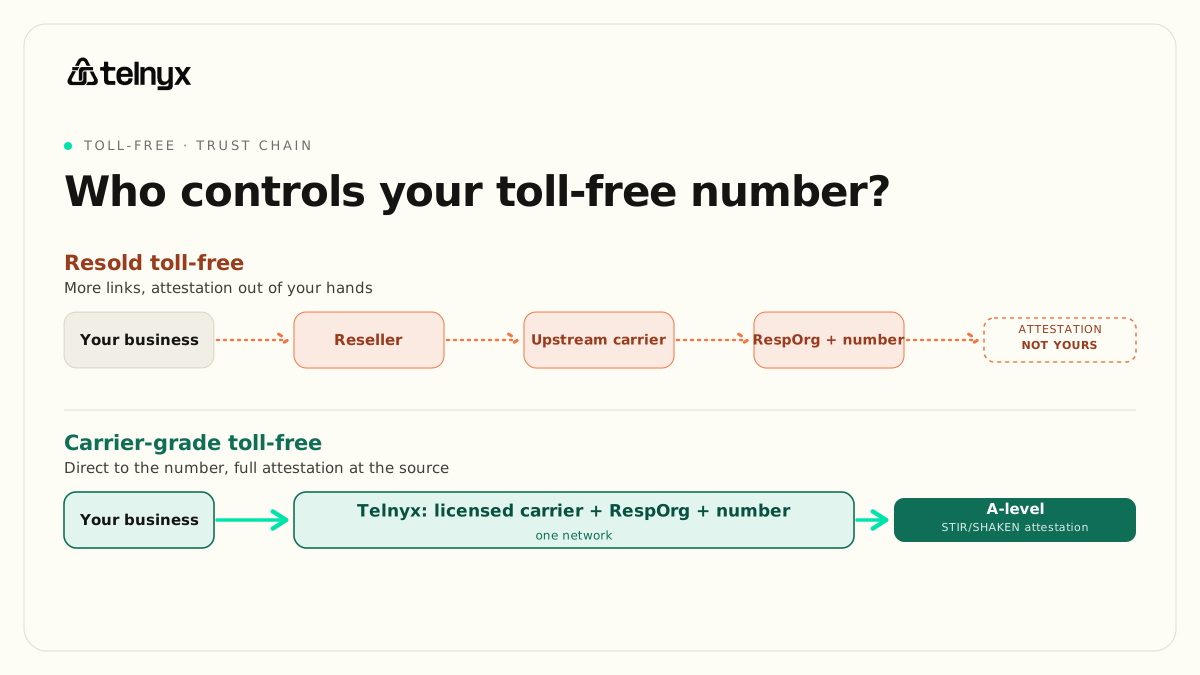
Behind every toll-free number sits a layer most buyers never see. A toll-free number is not assigned directly by your provider. It is reserved and managed by a Responsible Organization, or RespOrg. Federal regulation at 47 CFR 52.101 defines a RespOrg as the entity a toll-free subscriber chooses to manage and administer its records in the toll-free Service Management System. In effect, RespOrgs function much like domain registrars do for internet addresses. The database itself is administered by Somos, the FCC-appointed registry administrator, which also certifies RespOrgs and runs the verification process that text-enables toll-free numbers.
This matters for one practical reason: when your provider is its own RespOrg and a licensed carrier, you deal directly with the source. When it is a reseller, you are one more link removed from the number you depend on.
Why the 2026 regulatory shift changes the calculation
For years, choosing a toll-free VoIP provider was mostly a question of price and features. Two federal developments in 2026 reframed it as a question of compliance and trust.
The first is enforcement posture. On January 6, 2026, the FTC's biennial report to Congress on the National Do Not Call Registry disclosed that consumers had placed more than 258 million numbers on the Registry by the end of fiscal year 2025, an increase of more than 4.8 million over the prior year, and that the agency received more than 2.6 million Do Not Call complaints in FY2025, with most reported violations coming from robocalls rather than live callers. Since the Registry began in 2003, the Commission has filed 173 lawsuits against 570 companies and 449 individuals, collecting nearly $400 million. The report is explicit that the FTC now pursues VoIP providers that facilitate illegal calls alongside dialing-platform and soundboard vendors. Industry analysts reading the report described this as a targeted shift toward the infrastructure layer, with VoIP providers, dialing platforms, and soundboard firms named as growing enforcement targets.
The second is disclosure obligation. On April 23, 2026, the Federal Register published the FCC's notice of proposed rulemaking, "Improving Customer Service and Protecting Consumers Through Onshoring" (FCC 26-16). The proposal would require providers of telecommunications services, CMRS, interconnected VoIP, cable, and DBS services to disclose when a call is being handled outside the United States and to let consumers transfer to a U.S.-based representative. Comments were due May 26, 2026, with reply comments due June 22, 2026. The key takeaway for buyers: interconnected VoIP is explicitly inside the scope of this proposed regime, so toll-free routing over VoIP is squarely in the frame.
Together these two moves push the same conclusion. Running toll-free service over VoIP now carries compliance weight, and the safest place to run it is on a licensed carrier that can stand behind your traffic.
The trust layer: STIR/SHAKEN and attestation
The technical mechanism that ties all of this together is STIR/SHAKEN, the caller ID authentication framework the FCC has required voice providers to implement since 2021. It lets an originating carrier digitally sign a call so the terminating carrier can confirm the caller ID has not been spoofed.
Signing is not pass or fail. Each call gets one of three attestation levels. According to TransUnion's breakdown of attestation levels, an A-level (full) attestation signals the lowest risk: the originating provider confirms both who the caller is and that the caller has the right to use that number. Calls that receive lower than an A are at greater risk of being labeled spam or blocked outright.
Here is the catch. Only a provider with its own STIR/SHAKEN implementation obligation, which in practice means a licensed carrier, can make the attestation-level decision and sign calls with its own certificate. A reseller cannot grant your traffic full attestation on its own authority. If answer rates matter to your business, the attestation question is the provider question.
What toll-free VoIP actually costs
Commercial toll-free pricing pages tend to bury real numbers behind "contact sales." Government and university IT departments publish theirs, which makes them useful benchmarks. The table below pulls published figures from three public-sector rate sheets so you can anchor your own quotes.
| Provider (rate sheet) | Setup cost | Recurring cost | Per-minute usage | Provisioning time |
|---|---|---|---|---|
| Illinois DoIT (Megacom) | $77.00 install | $1.50 per line per month | $0.03 intrastate / $0.04 interstate | Target 14 business days |
| Illinois DoIT (Ready Line) | $48.00 install | $22.00 per line per month | $0.045 intrastate / $0.065 interstate | Target 14 business days |
| Duke OIT (domestic TFN) | No upfront expense | $2.00 per month minimum | Per-minute, billed at vendor rate | 5 to 7 business days |
A few things stand out. Setup costs vary widely, recurring line fees can be the larger long-run expense, and intrastate and interstate minutes are often priced differently. International toll-free is a separate animal: Duke notes that international service charges both a one-time setup fee and per-country monthly usage, and requires a customer-supplied list of originating countries.
The public sector also frames a useful trade-off. The North Carolina Department of Information Technology runs its toll-free inbound service on switched-access PSTN technology, which it describes as highly dependable for low-volume inbound calling, and it names VoIP as the modern alternative for higher-feature workloads such as call recording and video. That is the choice in miniature: resold PSTN toll-free for simple, low-volume needs, or carrier-grade VoIP toll-free when you need features, scale, and control.
What to look for in a toll-free VoIP provider
Pull the rate sheet comparison and the regulatory shift together and a short checklist emerges:
Licensed carrier status. A provider that is a licensed carrier and its own RespOrg provisions numbers directly rather than reselling them from an upstream supplier. That shortens the chain between you and your number.
A-level attestation by default. Confirm the provider signs your outbound toll-free traffic with full STIR/SHAKEN attestation. This directly affects whether your calls connect or get flagged.
Number portability. Toll-free numbers are portable by FCC rule, but the porting experience depends on whether your provider holds RespOrg status and can move quickly.
Transparent, predictable pricing. Use the published .gov rate sheets above as a sanity check against any quote, and separate setup, recurring, and per-minute components.
Inbound AI readiness. If you plan to route toll-free calls to an AI agent, the provider should support that on the same platform rather than through a patchwork of third-party integrations.
Where Telnyx fits
Telnyx is a licensed carrier, which means toll-free numbers are provisioned directly on owned infrastructure rather than resold from an upstream supplier. Outbound calls originate on the Telnyx network with STIR/SHAKEN attestation handled by the carrier, so your traffic carries the trust signal that terminating networks look for.
That same network is built for what comes after the connection. Because Telnyx colocates dedicated GPUs alongside its global points of presence, toll-free calls can route into low-latency AI voice agents without leaving the platform. For teams building inbound and outbound call flows in code, the Voice API exposes the full stack, and smaller teams can start with VoIP for small business.
The contrast with a typical multi-vendor setup is the point. Instead of stitching together a number reseller, a separate carrier for attestation, and yet another vendor for AI, you provision numbers, route calls, and run voice AI on one carrier-grade network. Under the FTC's enforcement posture and the FCC's proposed onshoring rules, consolidating onto a licensed carrier is no longer just an efficiency play. It is a compliance one.
Ready to provision toll-free over a licensed carrier?
Telnyx gives you toll-free numbers, carrier-grade STIR/SHAKEN attestation, and AI-ready voice infrastructure on a single private network, with transparent pricing you can scale. Sign up for a free Telnyx account to provision a toll-free number, or talk to our team about routing toll-free traffic to a voice AI agent.
Share on Social


