
Conversational AI
Deciding Where To Start With Conversational AI
the ideal AI solution implementation should keep customer experience at its core

While there are some obvious financial and operational efficiencies to be gained from implementing an AI solution, the ideal implementation should keep customer experience at its core. This will vary from business to business, however, by looking at consumer data we can identify a few key trends to help guide your decisions.
Customer Communication Trends
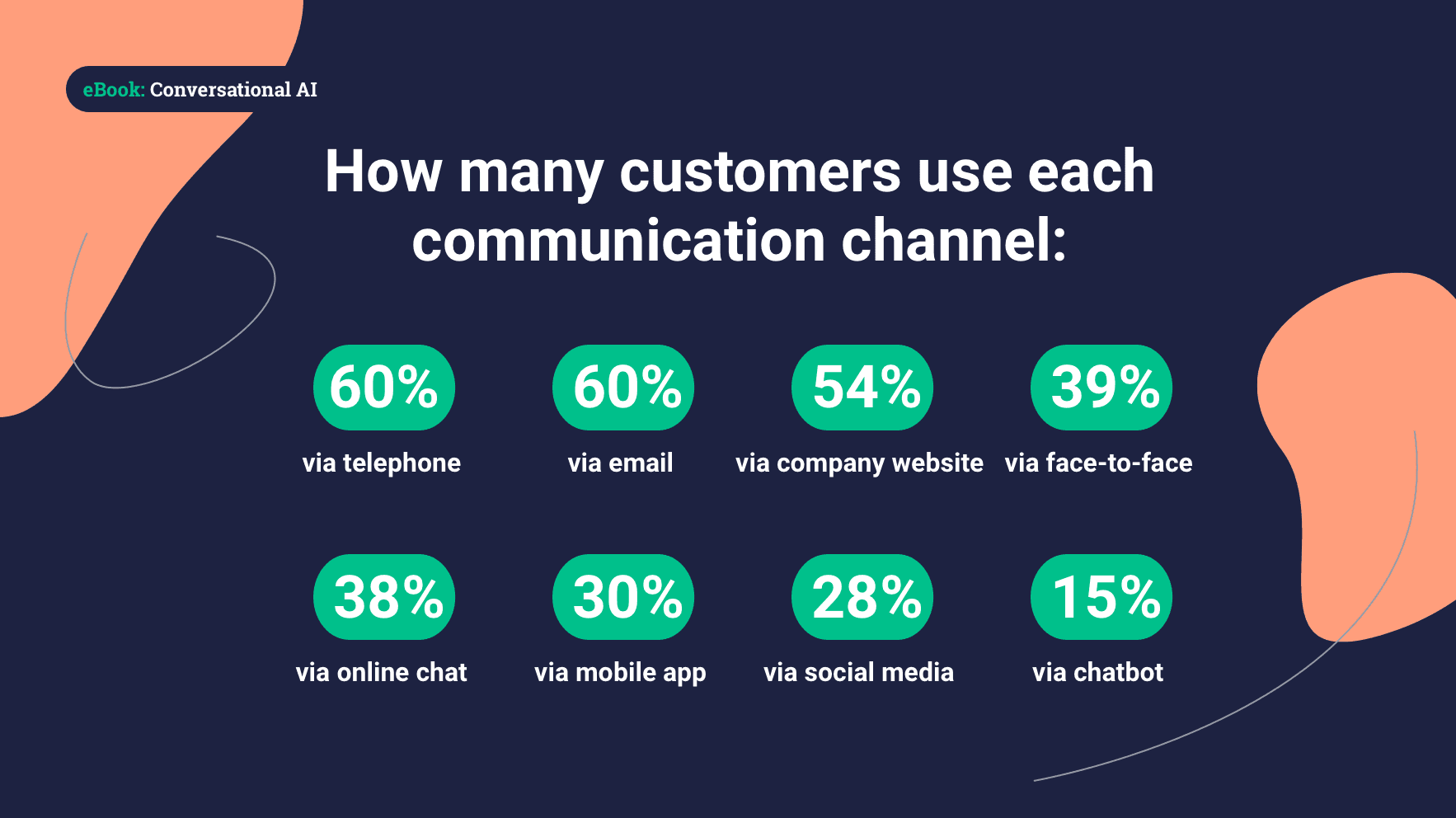
How consumers communicate with businesses is the easiest, and most instructive data to evaluate. According to Drift’s 2018 State of Chatbots Report, this is how many customers use each communication channel:
- 60% by telephone.
- 60% through email.
- 54% through the company's website.
- 39% face-to-face.
- 38% through online chat.
- 30% through a mobile app.
- 28% through social media.
- 15% via chatbot.
Many companies still aren’t using any automated communication. So, adding conversational AI and chatbots can be a big brand differentiator. Provided it’s done right of course.
The vast majority of consumers communicate with brands through channels that can be augmented with conversational AI and chatbots (telephone, company websites, online chat, and mobile apps).
Additionally, customers have stated how they’d like companies to use chatbots. When asked what they predict they would use a chatbot for, customers responded like this:
- Getting a quick answer in an emergency: 37%
- Resolving a complaint or problem: 35%
- Getting detailed answers or explanations: 35%
- Finding a human customer service assistant: 34%
- Making a reservation (e.g. restaurant or hotel): 33%
- Paying a bill: 29%
- Buying a basic item: 27%
- Getting ideas and inspiration for purchases: 22%
- Adding yourself to a mailing list or news service: 22%
- Communicating with multiple brands using one program: 18%
- (none of these things): 14%
- Buying an expensive item: 13%
The upshot? You’re almost guaranteed to see a positive impact from implementing conversational AI and chatbots, if you do it correctly.
Conversational AI and chatbots can enhance the communication channels that customers use most. And, customers have some expectations that companies will use automation to make certain buying and customer support activities easier and more convenient.
However, this means that you could potentially use conversational AI and chatbots for just about anything, since they cover most communication channels and a lot of business activities.
Check out our eBook: Your Guide to Better Leveraging Conversational AI to learn about key conversational AI use cases across industries.
FAQ
What is a key differentiator of conversational AI? The ability to sustain multi-turn, context-aware dialogue and handle interruptions in real time sets it apart. Top systems also trigger backend actions and update state mid-conversation for faster resolution.
What is a key differentiator of conventional AI? Conventional AI excels at single-shot predictions or batch processing with fixed inputs and outputs. It does not manage live turn-taking, clarifications, or tool use during an interaction.
What are the benefits of conversational AI? Enterprises gain 24/7 coverage, lower handling costs, and shorter wait times with scalable automation. Customers see faster answers and more relevant help that can incorporate rich content across channels, which drives customer engagement.
What is the difference between AI and conversational AI? Conversational AI pairs natural language understanding, dialogue management, and speech or text interfaces to exchange information in real time. General AI models produce outputs but lack the orchestration needed for turn-taking, memory, and error recovery.
Which channels matter most when deploying conversational AI? Voice provides immediacy, while SMS offers reach and MMS adds media richness that changes how you design prompts, flows, and confirmations, so understanding SMS vs MMS helps align content to each channel. Omnichannel assistants should route by intent and user preference to maintain continuity.
How do you integrate messaging with a conversational AI stack? Use APIs and webhooks to pass intents and payloads, then programmatically send confirmations or media via a MMS API when visuals add clarity. Keep message schemas consistent across channels so your dialogue manager can track state.
Should you use group or broadcast messaging in conversational AI workflows? Group messaging supports multi-party threads with shared context, while broadcast messaging sends the same update to many recipients without linking their replies, so choosing group or broadcast depends on whether participants need to see each other. For alerts and one-to-many campaigns, broadcasts reduce noise and simplify compliance.
Share on Social