
Voice
Text-to-speech API phone call demo
Watch a live demo of Telnyx’s text-to-speech API generating natural speech on a call. Real-time voice in action.

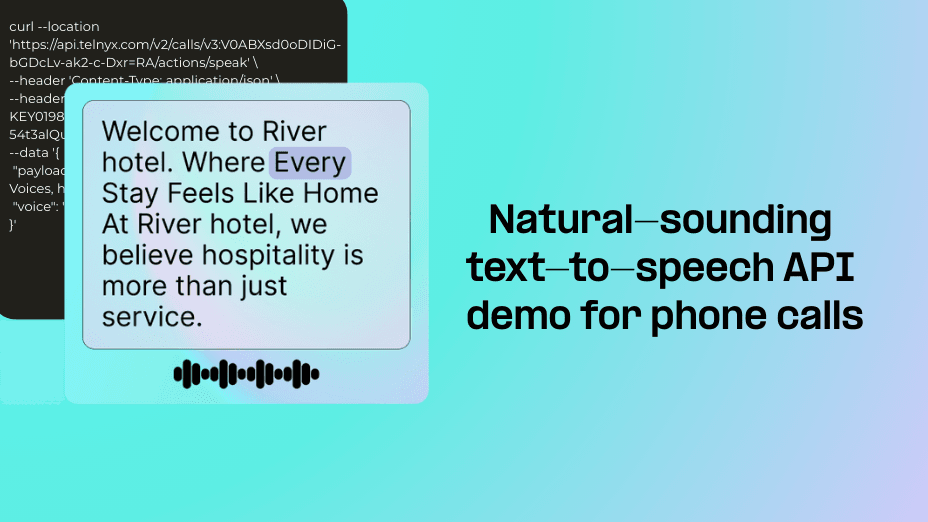
Whether for AI agents, customer service, dynamic IVRs, or on-call assistance, a text-to-speech API lets you generate lifelike speech in real time and control the call flow from start to finish.
Choosing the right provider matters. Telnyx gives you access to a wide range of high-quality TTS voices including Telnyx, Google, Azure and Amazon Polly, with deeper mid-call programmability so you can switch voices, update scripts, or inject new speech dynamically—all at a significantly lower cost than many CPaaS providers.
If you need flexibility, low latency, and the freedom to update your voice interactions mid-call, Telnyx’s API is built for you.
👉 Watch the demo to see text-to-speech on a phone call and learn how to add real-time voice to your product.
<script src="https://player.vimeo.com/api/player.js">
What is in the demo?
In this video, we go from zero to real-time TTS on a phone call in minutes. You’ll also hear us compare Telnyx NaturalHD voices, Azure neural voices, and Amazon Polly voices side by side. The current Telnyx TTS model portfolio also includes Telnyx Ultra for Voice AI, Qwen3TTS for custom voice clone paths, MiniMax, Rime, xAI, Resemble AI, AWS, and Azure through the broader TTS API to show how each provider handles clarity, tone, and responsiveness in phone conversations. Here’s what we cover:
- Setting up your account
- Buying a number
- Setting up your Telnyx Voice API application
- Where to test your webhooks
- Testing different voices on voice playground
- Making a live phone call with API commands
- Generating real-time audio with the Telnyx text-to-speech API
- Switching between Telnyx NaturalHD, Azure, and Amazon Polly voices
To follow along, you just need:
- A Telnyx account
During setup, you’ll grab two things (we show exactly where to find them in the video):
- Your Application ID from your Voice API application
- Your API key from the Telnyx portal
We show each of these steps in the demo so you can pause, copy, and test as you go.
Developer resources
FAQ
Which countries does Telnyx support? Telnyx provides voice and messaging coverage across more than 140 countries, with availability differing by service and number type. Country-by-country access can change based on local regulations and carrier partnerships.
Is MMS supported in every country Telnyx covers? MMS support is not universal, because SMS and MMS have different carrier support and pricing that vary by market. In regions without MMS, SMS is typically available and better suited for broad reach.
Can I get a local or toll-free number for my country? Local and toll-free numbers are available in many countries, subject to local KYC rules and use case review. Inventory and activation requirements can vary by city, province, or number type.
What country-specific rules affect messaging or voice? Most countries enforce sender registration, identity verification, and content restrictions, especially for A2P traffic. Understanding regional messaging types helps teams align with rules on sender IDs, concatenation, and MMS behavior.
Does Telnyx support group MMS outside the United States? Some regions limit group MMS or handle replies differently, so one-to-many campaigns often rely on distribution lists instead. When two-way threads are not allowed, broadcast MMS differs from group MMS and keeps replies from being seen by all recipients.
How can I validate service behavior in my country before going live? You can prototype flows, handle webhooks, and test error codes using the Developer Docs and sample apps. Controlled testing with a small set of destinations helps confirm number formatting, encoding, and carrier filtering.
What influences call quality and latency across countries? Physical distance to media servers, codec choice, and last-mile carrier routes all affect round-trip time and audio clarity. Using regional PoPs and wideband codecs reduces latency and improves voice quality for international traffic.
Share on Social
Deniz is a Senior Product Marketing Manager at Telnyx with 10 years of experience in technology and healthtech marketing. She previously led go-to-market initiatives at Philips Healthcare, Vodafone, and The Coca-Cola Company. Originally from Türkiye and based in Amsterdam, she ho