
Inference
What are frontier models and why data sovereignty matters
This guide explains what frontier models are, why data sovereignty has become the real buying question, and how Telnyx runs frontier-grade models like GLM-5.2 on GPUs it owns, with no conversation monitoring.

By Eli Mogul
What are frontier models
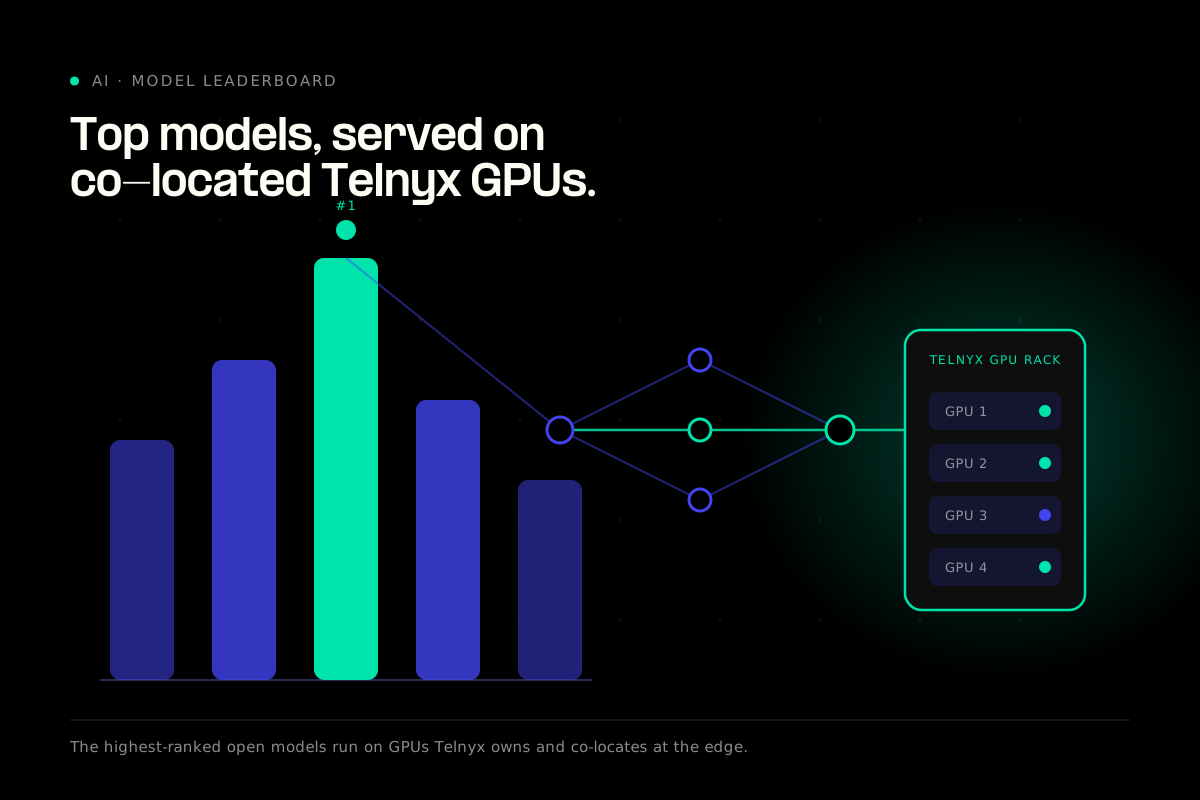
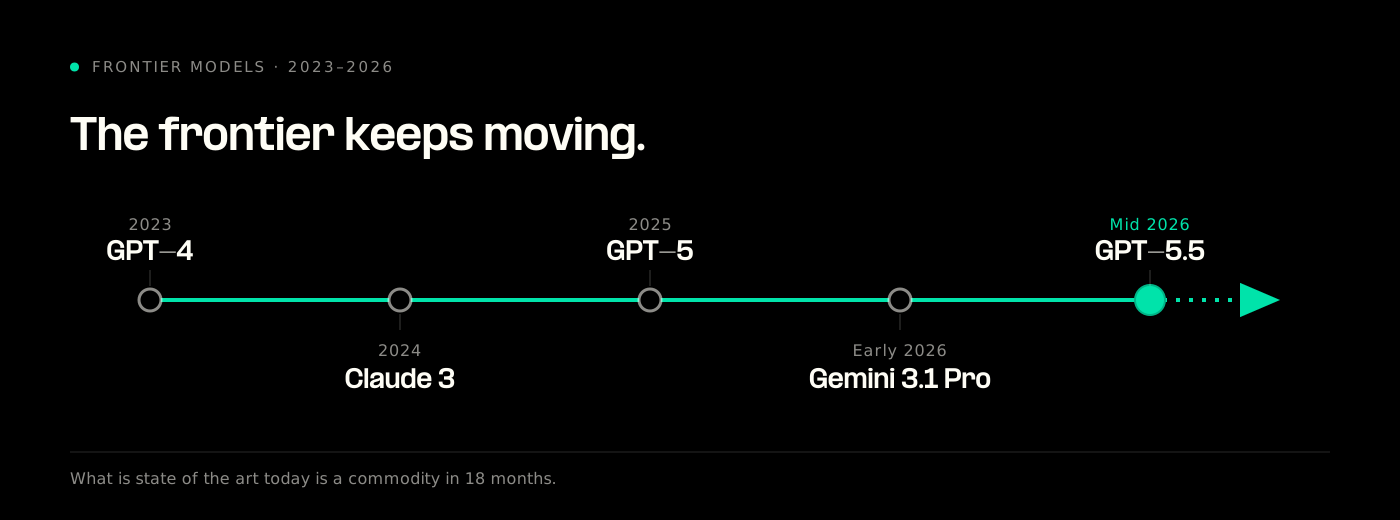
Frontier models are the most advanced, general-purpose AI models available at a given time. Labs train them on massive datasets to deliver state-of-the-art performance across reasoning, code generation, and multimodal tasks. The label is dynamic. What counts as frontier changes every time a lab ships a more capable model, so a system that defines the frontier today can be a commodity in 18 months.
Definition and core characteristics
A frontier model is distinguished less by a single feature than by where it sits relative to everything else. Many frontier models are defined by their training compute and their broad, general-purpose capability. These systems reason through multi-step problems, write and debug software, and power agents that use digital tools on their own. Each new generation raises the floor for what the next one has to beat.
Training compute and economics
The cost of training frontier models has climbed from millions of dollars a few years ago to hundreds of millions today, driven by GPU clusters that now run to tens of thousands of units. Stanford's 2026 AI Index tracks this steep rise in training compute alongside the performance gains it buys. The economics matter for buyers because they concentrate frontier development in a small number of well-funded labs, which shapes who controls the models most enterprises depend on.
Safety, alignment, and regulatory thresholds
Most frontier laws define the frontier by training compute. The EU AI Act sets its threshold at 10^25 floating point operations (FLOP), above which a general-purpose model is presumed to carry systemic risk. California's SB 53 and New York's RAISE Act set the bar ten times higher, at 10^26 FLOP, as the Future of Privacy Forum documents in its comparison of the two laws. Frontier labs publish safety frameworks, commit to adversarial red-teaming, and, under the EU AI Act, report serious incidents and maintain cybersecurity protections. Safety and data sovereignty are parallel concerns. Both come down to controlling risk when you deploy a model you did not build.
The data sovereignty problem with frontier models
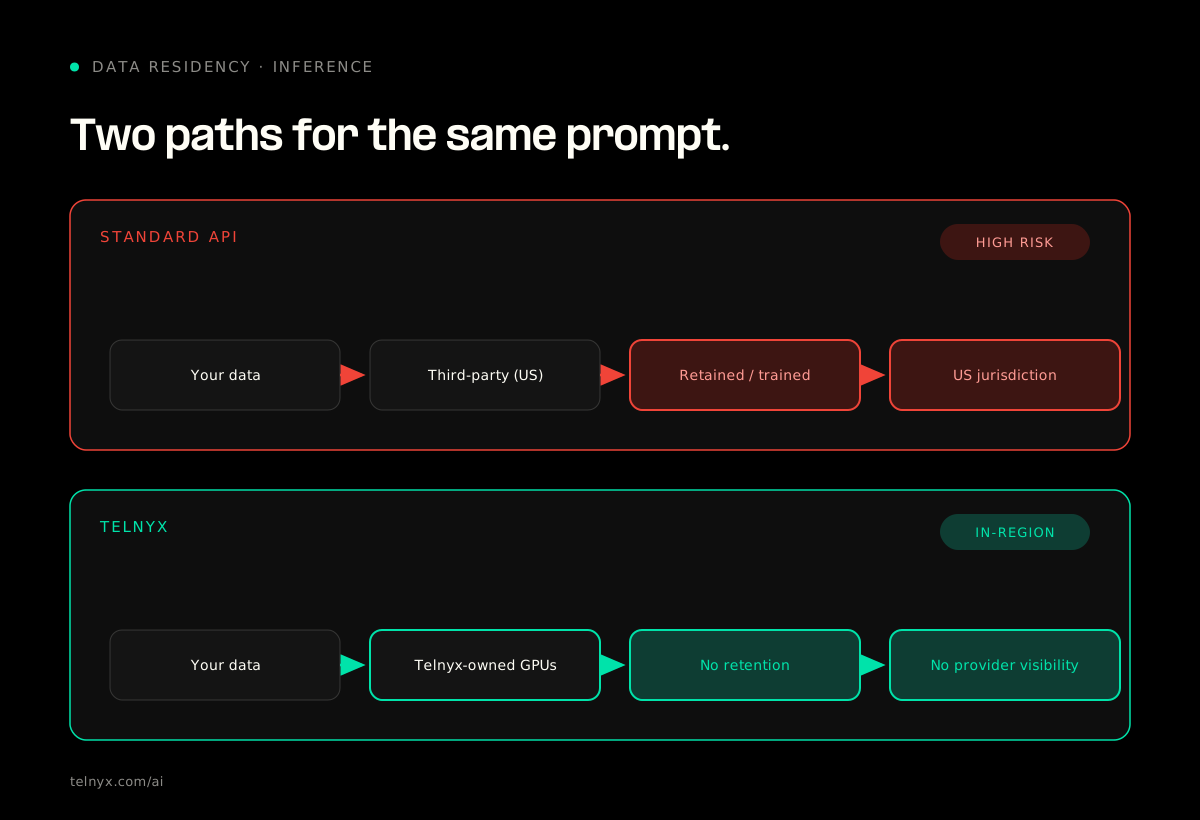
Capability comparisons tend to stop at benchmark scores. The harder question is what happens to your data. When you send a prompt to a third-party AI API, your data leaves your infrastructure and enters the provider's. What happens next is governed by their terms of service, not your policies. The core questions remain: what data is sent to the model provider, how that data is stored, logged, or used for further training, and where the data is physically processed.
What happens to your data when you call an AI API
Three specific risks follow from that handoff. First, retention. Providers may hold prompts for abuse monitoring or safety review, which means proprietary code and business data can sit on servers you do not control. Second, training use. Some provider terms allow customer data to inform future models, so your IP could shape a model your competitor also queries. Third, jurisdiction. Data processed on US servers falls under US law, including the CLOUD Act and FISA orders, no matter where your company is based.
IP exposure and training data concerns
For a business, the exposure is concrete. A prompt can contain source code, customer records, pricing logic, or an unreleased product spec. Once that text is processed and possibly retained by a third party, you are trusting a contract to protect information that used to live inside your own walls. The safest way to remove that risk is to stop sending the data outside infrastructure you trust.
Regulatory pressure from the EU AI Act and state laws
Regulation adds to the pressure. The EU AI Act requires providers of general-purpose models to publish training data summaries and copyright policies, and it imposes cybersecurity and reporting duties on systemic-risk models, as the European Commission details in its guidance. Data residency rules in the EU, Australia, and other markets go further, requiring that processing happen inside a specific jurisdiction. Most US-based AI providers cannot promise in-region processing for APAC or EU customers by default.
Current frontier models and rankings
The community measures frontier quality through LMArena, which scores models on human preference across millions of blind votes. The useful takeaway is that the top tier sits tightly clustered, often within a few dozen Elo points, with open-weight models now ranking among the proprietary leaders. Z.ai's open-weight GLM-5.2, for example, matches or beats top proprietary models on several long-horizon coding benchmarks at a fraction of the cost, as VentureBeat reported.
The table below maps the seven frontier models against the question buyers actually care about, which is how much control you keep over your data.
Frontier model comparison: capability vs data control
Model list per Third Way, May 2026. Residency and risk columns synthesize each provider's published terms and jurisdiction as of July 2026.
| Model | Provider | Open weight | Data residency options | Data sovereignty risk |
|---|---|---|---|---|
| GPT-5.5 | OpenAI (US) | No | Enterprise zero-retention by negotiation | High, US jurisdiction by default |
| Claude Opus 4.7 | Anthropic (US) | No | US processing, no default in-region | High, US jurisdiction by default |
| Gemini 3.1 Pro | Google (US) | No | Regional options at added cost | Medium, depends on configuration |
| Grok 4.3 | xAI (US) | No | Limited public documentation | High, US jurisdiction by default |
| Muse Spark | Meta (US) | Yes | Self-host anywhere | Low if self-hosted, needs GPU and MLOps |
| Mistral Large 3 | Mistral (EU) | Yes | EU processing, self-host option | Low to medium, EU base |
| DeepSeek V4 | DeepSeek (China) | Yes | Self-host, API routes through China | High for API, China jurisdiction |
| GLM-5.2 (via Telnyx) | Z.ai model on Telnyx-owned GPUs | Yes | Regional GPU processing, for example Sydney | Low, no provider visibility |
Because quality has converged, the data sovereignty argument no longer costs you much capability. You can pick a model that protects your data and still stay near the frontier.
How Telnyx solves the data sovereignty problem
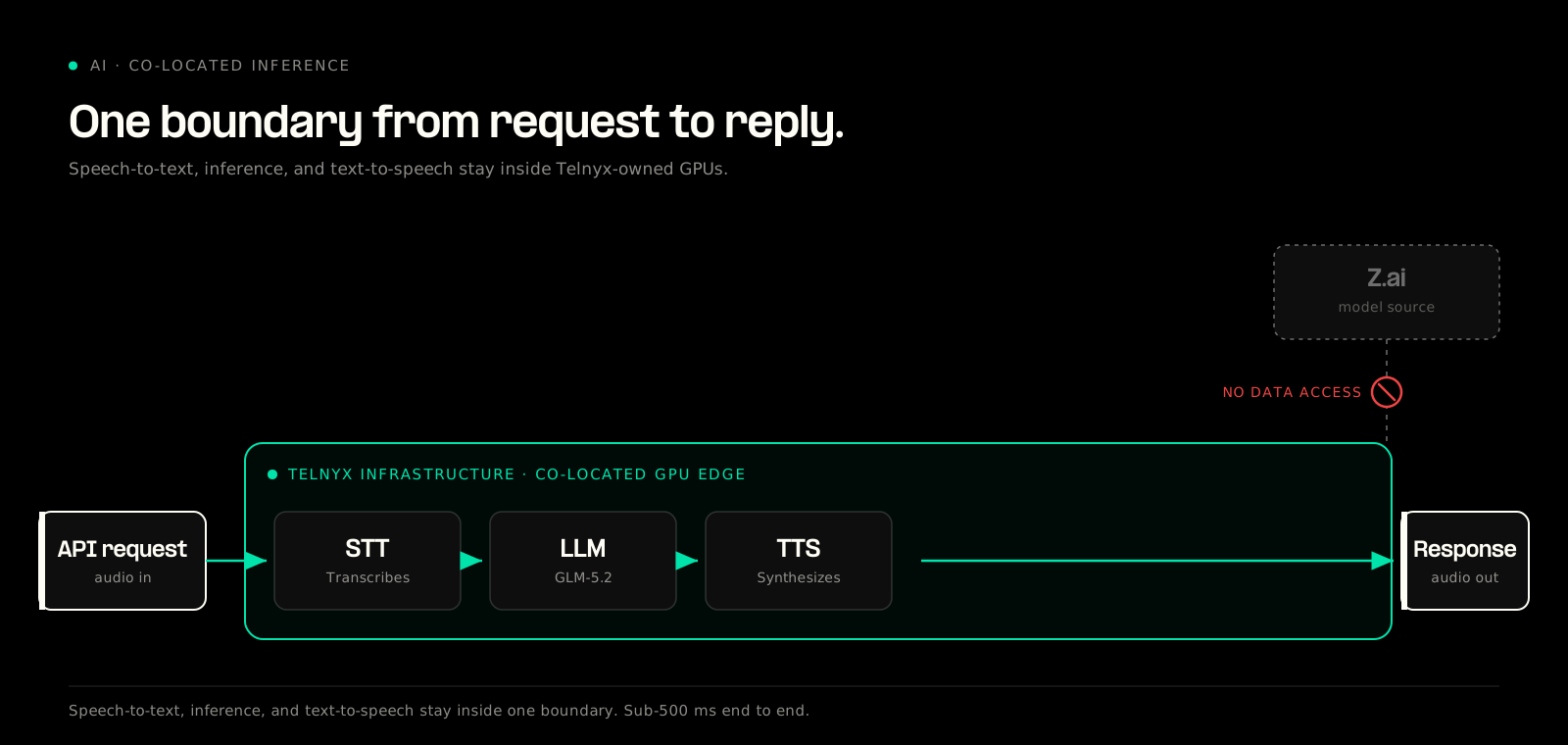
Owning the stack changes the answer. Telnyx runs frontier-grade models like GLM-5.2 on its own GPU infrastructure, not on Z.ai's servers. Because inference happens on Telnyx hardware, the model provider has no visibility into customer conversations. Telnyx does not monitor customer conversations or use customer conversation data to train models. That is the AI-Native Network in practice: one platform where your data stays on infrastructure you control.
Frontier models on infrastructure you control
Telnyx owns the B300 GPUs that run GLM-5.2, so no cloud provider sits between you and the model, and no third party sits in the inference path. The inference engine exposes an OpenAI-compatible API, which means switching takes a base URL change rather than a code rewrite.
Regional GPU infrastructure for data residency
For enterprises that need processing inside a specific jurisdiction, Telnyx colocates more than 4,000 GPUs with a telephony point of presence in Sydney, Australia, enabling full APAC data sovereignty. The model runs where your data lives, and it stays there.
 | “We started at Layer 0. Carrier licenses, private backbone, GPUs at the edge. That means less than 200ms RTT in global markets, deterministic call control, and compliance baked in.” |
Run frontier models on infrastructure you control
Telnyx runs GLM-5.2 and other frontier-grade models on GPUs it owns and operates, with no conversation monitoring. Explore Telnyx Voice AI.
Choosing a frontier model provider
Before you commit, put every provider through the same five questions.
- Where is my data physically processed?
- Does the provider retain or train on my data?
- Which jurisdiction's laws apply to my data?
- What is the latency cost of data residency?
- Can I switch models without rewriting my application?
Build vs buy vs colocate
Those questions resolve into three paths. You can call a US-based API, which is fast and easy but gives up data sovereignty. You can self-host open-weight models, which hands you full control at the price of GPU infrastructure and MLOps expertise. Or you can use a colocated provider like Telnyx, which runs frontier-grade models on infrastructure you trust with data sovereignty built in.
Comparing the three paths
| Approach | Data sovereignty | Effort |
|---|---|---|
| US-based API | Low, provider jurisdiction | Low |
| Self-host open weights | High, you control everything | High, GPU and MLOps required |
| Colocated provider (Telnyx) | High, your region and no monitoring | Low, OpenAI-compatible API |
Frontier models in production with Telnyx
Frontier models are one piece of a larger stack, and the advantage compounds when the pieces share infrastructure. When telephony and AI inference run on the same network, audio enters the AI pipeline without crossing vendor boundaries, which holds end-to-end latency below 500ms. The same platform handles speech-to-text, LLM inference, and text-to-speech, so there is no multi-vendor finger-pointing when something breaks.
| “Most ‘end-to-end Voice AI’ claims fall apart when you measure what actually matters, the end customer experience in real time. That only happens when you control the full stack. Network, media plane, orchestration, and inference paths, not a fragile chain of third-party services over the public internet.” |
Voice AI with colocated inference
A live call moves through Speech-to-Text API transcription, model inference, and Text-to-Speech API synthesis on one network. Keeping every hop inside Telnyx infrastructure removes the public-internet round trips that make most "end-to-end" voice claims fall apart under real-time load.
Multi-model access through one API
The same OpenAI-compatible interface reaches multiple models: GLM-5.2 for complex reasoning, Kimi K2.6 for general tasks, and DeepSeek for cost-sensitive workloads. You match the model to the job without stitching together vendors or rewriting integrations, and your data stays on infrastructure you control the whole way through.
Frequently asked questions
What are frontier models in AI?
Frontier models are the most advanced, general-purpose AI models available at a given time. Labs train them on massive datasets to deliver state-of-the-art performance across reasoning, code generation, and multimodal tasks. The label is dynamic, so what qualifies as frontier changes as new models ship. As of Third Way's May 2026 analysis, seven models were considered frontier: GPT-5.5 from OpenAI, Claude Opus 4.7 from Anthropic, Gemini 3.1 Pro from Google, Muse Spark from Meta, Grok 4.3 from xAI, Mistral Large 3 from Mistral, and DeepSeek V4 from DeepSeek.
Can AI companies access my IP through frontier models?
When you use a third-party AI API, your prompts and data pass through the provider's infrastructure, and their terms of service govern what happens next. Some providers retain prompts for abuse monitoring, and some terms allow customer data to inform future models. That means your proprietary code or internal documents could be stored on, or influence, a model your competitors also use. Running frontier-grade models on infrastructure you control removes that exposure.
What is data sovereignty in AI?
Data sovereignty in AI means that the data used for inference, including prompts, responses, and context, is processed within a specific jurisdiction and subject only to that jurisdiction's laws. When you use a US-based provider, your data falls under US law regardless of where you are. Regulations like the EU AI Act and Australia's data localization rules increasingly require in-region processing.
How does Telnyx protect data when running frontier models?
Telnyx runs frontier-grade models like GLM-5.2 on its own GPU infrastructure. The model provider has no visibility into customer conversations because inference happens on Telnyx hardware, not the provider's. Telnyx does not monitor customer conversations or use customer conversation data to train models, and regional GPU infrastructure in Sydney, Australia enables full APAC data sovereignty.
Can I switch from OpenAI to Telnyx without rewriting my code?
Yes. The Telnyx Inference API is OpenAI-compatible, so the request and response format matches OpenAI's. Switching takes a base URL change and a new API key, with no code rewrite. The API reaches multiple models, including GLM-5.2, Kimi K2.6, and DeepSeek, through one interface.
Share on Social


