
Cloud Storage
Distributed cloud storage, reimagined. Experience simple, low cost, AI-ready storage and save more for less. Start storing today with S3-compatible APIs.
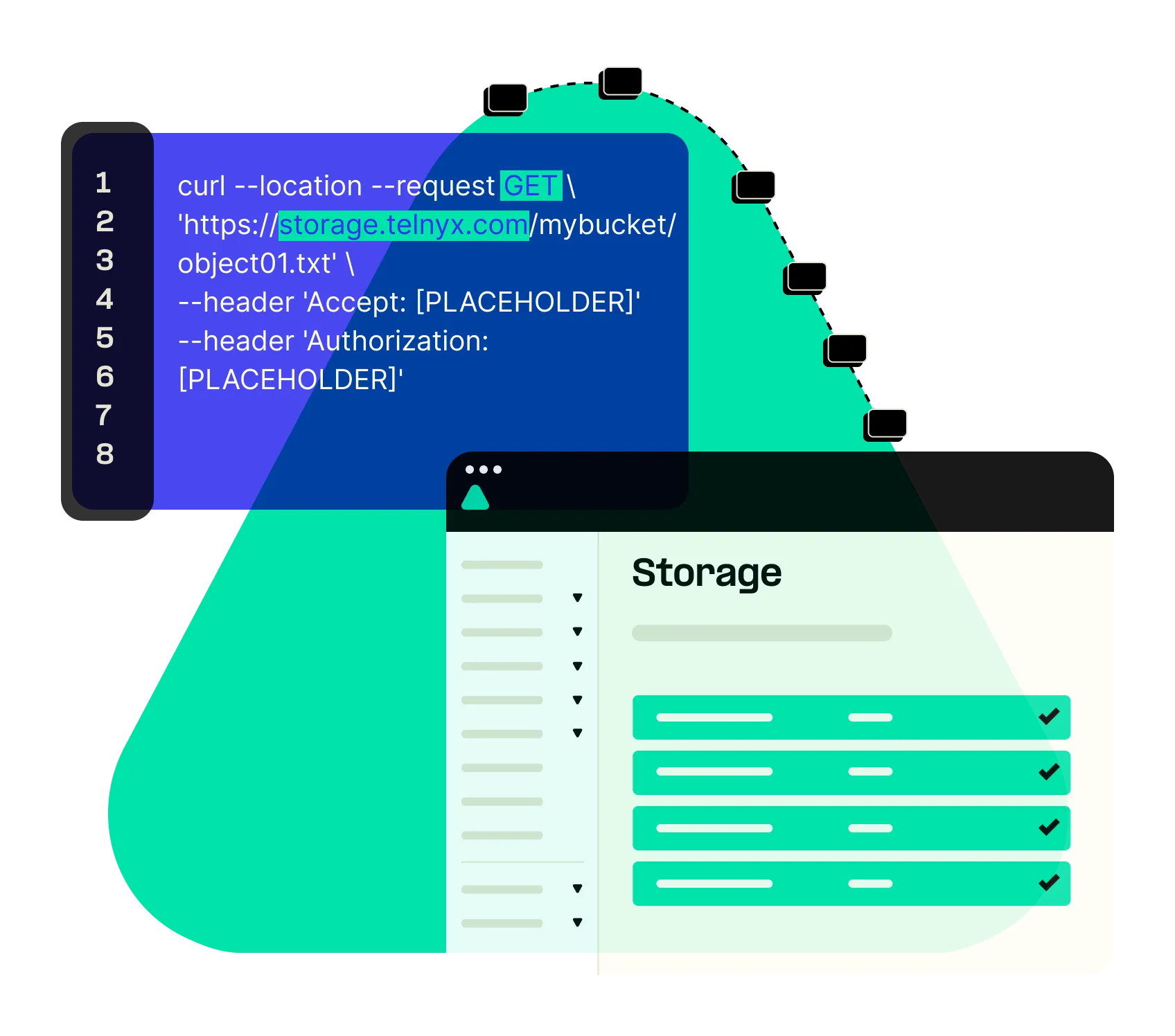
Low cost, distributed cloud storage
In 2024, businesses face soaring volumes of data, enhanced data privacy concerns, and accessibility and scalability issues—all while juggling the rising cost of data management and maintaining operational efficiency.
Modern, distributed infrastructure powers Telnyx Cloud Storage, allowing your applications to retrieve objects with super low latency. Instant bucket summaries and fast embedding of stored files means your data is AI-ready and primed for insightful, contextualized inference.
At up to 60% less than competitors, Telnyx allows you to store more data for less, without compromising on quality. Your pathway to intelligent, cost-effective, and agile data management starts here.
Distributed storage made simple
Introducing a low-cost, low-latency cloud storage solution that's fully compatible with industry-standard APIs, built on a distributed network.

S3 Migration API
We've made it easy to switch with our S3 Migration API, so you can move your data without incurring high egress fees.
Distributed network
Multiple datacenter locations ensure your data is duplicated and never subject to a single point of failure.
Scalable cloud storage
Scale with confidence, with fast access to data.
File summaries
Effortlessly generate summaries of your stored files to gain valuable insights, while saving time.
Embed for AI (beta)
Quickly generate embeddings from stored data to use in Inference and model training.
Embedding storage
Store your embeddings in AI-enabled buckets to use for model training and fine-tuning, and inference.
BENEFITS
Pay less for cloud storage
Major cloud providers charge high egress fees that tax your growth. Our low-cost Cloud Storage solution enables you to save without compromising on functionality.
60%
Per-GB cost savings vs. entry-level tier of S3 storage
Access your objects faster
Centralized storage from major cloud operators means your objects are farther from your end-users. Our distributed network makes low-latency object retrieval a reality.
3
Multi-zone regions across the US
Drive intelligent, efficient decisions
Use our summarization feature to instantly turn data into insights, powering smarter decisions that outpace the competition.
60%
Increase in operational efficiency using AI-integrated storage solutions
Future-proof your data
Stay ahead of the curve with AI-ready data by performing embeddings on Telnyx Storage Buckets. Your vectorized data is ready for analysis by LLMs and other AI-models.
$13T
Amount AI is predicted to contribute to the global economy by 2030
RESOURCES
Start building
Our code is your code.

Build on an S3-compatible API
Point your S3-centric applications at Telnyx endpoints for easy migration, and start saving, quickly.
VIDEO: Getting Started with Telnyx Storage
Follow a few simple steps in our five-minute video tutorial to start using Telnyx Storage.

Experience scalable cloud storage
Our new features and capabilities focus on improved infrastructure, fast access, easy migration, and enhanced interoperability with AI and ML tooling.
SOLUTIONS
Store more for less

Backup and restore services
Get peace-of-mind backups at lower costs, with quicker recovery times thanks to more local storage.
Learn more
Data archiving
Store your important data while taking advantage of zero egress costs and 11 9's of durability with automatic data replication to multiple data centers.
Learn more
AI and machine learning
Build the AI model you need using low-latency, cost-effective object storage.
Learn more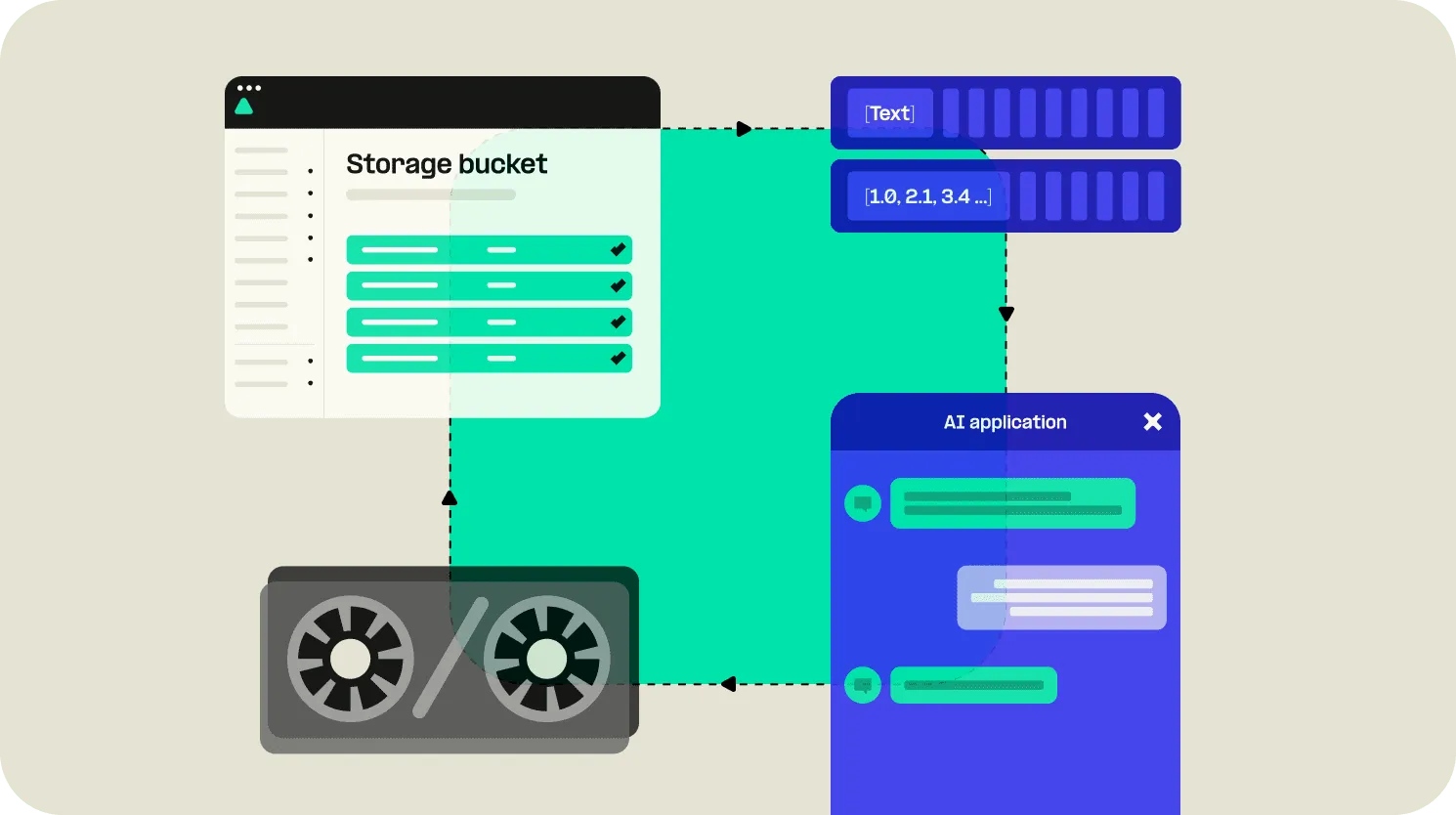
Storage for AI
Easily embed stored data for fast, contextualized inference on one platform.
Learn more
FAQ
Resources, Docs, Support
Cloud Storage hub
Telnyx Cloud Storage Quick Start | Telnyx
There are four ways to get started on Telnyx cloud storage:
Telnyx Cloud Storage API Endpoints and Organization | Telnyx
Discover Telnyx Cloud Storage API endpoints: Key details on regions, S3 compatibility, and API usage instructions.
Telnyx Cloud Storage Authentication | Telnyx
Learn how to authenticate with Telnyx Storage using API keys and AWS Signature Version 4 for secure API requests.
Telnyx Cloud Storage Compatibility with AWS S3 | Telnyx
Navigate AWS S3 compatibility in Telnyx Cloud Storage, focusing on supported headers and API methods.
Telnyx Cloud Storage Billing | Telnyx
Understand Telnyx Cloud Storage billing—Details on charges for storage bytes and API operation counts.
Cloud Storage S3 Compatible APIs | Telnyx
Telnyx Storage is distributed cloud storage evolved — low cost, low latency, and S3-compatible APIs for easy migration.
Create bucket (Cloud Storage) API | Telnyx
Learn to create a bucket in Telnyx Cloud Storage, with details on request headers, XML configuration, and naming conventions.
Put object (Cloud Storage) API | Telnyx
Learn to upload objects to Telnyx Cloud Storage with detailed AWS S3 API request examples and supported headers.
Get Bucket Usage API | Telnyx
Returns the amount of storage space and number of files a bucket takes up.
List buckets (Cloud Storage) API | Telnyx
Learn to quickly list and view all buckets in Telnyx Cloud Storage, guided by example API request and response.
Telnyx Blog | CPaas & UCaaS Resources
Find data-driven research, comprehensive guides and all things SIP trunking, voice and SMS APIs, wireless and more.
Build a scalable cloud storage solution with Telnyx
Store your valuable data on a scalable, cost-effective cloud storage solution. Embed stored files with intuatiive AI tools to get the most from your data.
How to build a data backup business with Telnyx Storage
Building a data backup business can be a highly lucrative venture. Make sure Telnyx Storage is included in your tech stack for low-cost object storage.
Your complete guide to enterprise cloud data storage
Learn how enterprise cloud data storage gives businesses more flexibility and cost savings than traditional on-premise storage.
Egress costs, a deep dive: S3 vs Telnyx Storage
Discover how S3 egress costs impact businesses and explore a cost-effective S3 alternative.
Cloud computing vs cloud storage: Key facts and insights
Understand how cloud computing and cloud storage serve your data management and scalability needs. Choose which option—or both—are best for your business.
Your comprehensive guide to hot cloud storage
Hot cloud storage helps you retrieve critical data quickly and from anywhere. Learn what it is, its use cases, and how to find the right provider.
How to choose the right storage solution for your AI needs
Choosing the right storage solution for your AI applications can be a daunting task. Learn about your options and which one is right for your business.
Amazon S3 Alternative w/ $0 egress fees
The new #1 S3 alternative for cloud object storage, with low costs and zero egress fees. Try Telnyx Cloud Storage today!
Cloud storage vs. on-premise: When is it time to switch?
Learn the difference between cloud storage vs. on-premise solutions and when it’s time for your business to switch.
The Better Amazon S3 Alternative - Telnyx
Explore Telnyx as an S3 Alternative with no egress fees and lower costs. Ideal for businesses seeking reliable, scalable, and cost-effective cloud storage.
The Better Google Cloud Storage Alternative - Telnyx
A comparison between Telnyx Storage and Google Cloud Object Storage, looking at price and product specifications
Telnyx Storage | Telnyx Help Center
Here you will find a collection of FAQs and guides on all things Telnyx Storage.
Get Started with Telnyx Storage & Inference Guide | Telnyx Help Center
This article provides you with a guide to setting up Telnyx Storage on your account
Use Cyberduck with Telnyx Storage | Telnyx Help Center
Learn how to set up Cyberduck, a popular FTP client, with Telnyx Storage for seamless file transfer and storage management.
Use MSP360 Cloudberry Explorer with Telnyx Storage | Telnyx Help Center
Learn how to setup MSP360 Cloudberry Explorer, an intuitive file explorer, with Telnyx Storage for effective file management and transfer.
Use rclone with Telnyx Storage | Telnyx Help Center
Easily configure rclone with Telnyx Storage using our step-by-step guide for efficient file transfer and storage management.
Use Syncovery with Telnyx Storage | Telnyx Help Center
Explore how to configure Syncovery with Telnyx Storage for seamless file transfer, synchronization, and secure data backup and recovery.
Data Archiving Use Cases with Storage
Find out how Telnyx data archiving enhances efficiency and reliability. Get started now.
Storage for AI | Document Summarizer
Optimize internal workflows and reduce costs with instant file summary and embedding from Telnyx.