
Messaging
What is an SMS number, and which type should you use?
An SMS number is a phone number enabled to send and receive texts. Compare 10DLC, toll-free, short codes, and sender IDs, and pick the right one.

By Emily Bowen
The number you text a friend from and the number a business texts you from are usually two different kinds of number. Both send SMS. Only one of them had to be registered with carriers before it could send a single message.
What is an SMS number?
An SMS number is a phone number enabled to send and receive text messages over the Short Message Service protocol. For an individual, it is almost always their mobile number. A business messaging customers at scale uses a dedicated SMS number instead, choosing among a 10-digit long code, a toll-free number, a short code, or an alphanumeric sender ID by how fast it must send and where it needs to reach.
Is your SMS number the same as your phone number?
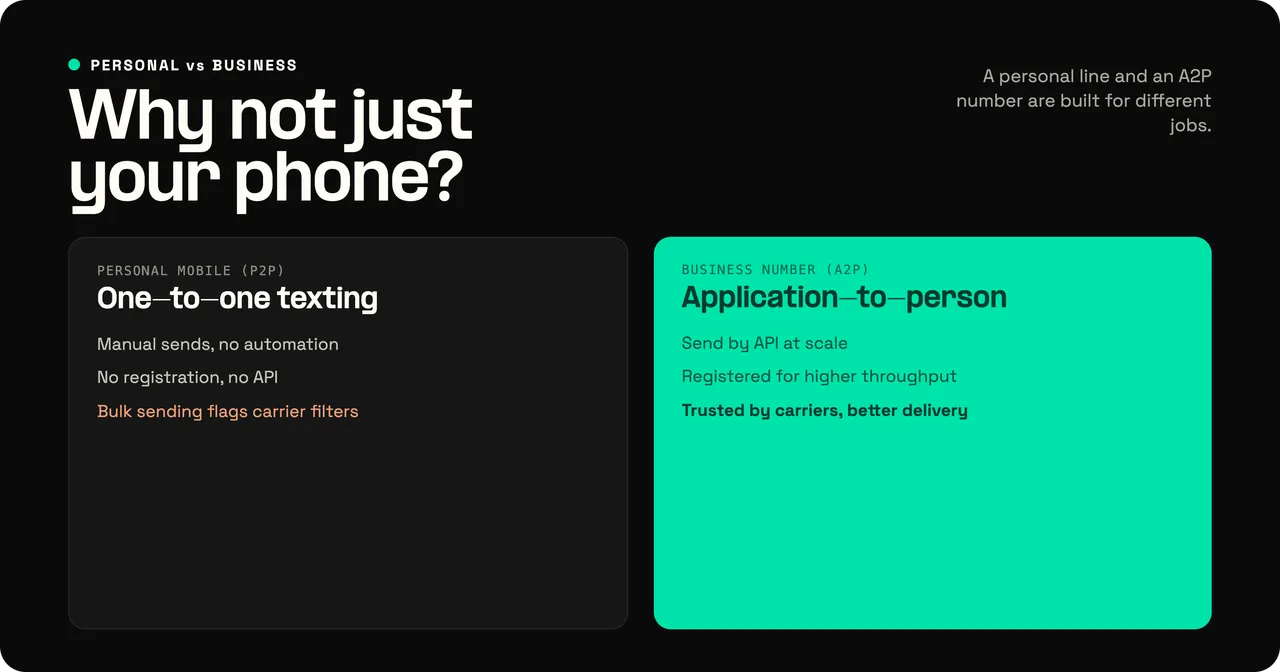
For most people, your SMS number and your phone number are the same. The number that shows in your phone's dialer is the number that sends and receives your texts, because a mobile line is provisioned for voice and SMS together.
Businesses are where the two split apart. A company sending appointment reminders, conversational SMS, or two-factor authentication codes rarely uses a personal mobile number. It uses a number provisioned specifically for application-to-person (A2P) messaging, registered so carriers can identify the sender and the purpose.
That registration is the whole reason business SMS numbers come in types. The number type decides throughput and reach; the registration decides whether the carrier delivers the message or filters it.
How do you find your SMS number?
Your SMS number is your own mobile number, and the fastest way to read it back is your phone's own contact card. On iPhone, open Settings, tap your name, then Phone. On Android, open Settings, then About phone, then SIM status.
If the field is blank or wrong, the number lives with your carrier, not your handset, so the carrier's app or a call to support is the reliable source. Sending a text to a second phone you control and reading the sender also works.
SMS, MMS, and text messages: what is the difference?
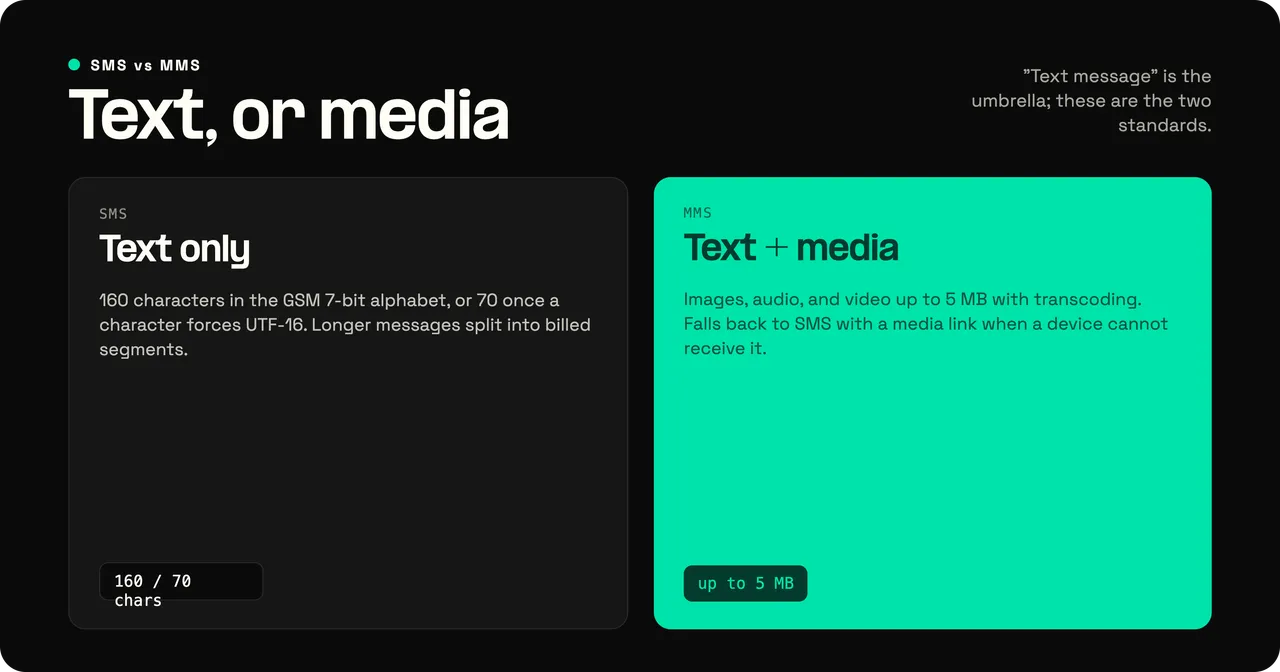
"Text message" is the umbrella term. SMS and MMS are the two standards underneath it. SMS carries text only; MMS carries media such as images, audio, and video.
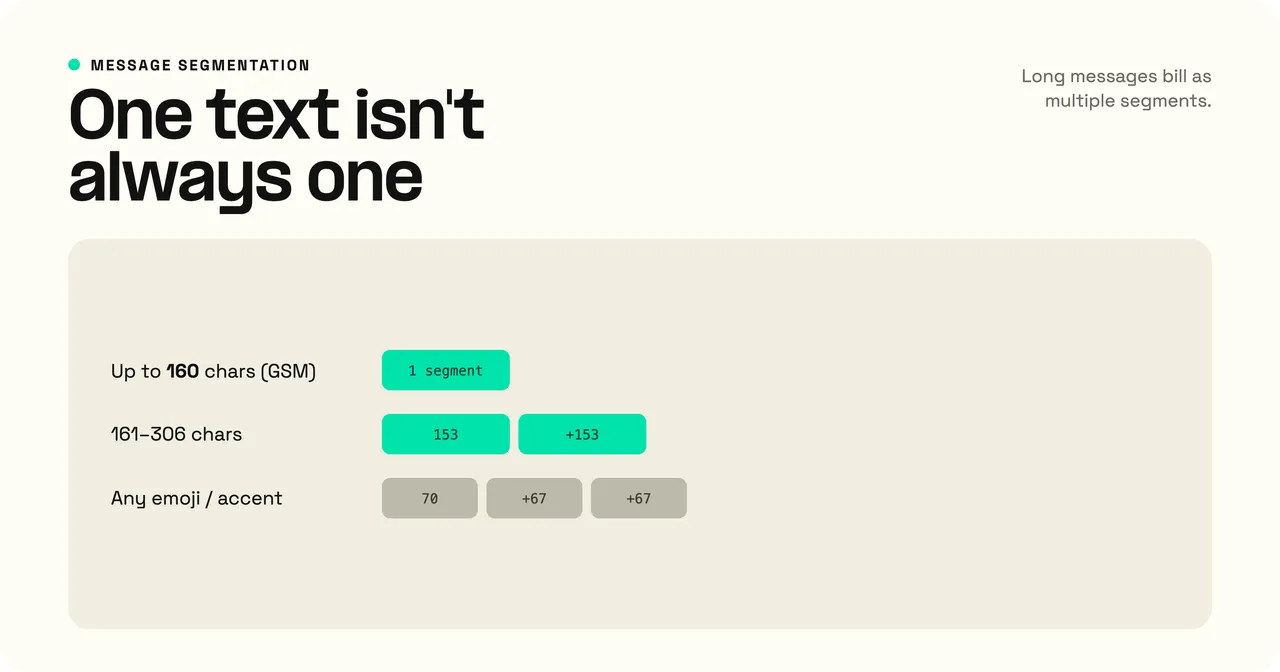
The split matters because of length. A single SMS holds 160 characters in the GSM 7-bit alphabet, and any character outside that set switches the whole message to UTF-16 encoding, which cuts the limit to 70 characters (Telnyx Messaging docs). Longer messages split into segments of 153 GSM-7 characters, or 67 for Unicode, and are billed per segment, so a 200-character text sends as two even though the recipient's phone usually stitches them back into one.
When a message needs an image or a file, it becomes MMS. On Telnyx, MMS supports media up to 5 MB with transcoding, and falls back to SMS with a media link for devices that cannot receive it.
What are the types of SMS numbers for business?
Four number types carry business SMS in the US: the 10-digit long code, toll-free, short code, and alphanumeric sender ID. Choosing between them is a decision about volume, reach, and how long you can wait to go live. Americans exchanged nearly 2.2 trillion SMS and MMS messages in 2024, 42 billion more than the year before, according to CTIA's annual survey, and carriers gate that volume behind registration rather than trust.
SMS number types compared
| SMS number type | Best for | Throughput and activation |
|---|---|---|
| 10DLC (10-digit long code) | Local presence, low to mid volume, two-way | Register a brand and campaign; throughput scales with your vetting score |
| Toll-free | National presence, mid to high volume, two-way | Verify before first send; roughly 1,200 messages per minute once approved |
| Short code | Mass campaigns at the highest throughput, two-way | Three filings and about six weeks; highest throughput of any type |
| Alphanumeric sender ID | One-way alerts outside the US and Canada | No number to buy; blocked to the US, Canada, and Puerto Rico |
10DLC (10-digit long code)
A 10DLC is a standard 10-digit local number approved for business messaging. It looks like an ordinary local number to the recipient, which is why it fits customer service, chatbots, appointment reminders, and local outreach at low to mid volume.
To send A2P traffic from one, you need to register your brand. This carries a one-time fee of about $4 passed through from the registry, plus roughly $15 per campaign for a vetting submission. The third-party vetting returns a trust score from 0 to 100 that sets your messaging volume. An unvetted brand defaults to the lowest tier.
Throughput is the payoff for registering. Unregistered U.S. long codes are throttled to 10 messages a minute and are filtered or blocked by carriers, while a well-vetted campaign sends far more, with the tiers set by your score and the carrier. Read the 10DLC throughput tiers, and check your obligations against 10DLC compliance, before you plan send volumes.
Toll-free numbers
A toll-free number carries an 800, 888, 877, 866, 855, 844, or 833 prefix and charges the call to the business, not the caller. It supports SMS and MMS in the US and Canada and two-way replies, which makes toll-free messaging a common national starting point, and it often beats a local number for reach (local vs toll-free).
Every toll-free number must be verified before it sends its first outbound message, and the industry has blocked unverified toll-free traffic since late 2023. Verification usually clears in five business days or less. Since February 17, 2026, a Business Registration Number is mandatory on new submissions, which for a U.S. business is the nine-digit EIN, aligning toll-free verification with the 10DLC standard.
Once verified, a toll-free number sends at roughly 1,200 messages a minute, well above an unregistered long code, with no per-number lease and no six-week wait. Buy toll-free numbers that are already SMS-capable rather than converting a voice-only one.
Short codes
A short code is a five- or six-digit number built for high-throughput campaigns, and it is the only US number type purpose-built for mass messaging, which is why retail and e-commerce campaigns lean on them. Short codes are country-specific, so a US short code delivers only to US numbers.
The cost is time and process, not just money. Provisioning a new short code takes around six weeks and three separate filings: a short code order brief to the carriers, a brand registration, and a content provider registration with the Short Code Registry. The number then carries a monthly carrier lease on top of registration.
Brand vetting is re-run every 12 months, and carriers can suspend a code that falls out of compliance. Pick a short code when you send at campaign scale and can absorb the runway; pick 10DLC when you cannot.
Alphanumeric sender IDs
An alphanumeric sender ID replaces the number with a short text label, up to 11 characters containing at least one letter, so a message arrives from a brand name instead of digits. It is one-way only: recipients cannot reply.
The hard limit is geographic. Alphanumeric sender IDs cannot deliver to the US, Canada, or Puerto Rico, where a long code or toll-free number is required instead, and many countries that do allow them require the sender ID to be pre-registered first.
Throughput scales with account verification: roughly 6 messages a minute at the base account level and 60 once the account is verified. They fit one-way notifications and authentication codes sent to international audiences.
Which SMS number type should you choose?
The right SMS number type is the one whose throughput and reach match your use case, so work backward from volume and destination rather than from the number that looks nicest. If you send high-volume US campaigns, throughput narrows the choice to a short code, or a well-vetted 10DLC or toll-free number. If you send one-way alerts abroad, an alphanumeric sender ID does the job a US number cannot.
The throughput gap between types is wide, and it is the number most buyers underestimate. An unregistered US long code moves 10 messages a minute; a verified toll-free number moves about 1,200; a short code moves far more again.
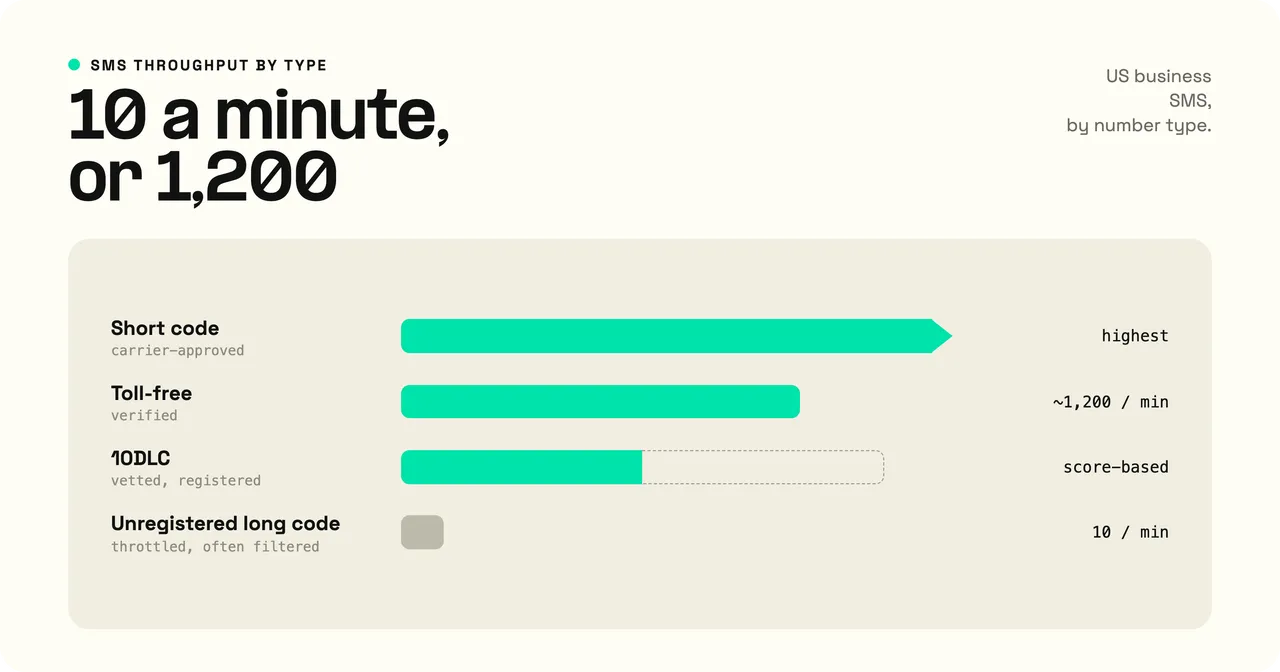
The runway differs just as much. A 10DLC or toll-free number can start sending within days of registration or verification, while a short code is a six-week project. Match the number type to the deadline you actually have, then confirm it supports two-way replies if your use case needs them.
How to get an SMS number for business messaging
Telnyx's Messaging API sends and receives SMS and MMS across all four number types through a single API and portal. You buy or port a messaging-capable number, assign it to a messaging profile, and register it for the traffic you intend to send.
If you are still choosing a number, SMS-capable numbers show their messaging features before you buy, and number lookup returns the line type and carrier for a number you already have. Check messaging pricing for per-message cost by destination.
The guide to phone number types covers the different kinds of numbers that can be registered for business messaging.
Start sending on the Telnyx SMS API
Verified toll-free numbers send at roughly 1,200 messages a minute.
Start sendingFrequently asked questions
What is an SMS short code?
An SMS short code is a five- or six-digit number built for high-throughput, application-to-person messaging such as alerts, marketing, and two-factor codes. Short codes are country-specific and carrier-approved for mass sending, which is why they cost more and take about six weeks to provision, far longer than a standard long code.
What is an SMS code?
An SMS code usually means one of two things. A verification or one-time code is the short string a service texts you to confirm your identity, while a short code is the five- or six-digit number that code is often sent from. The code proves who you are; the short code is the sender.
How many characters can one SMS message contain?
A single SMS holds 160 characters using the GSM 7-bit alphabet. Any character outside that set, such as many emoji or non-Latin scripts, switches the message to UTF-16 encoding and drops the limit to 70 characters. Longer messages split into segments and are billed per segment, then reassemble on the recipient's device.
Can you reply to a message from an alphanumeric sender ID?
No, an alphanumeric sender ID is one-way only. It is a text label rather than a routable number, so recipients cannot text back, and if you need two-way conversation you use a 10DLC, toll-free number, or short code instead. Alphanumeric sender IDs also cannot deliver to the US, Canada, or Puerto Rico.
Do businesses need to register an SMS number?
In the US, yes, business messaging numbers must be registered for the traffic they send. A2P traffic from a long code requires 10DLC brand and campaign registration, toll-free numbers require verification, and short codes require carrier approval. Unregistered traffic is throttled, filtered, or blocked, so registration is what lets a business number send at real throughput instead of a handful of messages a minute.
What is the difference between SMS and MMS?
SMS carries text only, capped at 160 GSM-7 characters per segment. MMS carries media such as images, audio, and video, and supports longer content. Both travel over carrier networks to the same phones; the choice comes down to whether the message needs an attachment or just text.
Share on Social


%20(1).png?width=96&format=webp)


